

Four Labour Codes
First Anniversary of the Four Labour Codes: As India marks one year since the implementation of its four Labour Codes on November 21, 2025, policy debates have intensified around worker protections during layoffs, retrenchment compensation, and social security gaps amid AI-driven corporate restructuring.
UPSC Syllabus Mapping:
General Studies Paper II (Governance & Social Justice): Welfare schemes for vulnerable sections of the population by the State and the performance of these schemes; Mechanisms, laws, institutions and bodies constituted for the protection and betterment of these vulnerable sections; Government policies and interventions for development in various sectors and issues arising out of their design and implementation.
General Studies Paper III (Indian Economy): Indian Economy and issues relating to planning, mobilization of resources, growth, development and employment; Inclusive growth and issues arising from it; Effects of liberalization on the economy, changes in industrial policy and their effects on industrial growth.
Scrutiny of Severance Pay Taxation: Legal and labour economists have flagged the heavy tax burden on laid-off white-collar and formal workers, as severance payouts are taxed as ‘profits in lieu of salary’ under the Income-tax Act.
Absence of Universal Unemployment Insurance: Experts highlight that unlike OECD economies with earnings-linked or payroll-funded unemployment insurance, India relies largely on one-time lump-sum severance, fragmented Employees’ State Insurance (ESI) hospital networks, and nascent registration portals like e-Shram for gig and informal workers.
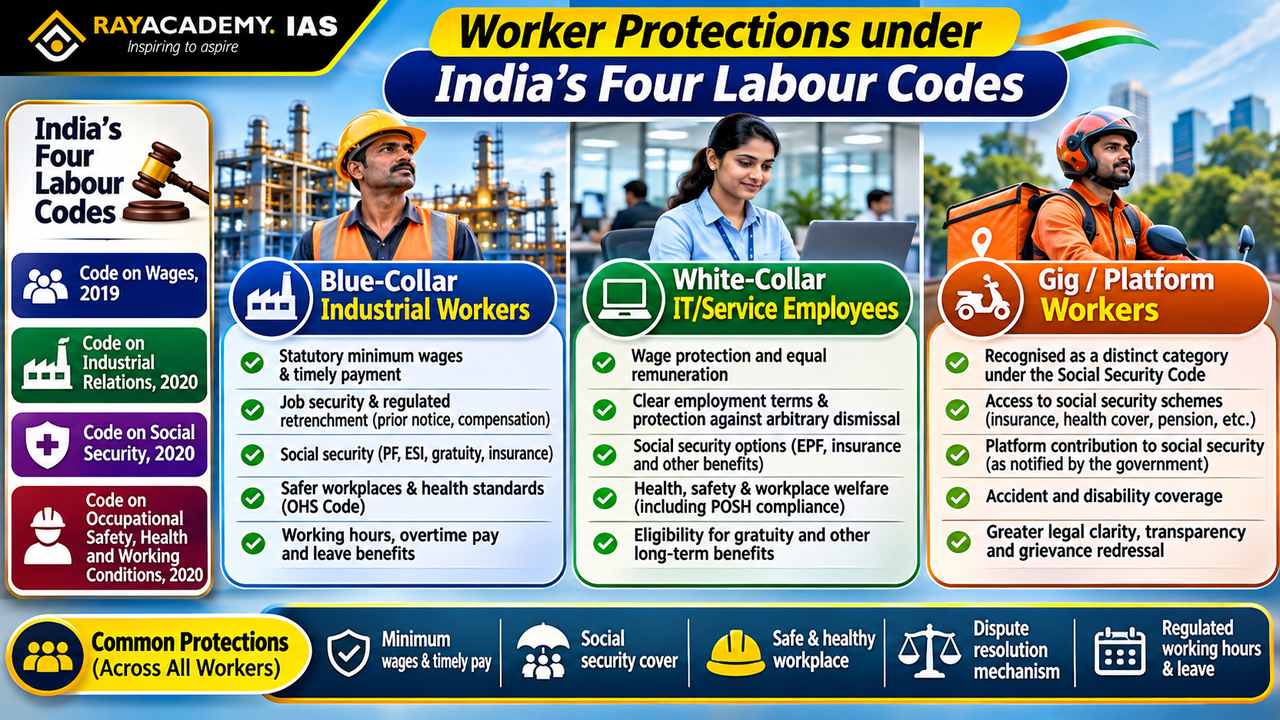
Static-Current Linkage: Constitutional, Statutory, and Fiscal Framework. Worker Protections
Constitutional Mandate on Labour Welfare
Concurrent List (Seventh Schedule): Labour is a Concurrent subject, empowering both Parliament and State Legislatures to enact laws under Entry 22 (Trade unions; industrial and labour disputes), Entry 23 (Social security and social insurance; employment and unemployment), and Entry 24 (Welfare of labour including conditions of work, provident funds, and workmen's compensation).
Directive Principles of State Policy (DPSPs): Article 39(a) directs the State to secure the right to an adequate means of livelihood; Article 41 mandates public assistance in cases of unemployment, old age, sickness, and disablement; and Article 43 calls for a living wage and decent standard of life for all workers. Worker Protections
Statutory Evolution: From Legacy Laws to the Four Labour Codes
India consolidated 29 central labour laws into four overarching codes (enforced on November 21, 2025):
Code on Wages, 2019
Industrial Relations (IR) Code, 2020 (subsuming the Industrial Disputes Act, 1947)
Code on Social Security, 2020
Occupational Safety, Health and Working Conditions (OSH) Code, 2020
Under Indian labour jurisprudence, temporary inability of an employer to provide work due to economic or technical reasons is termed a layoff, whereas permanent termination of surplus staff is legally defined as retrenchment. Under Chapter X of the Industrial Relations Code, 2020, establishments employing 300 or more workers (raised from the earlier threshold of 100) in factories, mines, and plantations must obtain prior government permission before effecting layoffs, retrenchment, or closure.
Fiscal Linkage: Taxation of Severance Pay
Under Section 17(3) of the Income-tax Act, 1961, lump-sum termination or severance compensation paid by an employer is classified as ‘profits in lieu of salary’ and taxed at the employee’s applicable income tax slab rate. While statutory retrenchment compensation (up to ₹5 lakh under Section 10(10B)) enjoys limited exemption for eligible workmen, contractual severance packages for white-collar professionals face substantial tax deductions—often up to one-third of the payout—eroding their financial buffer during job transitions.
Prelims Focus: High-Yield Objective Facts
Worker Re-skilling Fund (IR Code, 2020): Established under Section 83 of the Industrial Relations Code, 2020; requires employers to contribute an amount equivalent to 15 days’ last drawn wages for every retrenched worker, which is credited directly to the worker’s account within 45 days of retrenchment.
Industrial Tribunals (IR Code, 2020): Replaces the earlier multiplicity of Labour Courts and Industrial Tribunals with two-member Industrial Tribunals (comprising one Judicial Member and one Administrative Member) to expedite dispute adjudication.
Statutory Recognition of Gig and Platform Workers: For the first time, the Code on Social Security, 2020 explicitly defines gig workers, platform workers, and unorganized workers, proposing a Social Security Fund financed partly by aggregator contributions (1–2% of annual turnover, capped at 5% of payouts to gig workers).
e-Shram Portal: Launched by the Ministry of Labour and Employment in August 2021 to create a National Database of Unorganized Workers (NDUW) seeded with Aadhaar to facilitate portable welfare delivery.
Fixed-Term Employment (FTE): Formalized across sectors under the IR Code, 2020; entitles fixed-term workers to the same wages, working hours, and social security benefits as permanent staff, including pro-rata gratuity after one year of continuous service (reduced from five years).
Mains Analytical Breakdown
Significance of the Reformed Labour Governance Framework
Balancing Flexibility with Compliance Rationalization: Raising the prior-permission threshold for retrenchment to 300 workers reduces regulatory friction for medium enterprises, promoting Ease of Doing Business, formal job creation, and foreign investment.
Institutionalizing Retrenchment Re-skilling: The statutory Worker Re-skilling Fund shifts policy focus from passive compensation toward active labour market re-integration, crucial amid rapid Artificial Intelligence (AI) and automation disruptions.
Bringing New-Age Workers into Policy Focus: Statutory definitions for platform and gig workers under the Code on Social Security, 2020 and state-level welfare boards (such as in Rajasthan and Karnataka) lay the legal foundation for universalizing social protection.
Multi-Dimensional Challenges in Worker Protection
1. Sectoral Exclusion of White-Collar and Service Sector Employees
Narrow Industrial Coverage: Prior-permission safeguards and statutory retrenchment procedures under Chapter X of the IR Code apply predominantly to manufacturing, mining, and plantations, leaving IT, finance, and service-sector professionals reliant on private contractual terms.
Weak Bargaining Power: White-collar workers with firm-specific skills often face abrupt "hire-and-fire" terminations without mandatory pre-layoff counselling, legal aid, or outplacement support.
2. Fiscal and Tax Inequities During Distress
Taxation of Livelihood Cushion: Taxing severance packages as profits in lieu of salary—and taxing non-compete or ex-gratia components—penalizes workers precisely when they lose regular income and employer-sponsored health insurance.
3. Absence of a Universal Unemployment Insurance Architecture
Inadequacy of One-Time Lump Sums: One-off severance payouts cannot substitute for structured unemployment insurance during prolonged structural or AI-induced job displacements.
Infrastructure Deficit in ESI: While the Employees’ State Insurance (ESI) scheme offers limited unemployment allowances (such as the Atal Beemit Vyakti Kalyan Yojana), the physical spread of ESI hospitals and dispensaries lags disproportionately behind the expanding beneficiary base.
4. Institutional and Implementation Bottlenecks
Tribunal Vacancies and Adjudication Delays: Replacing Labour Courts with Industrial Tribunals risks bottlenecks unless judicial and administrative presiding officer vacancies are filled promptly.
Data-to-Delivery Gap in the Informal Sector: Despite massive registration on e-Shram, operationalizing income-loss protection for gig workers—whose earnings fluctuate dynamically—remains administratively complex without co-contributory micro-insurance models.
Way Forward
Rationalize Tax Treatment of Severance Compensation: Amend the Income-tax Act (and the upcoming Direct Tax Code framework) to provide targeted tax exemptions or multi-year spread-out relief under Section 89 for involuntary layoff severance packages, recognizing them as distress livelihood buffers rather than advance salary.
Design an Indian Model of Unemployment Insurance: Drawing from global best practices—such as Germany’s earnings-linked insurance and Singapore’s targeted skills-linked jobseeker support—restructure ESI’s Atal Beemit Vyakti Kalyan Yojana into a portable, co-contributory unemployment benefit paired with mandatory re-skilling.
Operationalize Co-Contributory Micro-Insurance for Gig Workers: Leverage the e-Shram database to introduce opt-in, low-premium earning-loss and health insurance for platform workers, with matching contributions from digital aggregators and state welfare boards.
Strengthen Labour Market Governance and Inter-Ministerial Synergy: In line with NITI Aayog’s Strategy for New India and 2nd ARC recommendations on outcome-oriented governance, align the Ministry of Labour and Employment with the Ministry of Skill Development and Entrepreneurship to ensure timely filling of Industrial Tribunal vacancies and proactive AI-transition re-skilling.
Value Addition for Mains Answers
Labour Force Context (PLFS Data): According to the Periodic Labour Force Survey (PLFS), over 80% of India’s workforce operates in the informal sector without written job contracts or paid leave, underscoring why social security cannot remain tied exclusively to formal factory employment.
Constitutional & Policy Anchor: "True labour reform must harmonize industrial flexibility with human dignity—ensuring that while enterprises adapt to AI and market shifts, no worker falls through the social security net."
Practice Questions for Active Recall
Prelims Practice MCQ
With reference to India’s Four Labour Codes, consider the following statements:
Under the Industrial Relations Code, 2020, industrial establishments employing 300 or more workers in manufacturing, mining, and plantations require prior government permission for layoff or retrenchment.
The Industrial Relations Code, 2020 mandates employers to contribute an amount equivalent to 45 days’ last drawn wages of each retrenched worker into the Worker Re-skilling Fund.
The Code on Social Security, 2020 provides statutory definitions for both gig workers and platform workers for the first time in Indian labour law.
Which of the statements given above is/are correct? A. 1 and 2 only
B. 1 and 3 only
C. 2 and 3 only
D. 1, 2 and 3
Correct Answer: B
Explanation:
Statement 1 is correct: Chapter X of the Industrial Relations Code, 2020 raised the threshold requiring prior government approval for layoff, retrenchment, or closure from 100 to 300 workers for factories, mines, and plantations.
Statement 2 is incorrect: Under Section 83 of the IR Code, 2020, the employer must contribute an amount equal to 15 days’ last drawn wages (not 45 days) for each retrenched worker, which must be credited to the worker within 45 days of retrenchment.
Statement 3 is correct: The Code on Social Security, 2020 formally defines gig workers and platform workers to extend social security schemes to non-traditional work arrangements.
Mains Practice Question (GS Paper II & GS Paper III – 150 Words / 10 Marks)
"While India’s Four Labour Codes aim to streamline industrial compliance, they leave significant gaps in protecting white-collar and gig workers against AI-driven layoffs." Critically examine the existing statutory and fiscal framework governing layoffs in India and suggest reforms toward universal social security.
Answer Structure Hint:
Introduction: Contextualize the first anniversary of the Four Labour Codes (enforced November 2025) alongside rising AI-led restructuring and Article 41 of the Constitution.
Body: Examine structural gaps—Chapter X of the IR Code covers only factories, mines, and plantations (excluding IT/service staff); severance pay is taxed as profits in lieu of salary under Section 17(3) of the Income-tax Act; ESI infrastructure lags behind beneficiary growth; and gig workers lack income-loss protection despite e-Shram registration. Suggest tax relief on involuntary severance, portable co-contributory unemployment insurance, aggregator-matched gig micro-insurance, and stronger Ministry of Skill Development integration.
Conclusion: Emphasize balancing Ease of Doing Business with Ease of Living to achieve inclusive growth under Viksit Bharat 2047.
Take this article with you
Save a reading copy for offline study.


