

India-Japan 2+2 Dialogue
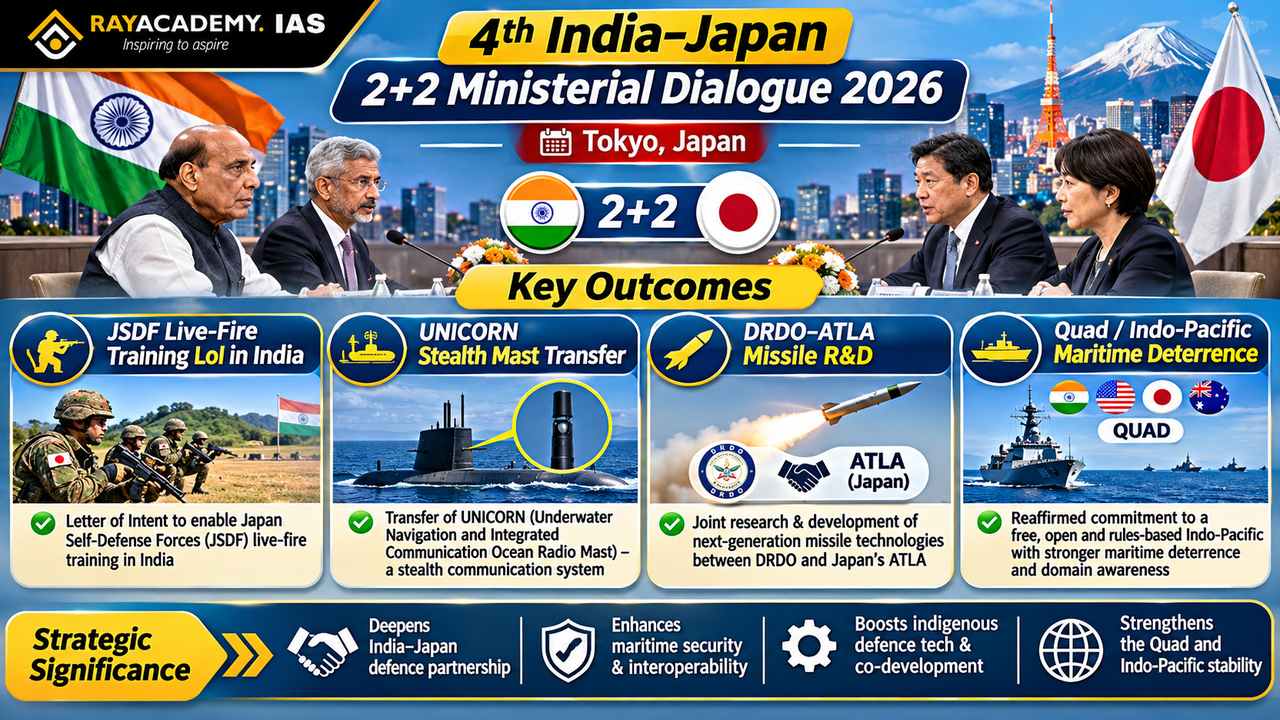
Historic Live-Fire Training Agreement: During the fourth India-Japan Foreign and Defence Ministers’ 2+2 Dialogue in Tokyo on November 19, 2026, both nations signed a landmark Letter of Intent (LoI) enabling the Japan Self-Defense Forces (JSDF) to utilize Indian test firing ranges for live-fire training—including surface-to-ship missile drills—for the very first time.
UPSC Syllabus Mapping:
General Studies Paper II (International Relations): Bilateral, regional and global groupings and agreements involving India and/or affecting India’s interests; Effect of policies and politics of developed and developing countries on India’s interests.
General Studies Paper III (Science & Technology and Internal Security): Indigenization of technology and developing new technology (defence technology transfer and co-development); Security challenges and their management in border and maritime areas.
Forward Movement on UNICORN Naval Radar: Defence Minister Rajnath Singh, External Affairs Minister S. Jaishankar, and their Japanese counterparts Shinjiro Koizumi and Toshimitsu Motegi fast-tracked arrangements for transferring Japan’s Unified Complex Radio Antenna (UNICORN) stealth naval radar system to India, targeting an Acceptance of Necessity (AoN) by February 2027.
Broadened Maritime and Defence R&D Cooperation: The joint statement underscored collaboration between DRDO and Japan’s Acquisition, Technology and Logistics Agency (ATLA) on missile technologies, joint naval ship design, mine countermeasures, consular evacuation Tabletop Exercises (TTX), and India hosting the 5th Coast Guard Global Summit (CGGS) in February 2027.
Static-Current Linkage: Institutional Architecture of India-Japan Defence Ties
Evolution to Special Strategic and Global Partnership
India-Japan ties are anchored in shared democratic values, Buddhist civilizational links, and former Prime Minister Shinzo Abe’s 2007 "Confluence of the Two Seas" vision. Upgraded to a Special Strategic and Global Partnership in 2014, the relationship marks its 75th anniversary of diplomatic relations in 2027 (designated as the India-Japan Year of Shared Horizons).
Foundational Bilateral Security Agreements
Joint Declaration on Security Cooperation (2008): Made India only the third country (after the U.S. and Australia) with which Japan established a formal security pact.
Reciprocal Provision of Supplies and Services Agreement (RPSS / ACSA, 2020): Enables the Indian Armed Forces and Japan Self-Defense Forces to reciprocally exchange logistics, fuel, rations, and maintenance facilities during bilateral training, UN peacekeeping, and Humanitarian Assistance and Disaster Relief (HADR) operations.
Agreement Concerning the Transfer of Defence Equipment and Technology (2015): Provides the legal framework governing joint defence R&D and hardware transfers such as the UNICORN integrated mast system.
Japan’s Post-War Pacifism and Strategic Shift
Under Article 9 of Japan’s 1947 Pacifist Constitution, Tokyo renounced war and restricted the JSDF strictly to self-defence, alongside a decades-old ban on arms exports (relaxed in 2014 via the Three Principles on Transfer of Defense Equipment and Technology). Amid rising regional tensions in the East and South China Seas and global conflicts in Ukraine and West Asia, Prime Minister Sanae Takaichi’s administration is revising Japan’s National Security Strategy (NSS), National Defence Strategy, and Defence Buildup Program, shifting from passive pacifism toward active deterrence and counterstrike capabilities.
Prelims Focus: High-Yield Objective Facts
UNICORN (Unified Complex Radio Antenna): A single, horn-shaped integrated stealth communications mast developed by Japan (used on Mogami-class stealth frigates) that houses multiple tactical communication and data-link antennas inside a single radome to drastically reduce a warship’s Radar Cross-Section (RCS); slated for co-development with Bharat Electronics Limited (BEL).
2+2 Ministerial Dialogue Format: A high-level diplomatic-cum-security consultation co-chaired by the Foreign and Defence Ministers; India conducts 2+2 ministerial dialogues exclusively with Quad partners (USA, Japan, Australia), Russia, and the United Kingdom (at Secretary/Ministerial levels).
Bilateral & Multilateral Military Exercises (India–Japan):
Malabar: Multilateral naval exercise involving Quad nations (India, Japan, USA, Australia); the 2026 edition was hosted by Japan.
JAIMEX (Japan-India Maritime Exercise) / JIMEX: Bilateral naval exercise between the Indian Navy and Japan Maritime Self-Defense Force (JMSDF).
Dharma Guardian: Annual bilateral Army exercise.
Veer Guardian: Bilateral Air Force fighter exercise.
Shinyuu Maitri: Bilateral Air Force transport exercise.
India’s Key Missile Test Ranges: Integrated Test Range (ITR), Chandipur and Dr. APJ Abdul Kalam Island (Wheeler Island) off the Odisha coast in the Bay of Bengal, managed by DRDO.
Mains Analytical Breakdown
Strategic Significance for India and the Indo-Pacific
Operationalizing Interoperability and Deterrence: Allowing the JSDF—which faces severe domestic geographical constraints for long-range missile testing—to conduct live-fire drills in Indian ranges moves bilateral ties from symbolic declarations to friction-tested operational interoperability.
Boosting Indigenous Defence Manufacturing ("Design with Japan, Make in India"): Transfer of the UNICORN stealth mast, joint naval ship design, and DRDO–ATLA missile co-development accelerate technological indigenization under Atmanirbhar Bharat, reducing India’s historical reliance on legacy defence suppliers.
Reinforcing a Free, Open, and Multipolar Indo-Pacific: Coupled with Quad coordination and synergy between India’s MAHASAGAR / Indo-Pacific Oceans Initiative (IPOI) and Japan’s Free and Open Indo-Pacific (FOIP) vision, the pact strengthens maritime domain awareness and counters unilateral coercion across vital sea lanes of communication (SLOCs).
Crisis Preparedness and Human Security: Consular Tabletop Exercises (TTX) for joint civilian evacuations and hosting the 5th Coast Guard Global Summit enhance non-traditional security capacities in disaster-prone and conflict-affected regions.
Multi-Dimensional Challenges and Strategic Nuances
1. Geopolitical Balancing and Strategic Autonomy
Managing Great-Power Sensitivities: Deepening military-operational integration with Tokyo and the Quad carries the risk of provoking sharper diplomatic or border friction with Beijing, requiring New Delhi to carefully calibrate its strategic autonomy without entering rigid treaty alliances.
2. Bureaucratic and Defence Procurement Delays
Slow Translation from LoI to Execution: Historically, India-Japan defence hardware deals (such as the stalled US-2 amphibious aircraft negotiations) have struggled with cost structures, technology-transfer terms, and protracted Defence Acquisition Procedure (DAP) timelines. Meeting the February 2027 Acceptance of Necessity (AoN) target for UNICORN will test institutional agility.
3. Operational, Legal, and Range-Security Protocols
Standard Operating Procedures (SOPs) for Foreign Live-Fire Drills: Hosting foreign surface-to-ship missile firings on sovereign Indian ranges requires strict bilateral protocols governing telemetry data security, airspace/maritime exclusion zones, environmental clearances, and liability frameworks.
Way Forward
Time-Bound Defence Acquisition Governance: Institutionalize a joint MoD–ATLA Implementation Task Force to ensure the UNICORN naval radar clears the Defence Acquisition Council’s (DAC) Acceptance of Necessity by February 2027 and transitions smoothly into co-production with BEL and Indian shipyards.
Clear Regulatory Framework for Foreign Range Utilization: Draft transparent bilateral Status of Forces / Range-Use SOPs specifying environmental safeguards, electronic signature protection, and reciprocal training access for Indian forces in Japan.
Expand Trilateral and Minilateral Maritime Coalitions: Link bilateral maritime domain awareness (via the Information Fusion Centre – Indian Ocean Region (IFC-IOR) in Gurugram) with minilateral partners such as Australia, the Philippines, and Indonesia to secure critical Indo-Pacific chokepoints.
Integrate Economic Security with Defence Tech: Align DRDO–ATLA defence R&D with the India-Japan AI Cooperation Initiative, semiconductor supply chains, and critical minerals partnerships to build end-to-end technological resilience.
Value Addition for Mains Answers
Diplomatic & Strategic Doctrine: As External Affairs Minister S. Jaishankar emphasized following the 2026 Tokyo 2+2 Dialogue, "Trusted cooperation between India and Japan supports a multipolar Asia and a multipolar world, advancing a free Indo-Pacific through practical cooperation."
Defence Industrial Synergy Catchphrase: Transitioning bilateral engagement from "Buyer–Seller" to "Design with Japan, Make in India" strengthens both nations' defence industrial bases while upholding a rules-based maritime order.
Practice Questions for Active Recall
Prelims Practice MCQ
Consider the following statements regarding India-Japan defence cooperation and the 2026 2+2 Ministerial Dialogue:
Under the Letter of Intent (LoI) signed during the November 2026 2+2 Dialogue in Tokyo, Japan’s Self-Defense Forces will conduct live-fire training, including surface-to-ship missile drills, at Indian firing ranges for the first time.
The UNICORN system proposed for transfer from Japan to India is a space-based early warning satellite constellation designed for ballistic missile defence.
India conducts 2+2 Ministerial Dialogues with all four Quad member nations—the United States, Japan, and Australia.
Which of the statements given above is/are correct? A. 1 and 2 only
B. 1 and 3 only
C. 2 and 3 only
D. 1, 2 and 3
Correct Answer: B
Explanation:
Statement 1 is correct: During the fourth India-Japan 2+2 Foreign and Defence Ministers' Dialogue in Tokyo (November 2026), both sides signed an LoI allowing the JSDF to use Indian test ranges for live-fire training, including surface-to-ship missiles, for the first time.
Statement 2 is incorrect: UNICORN (Unified Complex Radio Antenna) is an integrated stealth naval radio/radar mast system mounted on warships (such as Japan’s Mogami-class frigates) to reduce radar cross-section, not a satellite constellation.
Statement 3 is correct: India holds 2+2 Foreign and Defence Ministerial Dialogues with its Quad partners—the USA, Japan, and Australia—as well as with Russia and the UK.
Mains Practice Question (GS Paper II – 150 Words / 10 Marks)
"The 2026 India-Japan 2+2 Ministerial Dialogue marks a decisive shift from normative convergence to operational deterrence in the Indo-Pacific." Examine the key outcomes of the dialogue and evaluate their strategic significance for India.
Answer Structure Hint:
Introduction: Contextualize the 4th India-Japan 2+2 Dialogue in Tokyo (November 2026) under the Special Strategic and Global Partnership.
Body: Highlight key outcomes—the first-ever LoI for JSDF live-fire missile training in Indian ranges, fast-tracking of the UNICORN stealth naval radar transfer (AoN by Feb 2027), DRDO–ATLA missile R&D, joint ship design, and consular evacuation TTX. Evaluate strategic significance (operational interoperability, Make in India defence indigenization, securing Indo-Pacific SLOCs alongside Quad/IPOI, and balancing Japan’s evolving security doctrine) while briefly noting procurement and geopolitical balancing challenges.
Conclusion: Conclude with how the upcoming 75th anniversary of diplomatic ties (2027) positions India and Japan as anchors of a stable, multipolar Indo-Pacific.
Take this article with you
Save a reading copy for offline study.


