

NITI Aayog
Launched a five-part national workshop series titled "Leadership as Mission" at Bharat Mandapam, New Delhi, on November 17, 2026, to document administrative lessons from 25 years of Prime Minister Narendra Modi’s tenure as Head of Government (2001–2026). Delivering the inaugural keynote address, Principal Secretary to the Prime Minister Dr. P.K. Mishra underscored how decisive leadership, "vision-to-action" execution, and whole-of-government coordination shaped major governance milestones—ranging from the 2001 Kutch earthquake reconstruction and COVID-19 pandemic response to the Lakhpati Didi initiative and space sector liberalization. Deliberations from the series (running through October 2027) will be converted into structured case studies by the Capacity Building Commission (CBC) for civil services training institutes, universities, and the iGOT Karmayogi platform.
UPSC Syllabus Mapping:
General Studies Paper II (Governance & Polity): Important aspects of governance, transparency and accountability, e-governance—applications, models, successes, limitations, and potential; Role of civil services in a democracy; Development processes and the development industry.
General Studies Paper IV (Ethics, Integrity & Aptitude): Public/Civil service values and Ethics in Public administration: Status and problems; ethical concerns and dilemmas in government and private institutions; Lessons from the lives and teachings of great leaders, reformers and administrators; Probity in Governance: Concept of public service.
Static-Current Linkage: Constitutional Bureaucracy, Mission Karmayogi, and Administrative Ethics
Evaluating the transition from rule-bound administration to mission-mode governance requires linking India’s constitutional civil service framework with modern capacity-building reforms and administrative ethics.
1. Constitutional Architecture of the Indian Civil Services
Part XIV (Articles 308–323): Governs recruitment, conditions of service, and tenure protection for All-India Services and Central/State Services, ensuring political neutrality and institutional continuity.
Article 312 (All-India Services): Empowers the Rajya Sabha to create All-India Services (IAS, IPS, IFoS) that bind the Union and States together in administrative coordination—exemplified by the participation of District Collectors of Aspirational Districts at the workshop.
Articles 53, 74, 154, and 163: Establish the parliamentary executive model, wherein elected political leadership provides democratic vision and policy direction while the permanent executive executes mandates within the Rule of Law.
2. Evolution from Rule-Based to Role-Based Governance (Mission Karmayogi). Civil Service Reforms
Traditional Weberian bureaucracy in India often suffered from siloed functioning, procedural rigidity, and process-over-outcome inertia. To address this, the Union Government launched the National Programme for Civil Services Capacity Building (NPCSCB) – Mission Karmayogi in 2020, anchored by the Capacity Building Commission (CBC) and the iGOT Karmayogi digital learning platform. The NITI Aayog workshop operationalizes this shift by converting real-world administrative crises and welfare rollouts into experiential case-based pedagogy for civil servants. Civil Service Reforms
3. Ethical Foundations of Public Administration (GS Paper IV Linkage)
NITI Aayog CEO Anurag Jain articulated four core administrative principles during the workshop that directly mirror foundational ethical frameworks in public service:
Purpose Over Hierarchical Position: Prioritizing a shared public mission over bureaucratic status and turf wars.
Service Over Command (Antyodaya): Centering governance on reaching the last person in the queue—reflecting Mahatma Gandhi’s Talisman and Servant Leadership.
Intrinsic Conviction and Resilience: Converting administrative crises (such as disasters or pandemics) into opportunities for institutional innovation.
Institutionalization Over Individualism: Ensuring reforms outlive individual tenures through capable teams, decentralized empowerment, and sustainable systems.
Prelims Focus: High-Yield Facts for UPSC CSE
Workshop Series: "Leadership as Mission" (first of five national workshops organized by NITI Aayog between November 2026 and October 2027); subsequent themes cover Governance as Delivery, Development as Inclusion, Civilisational Identity, and India as a Global Force.
Key NITI Aayog Functionaries (Nov 2026): Ashok Kumar Lahiri (Vice Chairman, NITI Aayog) and Anurag Jain (CEO, NITI Aayog).
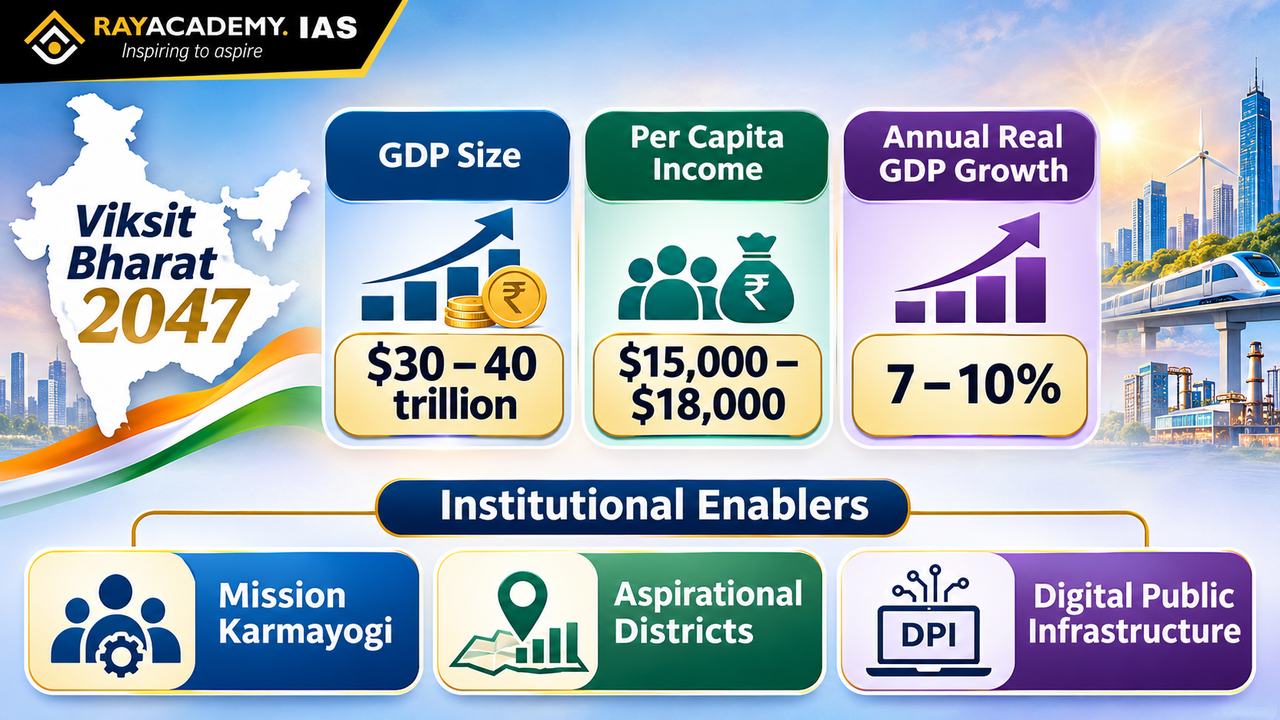
Viksit Bharat 2047 Economic Targets (NITI Aayog Roadmap): Building a $30–40 trillion economy by 2047 with a per capita income of $15,000–$18,000, underpinned by sustained annual real GDP growth of 7–10%.
Aspirational Districts Programme (ADP): Launched by NITI Aayog in January 2018 across 112 under-developed districts based on the 3Cs approach (Convergence of Central/State schemes, Collaboration of Prabhari Officers and District Collectors, and Competition among districts via real-time Champions of Change delta rankings).
Lakhpati Didi Initiative: Implemented by the Ministry of Rural Development under the Deendayal Antyodaya Yojana – National Rural Livelihoods Mission (DAY-NRLM) to enable rural Self-Help Group (SHG) women to earn a sustainable household income of at least ₹1 lakh per annum.
Space Sector Reform Institutions: IN-SPACe (Indian National Space Promotion and Authorisation Centre, established in 2020 as a single-window autonomous nodal agency under the Department of Space) and NewSpace India Limited (NSIL), guided by the Indian Space Policy, 2023.
Mains Analytical Breakdown: Significance and Multi-Dimensional Challenges
Significance for Governance and Public Administration
Bridging the "Vision-to-Action" Implementation Deficit: Indian policymaking has historically excelled in policy formulation while struggling with last-mile execution. Documenting empirical workflows from the 2001 Kutch rehabilitation and COVID-19 management provides actionable templates for inter-ministerial convergence and rapid crisis response.
Institutionalizing Experiential Pedagogy in Civil Services: Collaborating with the Capacity Building Commission to embed indigenous Indian governance case studies into training academies (such as LBSNAA) reduces reliance on Western management models and equips District Collectors with context-specific problem-solving tools.
Shifting From Process Compliance to Outcome Delivery: Emphasizing measurable human development indicators—seen in the Aspirational Districts Programme and Lakhpati Didi—reorients bureaucratic incentives from mere file clearance to tangible citizen empowerment.
Strengthening Whole-of-Government and Whole-of-Society Synergy: Integrating private enterprise (space startups), women’s SHGs, and grassroots Panchayats alongside state machinery fosters Jan Bhagidari (participatory governance).
Multi-Dimensional Challenges in Sustaining Mission-Mode Governance
Balancing Speed With Procedural Accountability (Administrative): Excessive focus on rapid "mission-mode" targets can inadvertently bypass statutory checks, environmental/social impact assessments, or legislative scrutiny if institutional guardrails are not equally strengthened.
Risk of Over-Centralization vs. Cooperative Federalism (Political): Concentrating strategic direction at the apex executive level must be balanced with genuine fiscal and administrative autonomy for State Governments and Panchayati Raj Institutions (73rd/74th Amendments) to prevent uniform, one-size-fits-all templates.
Institutional Sustainability Beyond Individual Leadership (Structural): As highlighted at the workshop itself, initiatives driven by charismatic or high-energy individual officers often lose momentum upon transfers unless embedded in permanent standard operating procedures (SOPs) and empowered local institutions.
Macroeconomic Execution Hurdles for Viksit Bharat 2047 (Economic): Sustaining 7–10% real GDP growth over two decades to reach a $30–40 trillion economy requires overcoming structural bottlenecks in manufacturing competitiveness, private capital expenditure, skilling, and Female Labour Force Participation.
Ethical Dilemmas in Target-Driven Bureaucracy (Ethical): High-pressure top-down targets can occasionally incentivize data misreporting or coercive compliance at the cutting-edge level unless paired with transparent third-party audits and ethical leadership training.
Way Forward: Reform-Oriented Roadmap
Embed Case-Based Learning Across All Tiers of Civil Services (Mission Karmayogi): Operationalize the Capacity Building Commission’s mandate to upload peer-reviewed case studies from the workshop series onto iGOT Karmayogi, making simulation-based crisis management mandatory across induction and mid-career training programmes.
Institutionalize Tenure Stability and Outcome-Based Appraisals (2nd ARC Framework): Implement the Second Administrative Reforms Commission (2nd ARC) 10th Report (Refurbishing of Personnel Administration) recommendations by ensuring fixed minimum tenures for District Collectors and linking performance appraisals to verifiable citizen-centric outcomes rather than subjective grading.
Deepen Decentralization and Cooperative Federalism: Expand the Aspirational Blocks Programme (ABP) by empowering Gram Sabhas and local block teams with untied flexible funds, ensuring mission-mode delivery strengthens—rather than substitutes—grassroots local self-government.
Pair Decisive Execution With Transparent Accountability Mechanisms: Mandate concurrent social audits, real-time public dashboards, and independent evaluation by NITI Aayog’s Development Monitoring and Evaluation Office (DMEO) to preserve institutional integrity alongside rapid execution.
Foster Regulatory Predictability for Private Sector & Startup Growth: Replicate the space sector liberalization model (IN-SPACe) across emerging sectors such as clean energy, semiconductors, and deep-tech manufacturing to sustain the 7–10% growth rate envisioned for Viksit Bharat 2047.
Value Addition for Mains
Official NITI Aayog Macroeconomic Benchmark (Nov 2026): According to NITI Aayog Vice Chairman Ashok Kumar Lahiri, achieving Viksit Bharat by 2047 entails transforming India into a $30–40 trillion economy with a per capita income of $15,000–$18,000, requiring sustained annual real GDP growth of 7–10% backed by institutional capacity and entrepreneurship.
Administrative & Ethical Quote for GS-2 & GS-4: Quoting NITI Aayog’s four governance lessons—"Purpose must take precedence over hierarchical position, service must replace command, and true empowerment must outlive individual leadership through strong institutions"—provides a crisp, exam-ready conclusion for answers on civil service reforms and ethical governance.
Practice Questions for Active Recall
Prelims Practice MCQ
With reference to NITI Aayog and governance initiatives in India, consider the following statements:
The "Leadership as Mission" national workshop series launched by NITI Aayog in November 2026 aims to develop first-hand administrative experiences into learning material for civil services training institutions.
The Aspirational Districts Programme (ADP) is implemented by NITI Aayog based on the three core principles of Convergence, Collaboration, and Competition.
The Capacity Building Commission (CBC) is a constitutional body established under Article 315 of the Constitution of India to oversee the iGOT Karmayogi platform.
Which of the statements given above are correct?
(a) 1 and 2 only
(b) 2 and 3 only
(c) 1 and 3 only
(d) 1, 2, and 3
Correct Answer: (a) 1 and 2 only
Explanation:
Statement 1 is correct: NITI Aayog launched the five-part "Leadership as Mission" workshop series in November 2026 at Bharat Mandapam to document governance experiences (such as Kutch reconstruction, COVID-19 response, Lakhpati Didi, and space reforms) into case studies for civil services training institutes and universities.
Statement 2 is correct: Launched in January 2018 across 112 backward districts, NITI Aayog’s Aspirational Districts Programme operates on the 3Cs: Convergence (of Central and State schemes), Collaboration (of Central, State-level Prabhari Officers, and District Collectors), and Competition (among districts through monthly delta rankings).
Statement 3 is incorrect: The Capacity Building Commission (CBC) was constituted in 2021 by an executive resolution of the Union Cabinet under Mission Karmayogi (NPCSCB)—it is not a constitutional body under Article 315 (which establishes the UPSC and State Public Service Commissions).
Mains Practice Question (GS Paper II & GS Paper IV — 150 Words | 10 Marks)
"True administrative empowerment must outlive individual leadership through strong institutions, capable teams, and sustainable systems." Discuss the significance of shifting Indian civil services from a rule-bound command culture to mission-mode, service-oriented governance in achieving the vision of Viksit Bharat 2047.
Answer Structure Hints:
Introduction: Contextualize NITI Aayog’s "Leadership as Mission" workshop (Nov 2026) and its roadmap for Viksit Bharat 2047 ($30–40 trillion economy), highlighting the shift from process compliance to outcome-oriented public service.
Body Part 1 (Significance of Mission-Mode & Service-Oriented Governance): Explain how prioritizing purpose over hierarchy and service over command (Antyodaya) accelerates crisis response (e.g., disaster/pandemic management) and last-mile inclusion (e.g., Aspirational Districts, Lakhpati Didi).
Body Part 2 (Institutionalizing Beyond Individuals): Discuss embedding case-based learning via Mission Karmayogi / iGOT, ensuring tenure stability (2nd ARC), empowering local bodies, and maintaining procedural transparency so reforms endure beyond individual officers.
Conclusion: Conclude with Gandhi’s Talisman and Articles 309–312, noting that an ethical, accountable, and citizen-centric bureaucracy is the decisive institutional bridge to Viksit Bharat 2047.
Take this article with you
Save a reading copy for offline study.


