

Material Security
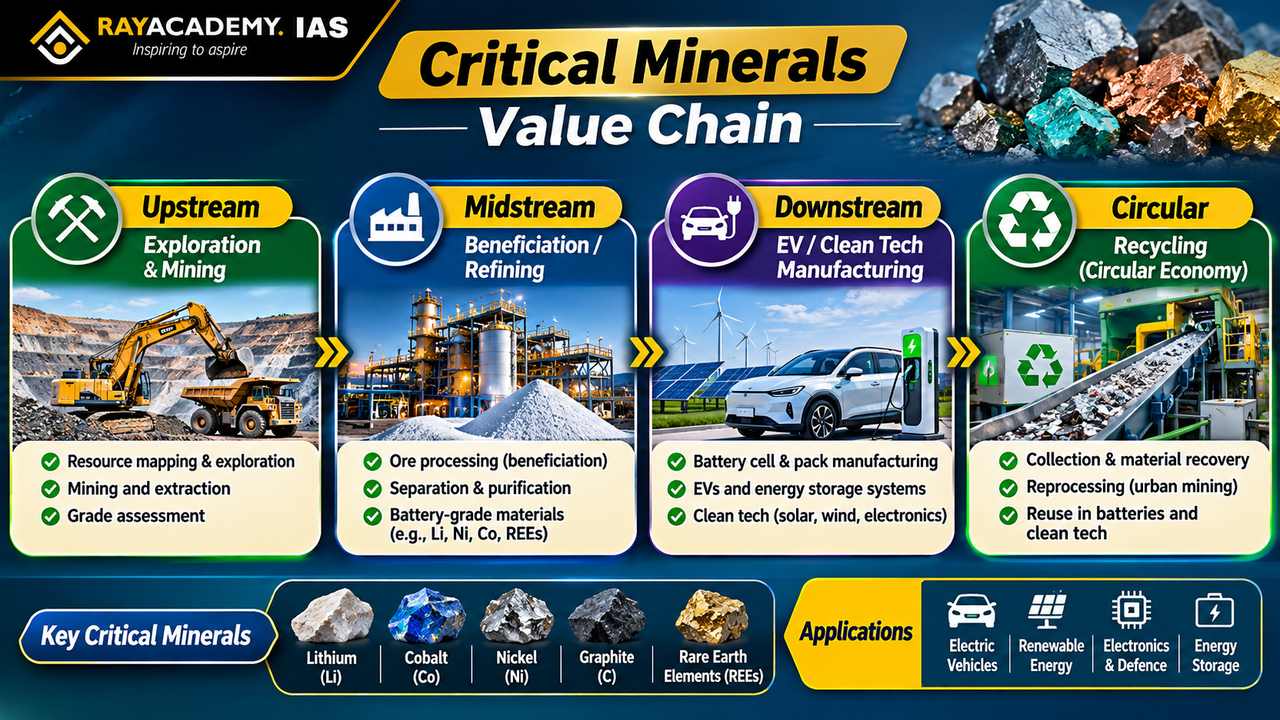
Shift Toward Midstream Refining: Recent policy analyses highlight that while India has accelerated upstream mineral block auctions, true material security requires building domestic beneficiation, refining, and urban mining capacities.
UPSC Syllabus Mapping:
General Studies Paper I (Geography): Distribution of key natural resources across the world (including South Asia and the Indian subcontinent); factors responsible for the location of primary, secondary, and tertiary sector industries in various parts of the world (including India).
General Studies Paper III (Indian Economy & Environment): Indian Economy and issues relating to planning, mobilization of resources, growth, development and employment; Infrastructure: Energy, Ports, Roads, Airports, Railways etc.; Indigenization of technology and developing new technology; Conservation, environmental pollution and degradation, environmental impact assessment.
National Critical Mineral Mission (NCMM): Backed by a ₹34,300 crore seven-year outlay (FY 2024–25 to 2030–31), the government is expanding exploration, processing parks, and a ₹1,500 crore recycling scheme targeting 400 kilotonnes of mineral recovery by 2031.
Geopolitical Supply Chain Risks: Global export restrictions on Rare Earth Elements (REEs), lithium, and cobalt have underscored the vulnerability of relying solely on raw ore extraction or short-term stockpiling.
Static-Current Linkage: Constitutional, Legal, and Institutional Framework
Constitutional Mandate Over Mineral Resources
Under the Seventh Schedule of the Indian Constitution, mineral regulation is divided between the Union and the States to balance cooperative federalism with national strategic interests. Entry 54 of the Union List empowers Parliament to regulate mines and mineral development in the public interest, whereas Entry 23 of the State List vests residual rights over mines and mineral development with State Governments.
Legislative Evolution: MMDR Amendment Act, 2023
To unlock domestic reserves, Parliament enacted the Mines and Minerals (Development and Regulation) Amendment Act, 2023. Key statutory reforms include:
Delisting Atomic Minerals: Six minerals—lithium, beryllium, niobium, titanium, tantalum, and zirconium—were removed from the restricted list of 12 atomic minerals, opening them to private sector participation.
Centralized Auctioning: Insertion of Section 11D empowered the Central Government to exclusively auction mining leases and composite licences for 24 critical and strategic minerals listed in Part D of the First Schedule, while auction revenues continue to accrue to State Governments.
Exploration Licence (EL): Introduced a dedicated licence for deep-seated and critical minerals (Schedule VII) to incentivize junior mining companies and Foreign Direct Investment (FDI).
Scientific Principle: Beneficiation vs. Refining . Critical Minerals Policy
Auctioning a mineral block is merely the upstream starting point; extracted ore cannot be directly fed into battery gigafactories. Beneficiation involves physical and chemical treatment of raw ore to remove impurities (gangue) and increase mineral concentration. Subsequent hydrometallurgical and pyrometallurgical refining converts concentrates into battery-grade chemicals (such as lithium carbonate or cobalt sulphate), where global supply chain bottlenecks are most acute. Critical Minerals Policy
Prelims Focus: High-Yield Objective Facts
National Critical Mineral Mission (NCMM): Approved in January 2025 with a total outlay of ₹34,300 crore (₹16,300 crore budgetary support and ₹18,000 crore expected investment from PSUs/stakeholders) over seven years up to 2030–31.
Nodal Ministry: Ministry of Mines, Government of India.
Critical Mineral Recycling Incentive Scheme: Allocated ₹1,500 crore under NCMM to recover 400 kilotonnes of critical minerals from mining tailings, fly ash, red mud, and end-of-life products by 2031.
Khanij Bidesh India Ltd (KABIL): A joint venture of three Central Public Sector Enterprises (NALCO, HCL, and MECL) mandated to identify, acquire, and develop overseas critical mineral assets (e.g., lithium brine blocks in Catamarca, Argentina).
Global Partnerships: India is a member of the US-led Minerals Security Partnership (MSP) and the Indo-Pacific Economic Framework (IPEF) Supply Chain Agreement.
E-Waste Management Rules, 2022 & Battery Waste Management Rules, 2022: Enforce Extended Producer Responsibility (EPR) to formalize scrap collection and domestic metal recovery.
Mains Analytical Breakdown
Strategic Significance of Material Security
Energy Transition and Net-Zero 2070: Achieving India’s target of 500 GW non-fossil fuel capacity by 2030 and scaling Electric Vehicle (EV) adoption depends on uninterrupted supplies of lithium, cobalt, nickel, graphite, and REEs.
Atmanirbhar Bharat in Manufacturing: Without domestic refined inputs, flagship initiatives like the Production Linked Incentive (PLI) Scheme for Advanced Chemistry Cell (ACC) Battery Storage risk remaining dependent on imported processed intermediates.
Geoeconomic De-risking: China dominates global midstream processing (refining over 60% of global lithium and 85% of rare earths), giving it asymmetric leverage through export controls. Building domestic refining insulates India’s defence, electronics, and renewable sectors from external supply shocks.
Multi-Dimensional Challenges
1. Economic and Midstream Infrastructure Gaps
Refining Deficit: India lacks commercial-scale beneficiation and refining plants. Exporting raw concentrates or importing processed battery chemicals undermines domestic value addition.
Capital Intensity and Long Gestation: Greenfield mines take 7 to 12 years to become operational due to high capital costs and technological complexity, creating a temporal mismatch with immediate industrial demand.
2. Environmental and Social Bottlenecks
Ecological Footprint: Hard-rock lithium and REE extraction requires massive water consumption and generates toxic tailings and radioactive by-products (such as thorium in monazite sands), triggering local resistance.
Land Acquisition and Clearance Delays: Overlapping forest clearances, Environmental Impact Assessment (EIA) hurdles, and tribal land rights concerns under the Forest Rights Act (FRA), 2006 frequently stall mine operationalization.
3. Circular Economy and Scrap Traceability Hurdles
Informal E-Waste Sector: Over 80% of India’s electronic and battery waste is handled by the unorganized scrap economy, leading to low recovery yields, hazardous leaching, and lack of feedstock traceability for formal recyclers.
Limitations of Strategic Stockpiling: Maintaining a National Critical Mineral Stockpile buffers short-term disruptions, but rapid technological shifts (e.g., transitioning from NMC to LFP or sodium-ion batteries) risk rendering stockpiled inventories obsolete.
Way Forward
Synchronized Mining and Processing Parks: Operationalize dedicated Critical Mineral Processing Parks alongside auctioned blocks, backed by viability gap funding and tax incentives recommended by NITI Aayog to attract global refining technology.
Formalizing Urban Mining and Traceability: Enforce digital Battery Aadhaar passports and strict Extended Producer Responsibility (EPR) audits under Central Pollution Control Board (CPCB) oversight to channel e-waste and red mud/fly ash tailings toward formal hydrometallurgical recyclers.
Streamlining Clearances via Single-Window Governance: Implement 2nd Administrative Reforms Commission (ARC) recommendations on time-bound, transparent single-window environmental clearances while ensuring fair District Mineral Foundation (DMF) benefit-sharing with local communities.
Dynamic Strategic Reserves and R&D: Align the National Critical Mineral Stockpile with periodic technology-horizon scanning by the Principal Scientific Adviser (PSA), while funding CSIR laboratories and startups to develop alternative battery chemistries.
Value Addition for Mains Answers
E-Waste Generation Data: According to industry assessments (Redseer), India generated 3.8 million metric tonnes of e-waste in 2024, making urban mining a viable, fast-gestation secondary source of critical minerals.
Economic Survey Insight: The Economic Survey emphasizes that India’s clean energy transition must avoid substituting import dependence on fossil fuels with import dependence on critical mineral supply chains.
Administrative Catchphrase: "Mineral security lies beneath the earth, but material security is forged in refineries and recycling plants."
Practice Questions for Active Recall
Prelims Practice MCQ
Consider the following statements regarding India’s Critical Minerals Policy and the National Critical Mineral Mission (NCMM):
Under the Mines and Minerals (Development and Regulation) Amendment Act, 2023, the Central Government is empowered to exclusively auction mining leases for critical minerals, while the auction revenue accrues to the Consolidated Fund of India.
Lithium, beryllium, and titanium have been omitted from the list of atomic minerals under the First Schedule of the MMDR Act to enable private sector exploration and mining.
The Critical Mineral Recycling Incentive Scheme under NCMM targets the recovery of critical minerals from industrial wastes such as fly ash, red mud, and mining tailings.
Which of the statements given above is/are correct? A. 1 and 2 only
B. 2 and 3 only
C. 1 and 3 only
D. 1, 2 and 3
Correct Answer: B
Explanation:
Statement 1 is incorrect: While Section 11D of the MMDR Amendment Act, 2023 empowers the Central Government to exclusively auction critical mineral blocks, the auction revenue and royalties accrue directly to the respective State Governments, not the Consolidated Fund of India.
Statement 2 is correct: Six minerals (lithium, beryllium, niobium, titanium, tantalum, and zirconium) were delisted from the atomic minerals category in 2023 to allow private participation.
Statement 3 is correct: The ₹1,500 crore recycling scheme under NCMM aims to recover 400 kilotonnes of critical minerals from end-of-life products as well as tailings, fly ash, and red mud by 2031.
Mains Practice Question (GS Paper III – 150 Words / 10 Marks)
"While auctioning critical mineral blocks is an essential first step, India’s strategic autonomy depends on transitioning from mineral security to material security." Examine the bottlenecks in India’s critical minerals value chain and suggest measures to build a resilient domestic ecosystem.
Answer Structure Hint:
Introduction: Define the distinction between mineral security (upstream resource access) and material security (midstream refining and usable industrial supply), citing the ₹34,300 crore National Critical Mineral Mission.
Body: Highlight midstream bottlenecks (lack of beneficiation/refining capacity, China’s processing dominance, long mine gestation, informal e-waste fragmentation, and limitations of static stockpiling). Suggest measures (Critical Mineral Processing Parks, EPR enforcement, urban mining incentives, KABIL overseas acquisitions, and R&D in alternative chemistries).
Conclusion: Link domestic material security to Atmanirbhar Bharat, EV manufacturing competitiveness, and India’s 2070 Net-Zero commitment.
Take this article with you
Save a reading copy for offline study.


