

Election Commission of India
ECI’s Corrective Measures on Deleted Electors: Following the Supreme Court’s observation on October 28, 2026, that forcing electors deleted during the Special Intensive Revision (SIR) to re-enrol as new voters via Form 6 was an "error", the Election Commission of India (ECI) introduced targeted remedial measures under Rule 21(1) of the Registration of Electors Rules, 1960.
UPSC Syllabus Mapping:
General Studies Paper II (Indian Polity & Governance): Indian Constitution—historical underpinnings, evolution, features, amendments, significant provisions and basic structure; Appointment to various Constitutional posts, powers, functions and responsibilities of various Constitutional Bodies (Election Commission of India); Salient features of the Representation of People’s Act.
Restoration of Old EPIC Numbers: In seven States and Union Territories where Phase 3 of the SIR is ongoing—including Delhi and Maharashtra—deleted electors who failed to submit enumeration forms or shifted within the State can now submit delayed forms with address proof to restore their original Electors Photo Identity Card (EPIC) numbers.
Extension of Special Summary Revision (SSR): After adding roughly 74 lakh voters across 13 Phase 1 and Phase 2 States through an SSR, the ECI extended the SSR framework to Phase 3 States, mandating personal notices before non-death deletions and personal cross-verification by Electoral Registration Officers (EROs) wherever deletions exceed 2% at a polling station.
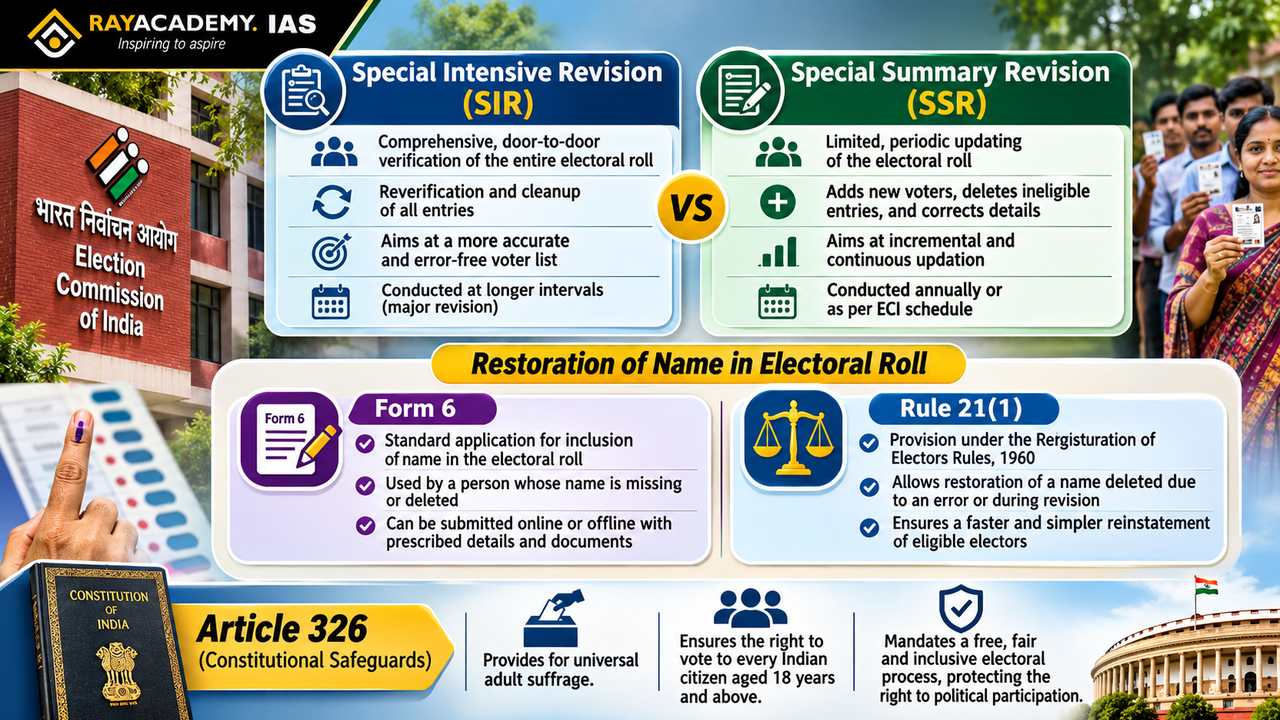
Static-Current Linkage: Constitutional and Statutory Framework
Constitutional Mandate of the Election Commission
Article 324: Vests the superintendence, direction, and control of the preparation of electoral rolls and the conduct of all elections to Parliament and State Legislatures in the Election Commission of India.
Article 325: Mandates one general electoral roll for every territorial constituency and prohibits exclusion on grounds only of religion, race, caste, or sex.
Article 326: Enshrines Universal Adult Suffrage, granting every citizen of India aged 18 years or above the constitutional right to be registered as a voter, unless disqualified under law on grounds of non-residence, unsoundness of mind, crime, or corrupt/illegal practice.
Statutory Architecture: RPA, 1950 & Registration of Electors Rules, 1960 . Electoral Roll Revision
Representation of the People Act (RPA), 1950: Governs the preparation and revision of electoral rolls. Section 16 specifies disqualifications (such as non-citizenship), Section 19 outlines registration conditions (age and ordinary residence), and Section 21 empowers the ECI to prepare and revise rolls in the prescribed manner (intensive, summary, or partly intensive and partly summary).
Registration of Electors Rules, 1960: Operationalizes roll management. Rule 21(1) empowers the Electoral Registration Officer (ERO) to include names inadvertently omitted from the roll while preserving continuity of record, whereas Form 6 is statutory machinery meant strictly for fresh registration of new electors (such as first-time voters or inter-constituency migrants).Electoral Roll Revision
Judicial Precedent: Lal Babu Hussein v. Electoral Registration Officer (1995)
In Lal Babu Hussein (1995), the Supreme Court held that if a person’s name already exists on the electoral roll, the ERO cannot delete it on suspicion of non-citizenship without following principles of natural justice, issuing proper notice, and affording a reasonable opportunity of being heard.
Prelims Focus: High-Yield Objective Facts
Statutory Forms for Electoral Rolls:
Form 6: Application for inclusion of name in electoral roll (new voters / shifting from another constituency).
Form 6A: Application for inclusion of name by an Overseas (NRI) Elector.
Form 7: Application for objecting to proposed inclusion or seeking deletion of a name in an existing electoral roll.
Form 8: Application for shifting of residence within the same constituency, correction of entries, replacement of EPIC, or marking as Person with Disability (PwD).
Electoral Registration Officer (ERO): Appointed by the ECI in consultation with the respective State Government under Section 13B of the RPA, 1950; functions as a statutory quasi-judicial authority for roll revision.
Special Intensive Revision (SIR) vs. Special Summary Revision (SSR): An Intensive Revision involves de novo preparation of electoral rolls through house-to-house enumeration without reference to earlier rolls, whereas a Summary Revision updates existing rolls based on claims and objections.
Nature of Right to Vote: In PUCL v. Union of India (2003) and Anoop Baranwal v. Union of India (2023), the Supreme Court reaffirmed that while the right to vote is a statutory right subject to statutory limitations, the right to know and freedom of expression in voting are integral to Article 19(1)(a) and the Basic Structure of democracy.
Mains Analytical Breakdown
Significance of Electoral Roll Purification and ECI’s Course Correction
Electoral Integrity and Purity of Rolls: Periodic intensive revisions remove deceased voters, duplicate entries, and permanently shifted electors, preventing bogus voting and strengthening public confidence in electoral outcomes.
Institutional Responsiveness to Judicial Review: By invoking Rule 21(1) to restore original EPIC numbers and mandating personal verification by EROs when deletions exceed 2%, the ECI demonstrated corrective flexibility following Supreme Court scrutiny.
Procedural Safeguards in SSR: Extending the SSR without requiring prior roll-mapping or documentary citizenship proof—while insisting on personal notice prior to deletion—lowers administrative barriers for marginalized voters.
Multi-Dimensional Challenges and Governance Concerns
1. Constitutional and Legal Concerns (De Facto Citizenship Screening)
Burden of Proof on Existing Voters: Under the SIR framework, electors unable to trace or match details from the "last SIR" are required to furnish documentary proof, effectively turning routine voter verification into a de facto citizenship test.
Opaque Algorithmic Flagging: The use of automated "logical discrepancy" checks to flag records without transparent criteria or statutory backing raises concerns regarding procedural fairness and Article 14 (non-arbitrariness).
2. Social Equity and Asymmetric Remedies
Asymmetric Treatment Across States: The ECI’s Rule 21(1) remedy covers roughly 4.5 crore of the 13.37 crore electors struck off draft rolls, primarily benefiting ongoing Phase 3 States. Electors in States where SIR has already concluded (such as Bihar and West Bengal) must still apply afresh via Form 6, losing historical roll continuity.
Exclusion of Inter-State Migrants and Vulnerable Groups: Current corrective measures do not cover inter-State internal migrants. Informal workers, urban slum dwellers, and women who relocate after marriage disproportionately lack legacy documentation, risking structural disenfranchisement.
3. Administrative and Institutional Trust Deficit
Deviation from the 2002–03 Door-to-Door Model: Unlike the 2002–03 revision—where enumerators actively mapped shifted residents door-to-door at their new addresses—reliance on form-return compliance shifts the administrative burden from the state onto the citizen.
Erosion of Institutional Credibility: Massive draft deletions (averaging 17% in Phase 3 and reaching 32.8% in Delhi) followed by partial rollbacks strain administrative capacity and risk eroding trust in the ECI’s impartiality.
Way Forward
Uniform Pan-India Restoration Under Rule 21(1): Extend the restoration of original EPIC numbers and historical roll records uniformly to all States—including Phase 1 and Phase 2 States where SIR has concluded—to ensure equality before law (Article 14).
Return to Proactive Door-to-Door Enumeration: In line with Supreme Court jurisprudence (Lal Babu Hussein) and the 2002–03 revision template, Booth Level Officers (BLOs) should conduct proactive house-to-house verification rather than deleting electors solely for non-submission of forms.
Portability for Inter-State Migrants: Implement recommendations of the Law Commission of India (255th Report on Electoral Reforms) and ECI’s Remote Voting / Migrant Facilitation proposals to allow seamless constituency transfer without loss of voter history.
Algorithmic Transparency and Audit: Mandate public disclosure of parameters used in "logical discrepancy" software, alongside mandatory social audits by political party Booth Level Agents (BLAs) and 2nd ARC citizen-centric accountability norms.
Value Addition for Mains Answers
Scale of Deletions and Restorations: Across 13 Phase 1 and Phase 2 States, the electorate contracted from 49.61 crore to 45.22 crore post-SIR before recovering to 45.96 crore following the addition of 74 lakh electors via SSR. Overall, 13.37 crore names were struck off draft rolls across phases, with Phase 3 draft deletions averaging 17% (and peaking at 32.8% in Delhi).
Constitutional Principle: "In a constitutional democracy anchored in Universal Adult Suffrage (Article 326), electoral roll purification must remain an exercise in inclusion, never an instrument of mass exclusion."
Practice Questions for Active Recall
Prelims Practice MCQ
Consider the following statements regarding the revision of electoral rolls in India:
Under Section 21 of the Representation of the People Act, 1950, the Election Commission of India is empowered to conduct either an intensive or a summary revision of electoral rolls.
Under Rule 21(1) of the Registration of Electors Rules, 1960, an Electoral Registration Officer (ERO) can restore an inadvertently omitted name to the electoral roll while retaining the elector’s original EPIC number.
Form 6 under the Registration of Electors Rules, 1960 is exclusively meant for Indian citizens residing abroad to register as overseas electors.
Which of the statements given above is/are correct? A. 1 and 2 only
B. 2 and 3 only
C. 1 and 3 only
D. 1, 2 and 3
Correct Answer: A
Explanation:
Statement 1 is correct: Section 21 of the Representation of the People Act, 1950 authorizes the ECI to prepare and revise electoral rolls either intensively, summarily, or partly intensively and partly summarily.
Statement 2 is correct: Rule 21(1) of the Registration of Electors Rules, 1960 allows EROs to include names inadvertently omitted from the roll, thereby restoring the elector’s existing record and old EPIC number.
Statement 3 is incorrect: Form 6 is used for general domestic registration as a new voter (or shifting from another constituency), whereas Form 6A is designated for Overseas (NRI) Electors.
Mains Practice Question (GS Paper II – 150 Words / 10 Marks)
"While accurate electoral rolls are foundational to free and fair elections, excessive procedural rigidity during intensive revisions risks undermining Universal Adult Suffrage." Discuss in light of recent debates surrounding the Election Commission of India’s Special Intensive Revision (SIR).
Answer Structure Hint:
Introduction: Cite Articles 324 and 326 of the Constitution and contextualize the Supreme Court’s October 2026 intervention on the ECI’s Special Intensive Revision (SIR) and subsequent Rule 21(1) remedies.
Body: Balance both dimensions—first, the need for roll purification (eliminating deceased, duplicate, and shifted entries); second, the concerns raised by mass draft deletions (13.37 crore across phases), de facto citizenship documentation burdens, unverified "logical discrepancy" checks, and exclusion of inter-State migrants.
Conclusion: Suggest institutionalizing door-to-door BLO verification, uniform restoration of EPIC records across all States, and transparent audit mechanisms to uphold electoral inclusion.
Take this article with you
Save a reading copy for offline study.


