

Trilateral Negotiations
Earlier in November 2026, two-day trilateral talks between Russia, Ukraine, and the United States in Abu Dhabi failed to produce a ceasefire breakthrough, though the warring sides agreed on humanitarian measures including a prisoner-of-war (PoW) exchange.
UPSC Syllabus Mapping:
General Studies Paper II (International Relations): Bilateral, regional and global groupings and agreements involving India and/or affecting India’s interests; Effect of policies and politics of developed and developing countries on India’s interests; Important International institutions, agencies and fora—their structure, mandate.
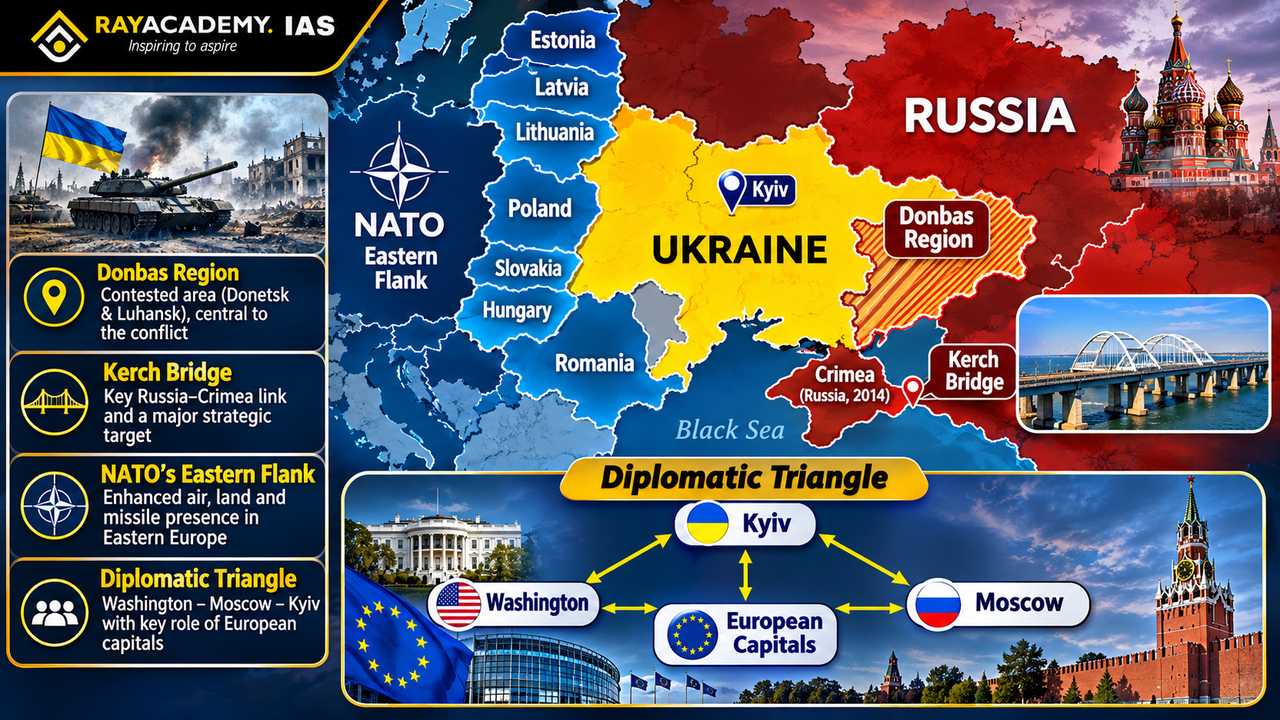
Follow-Up Diplomatic Track: Following the Abu Dhabi engagement, U.S. envoys Steve Witkoff and Jared Kushner met Russian President Vladimir Putin in Moscow, while European leaders convened in Berlin under the Coalition of the Willing format to insist that Europe cannot be excluded from a settlement.
Persistent Core Deadlock: Nearly five years into Europe’s longest conflict since World War II, Moscow demands Ukrainian withdrawal from Donbas, military caps, and permanent neutrality, whereas Kyiv rejects territorial concessions without binding Western security guarantees.
Static-Current Linkage: Historical and Legal Architecture
Post-Cold War European Security and NATO Expansion
The Russia-Ukraine conflict is rooted in the unresolved post-Cold War security order in Europe. Under the 1994 Budapest Memorandum on Security Assurances, Ukraine relinquished the world’s third-largest nuclear arsenal in exchange for commitments from Russia, the United States, and the United Kingdom to respect its sovereignty and existing borders. Subsequent waves of North Atlantic Treaty Organization (NATO) eastward expansion—and the 2008 Bucharest Summit declaration promising future membership to Ukraine and Georgia—deepened Moscow’s perception of strategic encirclement.Russia-Ukraine Peace Talks
Failure of the Minsk Accords (2014–2015). Russia-Ukraine Peace Talks
Following Russia’s annexation of Crimea in 2014 and the outbreak of insurgency in the Donbas region (Donetsk and Luhansk), France and Germany mediated the Minsk I (2014) and Minsk II (2015) agreements under the Normandy Format. Both agreements collapsed due to irreconcilable sequencing disputes over ceasefire verification, withdrawal of foreign forces, and constitutional autonomy for Donbas—culminating in Russia’s full-scale invasion in February 2022.
International Humanitarian Law and Collective Security
The conflict tests foundational principles of the United Nations Charter, specifically Article 2(4) (prohibition on the threat or use of force against territorial integrity) and Article 51 (inherent right of individual or collective self-defence). Meanwhile, negotiated prisoner swaps draw directly upon the Third Geneva Convention (1949) governing the treatment and repatriation of prisoners of war.
Prelims Focus: High-Yield Objective Facts
Kerch Strait Bridge (Crimean Bridge): A 19-km rail-and-road bridge connecting the Taman Peninsula (Krasnodar Krai, Russia) with the Kerch Peninsula (Crimea), separating the Sea of Azov from the Black Sea.
Donbas Region: An industrial and coal-mining basin in eastern Ukraine comprising Donetsk and Luhansk oblasts, largely bordering Russia.
NATO Article 5: Enshrines the principle of collective defence, stating that an attack against one Ally is considered an attack against all Allies; notably, it does not automatically mandate military intervention without national constitutional processes.
Organization for Security and Co-operation in Europe (OSCE): Headquartered in Vienna, it is the world’s largest regional security-oriented intergovernmental organization (57 participating states) that previously monitored ceasefires in eastern Ukraine.
Montreux Convention (1936): Grants Türkiye control over the Turkish Straits (Bosporus and Dardanelles) and regulates the transit of naval warships during wartime, directly impacting Black Sea naval dynamics.
Mains Analytical Breakdown
Strategic Significance of the Abu Dhabi Diplomatic Track
Recognition of a Military Stalemate: After nearly five years of attrition, neither Russia nor Ukraine possesses a credible pathway to decisive military victory, making a negotiated political settlement imperative.
Confidence-Building Measures (CBMs): Even without a comprehensive truce, institutionalized prisoner exchanges and humanitarian corridors preserve communication channels and mitigate civilian and combatant suffering.
Shifting Transatlantic Dynamics: Washington’s push to reset bilateral ties with Moscow—including selective sanctions relief—and direct contacts by European states like Finland and Norway indicate a pragmatic pivot toward conflict termination.
Multi-Dimensional Challenges to a Durable Peace
1. Geopolitical Exclusion of Europe ("Yalta-Style" Dilemma)
Indivisibility of European Security: Any settlement addressing NATO enlargement, sanctions regimes, and Ukraine’s post-war reconstruction directly alters Europe’s security architecture. Excluding the European Union from core negotiations risks producing an unenforceable pact that European capitals refuse to underwrite financially or militarily.
2. Irreconcilable Sovereignty vs. Security Demands
Territorial Integrity vs. De Facto Control: Russia occupies over 20% of Ukrainian territory and demands full withdrawal from unoccupied parts of Donbas. For Kyiv, ceding sovereign territory sets a dangerous precedent and violates constitutional provisions, while Moscow views Ukrainian neutrality and demilitarization as non-negotiable buffer requirements.
3. Credibility Deficit of Security Guarantees
Deterrence Without NATO Membership: Ukraine seeks binding, Article 5-style Western security guarantees to prevent renewed Russian aggression. However, Western allies remain divided over deploying peacekeeping troops or committing to automatic military intervention in a nuclear-armed standoff.
4. Economic and Social Attrition
Demographic and Fiscal Strain: Ukraine faces acute manpower shortages, displacement of millions of citizens, and heavy dependence on European financial aid and NATO weaponry to keep its state apparatus and economy afloat. Prolonged war also perpetuates global energy and fertilizer market volatility, disproportionately hurting the Global South.
Way Forward
Inclusive Multilateral Negotiating Format: Expand the Abu Dhabi trilateral framework into a structured multilateral architecture incorporating the European Union and key regional stakeholders so that security guarantees, sanctions calibration, and reconstruction funding are jointly owned.
Phased Ceasefire and Neutral Monitoring: Implement a sequenced truce beginning with critical energy infrastructure and Black Sea maritime corridors, verified by a neutral, UN- or OSCE-mandated international monitoring mission.
Legally Binding, Deterrence-Backed Security Assurances: Replace non-binding political pledges (like the 1994 Budapest Memorandum) with treaty-backed bilateral security pacts, air-defence integration, and accelerated EU accession pathways for Ukraine.
India’s Constructive Bridge-Building Role: Guided by Prime Minister Narendra Modi’s principle that "this is not an era of war", India can leverage its strategic autonomy and high-level trust with Washington, Moscow, Kyiv, and Brussels to facilitate humanitarian diplomacy and Global South food/energy stability.
Value Addition for Mains Answers
Conflict Impact Data: Russia currently controls over 20% of Ukraine’s sovereign territory, while millions remain internally displaced or refugees across Europe.
Diplomatic Doctrine Quote: "A durable peace in Europe cannot be negotiated over the heads of Europeans; security is indivisible, and lasting settlements require stakeholder legitimacy."
Indian Foreign Policy Linkage: India’s balanced posture exemplifies multi-alignment—upholding the UN Charter and territorial sovereignty while safeguarding national energy security and defence ties.
Practice Questions for Active Recall
Prelims Practice MCQ
Consider the following statements regarding the geopolitical and legal context of the Russia-Ukraine conflict:
Under the 1994 Budapest Memorandum, Ukraine agreed to transfer its Soviet-era nuclear stockpile to Russia in exchange for security assurances from Russia, the United States, and the United Kingdom.
The Kerch Strait Bridge connects mainland Russia with the Crimean Peninsula and separates the Black Sea from the Sea of Azov.
Under the Montreux Convention of 1936, the European Union regulates the passage of naval warships through the Bosporus and Dardanelles straits.
Which of the statements given above is/are correct? A. 1 and 2 only
B. 2 and 3 only
C. 1 and 3 only
D. 1, 2 and 3
Correct Answer: A
Explanation:
Statement 1 is correct: Signed in December 1994, the Budapest Memorandum saw Ukraine give up its nuclear arsenal in return for security assurances regarding its sovereignty and territorial integrity from Russia, the US, and the UK.
Statement 2 is correct: The 19-km Kerch Bridge links Russia’s Taman Peninsula to Crimea across the Kerch Strait, which connects the Black Sea and the Sea of Azov.
Statement 3 is incorrect: The 1936 Montreux Convention vests sovereign control and regulatory authority over the Turkish Straits (Bosporus and Dardanelles) exclusively in Türkiye, not the European Union.
Mains Practice Question (GS Paper II – 150 Words / 10 Marks)
"While trilateral negotiations between the U.S., Russia, and Ukraine mark a pragmatic shift toward conflict resolution, no peace architecture can endure without Europe at the negotiating table." Analyse this statement in the context of recent diplomatic developments and examine its implications for India.
Answer Structure Hint:
Introduction: Briefly contextualize the November 2026 Abu Dhabi trilateral talks and the resulting PoW exchange amid a five-year military stalemate.
Body: Explain why European inclusion is vital (financial underwriting of Ukraine’s economy, EU accession, sanctions alignment, and indivisible continental security) alongside core deadlocks (Donbas territory vs. NATO-style security guarantees). Discuss implications for India (stabilization of global crude/fertilizer supply chains, easing of secondary sanctions pressure, and validation of India’s dialogue and diplomacy stance).
Conclusion: Conclude with the need for an inclusive, UN Charter-compliant peace framework supported by Global South diplomacy.
Take this article with you
Save a reading copy for offline study.


