

Droupadi Murmu
President Droupadi Murmu inaugurated the year-long Golden Jubilee celebrations of the Indian Council of Medical Research–National Institute of Malaria Research (ICMR–NIMR) in New Delhi on November 17, 2026, celebrating five decades of public health and vector-borne disease research. Highlighting India’s progress toward malaria elimination by 2030, the President noted that malaria cases and deaths declined by nearly 80% between 2015 and 2025, while high-burden districts dropped from 155 to 33, and 160 districts reported zero indigenous cases during 2022–2025. She also commended India’s 2024 exit from the World Health Organization’s (WHO) High Burden to High Impact (HBHI) group and praised ICMR–NIMR’s contribution to the indigenous malaria vaccine under development in Bhubaneswar.
UPSC Syllabus Mapping:
General Studies Paper II (Social Justice & Governance): Issues relating to development and management of Social Sector/Services relating to Health, Education, Human Resources; Welfare schemes for vulnerable sections of the population by the State and the performance of these schemes.
General Studies Paper III (Science & Technology): Science and Technology—developments and their applications and effects in everyday life; Achievements of Indians in science & technology; Indigenization of technology and developing new technology (indigenous malaria vaccine and vector control).
Static-Current Linkage: Parasitology, National Elimination Frameworks, and Constitutional Health Mandate
Analyzing India’s trajectory toward a malaria-free status by 2030 requires connecting biological principles of vector-borne transmission with India’s statutory public health architecture and constitutional directives.
1. Constitutional and Policy Foundations of Public Health
Article 47 (Directive Principles of State Policy): Mandates the State to regard the raising of the level of nutrition and the standard of living of its people and the improvement of public health as among its primary duties.
Article 21 (Right to Life): Interpreted by the Supreme Court (e.g., Paschim Banga Khet Mazdoor Samity v. State of West Bengal, 1996) to include the fundamental right to accessible, quality healthcare.
National Health Policy (NHP), 2017: Aligns India’s vector-borne disease control strategy with global Sustainable Development Goal (SDG) 3.3 (ending the epidemics of AIDS, tuberculosis, malaria, and neglected tropical diseases by 2030).
2. Scientific & Epidemiological Basis of Malaria
Causative Agent & Vector: Malaria is caused by protozoan parasites of the genus Plasmodium—primarily Plasmodium falciparum (responsible for severe cerebral malaria and highest mortality) and Plasmodium vivax (prevalent across India and capable of dormant liver-stage hypnozoites causing relapse). It is transmitted exclusively by the bite of infected female Anopheles mosquitoes.
Indigenous Vaccine Development (AdFalciVax): Developed jointly by ICMR–Regional Medical Research Centre (RMRC), Bhubaneswar, ICMR–NIMR, and the National Institute of Immunology (NII), India’s indigenous multi-stage recombinant falciparum malaria vaccine (AdFalciVax) targets both the pre-erythrocytic (sporozoite) and sexual transmission-blocking stages of Plasmodium falciparum.
3. National Framework for Malaria Elimination (NFME) 2016–2030
Launched in 2016 under the National Center for Vector Borne Diseases Control (NCVBDC) (Ministry of Health and Family Welfare), the NFME stratifies States/UTs based on Annual Parasite Incidence (API) and sets two core milestones:
Elimination of indigenous malaria transmission across India by 2027 (zero indigenous cases).
WHO Certification of Malaria-Free Status by 2030 (awarded after maintaining zero indigenous cases for at least three consecutive years with robust surveillance).
Prelims Focus: High-Yield Facts for UPSC CSE
Institution in Focus: ICMR–National Institute of Malaria Research (NIMR), established in 1977 (originally as the Malaria Research Centre) under the Indian Council of Medical Research (ICMR), headquartered in New Delhi (celebrating its Golden Jubilee in 2026–27).
Nodal Programme & Ministry: National Center for Vector Borne Diseases Control (NCVBDC) under the Ministry of Health and Family Welfare (MoHFW) (covers six diseases: Malaria, Dengue, Chikungunya, Japanese Encephalitis, Kala-azar, and Lymphatic Filariasis).
WHO High Burden to High Impact (HBHI) Group: Launched by WHO and the RBM Partnership to End Malaria in 2018 for the 11 highest-burden nations; India officially exited the HBHI group in 2024 due to sustained reductions in malaria incidence and mortality.
WHO-Recommended Global Malaria Vaccines: RTS,S/AS01 (Mosquirix) and R21/Matrix-M (developed by Oxford University and manufactured by the Serum Institute of India), alongside India’s indigenous candidate being developed in Bhubaneswar.
Key Diagnostic & Vector Control Tools: Bivalent Rapid Diagnostic Tests (RDTs), Artemisinin-based Combination Therapy (ACT), Long-Lasting Insecticidal Nets (LLINs), and Indoor Residual Spraying (IRS).
Mains Analytical Breakdown: Drivers of Success and Last-Mile Challenges
Significance and Drivers of India’s Malaria Turnaround
Targeted High-Burden District Interventions: Focused deployment of LLINs, bivalent RDTs, and community-level fever screening in forested and tribal belts (such as Odisha’s DAMAN—Durgama Anchalare Malaria Nirakaran—initiative) drove steep declines in endemic hotspots.
Last-Mile Community Health Workforce: Grassroots mobilization through Accredited Social Health Activists (ASHAs) enabled early diagnosis and radical treatment within 24 hours of fever onset, interrupting local transmission chains.
Scientific Indigenization and Research Ecosystem: Five decades of operational research by ICMR–NIMR in parasite genomics, insecticide resistance monitoring, and indigenous vaccine development in Bhubaneswar strengthens India’s health sovereignty.
Socio-Economic Productivity Gains: Reducing malaria morbidity directly protects rural and tribal households from wage losses, school absenteeism, and catastrophic out-of-pocket health expenditure (OOPE).
Multi-Dimensional Challenges in the "Last Mile" to 2030
Biological & Ecological Threats (Environmental & Scientific): Increasing insecticide resistance (against synthetic pyrethroids used in LLINs) among Anopheles vectors, emerging artemisinin partial resistance in P. falciparum, and climate-induced shifts in temperature and rainfall expanding mosquito breeding windows.
Persistent Tribal and Forested Pockets (Social & Geographical): The remaining 33 high-burden districts are heavily concentrated in remote, forested, and tribal regions (e.g., parts of Chhattisgarh, Jharkhand, Odisha, Maharashtra, and Northeast India) where difficult terrain and migration impede vector control.
Asymptomatic Reservoirs and P. vivax Relapse (Clinical): Sub-microscopic asymptomatic carriers sustain silent transmission, while incomplete adherence to the 14-day Primaquine radical cure (and G6PD deficiency screening gaps) causes P. vivax relapses.
Cross-Border Transmission & Urban Malaria (Governance): Porous international borders (with Myanmar and Bangladesh) pose re-introduction risks into border districts, while unplanned urbanization and construction sites fuel urban vector breeding (Anopheles stephensi).
Sustaining Vigilance Amid Declining Burden (Administrative): As malaria cases fall, waning political and public risk perception can lead to reduced surveillance funding and diagnostic complacency—a risk explicitly flagged by President Murmu.
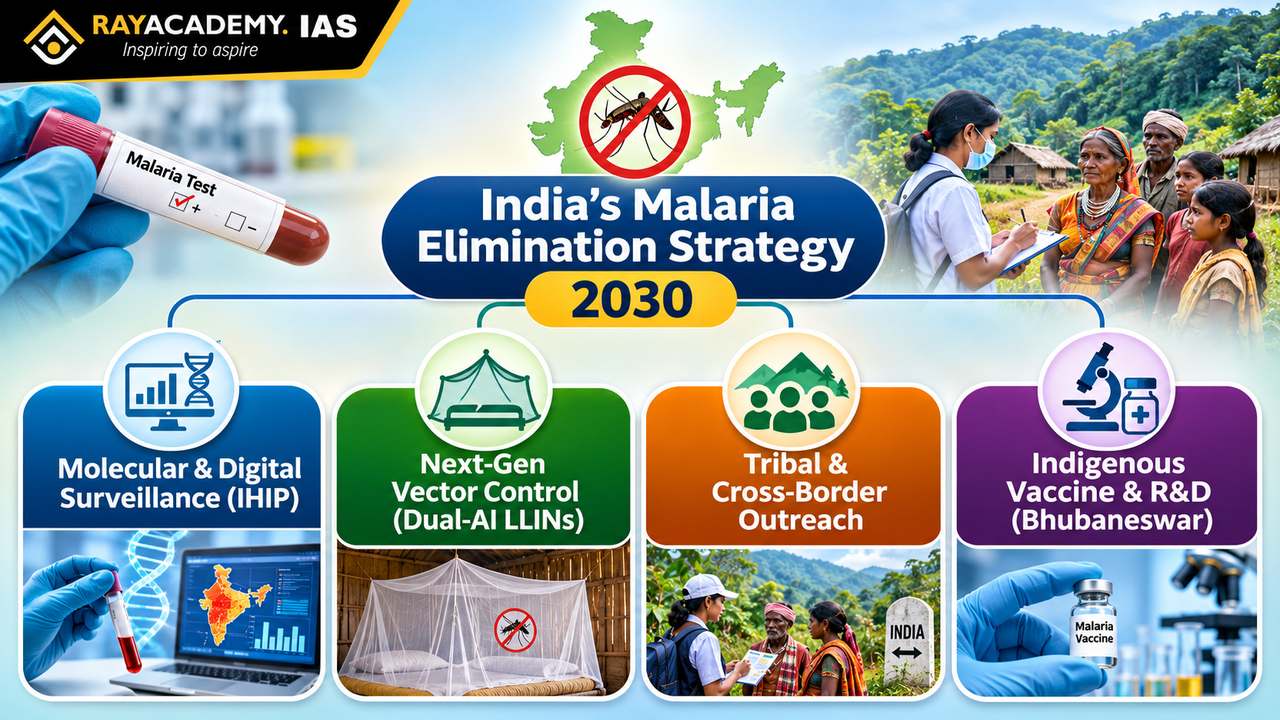
Way Forward: Reform-Oriented Roadmap
Strengthen Real-Time Digital and Molecular Surveillance: Integrate block-level malaria reporting into the Integrated Health Information Platform (IHIP) and deploy sensitive molecular diagnostics (PCR/LAMP) to detect low-density asymptomatic reservoirs in low-endemic districts.
Accelerate Next-Generation Vector Control & Resistance Management: Transition from single-pyrethroid nets to dual-active-ingredient LLINs (e.g., pyrethroid–chlorfenapyr or PBO nets) guided by ICMR–NIMR’s nationwide insecticide resistance mapping.
Prioritize Tribal-Centric Delivery and Treatment Adherence: Leverage Jan Aushadhi Kendras, Ayushman Arogya Mandirs, and tribal mobile medical units alongside point-of-care G6PD testing to ensure safe, complete 14-day radical cure for P. vivax patients.
Expedite Clinical Trials for Indigenous Vaccines and Therapeutics: Fast-track regulatory and clinical validation of the Bhubaneswar-developed indigenous malaria vaccine and next-generation antimalarials through public–private partnerships under the National Biopharma Mission.
Institutionalize Cross-Border and One Health Coordination: Establish synchronized cross-border vector surveillance protocols with neighboring countries (under WHO SEARO frameworks) and adopt an integrated One Health approach linking climate forecasting with vector control.
Value Addition for Mains
Official National Epidemiological Benchmarks (2015–2025): According to official figures highlighted at the ICMR–NIMR Golden Jubilee (Nov 2026), India achieved an ~80% decline in both malaria cases and deaths between 2015 and 2025, reduced high-burden districts from 155 to 33, recorded zero indigenous cases across 160 districts during 2022–2025, and exited the WHO High Burden to High Impact (HBHI) group in 2024.
Global Context (WHO World Malaria Report): India accounted for the largest absolute reduction in malaria cases within the WHO South-East Asia Region over the past decade, positioning the country as a global model for high-population, resource-calibrated disease elimination.
Mains Conclusion Snippet: "Eliminating malaria by 2030 requires converting India’s scientific breakthroughs—from ICMR–NIMR’s vector research to Bhubaneswar’s indigenous vaccine—into sustained last-mile vigilance across every tribal and border village."
Practice Questions for Active Recall
Prelims Practice MCQ
With reference to malaria control and elimination efforts in India, consider the following statements:
India officially exited the World Health Organization’s (WHO) High Burden to High Impact (HBHI) group in 2024 following a sustained decline in malaria cases and mortality.
Under the National Framework for Malaria Elimination (NFME), India aims to achieve WHO certification of malaria-free status by 2030.
Malaria in humans is transmitted by the bite of infected male and female Aedes mosquitoes.
Which of the statements given above are correct?
(a) 1 and 2 only
(b) 2 and 3 only
(c) 1 and 3 only
(d) 1, 2, and 3
Correct Answer: (a) 1 and 2 only
Explanation:
Statement 1 is correct: Owing to an ~80% reduction in malaria cases and deaths between 2015 and 2025, India officially exited the WHO’s High Burden to High Impact (HBHI) group in 2024.
Statement 2 is correct: Launched in 2016 by the Ministry of Health and Family Welfare, the National Framework for Malaria Elimination (NFME) targets interrupting indigenous transmission by 2027 and attaining WHO malaria-free certification by 2030.
Statement 3 is incorrect: Malaria is transmitted exclusively by the bite of infected female Anopheles mosquitoes (whereas Aedes mosquitoes transmit dengue, chikungunya, Zika, and yellow fever).
Mains Practice Question (GS Paper II & GS Paper III — 150 Words | 10 Marks)
"While India’s exit from the WHO’s High Burden to High Impact (HBHI) group underscores major gains in malaria control, achieving complete elimination by 2030 demands sustained scientific innovation and last-mile tribal vigilance." Examine the key drivers behind India’s progress in malaria reduction and discuss the major challenges remaining in the final phase of elimination.
Answer Structure Hints:
Introduction: Contextualize the ICMR–NIMR Golden Jubilee (Nov 2026), citing India’s ~80% drop in malaria cases/deaths (2015–2025), 160 districts with zero indigenous cases, and 2024 exit from WHO’s HBHI group.
Body Part 1 (Key Drivers of Success): Highlight targeted LLIN distribution, rapid diagnosis (bivalent RDTs) and ACT treatment via ASHAs, state-level tribal campaigns (e.g., Odisha’s DAMAN), and ICMR–NIMR’s operational research.
Body Part 2 (Remaining Last-Mile Challenges): Discuss concentrated endemicity in 33 high-burden tribal/forested districts, insecticide and drug resistance, asymptomatic reservoirs and P. vivax relapse, cross-border transmission, and surveillance fatigue.
Conclusion: Conclude with molecular surveillance (IHIP), dual-active-ingredient nets, fast-tracking Bhubaneswar’s indigenous malaria vaccine, and realizing Article 47 and SDG 3.3.
Take this article with you
Save a reading copy for offline study.


