

Indian Police Foundation
The Indian Police Foundation (IPF)—a multidisciplinary police reform think tank—finalized a comprehensive "Change Manual" for internal police reforms in New Delhi (November 4–5, 2026) aimed at transforming everyday police station-level functioning without requiring heavy additional budgetary outlays.
UPSC Syllabus Mapping:
General Studies Paper II (Indian Polity & Governance): Structure, organization and functioning of the Executive and the Judiciary; Ministries and Departments of the Government; Important aspects of governance, transparency and accountability, e-governance—applications, models, successes, limitations, and potential; Role of civil services in a democracy.
General Studies Paper IV (Ethics, Integrity & Aptitude): Public/Civil service values and Ethics in Public administration: Status and problems; ethical concerns and dilemmas in government and private institutions; Probity in Governance: Concept of public service, Citizen’s Charters, Work culture, Quality of service delivery.
Developed under a project headed by retired IPS officer Ish Kumar with support from the Azim Premji Foundation, the manual is based on empirical surveys and interviews across 15 police stations in Punjab, Telangana, and Tamil Nadu. It targets four grassroots reform pillars—FIR registration and police response, crime prevention and community outreach, prevention of custodial misconduct, and police station working conditions—and will undergo a phased rollout starting in Punjab, followed by Telangana and Tamil Nadu.
Static-Current Linkage: Constitutional Policing, Prakash Singh Directives, and BNSS 2023
Translating police reform from statutory ideals into station-house practice requires connecting constitutional federalism with Supreme Court jurisprudence and India’s revamped criminal procedure framework.
1. Constitutional Mandate & Supreme Court’s Prakash Singh Directives
Federal Distribution of Powers (Seventh Schedule): Under Entry 1 (Public Order) and Entry 2 (Police) of the State List, policing is primarily a State subject, though All India Services (IPS) officers are recruited under Article 312 and governed jointly by the Union and States.
Prakash Singh v. Union of India (2006): The Supreme Court issued seven binding directives to insulate policing from extraneous political interference—including establishing State Security Commissions (SSCs), fixed two-year tenures for DGPs and field officers, separating investigation from law-and-order duties, and setting up Police Complaints Authorities (PCAs).
Internal vs. Structural Reforms: While Prakash Singh focused largely on top-level structural and legislative autonomy, the IPF Change Manual addresses internal operational reforms at the cutting-edge police station level, where citizens directly experience the rule of law.
2. Bharatiya Nagarik Suraksha Sanhita (BNSS), 2023 & Digital Evidence
Zero FIR & e-FIR (Section 173, BNSS): Replaces Section 154 of the CrPC to statutorily codify Zero FIR (registration regardless of territorial jurisdiction) and electronic FIR (e-FIR)—requiring complainants to sign the e-complaint within three days to convert it into a formal FIR.
Mandatory Audio-Video Recording (Section 105, BNSS & e-Sakshya): Mandates videography of search and seizure operations and recording of witness statements via digital tools like the e-Sakshya mobile application, directly aligning with IPF’s emphasis on transparent personal searches and tablet-equipped Investigating Officers (IOs).
Custodial Safeguards (D.K. Basu & Section 35–38, BNSS): Reinforces Article 21 and Article 22 protections against arbitrary arrest, mandatory arrest memos, intimation to relatives, and access to free legal aid (Article 39A).
Prelims Focus: High-Yield Objective Facts
Indian Police Foundation (IPF): Established on October 21, 2015 (Police Commemoration Day) as an independent, multidisciplinary think tank comprising serving/retired police officers, researchers, and citizen stakeholders working on evidence-based police reforms.
Phased Rollout States (2026): Punjab (pilot phase), followed by Telangana and Tamil Nadu.
Key Digital Tools Highlighted:
e-Sakshya App: Developed by the National Informatics Centre (NIC) to enable Investigating Officers (IOs) to capture geo-tagged, time-stamped audio-visual recordings of crime scenes, searches, and seizures under BNSS, 2023.
Visitor Management System (VMS) & QR Codes: Digital entry logging, help desks, and QR-based feedback mechanisms at police stations to prevent "burking" (non-registration of complaints).
Constitutional Provisions on Policing & Legal Aid:
State List (Seventh Schedule): Entry 1 (Public Order) and Entry 2 (Police).
Article 22(1) & (2): Right to be informed of grounds of arrest, right to consult a legal practitioner, and production before a Magistrate within 24 hours.
Article 39A: Equal justice and free legal aid (operationalized via NALSA).
Mains Analytical Breakdown
Significance of Internal Station-Level Police Reforms
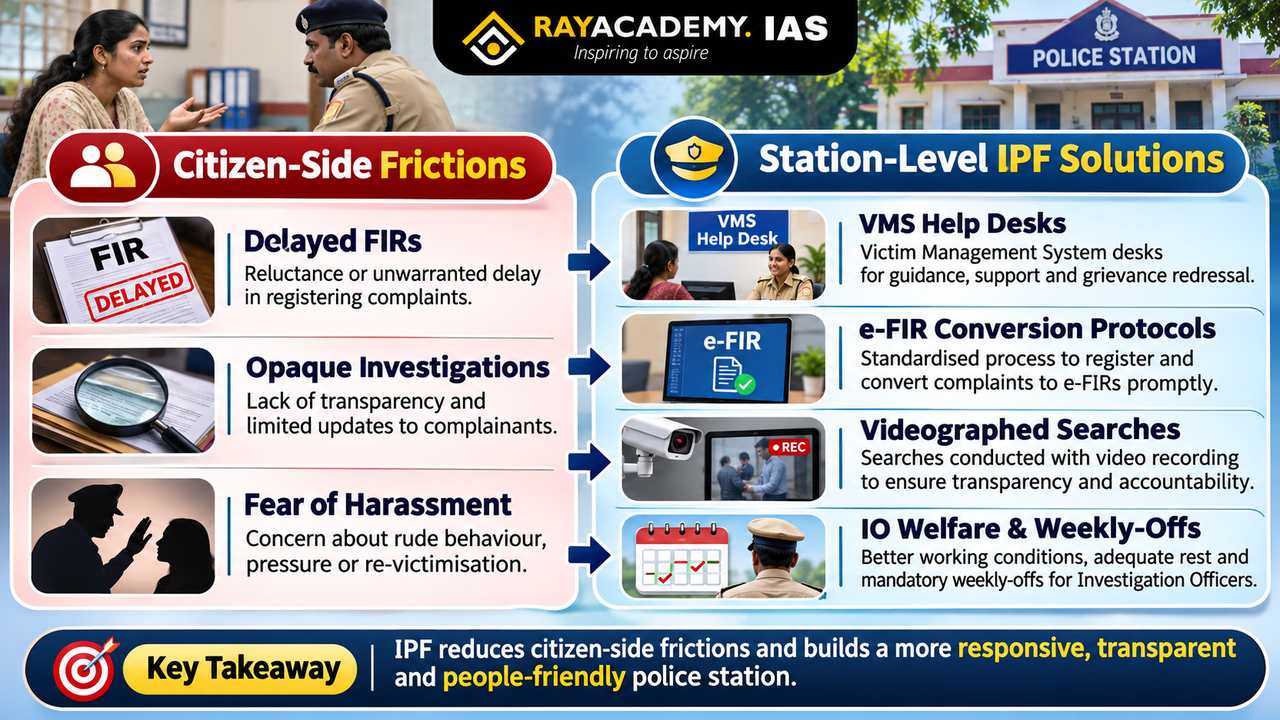
Bridging the Citizen–Police Trust Deficit: Even 79 years after Independence, citizens hesitate to approach police stations due to fears of harassment, repeated visits for FIR registration, and lack of case status updates. Introducing help desks, digital Visitor Management Systems (VMS), and QR-code tracking institutionalizes citizen-centric governance.
Budget-Neutral Administrative Feasibility: Unlike capital-heavy infrastructure overhauls, most IPF recommendations—such as DySP-level scrutiny of arrests, videographed personal searches, soft-skill training, and constable empowerment in investigations—can be implemented through administrative SOPs without straining State exchequers.
Operationalizing BNSS Digital Mandates: Equipping every Investigating Officer (IO) with tablets for the e-Sakshya app and streamlining the conversion of e-FIRs (beyond mere insurance-claim logs for property offences) translates criminal law modernization into higher conviction rates.
Humanizing Working Conditions to Improve Service Delivery: Recognizing that excessive workloads, lack of weekly rest days, and inadequate investigation contingencies directly breed burnout and rudeness, the manual treats police welfare (rest rooms, vehicle allowances, e-academy training linked to career progression) as a sine qua non for ethical policing.
Multi-Dimensional Challenges
Persistent "Burking" & Reluctance in e-FIR Conversion (Administrative): While e-FIR facilities exist in jurisdictions like Delhi, converting digital complaints into regular FIRs after securing physical signatures remains cumbersome, and property-theft e-complaints are often treated solely as insurance formalities rather than active investigations.
Acute Manpower Shortages & Work-Life Burnout (Human Resource): Chronic vacancies in State police forces—combined with VIP security duties and overlapping law-and-order demands—make enforcing mandatory weekly-offs and separating investigation from law-and-order difficult on the ground.
Custodial Misconduct & Accountability Gaps (Ethical & Legal): Custodial harassment persists where arrest powers are exercised mechanically without senior supervision, remote lock-up monitoring, or transparent compliance with Article 22 and NALSA free legal aid mandates.
Digital Divide & Infrastructure Deficits in Rural Stations (Technical): Many rural police stations face erratic internet connectivity, inadequate hardware for e-Sakshya uploads, and limited digital literacy among frontline constabulary.
Institutional Inertia & Colonial Sub-Culture (Organizational): Top-down manuals often falter without sustained leadership buy-in at the Superintendent of Police (SP) and Station House Officer (SHO) levels to replace a coercive colonial mindset with SMART policing (Strict and Sensitive, Modern and Mobile, Alert and Accountable, Reliable and Responsive, Techno-savvy and Trained).
Way Forward
Mandate Digital Entry & Anti-Burking Audits: Implement digital Visitor Management Systems (VMS), dedicated citizen help desks, and QR-code feedback systems across all police stations, backed by random supervisory audits of non-registered complaints.
Institutionalize Custodial & Arrest Safeguards: Enforce DySP-level scrutiny of arrest memos, mandatory phone calls for arrestees, videography of personal searches, remote online monitoring of police lock-ups, and real-time integration with District Legal Services Authorities (DLSA) for free legal aid.
Empower Frontline Constabulary & Separate Investigation Wings: Aligning with the 2nd Administrative Reforms Commission (5th Report on Public Order) and Prakash Singh directives, train and empower head constables and constables to handle routine investigations, provide every IO with e-Sakshya tablets and contingency funds, and enforce roster-based weekly rest days.
Scale Community & Gender-Responsive Policing: Expand night safety escort schemes for working women, mandatory QR codes and panic buttons in taxis linked to district control rooms, body-worn cameras, Citizen Sentinel networks, and youth skill/internship programmes to build preventive community trust.
Link Continuous Training with Career Progression: Utilize police e-academies for periodic soft-skill, behavioral, and forensic training, making module completion an objective criterion for promotions and postings.
Value Addition for Mains
Official Policing Benchmarks (BPR&D Data on Police Organizations):
Police-to-Population Ratio: India’s actual police strength stands at roughly 152–155 police personnel per lakh population (against a sanctioned strength of ~195 per lakh), well below the United Nations recommended benchmark of 222 per lakh, resulting in 12-to-14-hour daily shifts and acute investigation bottlenecks.
Administrative & Ethical Anchor: As emphasized by the 2nd ARC (Public Order Report) and SMART Policing framework, genuine police reform requires dual transformation—ensuring democratic accountability to citizens outside the station while guaranteeing dignified working conditions and professional autonomy inside the station.
Practice Questions for Active Recall
Prelims Practice MCQ
With reference to criminal procedure and policing reforms in India, consider the following statements:
Under the Seventh Schedule of the Constitution of India, "Police" and "Public Order" are enumerated in the Concurrent List.
The Bharatiya Nagarik Suraksha Sanhita (BNSS), 2023 provides statutory backing for electronic FIRs (e-FIRs) as well as mandatory audio-video recording of search and seizure operations.
Under Article 39A of the Constitution, the State is mandated to provide free legal aid to ensure that opportunities for securing justice are not denied to any citizen by reason of economic or other disabilities.
Which of the statements given above are correct?
(a) 1 and 2 only
(b) 2 and 3 only
(c) 1 and 3 only
(d) 1, 2, and 3
Correct Answer: (b) 2 and 3 only
Explanation:
Statement 1 is incorrect: Under the Seventh Schedule of the Constitution, Public Order (Entry 1) and Police (Entry 2) fall under the State List (List II), not the Concurrent List.
Statement 2 is correct: Section 173 of the BNSS, 2023 institutionalizes e-FIRs, while Section 105 mandates audio-video recording of searches and seizures (supported digitally by NIC’s e-Sakshya app).
Statement 3 is correct: Article 39A (inserted by the 42nd Constitutional Amendment Act, 1976) directs the State to promote equal justice and provide free legal aid.
Mains Practice Question (GS Paper II & GS Paper IV — 150 Words | 10 Marks)
"Sustainable police reform in India depends as much on internal station-level operational changes and personnel welfare as on top-down legislative restructuring." Discuss in the context of recent internal police reform initiatives.
Answer Structure Hints:
Introduction: Contrast top-down structural mandates (Prakash Singh directives) with grassroots station-house realities highlighted by the Indian Police Foundation (IPF) Change Manual (2026).
Body Part 1 (Citizen-Centric Operational Reforms): Detail Visitor Management Systems (VMS), help desks, seamless BNSS e-FIR registration, DySP arrest scrutiny, videographed searches, and community safety schemes (women night escorts, taxi QR codes).
Body Part 2 (Personnel Welfare & Capacity Building): Explain why weekly rest days, rest rooms, e-Sakshya tablets, investigation contingency funds, soft-skill e-training, and constable empowerment are essential to curb burnout and custodial misconduct.
Conclusion: Anchor in 2nd ARC (Public Order Report) and SMART Policing, emphasizing phased State-level adoption (Punjab, Telangana, Tamil Nadu) to strengthen the rule of law.
Take this article with you
Save a reading copy for offline study.


