

APEC Summit
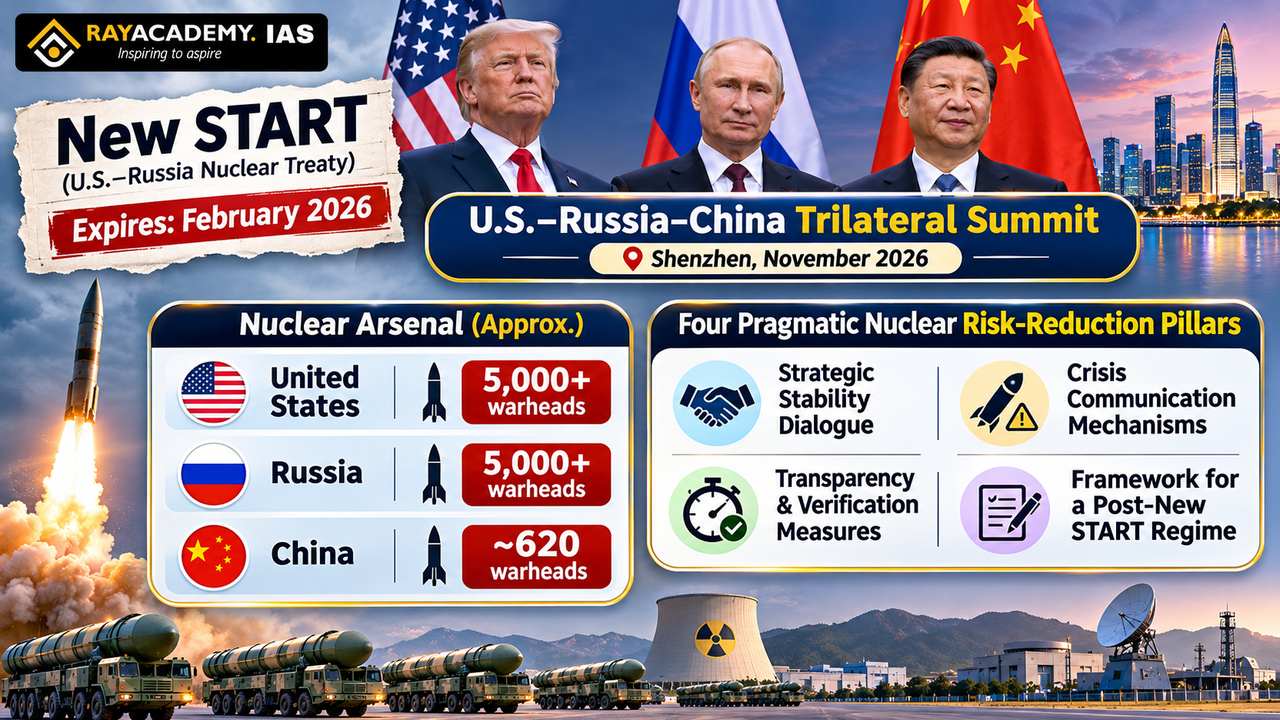
First Trilateral Summit of US, China, and Russia in Shenzhen: On November 19, 2026, U.S. President Donald Trump, Chinese President Xi Jinping, and Russian President Vladimir Putin met for the first time in a trilateral format on the sidelines of the Asia-Pacific Economic Cooperation (APEC) Summit in Shenzhen, China.
UPSC Syllabus Mapping:
General Studies Paper II (International Relations): Bilateral, regional and global groupings and agreements involving India and/or affecting India’s interests; Effect of policies and politics of developed and developing countries on India’s interests; Important International institutions, agencies and fora—their structure, mandate.
General Studies Paper III (Internal Security & Science and Technology): Security challenges and their management in border areas; Science and Technology—developments and their applications and effects in everyday life (Nuclear technology, Artificial Intelligence in military command and control, and strategic deterrence).
Joint Declaration on Nuclear Risk Reduction: The three leaders issued a joint declaration reaffirming the principle that "a nuclear war cannot be won and must never be fought" and pledged follow-up talks on nuclear risk reduction and non-proliferation.
Post-New START Arms Control Vacuum: The engagement follows the formal expiration of the New START (Strategic Arms Reduction Treaty) on February 5, 2026—leaving the world’s largest nuclear arsenals without any legally binding bilateral treaty limits for the first time since 1972—though the Shenzhen statement contains no verification mechanisms or fixed dates for future negotiations.
Static-Current Linkage: Evolution of Nuclear Arms Control and India’s Doctrine. Nuclear Risk
Understanding the urgency of a nuclear risk reduction framework requires tracing the collapse of Cold War arms-control treaties and examining India’s own nuclear posture within the global non-proliferation regime.
1. Collapse of the Bilateral US–Russia Arms Control Architecture
SALT I & ABM Treaty (1972): Initiated formalized strategic restraint by capping intercontinental ballistic missiles and restricting national missile defence systems (the U.S. withdrew from the Anti-Ballistic Missile (ABM) Treaty in 2002).
INF Treaty (1987): Eliminated ground-launched intermediate-range missiles (500–5,500 km) until its demise in 2019.
New START (2010–2026): Signed in 2010 and effective from 2011, it capped deployed strategic nuclear warheads at 1,550 and deployed delivery vehicles at 700 for both Washington and Moscow. After Russia suspended inspections in 2023 and Washington rejected Moscow's offer of a one-year informal extension in favor of bringing China into a trilateral pact, New START expired on February 5, 2026.
2. Core Global Non-Proliferation Treaties & Testing Moratoriums
Nuclear Non-Proliferation Treaty (NPT), 1968: Recognizes five Nuclear-Weapon States (NWS)—the US, Russia, UK, France, and China—while obligating them under Article VI to pursue good-faith nuclear disarmament. India refused to sign the NPT, terming it discriminatory for creating a permanent divide between nuclear "haves" and "have-nots."
Comprehensive Nuclear-Test-Ban Treaty (CTBT), 1996: Bans all nuclear test explosions for civilian or military purposes. It has not entered into force because key Annex 2 states—including the US and China—have not ratified it, and Russia revoked its ratification in 2023.
3. India’s Nuclear Doctrine (2003) & Strategic Posture
Credible Minimum Deterrence (CMD): India maintains a survivable nuclear triad (land, air, and sea-based delivery systems like INS Arihant) sufficient to deter aggression without engaging in an open-ended arms race.
No First Use (NFU): India pledges never to use nuclear weapons first against any state, reserving them strictly for massive retaliation against a nuclear strike on Indian territory or Indian forces anywhere, alongside strict civilian political control through the Nuclear Command Authority (NCA) chaired by the Prime Minister.
Prelims Focus: High-Yield Objective Facts
UPSC Prelims Quick-Revision Box:
Nuclear Treaties, Arsenal Asymmetries & 2026 DevelopmentsNew START Expiration Date: February 5, 2026—ended the last legally binding cap (1,550 deployed strategic warheads) between the United States and Russia.
Global Nuclear Warhead Asymmetry (2026 Estimates):Russia & United States: Over 5,000 total warheads each (deployed, reserve, and retired awaiting dismantlement). China: Approximately 620 warheads (rapidly expanding toward 1,000+ by 2030, yet roughly one-eighth of US or Russian stockpiles). France (~290), UK (~225), India (~180), Pakistan (~170), Israel (~90), North Korea (~50).
Shenzhen Trilateral Summit (November 19, 2026): Held on the sidelines of the APEC Summit in Shenzhen, China; produced a four-point joint declaration reaffirming nuclear war prevention, UN Security Council reform dialogue, petroleum supply stability, and opposition to ICC jurisdictional overreach.
UN Resolution on Military AI (November 2026): Both the United States and Russia opposed a UN resolution on military Artificial Intelligence in November 2026, underscoring resistance to binding legal curbs on autonomous and AI-enabled military systems.
India’s Bilateral Nuclear Confidence-Building Measure (CBM): Under the 1988 India–Pakistan Agreement on the Prohibition of Attack against Nuclear Installations and Facilities (effective 1991), both countries exchange lists of nuclear installations every year on January 1.
Mains Analytical Breakdown: Significance and Multi-Dimensional Challenges
Strategic Significance of the Shenzhen Opening
Re-establishing Direct Crisis Communication: Amid active geopolitical flashpoints—including the Russia–Ukraine war, tensions across the Taiwan Strait, and the 2026 U.S.–Iran conflict—direct summitry among Washington, Moscow, and Beijing signals shared recognition that unchecked nuclear escalation risks mutual catastrophe.
Adapting Arms Control to a Tripolar Nuclear Reality: Unlike the Cold War’s bipolar balance, contemporary strategic stability involves three major nuclear peers, making dialogue inclusive of China’s expanding arsenal essential for long-term global security.
Momentum for Practical Confidence-Building Measures (CBMs): Even without a binding numbers-based treaty, consensus on human-in-the-loop nuclear launch controls, crisis hotlines, and ballistic missile launch notifications can immediately lower the risk of accidental or miscalculated conflict.
Multi-Dimensional Challenges in Forging a Trilateral Framework
Severe Numerical Asymmetry & Strategic Secrecy (Geopolitical): China’s arsenal (~620 warheads) is a fraction of the U.S. and Russian stockpiles (>5,000 each). Beijing views Washington’s demand for equal numerical caps as unfair and fears that intrusive verification transparency would expose its smaller deterrent to a disarming U.S. first strike backed by advanced missile defence.
Divergent Strategic Priorities (Diplomatic): Moscow refuses to pressure Beijing into trilateral limits, instead demanding that Britain and France (NATO nuclear allies) join any broader talks—a condition unacceptable to Washington.
Erosion of Treaty Credibility & Testing Moratoriums (Legal & Security): Trust deficits—exacerbated by U.S. exits from the ABM Treaty and the 2018 Iran nuclear deal (JCPOA), Russia’s CTBT de-ratification, mutual accusations of covert low-yield testing, and orders to resume U.S. nuclear testing—undermine confidence in binding accords.
Disruptive Technologies & AI Integration (Technological): Integrating Artificial Intelligence (AI), hypersonic glide vehicles, and cyber warfare into military command, control, and early-warning systems compresses decision-making timelines and heightens the danger of inadvertent nuclear escalation.
Impact on India’s Strategic Environment (Regional Security): Rapid expansion and modernization of China’s nuclear and missile forces directly affect Southern Asian strategic stability, compelling India to maintain credible deterrence and agile India–China border and crisis management mechanisms.
Way Forward: Pragmatic Steps Beyond Idealistic Treaties
Prioritize Functional Risk Reduction Over Immediate Numerical Parity (Track-1 Diplomacy): Rather than waiting for a comprehensive, legally binding trilateral warhead treaty, the US, Russia, and China should operationalize practical guardrails: binding agreements keeping humans in exclusive control of nuclear launch decisions, dedicated 24/7 crisis hotlines, and pre-launch ballistic missile notifications.
Restore Bilateral US–Russia Caps as an Interim Bridge: Washington and Moscow should reinstate voluntary adherence to New START numerical limits (1,550 warheads) and resume bilateral verification inspections while engaging China on nuclear doctrine, No-First-Use (NFU), and missile defence transparency.
Preserve the Global Moratorium on Explosive Nuclear Testing (CTBT Norms): All nuclear-armed states must step back from resuming explosive nuclear testing and uphold the de facto testing moratorium to prevent a renewed qualitative arms race.
Strengthen India’s Strategic Autonomy and Regional CBMs (MEA & National Security Architecture): India should actively champion global No-First-Use norms and AI-nuclear firebreaks at multilateral fora (such as the UN Conference on Disarmament in Geneva), while upgrading bilateral India–China crisis communication protocols and advancing indigenous triad survivability.
Value Addition: Official Data Points for Mains Answers
Global Nuclear Arsenal Concentration (SIPRI Yearbook Data): Out of approximately 12,100+ nuclear warheads worldwide, the United States and Russia together possess nearly 88% of all nuclear weapons, while China holds the fastest-growing stockpile at roughly 600–620 warheads.
India’s Disarmament Diplomacy Record (Ministry of External Affairs): Since 1988 (Rajiv Gandhi Action Plan), India has consistently advocated for universal, verifiable, and non-discriminatory nuclear disarmament, and regularly tables resolutions at the UN General Assembly on reducing nuclear danger and prohibiting the use of nuclear weapons.
Administrative Catchphrase for Mains Conclusions: "In an era of tripolar nuclear competition and AI-compressed decision cycles, pragmatic risk-reduction guardrails—human launch control, crisis hotlines, and testing restraint—are indispensable to prevent strategic miscalculation."
Practice Questions for Active Recall
Prelims Practice Question (Multi-Statement Format)
Q. With reference to global nuclear arms control treaties and recent developments, consider the following statements:
The New START treaty, which placed legally binding caps on deployed strategic nuclear warheads of the United States and Russia, expired in February 2026.
Unlike the United States and Russia, China officially maintains a No-First-Use (NFU) nuclear policy.
India is a signatory to the Comprehensive Nuclear-Test-Ban Treaty (CTBT) but has not ratified it.
Which of the statements given above is/are correct?
(a) 1 and 2 only
(b) 2 and 3 only
(c) 1 and 3 only
(d) 1, 2, and 3
Correct Answer: (a) 1 and 2 only
Explanation:
Statement 1 is correct: Signed in 2010 and extended in 2021, the New START treaty officially expired on February 5, 2026, ending formal bilateral limits on US and Russian strategic nuclear forces.
Statement 2 is correct: Both China and India officially adhere to a No-First-Use (NFU) nuclear doctrine, whereas the United States and Russia retain options for first use under extreme circumstances.
Statement 3 is incorrect: India has neither signed nor ratified the Comprehensive Nuclear-Test-Ban Treaty (CTBT) of 1996, maintaining a voluntary unilateral moratorium on nuclear explosive testing since May 1998.
Mains Practice Question (150 Words | 10 Marks)
Q. "The expiration of New START and the integration of Artificial Intelligence into military command systems have created an acute arms-control vacuum." Discuss the challenges of forging a trilateral US–Russia–China nuclear framework and its implications for India. (150 words)
Model Answer Structure:
Introduction: Contextualize the February 2026 expiration of New START and the November 2026 Shenzhen Trilateral Summit, highlighting the absence of binding nuclear limits for the first time since 1972.
Body Paragraph 1 (Challenges to a Trilateral Framework): Explain the severe warhead asymmetry (~5,000+ each for US/Russia vs. ~620 for China), Beijing’s fear of transparency exposing its second-strike capability, Russia’s demand to include UK/France, eroding testing moratoriums, and military AI risks.
Body Paragraph 2 (Implications for India): Analyze how China’s nuclear modernization affects Southern Asian deterrence stability, necessitating credible minimum deterrence and bilateral crisis-management mechanisms.
Conclusion: Suggest pragmatic nuclear risk-reduction measures—human control over nuclear launch decisions, crisis hotlines, launch notifications, and preserving testing moratoriums—over rigid numerical parity.
Take this article with you
Save a reading copy for offline study.


