

Higher education governance
Debate Over Meritocracy and Governance in Premier HEIs: Renewed policy discourse surrounding higher education governance in India has spotlighted the tension between institutional autonomy, commercialization, and executive oversight across premier Higher Education Institutions (HEIs) such as the IITs and IIMs.
UPSC Syllabus Mapping:
General Studies Paper II (Governance & Social Justice): Issues relating to development and management of Social Sector/Services relating to Health, Education, Human Resources; Statutory, regulatory and various quasi-judicial bodies; Government policies and interventions for development in various sectors and issues arising out of their design and implementation.
General Studies Paper IV (Ethics, Integrity, and Aptitude): Probity in Governance—Concept of public service, philosophical basis of governance and probity; Ethical concerns and dilemmas in government and private institutions; Corporate and institutional governance.
Shift Under the IIM (Amendment) Act, 2023: Analysts and former administrators have highlighted how the Indian Institutes of Management (Amendment) Act, 2023 altered the autonomy framework of the 2017 Act by designating the President of India as the 'Visitor' of every IIM—granting the Central Government decisive authority over Board nominations, Chairperson selections, and Director appointments.
Need for Internal Vigilance and Academic Safeguards: Alongside heightened scrutiny of national entrance examinations (such as NEET-UG) and past governance controversies (including the 2019 IIM Rohtak episode), experts underscore that sustaining global rankings requires insulating faculty recruitment, leadership selection, and internal vigilance mechanisms from administrative expediency.
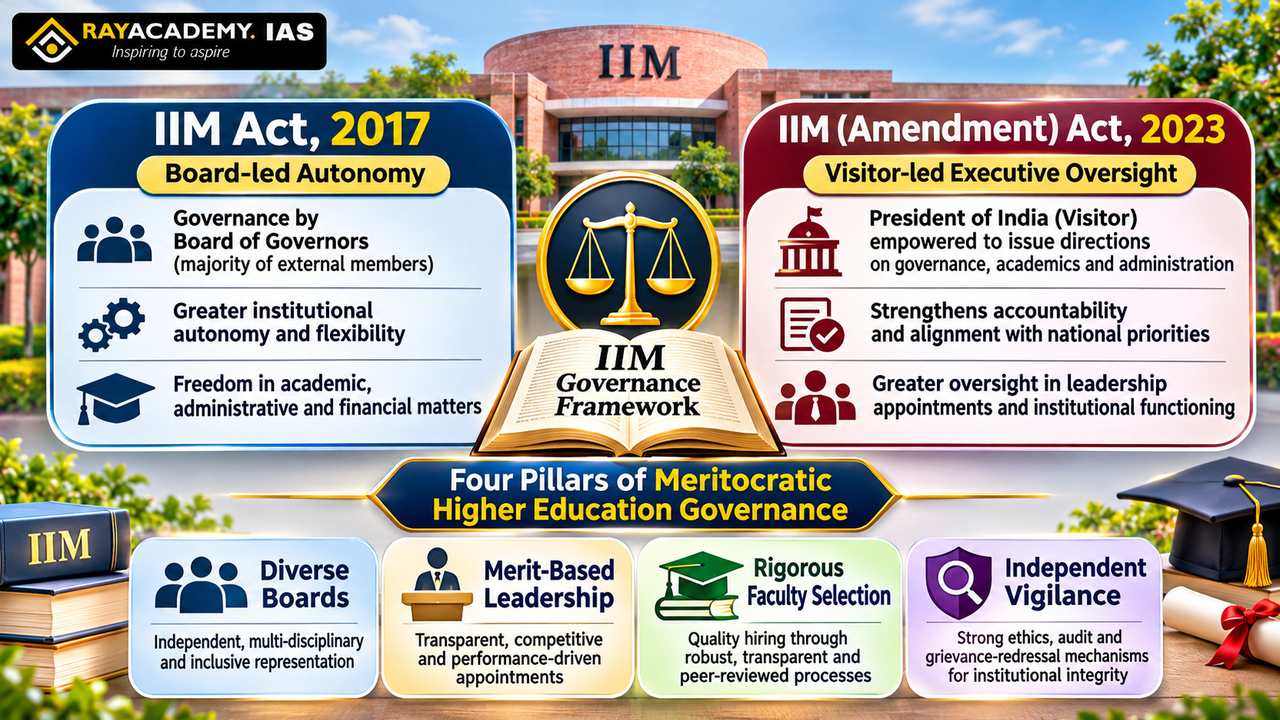
Static-Current Linkage: Constitutional Mandate, Statutory Acts, and NEP 2020
Evaluating the governance of India’s premier Higher Education Institutions (HEIs) requires linking constitutional provisions on education with statutory reforms and the National Education Policy (NEP) 2020.
1. Constitutional Framework for Higher Education
Entry 66 of the Union List (Seventh Schedule): Empowers Parliament exclusively to legislate on "co-ordination and determination of standards in institutions for higher education or research and scientific and technical institutions."
Entry 25 of the Concurrent List (42nd Constitutional Amendment Act, 1976): Places "education, including technical education, medical education and universities" in the Concurrent List, subject to Entries 63, 64, 65, and 66 of the Union List—requiring cooperative federalism between the Union and States.
Article 21A & Article 41 (DPSP): While Article 21A guarantees free and compulsory elementary education (6–14 years), Article 41 directs the State, within its economic capacity, to make effective provision for securing the right to education.
2. Evolution of IIM Governance: 2017 Act vs. 2023 Amendment Act
Indian Institutes of Management (IIM) Act, 2017: Declared all IIMs as Institutes of National Importance (INIs) and granted unprecedented operational autonomy. Under the 2017 Act, the Board of Governors (BoG) held independent authority to appoint the Chairperson and Director without requiring prior Central Government approval.
Indian Institutes of Management (Amendment) Act, 2023: Amended the 2017 Act to designate the President of India as the 'Visitor' of every IIM. Under this framework:
Appointment of the IIM Director by the Board requires prior approval of the Visitor.
The Visitor nominates the Chairperson of the Board of Governors and exercises powers to order inquiries into an institute’s affairs or dissolve a Board in cases of persistent default.
3. National Education Policy (NEP) 2020 Vision
Graded Autonomy & Light-But-Tight Regulation: NEP 2020 envisions transforming all HEIs into large, multidisciplinary, autonomous degree-granting institutions governed by independent, merit-selected Boards of Governors, regulated by a single overarching Higher Education Commission of India (HECI) with four distinct verticals (NHERC, NAC, HEGC, and GEC).
Prelims Focus: High-Yield Objective Facts
UPSC Prelims Quick-Revision Box:
Higher Education Governance, Statutory Bodies & CommitteesInstitutes of National Importance (INIs): A status conferred on premier public higher education institutions in India by an Act of Parliament (e.g., IITs under the Institutes of Technology Act, 1961; IIMs under the IIM Act, 2017).
Visitor of Central Universities & Premier Institutes:Under the Central Universities Act, 2009, the President of India is the ex-officio Visitor of all Central Universities.Following the 2023 Amendment, the President of India is also the Visitor of all IIMs (and already serves as Visitor of IITs and NITs). In contrast, for State Public Universities, the Governor of the respective State generally acts as the ex-officio Chancellor under State University Acts (subject to state legislative amendments).
Statutory Regulatory Bodies:University Grants Commission (UGC): Established as a statutory body under the UGC Act, 1956 (on the recommendation of the Radhakrishnan Commission, 1948–49).
All India Council for Technical Education (AICTE): Established in 1945 as an advisory body and granted statutory status under the AICTE Act, 1987.Key Committees on Higher Education & Autonomy:Yash Pal Committee (2009): Recommended replacing multiple overlapping regulators with a single apex body and safeguarding university autonomy.
K. Kasturirangan Committee (2019): Drafted the National Education Policy (NEP) 2020, advocating "light but tight" regulation and Board-led institutional autonomy.
Mains Analytical Breakdown: Significance and Multi-Dimensional Challenges
Significance of Merit-Centric Autonomy in HEIs
Global Academic Competitiveness: Leading global institutions—such as Harvard, Wharton, Stanford, and top Chinese research universities—maintain their standing by enforcing uncompromising meritocracy across student admissions, faculty hiring, research grants, and academic leadership.
Agility in Curriculum and Industry Alignment: Operational autonomy enables premier institutes like IITs and IIMs to launch interdisciplinary programmes (such as AI, public policy, and executive management), expand research centres, and mobilize non-government endowments.
Academic Freedom and Innovation: When Academic Councils control curricula and academic standards independently of bureaucratic micro-management, institutions foster critical inquiry, patent generation, and high-impact publications.
Multi-Dimensional Challenges in Higher Education Governance
Shift from De Facto Influence to De Jure Executive Control (Political & Institutional): While the IIM (Amendment) Act, 2023 aimed to enforce accountability after governance lapses (such as the 2019 IIM Rohtak controversy over directorial credentials), vesting direct control over Director and Chairperson appointments in the Visitor risks eroding institutional autonomy if executive discretion overrides Board recommendations.
Commercialization vs. Academic Rigour (Economic): As noted in former Harvard President Derek Bok’s critique (Universities in the Marketplace), aggressive pursuit of market revenues, executive fees, and rapid campus expansion without commensurate governance guardrails can dilute educational standards.
Compromises in Faculty Recruitment & Leadership Profile (Administrative): Newer HEIs sometimes prioritize administrative expediency over rigorous peer-reviewed faculty selection, while appointing pure administrators without strong teaching or research pedigrees as Directors weakens academic mentorship.
Weak Internal Vigilance Architecture (Ethical & Governance): When internal vigilance officers report operationally to the Director rather than independently to the Board of Governors, financial irregularities or arbitrary administrative decisions can go unchecked—causing severe reputational damage in the age of instant digital scrutiny.
Human Subterfuge in Examination & Operational Systems (Technological & Ethical): Recent exam integrity controversies (such as NEET-UG and past recruitment scams) demonstrate that technological fail-safes alone cannot prevent fraud if key officials overseeing operational systems lack ethical probity.
Way Forward: Reform-Oriented Roadmap
Constitute Diverse, Merit-Based Boards of Governors (NEP 2020 & NITI Aayog Framework): Appointments to IIT and IIM Boards must prioritize eminent academic standing and intellectual diversity, blending expertise across academia, industry, public administration, and finance rather than political patronage.
Respect Search-cum-Selection Committee Recommendations for Directors: Even within the Visitor framework of the IIM (Amendment) Act, 2023, the Central Government should establish a convention of honouring panels recommended by merit-based Search-cum-Selection Committees, ensuring Directors possess tenured teaching and research credentials alongside administrative competence.
Establish Independent, Board-Reporting Vigilance Mechanisms (2nd ARC Principles on Probity): Aligning with 2nd Administrative Reforms Commission (ARC) recommendations on institutional accountability, Chief Vigilance Officers (CVOs) in HEIs should function as independent compliance and audit officers appointed by and directly answerable to the Board of Governors, insulating inquiries against senior leadership.
Enforce Strict Separation of Powers Inside Campuses: Institutional governance must maintain a clear demarcation—where the Board of Governors exercises strategic oversight, the Director manages day-to-day administration, and the Academic Council retains exclusive jurisdiction over curricula, grading, and faculty selection.
Preserve Rigorous Peer-Reviewed Faculty Recruitment Across New HEIs: Newer IITs, IIMs, and Central Universities must resist ad-hoc or expedited hiring shortcuts, instituting transparent, multi-tier peer evaluation benchmarks (modeled on global best practices and institutions like ISB) to safeguard long-term research output.
Value Addition: Official Data Points for Mains Answers
Higher Education Expansion & GER (AISHE Report, Ministry of Education): India’s higher education ecosystem comprises over 1,168 Universities, 45,473 Colleges, and 12,002 Standalone Institutions (including 23 IITs and 21 IIMs), with total student enrolment crossing 4.33 crore and the Gross Enrolment Ratio (GER) reaching 28.4% (targeting 50% GER by 2035 under NEP 2020).
Global Ranking Trajectory (QS World University Rankings): While Indian institutions have steadily improved their representation in global rankings, no Indian HEI has yet broken into the global top 20, largely due to gaps in faculty-student ratio, international faculty diversity, and research citation impact.
Administrative Catchphrase for Mains Conclusions: "True excellence in higher education requires pairing institutional autonomy with transparent, Board-driven accountability—ensuring that merit remains the non-negotiable fulcrum of leadership, faculty recruitment, and governance."
Practice Questions for Active Recall
Prelims Practice Question (Multi-Statement Format)
Q. With reference to the governance of Higher Education Institutions (HEIs) in India, consider the following statements:
Under the Indian Institutes of Management (Amendment) Act, 2023, the President of India is designated as the Visitor of every IIM, and prior approval of the Visitor is required for the appointment of an IIM Director.
"Co-ordination and determination of standards in institutions for higher education or research" is a subject enumerated in the Concurrent List of the Seventh Schedule to the Constitution.
The National Education Policy (NEP) 2020 recommends establishing a single overarching regulator, the Higher Education Commission of India (HECI), for higher education excluding medical and legal education.
Which of the statements given above is/are correct?
(a) 1 and 2 only
(b) 1 and 3 only
(c) 2 and 3 only
(d) 1, 2, and 3
Correct Answer: (b) 1 and 3 only
Explanation:
Statement 1 is correct: The IIM (Amendment) Act, 2023 amended the 2017 Act to make the President of India the 'Visitor' of all IIMs, mandating the Visitor’s prior approval for appointing Directors and empowering the Visitor to nominate Board Chairpersons.
Statement 2 is incorrect: While general education is in the Concurrent List (Entry 25, shifted via the 42nd Amendment), "Co-ordination and determination of standards in institutions for higher education or research and scientific and technical institutions" falls exclusively under Entry 66 of the Union List.
Statement 3 is correct: NEP 2020 proposes setting up the Higher Education Commission of India (HECI) as a single overarching umbrella regulator for all higher education, except medical and legal education.
Mains Practice Question (150 Words | 10 Marks)
Q. "Sustaining global excellence in premier Higher Education Institutions requires harmonizing institutional autonomy with merit-based leadership and independent vigilance." Discuss in the context of recent statutory reforms in India’s higher education sector. (150 words)
Model Answer Structure:
Introduction: Highlight India’s ambition to place premier HEIs (IITs, IIMs) in the global top 20 under NEP 2020, noting the recent governance shift introduced by the IIM (Amendment) Act, 2023.
Body Paragraph 1 (Autonomy vs. Executive Oversight): Explain how the 2023 Amendment designated the President as Visitor with decisive powers over Board and Director appointments to curb administrative arbitrariness, while creating risks of executive over-centralization.
Body Paragraph 2 (Core Governance Pillars): Emphasize four meritocratic safeguards—intellectual diversity in Boards of Governors, appointing scholar-administrators as Directors, uncompromising peer-reviewed faculty recruitment, and Board-reporting vigilance officers.
Conclusion: Conclude with NEP 2020’s "light but tight" regulatory ethos—protecting academic freedom while ensuring ethical probity and accountability.
Take this article with you
Save a reading copy for offline study.


