

European Space Agency
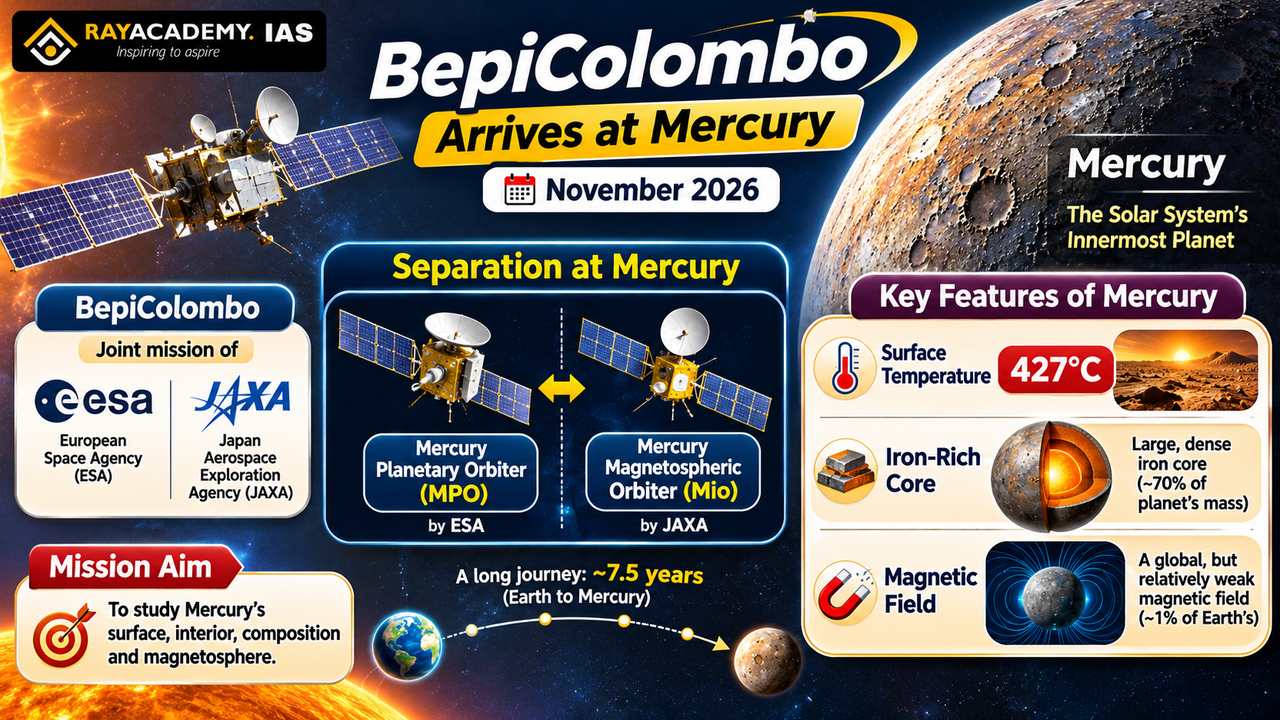
BepiColombo Achieves Mercury Orbit Insertion: After an eight-year, 10-billion-kilometre interplanetary cruise, the joint European Space Agency (ESA) and Japan Aerospace Exploration Agency (JAXA) spacecraft BepiColombo successfully slipped into orbit around Mercury on November 21, 2026 (confirmed via telemetry at ESA’s European Space Operations Centre in Darmstadt, Germany).
UPSC Syllabus Mapping:
General Studies Paper III (Science and Technology): Awareness in the fields of IT, Space, Computers, robotics, nano-technology, bio-technology; Achievements of Indians in science & technology; International space cooperation and planetary exploration missions.
General Studies Paper I (Physical Geography): Important Geophysical phenomena, solar system evolution, terrestrial planets, and planetary magnetospheres.
First Dual-Orbiter Mission at the Innermost Planet: Becoming only the third spacecraft to visit Mercury and the second to orbit it (more than a decade after NASA’s MESSENGER mission ended in 2015), BepiColombo carries two linked robotic explorers—ESA’s Mercury Planetary Orbiter (MPO) and JAXA’s Mercury Magnetospheric Orbiter (Mio)—which will separate in December 2026 to study the planet simultaneously from complementary altitudes.
Overcoming Extreme Thermal & Gravitational Challenges: Despite a software-triggered premature cutoff of its axial thruster burn during Mercury Orbit Insertion (MOI) (achieving ~77% of planned velocity change and entering a 75-hour capture orbit), flight dynamics teams confirmed safe orbital capture ahead of routine science operations beginning in April 2027.
Static-Current Linkage: Orbital Mechanics, Planetary Geology, and Deep-Space Cooperation
Understanding the scientific and engineering triumph of BepiColombo requires linking fundamental principles of astrophysics and orbital mechanics with comparative planetary geology.
1. Why Reaching Mercury Is Harder Than Reaching Pluto
Overcoming the Sun’s Gravity Well: Although Mercury is only ~91–152 million km from Earth, reaching it requires immense energy (delta-v). A spacecraft launched from Earth inherits Earth’s orbital velocity (~30 km/s around the Sun); falling inward toward the Sun accelerates the probe sharply due to solar gravity, risking a high-speed flyby unless it continuously sheds orbital momentum.
Gravity-Assist Flybys & Weak Stability Capture: To brake without carrying prohibitive amounts of chemical propellant, BepiColombo combined solar electric ion propulsion with nine planetary gravity-assist flybys (one past Earth, two past Venus, and six past Mercury) before executing weak gravity capture and chemical thruster braking.
2. Unique Planetary Characteristics of Mercury. BepiColombo Enters Mercury
Anomalous High Density & Oversized Iron Core: Barely larger than Earth’s Moon, Mercury is the second-densest planet in the Solar System (after Earth), possessing a massive metallic iron-nickel core that occupies nearly 85% of the planet’s radius (compared to ~55% for Earth)—challenging standard models of terrestrial planet formation.
Global Magnetosphere & Solar Wind Interaction: Unlike Venus or Mars, Mercury generates an active intrinsic dipole magnetic field (roughly 1% as strong as Earth’s), suggesting its outer core remains partially molten despite its small size.
Extreme Thermal Diurnal Range & Permanently Shadowed Craters: Because Mercury lacks a substantial atmosphere to retain heat and rotates slowly (a 3:2 spin-orbit resonance), daytime equatorial temperatures soar past 427°C (800°F) while nighttime temperatures plunge to -180°C. Paradoxically, radar observations confirm water ice trapped inside permanently shadowed polar craters. BepiColombo Enters Mercury
3. Legacy of Mercury Exploration Missions
Mariner 10 (NASA, 1974–1975): First spacecraft to visit Mercury; executed three flybys and mapped ~45% of its cratered surface.
MESSENGER (NASA, 2011–2015): MErcury Surface, Space ENvironment, GEochemistry, and Ranging became the first spacecraft to orbit Mercury, mapping 100% of the surface, discovering volatile-rich deposits, and intentionally impacting the surface in April 2015 upon depleting propellant.
BepiColombo (ESA–JAXA, Launched Oct 2018 – Orbit Nov 2026): Named after late Italian mathematician and engineer Giuseppe "Bepi" Colombo (1920–1984), whose calculations enabled Mariner 10’s multiple gravity-assist flybys.
Prelims Focus: High-Yield Objective Facts
UPSC Prelims Quick-Revision Box:
BepiColombo Mission Architecture & Space FactsSpacecraft Agencies & Budget: Joint $2 billion (€1.7 billion) flagship mission between the European Space Agency (ESA) and Japan Aerospace Exploration Agency (JAXA).
Four Modular Components of BepiColombo:Mercury Planetary Orbiter (MPO – built by ESA): Carries 11 instruments to map Mercury’s surface topography, mineral composition, gravity field, and interior structure in a low polar orbit (~480 × 1,500 km).
Mercury Magnetospheric Orbiter (MMO / 'Mio' – built by JAXA): Spin-stabilized spacecraft carrying 5 instruments to study Mercury’s magnetic field, exosphere, and interaction with the solar wind from a higher elliptical orbit (~590 × 11,640 km).
Mercury Transfer Module (MTM – built by ESA): Provided solar electric (ion) propulsion using Xenon propellant during the 8-year cruise; jettisoned in September 2026 prior to final arrival. Magnetospheric Orbiter Sunshield and Interface (MOSIF – built by ESA): Protected Mio from intense solar radiation during cruise until orbital separation.
Mercury’s Orbital & Physical Facts:Orbital Period (1 Mercury Year): 88 Earth days (four Mercury years equal roughly one Earth year). Caloris Basin: One of the largest impact basins in the Solar System (~1,550 km diameter), located on Mercury.
Absence of Natural Satellites: Like Venus, Mercury has zero moons and no rings.India’s Inner-Solar-System Missions (ISRO Context):Aditya-L1: India’s first space-based solar observatory stationed in a halo orbit around Sun-Earth Lagrange Point 1 (L1) (~1.5 million km from Earth).
Shukrayaan-1 (Venus Orbiter Mission): Approved ISRO mission targeted for March 2028 to study Venus’s dense atmosphere and subsurface geology.
Mains Analytical Breakdown: Significance and Multi-Dimensional Challenges
Scientific and Strategic Significance
Unprecedented Two-Point Simultaneous Measurements: For the first time, two dedicated orbiters (MPO close to the surface and Mio in the outer magnetosphere) will operate simultaneously—allowing scientists to separate spatial variations from temporal fluctuations as solar wind storms buffet Mercury.
Testing General Relativity & Solar System Formation: Precision tracking of BepiColombo’s orbit near the Sun’s intense gravitational field will provide the most stringent tests yet of Einstein’s General Theory of Relativity while clarifying how rocky exoplanets form close to host stars.
Benchmark Model for International Space Diplomacy: Amid growing geopolitical fragmentation in outer space, the $2-billion ESA–JAXA cost- and hardware-sharing partnership demonstrates how pooling specialized agency strengths (ESA’s deep-space propulsion and planetary imaging + JAXA’s magnetospheric expertise) makes complex deep-space missions financially viable.
Technological Spin-Offs for Extreme-Environment Engineering: Developing high-temperature multi-layer ceramic/titanium insulation, optical solar reflectors, and radiation-hardened electronics capable of surviving 10 times Earth’s solar irradiance advances materials science for solar probes and terrestrial high-heat industries.
Multi-Dimensional Challenges in Deep-Space Planetary Exploration
Extreme Thermal and Radiation Stress (Engineering): Operating at ~0.31–0.47 AU from the Sun exposes spacecraft electronics and solar arrays to temperatures exceeding 427°C and intense infrared reradiation from Mercury’s sunlit surface—requiring complex thermal management and tilted solar panels to prevent degradation.
Autonomous Software & Thruster Anomalies (Operational): Deep-space communication delays (several minutes round-trip over 150 million km) force spacecraft to rely on onboard autonomy; as seen during BepiColombo’s November 21 thruster glitch and its earlier 2024 ion-thruster power reduction, minor software faults can trigger safe-mode interruptions during critical maneuvers.
Prolonged Gestation Periods & Budget Escalation (Economic & Governance): Multi-decade planning timelines (conceived in the early 2000s, launched in 2018, arriving in 2026) test sustained public funding and institutional continuity across shifting political cycles.
Asymmetry in Global Deep-Space Access (Geopolitical & Ethical): High capital barriers (~$2 billion per flagship mission) concentrate deep-space data generation among a handful of spacefaring blocs unless open-data protocols democratize access for researchers in the Global South.
Way Forward: Lessons for Global Space Governance and ISRO’s Deep-Space Roadmap
Expand Bilateral & Multilateral Deep-Space Partnerships (ISRO – Indian Space Policy 2023): India should leverage its cost-effective planetary engineering (proven in Chandrayaan-3 and Mars Orbiter Mission) to forge modular payload-sharing partnerships with ESA, JAXA, and NASA—building on existing collaborations like NISAR (with NASA) and LUPEX (Lunar Polar Exploration Mission with JAXA).
Invest in Solar Electric Propulsion & Gravity-Assist Navigation: As ISRO plans missions to Venus (Shukrayaan-1), Mars, and near-Earth asteroids, indigenous development of high-efficiency Hall-effect / ion thrusters and autonomous deep-space navigation software will significantly enhance payload mass fractions.
Promote Open Planetary Science Data Repositories (UN COPUOS Norms): Space agencies should uphold FAIR (Findable, Accessible, Interoperable, Reusable) open-science data policies for BepiColombo’s telemetry so universities and planetary scientists in developing nations, including India, can participate in cutting-edge comparative planetology.
Strengthen Onboard Fault-Tolerant AI & Digital Twin Testing: Rigorous ground-based digital twin simulations and fault-tolerant flight software verification are essential to minimize thruster and attitude-control anomalies during autonomous planetary orbit insertions.
Value Addition: Official Data Points for Mains Answers
Mission Scale & Engineering Metrics (ESA / JAXA): BepiColombo travelled over 10 billion kilometres across 8 years using 9 planetary flybys to enter orbit around Mercury, operating in an environment where solar intensity is up to 10 times stronger than near Earth and surface temperatures exceed 427°C.
India’s Space Economy & Deep-Space Trajectory (IN-SPACe / Economic Survey): India’s space economy, valued at approximately $8.4 billion (~2% of the global space market), is projected to reach $44 billion by 2033, driven by private sector participation under IN-SPACe alongside ISRO’s upcoming Gaganyaan, Shukrayaan-1, and Bharatiya Antariksh Station (BAS) missions.
Administrative Catchphrase for Mains Conclusions: "BepiColombo’s arrival at Mercury exemplifies how international scientific collaboration, solar-electric propulsion, and resilient thermal engineering can unlock the deepest mysteries of our Solar System."
Practice Questions for Active Recall
Prelims Practice Question (Multi-Statement Format)
Q. With reference to the BepiColombo space mission and the planet Mercury, consider the following statements:
BepiColombo is a joint planetary exploration mission of the European Space Agency (ESA) and the Japan Aerospace Exploration Agency (JAXA).
It is the first spacecraft in history to enter into orbit around Mercury.
Unlike Venus and Mars, Mercury possesses an intrinsic global dipole magnetic field.
Which of the statements given above is/are correct?
(a) 1 and 2 only
(b) 1 and 3 only
(c) 2 and 3 only
(d) 1, 2, and 3
Correct Answer: (b) 1 and 3 only
Explanation:
Statement 1 is correct: BepiColombo is a collaborative mission between ESA (which built the Mercury Planetary Orbiter and Mercury Transfer Module) and JAXA (which built the Mercury Magnetospheric Orbiter, Mio).
Statement 2 is incorrect: BepiColombo is the second spacecraft to orbit Mercury (after NASA’s MESSENGER, which orbited Mercury from 2011 to 2015) and the third to visit the planet (including NASA’s Mariner 10 flybys in 1974–75).
Statement 3 is correct: Among the four terrestrial planets, only Earth and Mercury generate active intrinsic dipole magnetic fields, whereas Venus and Mars lack global dynamos.
Mains Practice Question (150 Words | 10 Marks)
Q. "Reaching and orbiting Mercury poses far steeper orbital mechanics and thermal engineering challenges than missions to the outer Solar System." Discuss in the context of the ESA–JAXA BepiColombo mission and highlight the value of international space collaboration. (150 words)
Model Answer Structure:
Introduction: Introduce the November 2026 Mercury Orbit Insertion of BepiColombo—the joint ESA–JAXA dual-orbiter mission—as only the second mission to orbit the innermost planet.
Body Paragraph 1 (Orbital & Thermal Challenges): Explain the physics of falling deep into the Sun’s gravity well (requiring nine gravity-assist flybys and solar-electric ion propulsion to shed momentum) alongside surviving 427°C temperatures and intense solar radiation.
Body Paragraph 2 (Scientific & Collaborative Value): Highlight simultaneous two-point measurements of Mercury’s oversized iron core and magnetosphere by MPO and Mio, and how ESA–JAXA cost/hardware sharing offers a template for global space diplomacy (relevant to ISRO–JAXA LUPEX).
Conclusion: Conclude with the importance of open planetary data sharing and indigenous propulsion R&D for India’s upcoming Shukrayaan-1 and deep-space roadmap.
Take this article with you
Save a reading copy for offline study.