

India-Nepal Bilateral Relations
India-Nepal bilateral relations entered a renewed phase of developmental cooperation on November 23, 2026, as Prime Minister Narendra Modi announced a ₹15,000-crore development assistance package for Nepal during the maiden official visit of Nepalese Prime Minister Balendra Shah to New Delhi.
UPSC Syllabus Mapping:
General Studies Paper II (International Relations): India and its neighbourhood—relations; Bilateral, regional and global groupings and agreements involving India and/or affecting India’s interests; Effect of policies and politics of developed and developing countries on India’s interests.
General Studies Paper III (Disaster Management & Infrastructure): Disaster and disaster management; Infrastructure: Energy, Ports, Roads, Airports, Railways etc.
Extended in the aftermath of the devastating August 2026 flash floods in the Bhotekoshi River, the financial package aims to bolster Nepal's post-disaster reconstruction, climate resilience, and long-term infrastructure capacity.
According to Foreign Secretary Vikram Misri, the package comprises a ₹11,500-crore rupee-denominated concessional Line of Credit (LoC) dedicated exclusively to energy projects and ₹3,500 crore in direct grants for infrastructure reconstruction. Both leaders also adopted a 10-pillar Joint Vision Document (Viksit Bharat and Samunnat Nepal) and instructed their respective Foreign Secretaries to pursue a forward-looking diplomatic resolution to outstanding boundary issues.
Static-Current Linkage: Treaties, Boundary Disputes, and Hydropower Diplomacy
Understanding contemporary India-Nepal diplomacy requires examining the historical treaties, shared river basins, and institutional frameworks that govern this unique open-border relationship.
The 1950 Treaty of Peace and Friendship
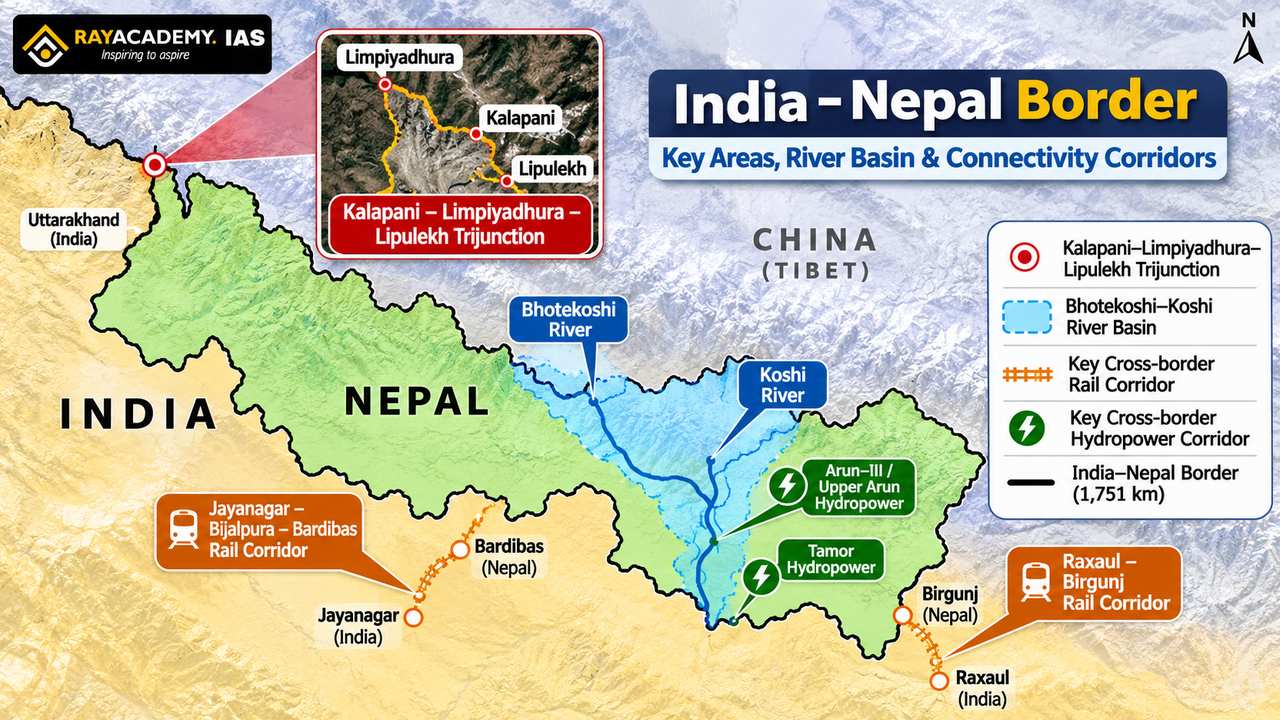
Signed on July 31, 1950, the India-Nepal Treaty of Peace and Friendship forms the bedrock of bilateral ties. It establishes reciprocal national treatment for citizens of both countries regarding residence, property ownership, trade, and movement across an open international border spanning over 1,750 km.
The 1816 Treaty of Sugauli and the Kalapani Boundary Dispute
The boundary dispute over the Kalapani-Limpiyadhura-Lipulekh trijunction—strategically located where Uttarakhand (India), Sudurpashchim Province (Nepal), and the Tibet Autonomous Region (China) meet—stems from differing interpretations of the Treaty of Sugauli (1816). While the treaty designated the Kali (Mahakali) River as Nepal’s western boundary with British India, cartographic ambiguities regarding the exact headwaters of the river have sustained competing territorial claims.
The Eminent Persons Group (EPG) Framework
To review all bilateral treaties—including the 1950 Treaty—and address structural irritants, India and Nepal constituted a joint Eminent Persons Group (EPG) in 2016. Although the EPG finalized a consensus report in 2018, its recommendations remain pending official acceptance and public release by both governments.
Transboundary River Systems and Hydropower Cooperation
Nepal possesses an estimated 42,000 MW of economically viable hydropower potential, while India offers a vast, growing energy market. Bilateral cooperation is anchored in the India-Nepal Power Trade Agreement (2014) and the Long-Term Power Trade Agreement (2024), under which India committed to importing 10,000 MW of hydropower from Nepal over a ten-year horizon.
Prelims Focus: High-Yield Objective Facts
UPSC Prelims Quick-Revision Box:
India-Nepal 2026 Outcomes & GeographyNodal Ministry: Ministry of External Affairs (MEA), Government of India (Development Partnership Administration).Financial Structure of the 2026 Package: Total ₹15,000 crore (~24,000 crore Nepalese Rupees), split into ₹11,500 crore (Rupee-denominated Concessional LoC for energy) and ₹3,500 crore (Direct Grant-in-Aid for flood reconstruction).
Bhotekoshi River: A major transboundary river originating in Tibet (where it is known as the Poiqu River) that flows into Nepal, forming a key upper tributary of the Sun Koshi and the larger Koshi River system. Kalapani-Limpiyadhura-Lipulekh Trijunction: Situated in the Pithoragarh district of Uttarakhand along the Lipulekh Pass, a historic trade and pilgrimage route to Kailash-Mansarovar.
Key Connectivity & Energy Milestones (Nov 2026):Launch of the Sarayu-Kamala Express cross-border passenger rail service linking Ayodhya (India) and Janakpur (Nepal).Inauguration of the motorable bridge connecting Dharchula (Uttarakhand) and Darchula (Nepal).
Foundation stone laid for the Lower Arun Hydroelectric Project alongside progress on the 900 MW Arun-3 Project (executed by SJVN Limited).Announcement of an offshore campus of the Indian Institute of Technology (IIT) in Nepal.
Mains Analytical Breakdown: Significance and Multi-Dimensional Challenges
Strategic and Developmental Significance
Reinforcing the 'Neighbourhood First' Policy: Extending a substantial rupee-denominated development package demonstrates India's commitment to acting as a first responder and reliable development partner in South Asia, insulating bilateral ties from transient political shifts.
Energy Security and Clean Transition: Dedicating ₹11,500 crore to energy infrastructure accelerates cross-border grid synchronization. Importing clean Nepalese hydropower helps India meet its Panchamrit non-fossil fuel targets while generating crucial export revenue for Kathmandu.
Sub-Regional Connectivity and Trade Facilitation: Operationalizing Integrated Check Posts (ICPs) at Banbasa and Dodhara-Chandani, alongside rail links like the Sarayu-Kamala Express, reduces logistics costs for landlocked Nepal and strengthens BBIN (Bangladesh-Bhutan-India-Nepal) sub-regional integration.
Soft Power and Human Capital Synergy: Establishing an offshore IIT campus and expanding digital financial connectivity (UPI integration) deepen people-to-people ties (Roti-Beti ka Rishta) and align youth aspirations with India's technological ecosystem.
Multi-Dimensional Challenges in India-Nepal Ties
Geopolitical Challenges (The Boundary Impasse): Despite positive momentum, unresolved territorial claims over Kalapani, Lipulekh, and Limpiyadhura—and Nepal's 2020 constitutional amendment altering its political map—remain sensitive domestic political triggers that can stall broader diplomatic trust.
External Strategic Competition: Increasing infrastructure investments and strategic outreach by China in Nepal—particularly under the Belt and Road Initiative (BRI) and trans-Himalayan connectivity proposals—pose long-term geostrategic and security concerns for New Delhi along an open border.
Economic and Implementation Bottlenecks: Historically, India-assisted infrastructure projects in Nepal have faced execution delays, land acquisition hurdles, and bureaucratic clearances, leading to underutilization of Lines of Credit and perception gaps regarding project delivery.
Environmental and Transboundary Disaster Risks: The August 2026 Bhotekoshi flash floods highlight the acute vulnerability of the Young Fold Himalayas to Glacial Lake Outburst Floods (GLOFs), cloudbursts, and sediment-laden inundations that severely impact downstream communities in Bihar and Uttar Pradesh.
Ethical and Diplomatic Sensitivity: Navigating relations with a smaller, sovereign neighbour requires avoiding perceptions of asymmetric hegemony or domestic interference while safeguarding India's legitimate security interests.
Way Forward: Institutionalizing Trust and Cooperative Resilience
Depoliticizing Boundary Negotiations: Both nations should empower the Foreign Secretary-level mechanism and the Boundary Working Group (BWG) to conduct technical, cartographic, and historical consultations away from media glare, drawing constructive insights from the Eminent Persons Group (EPG) framework.
Adopting the Gujral Doctrine in Project Execution: Anchored in the Gujral Doctrine's principle of non-reciprocity, India should institute a Joint Project Monitoring Mechanism with strict timelines, streamlined clearances, and local capacity building to eliminate LoC disbursement delays.
Establishing a Transboundary Himalayan Early Warning System: Building on NDMA guidelines and NITI Aayog's Himalayan Sustainable Development framework, India and Nepal must co-develop real-time satellite-based telemetry and GLOF monitoring across the Koshi, Gandak, and Mahakali basins.
Promoting Trilateral Power Trade: Operationalizing seamless electricity transit through the Indian grid to Bangladesh will transform India-Nepal bilateral hydropower cooperation into a broader South Asian regional energy market.
Value Addition: Official Data Points for Mains Answers
Bilateral Trade Dominance (Ministry of Commerce & Industry): Bilateral goods trade between India and Nepal reached $9.38 billion in FY 2025–26 (a growth of 8.24% over FY25), with India accounting for over 60% of Nepal’s total external merchandise trade.
Export Growth Trajectory: Nepal's exports to India surged by 50% to $1.94 billion in FY 2025–26, driven largely by hydropower electricity exports and manufactured goods.
Hydropower Potential vs. Installed Capacity (CEA / NITI Aayog): Against a theoretical potential of ~83,000 MW (42,000 MW economically viable), Nepal's installed capacity crossed 3,200 MW, underscoring the massive untapped scope for Indian public-private joint ventures.
Practice Questions for Active Recall
Prelims Practice Question (UPSC Standard)
Q. With reference to India-Nepal bilateral relations and geographical features recently in news, consider the following statements:
The Bhotekoshi River originates in the Tibet Autonomous Region and forms a major upper tributary of the Koshi River system.
The Kalapani-Limpiyadhura-Lipulekh trijunction lies along the Kali River, which was demarcated as Nepal's western boundary under the Treaty of Sugauli (1816).
Under the 1950 Treaty of Peace and Friendship, citizens of Nepal require a work permit to seek employment in India's private sector.
Which of the statements given above is/are correct?
(a) 1 and 2 only
(b) 2 and 3 only
(c) 1 and 3 only
(d) 1, 2 and 3
Correct Answer: (a) 1 and 2 only
Explanation:
Statement 1 is correct: The Bhotekoshi (known as Poiqu in Tibet) flows south into Nepal's Sindhupalchok district, joining the Sun Koshi, which is a primary tributary of the Sapta Koshi river system.
Statement 2 is correct: The 1816 Treaty of Sugauli between the East India Company and the Kingdom of Nepal established the Kali (Mahakali) River as Nepal's western boundary, making the origin of its headwaters in the Kalapani-Limpiyadhura region the core of the boundary dispute.
Statement 3 is incorrect: Articles 6 and 7 of the 1950 Treaty of Peace and Friendship grant reciprocal national treatment to citizens of both countries in matters of residence, ownership of property, participation in trade/commerce, and movement, without requiring work permits.
Mains Practice Question (150 Words | 10 Marks)
Q. "Developmental diplomacy and energy interdependence remain the strongest anchors of India-Nepal ties, even as unresolved boundary disputes test bilateral trust." Discuss in the context of India’s ₹15,000-crore assistance package to Nepal. (150 words)
Model Answer Structure:
Introduction: Briefly introduce the November 2026 ₹15,000-crore Indian aid package during Nepal PM Balendra Shah’s visit following the Bhotekoshi floods, highlighting the blend of developmental support and diplomatic engagement.
Body Paragraph 1 (Anchors of Cooperation): Explain how the ₹11,500-crore energy LoC, 10,000 MW power trade agreement, ₹3,500-crore reconstruction grants, and cross-border rail/bridge links create deep economic interdependence.
Body Paragraph 2 (Boundary Friction & External Factors): Analyze how the Kalapani-Limpiyadhura-Lipulekh dispute, the pending 2018 EPG report, and external geopolitical competition create periodic friction.
Conclusion: Conclude with a forward-looking administrative solution—insulating economic/disaster cooperation from political rhetoric while empowering quiet Foreign Secretary-level boundary dialogue.
Take this article with you
Save a reading copy for offline study.


