

Atal Pension Yojana
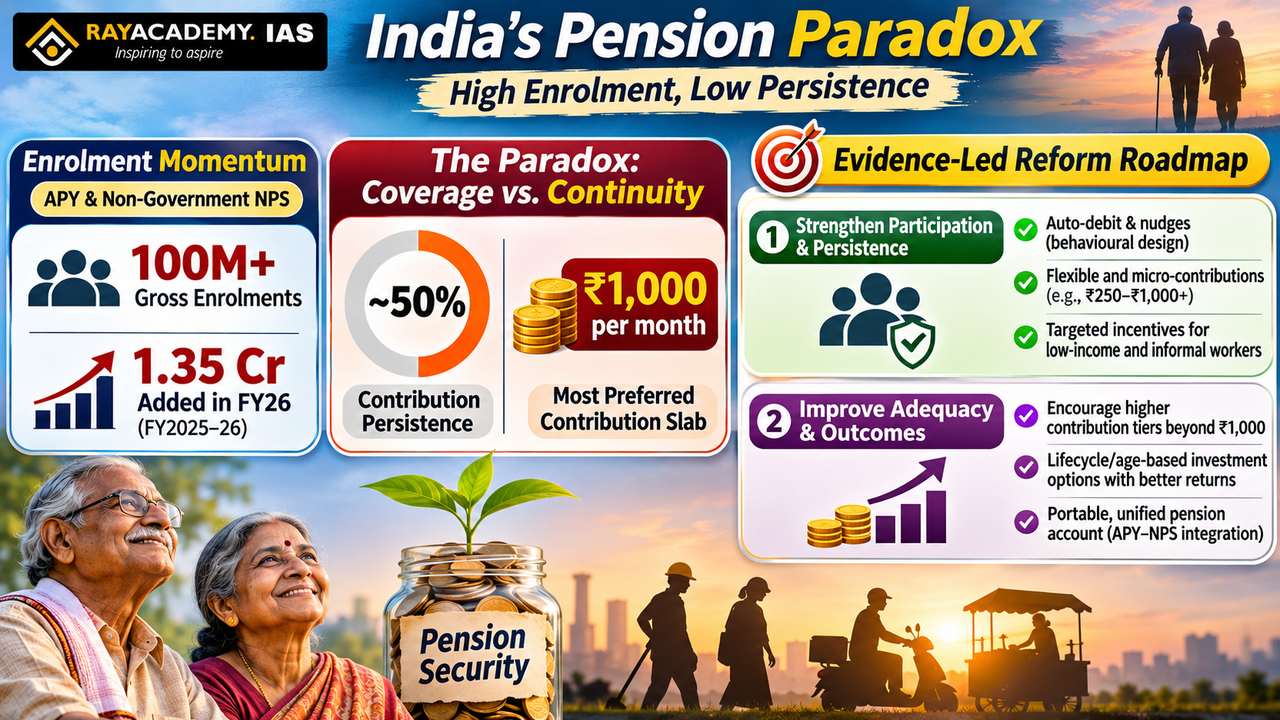
100-Million Voluntary Pension Milestone vs. Adequacy Gap: Gross enrolments under India’s flagship voluntary pension schemes—the Atal Pension Yojana (APY) and non-government National Pension System (NPS)—have crossed 100 million subscribers, with APY alone adding a record 1.35 crore subscribers in FY 2025–26.
UPSC Syllabus Mapping:
General Studies Paper II (Social Justice & Governance): Welfare schemes for vulnerable sections of the population by the State and the performance of these schemes; Mechanisms, laws, institutions and bodies constituted for the protection and betterment of these vulnerable sections; Issues relating to poverty and hunger.
General Studies Paper III (Indian Economy): Inclusive growth and issues arising from it; Indian Economy and issues relating to planning, mobilization of resources, growth, development and employment; Financial inclusion and pension sector regulation.
Persistently Low Contribution Persistence & Minimal Pension Slabs: Despite building the world’s largest voluntary pension on-ramp, recent policy analysis highlights a critical pension adequacy concern: contribution persistence in APY hovers around 50%, and the vast majority of subscribers opt for the lowest guaranteed slab of ₹1,000 per month.
Call for Behavioural & Evidence-Led Pension Design: While the Pension Fund Regulatory and Development Authority (PFRDA) has launched innovative initiatives—including NPS Sanchay, NPS Swasthya, and 10-rupee micro-contributions—experts emphasize pairing longitudinal account-level analytics with periodic national household retirement surveys (drawing lessons from Rwanda’s Ejo Heza micro-pension model) to turn enrolment into adequate old-age income security.
Static-Current Linkage: Constitutional Mandate, PFRDA Act 2013, and Evolution of NPS/APY
Understanding the debate over pension coverage versus adequacy requires linking India’s constitutional social security goals with statutory pension governance and historical survey-driven reforms.
1. Constitutional Mandate for Old-Age Social Security
Article 41 (Directive Principles of State Policy): Directs the State, within the limits of its economic capacity and development, to make effective provision for securing the right to work, education, and public assistance in cases of unemployment, old age, sickness, and disablement.
Entry 23 & Entry 24 of the Concurrent List (Seventh Schedule): Cover "Social security and social insurance; employment and unemployment" and "Welfare of labour including conditions of work, provident funds, employers' liability, workmen's compensation, invalidity and old age pensions".
2. Statutory & Institutional Architecture (PFRDA Act, 2013). Pension Coverage
Pension Fund Regulatory and Development Authority (PFRDA): Originally established via an executive resolution in 2003 and granted statutory status under the PFRDA Act, 2013, PFRDA regulates and promotes the National Pension System (NPS) and Atal Pension Yojana (APY) to ensure orderly growth of the pension market and protect subscriber interests.
Central Recordkeeping Agencies (CRAs): Regulated entities (such as Protean eGov, KFinTech, and CAMS) that maintain longitudinal, unit-record digital histories of every APY and NPS subscriber—tracking contributions, dormancy, investment choices, and withdrawals.
3. Historical Evolution: Survey-Led Reforms to APY (2015)
Project OASIS & 2004–2007 Retirement Surveys: India’s shift from defined-benefit civil service pensions to the defined-contribution NPS (effective January 1, 2004) was shaped by Project OASIS (2000), a 2004 Ministry of Finance–ADB retirement survey of 42,000 respondents, and the 2007 Indian Retirement and Savings Survey (covering over 1 million households and 1,06,000 in-depth interviews).
Atal Pension Yojana (Launched May 2015): Replaced the earlier Swavalamban scheme to target unorganized-sector workers aged 18–40 years (excluding income-tax payers since October 2022), guaranteeing a fixed monthly pension of ₹1,000, ₹2,000, ₹3,000, ₹4,000, or ₹5,000 after age 60, backed by a sovereign guarantee and spouse/nominee corpus protection.
Prelims Focus: High-Yield Objective Facts
UPSC Prelims Quick-Revision Box:
APY, PFRDA Innovations & Global Micro-PensionsAtal Pension Yojana (APY) Eligibility & Features:Administered by: PFRDA under the Department of Financial Services, Ministry of Finance.Age Criteria: Open to Indian citizens aged 18 to 40 years with a savings bank or post office account; minimum contribution period of 20 years (till age 60).
Taxpayer Exclusion Rule: Effective October 1, 2022, any citizen who is or has been an income-tax payer is ineligible to join APY.Pension Slabs: Five guaranteed monthly slabs (₹1,000 to ₹5,000); after subscriber's death, the same pension goes to the spouse, and after both pass away, the accumulated corpus is returned to the nominee.
Recent PFRDA Product Innovations:NPS Vatsalya: Allows parents/guardians to open contributory pension accounts for minors, seamlessly converting into standard NPS at age 18.NPS Swasthya, NPS Sanchay & ₹10 Micro-Contributions: New flexible modules aimed at integrating health-linked retirement savings, goal-based accumulation, and ultra-low-ticket digital micro-savings for informal workers.
Global Best Practice – Ejo Heza (Rwanda):Rwanda’s national voluntary micro-pension scheme managed by the Rwanda Social Security Board (RSSB); links every member’s savings record to their National ID (4.9 million+ members) and uses longitudinal data mining plus saver interviews to tailor behavioral nudges.
United Nations Population Fund (UNFPA) Ageing Projection: India’s elderly population (aged 60+) is projected to double from ~10.5% in 2022 to 20.8% (~347 million people) by 2050, outnumbering children aged 0–14 by mid-century.
Mains Analytical Breakdown: Significance and Multi-Dimensional Challenges
Strategic and Social Significance
Unprecedented Financial Inclusion Architecture: Leveraging the JAM Trinity (Jan Dhan–Aadhaar–Mobile), India has built the world’s largest voluntary pension onboarding pipeline, bringing over 100 million informal and non-government workers into formal retirement accounts.
Mitigating Demographic Ageing Risks: As joint-family support structures weaken amid rapid urbanization and rising life expectancy, institutionalizing contributory micro-pensions prevents old-age destitution and reduces future fiscal strain on tax-funded social assistance (such as NSAP).
Mobilizing Long-Term Patient Capital: Retail pension funds under NPS and APY channel stable, long-horizon domestic savings into infrastructure bonds and capital markets, supporting macroeconomic capital formation.
Multi-Dimensional Challenges: Moving From Coverage to Adequacy
Low Contribution Persistence & Account Dormancy (Behavioural & Economic): Roughly half of APY accounts experience irregular contributions or dormancy, driven by volatile informal-sector cash flows, rigid monthly auto-debit schedules, and lack of behavioral reminders during lean income months.
Inflation Erosion & Inadequate Pension Slabs (Financial): With the overwhelming majority of APY subscribers locked into the ₹1,000 monthly pension slab (unindexed to inflation), the real purchasing power of ₹1,000 twenty to thirty years from now will fall far short of basic subsistence needs.
Data-to-Policy Disconnect (Institutional & Administrative): Although Central Recordkeeping Agencies (CRAs) hold granular longitudinal transaction histories of over 100 million savers, policy evaluation often relies on headline gross enrolment tallies rather than analyzing why specific cohorts persist, pause, or drop out.
Absence of Updated Household Retirement Surveys (Evidence Deficit): Nearly two decades have passed since the landmark 2007 Indian Retirement and Savings Survey, leaving policymakers without fresh, nationally representative data on latent household retirement demand and multi-generational financial resilience.
Informal Sector Vulnerability & Trust Deficit (Social & Ethical): Domestic workers, street vendors, and gig workers face competing immediate liquidity needs (health shocks, education); rigid lock-in rules without partial emergency liquidity or clear communication deter sustained saving.
Way Forward: Reform-Oriented Roadmap
Institutionalize a Periodic National Retirement Survey (MoSPI & Ministry of Finance): Rather than building a costly standalone survey from scratch, embed a compact retirement ownership, latent demand, and adequacy module every 1–2 years inside existing large-scale MoSPI household surveys (such as PLFS or HCES).
Pair Longitudinal CRA Data Mining with Structured Saver Listening (PFRDA & Behavioural Economics): Direct Central Recordkeeping Agencies (CRAs) to analyze unit-record data on contribution persistence, slab upgrades, and lapses, complemented by qualitative focus groups comparing active savers, dormant accounts, and non-subscribers—emulating Rwanda’s Ejo Heza evidence loop.
Publish an Annual 'State of Retirement Readiness Report' (PFRDA Accountability Framework): Synthesize survey findings, CRA persistence metrics, and saver feedback into a single public benchmark so every new product—such as NPS Swasthya, NPS Sanchay, and ₹10 micro-contributions—is evaluated on actual contribution persistence and corpus adequacy, not just account openings.
Introduce Flexible Micro-Contribution Frequencies & Auto-Escalation Nudges (NITI Aayog Financial Inclusion Lens): Allow informal workers with seasonal or daily wages to make flexible, small-ticket digital top-ups (via UPI) alongside opt-out auto-escalation features that gradually upgrade subscribers from the ₹1,000 slab toward ₹3,000–₹5,000 as incomes rise.
Integrate Emergency Liquidity Buffers (Sidecar Savings Model): Pilot dual-bucket micro-pension accounts (such as NPS Sanchay/Swasthya) that pair a long-term locked retirement pot with an accessible short-term emergency/health buffer, preventing savers from abandoning pension contributions during household crises.
Value Addition: Official Data Points for Mains Answers
Enrolment vs. Persistence Metrics (PFRDA / Policy Data, 2026): Gross enrolments across APY and non-government NPS exceed 100 million, with APY adding a record 1.35 crore subscribers in FY 2025–26; however, contribution persistence remains ~50% and the majority remain clustered in the ₹1,000/month pension slab.
Informal Workforce & Demographic Imperative (PLFS & UNFPA): Nearly 88%–90% of India’s workforce operates in the informal sector without employer-sponsored EPFO/pension coverage, while India’s 60+ elderly population is projected to reach 347 million (20.8% of total population) by 2050.
Administrative Catchphrase for Mains Conclusions: "In pension policy, coverage without adequacy is an incomplete promise; pairing digital onboarding with behavioural insights and longitudinal data analytics is key to securing dignified old age for India’s informal workforce."
Practice Questions for Active Recall
Prelims Practice Question (Multi-Statement Format)
Q. With reference to the Atal Pension Yojana (APY) and pension governance in India, consider the following statements:
The Atal Pension Yojana is administered by the Pension Fund Regulatory and Development Authority (PFRDA) and is open to all Indian citizens aged 18 to 40 years, including income-tax payers.
Under APY, a subscriber receives a guaranteed minimum monthly pension ranging from ₹1,000 to ₹5,000 after attaining the age of 60 years.
The PFRDA is a statutory body established under an Act of Parliament passed in 2013.
Which of the statements given above is/are correct?
(a) 1 and 2 only
(b) 2 and 3 only
(c) 1 and 3 only
(d) 1, 2, and 3
Correct Answer: (b) 2 and 3 only
Explanation:
Statement 1 is incorrect: While APY is administered by PFRDA for citizens aged 18–40 years, effective October 1, 2022, any citizen who is or has been an income-tax payer is not eligible to join APY.
Statement 2 is correct: APY provides five defined, guaranteed minimum monthly pension slabs—₹1,000, ₹2,000, ₹3,000, ₹4,000, or ₹5,000—starting at age 60, depending on the contribution amount and age at entry.
Statement 3 is correct: Originally set up in 2003 by executive order, PFRDA became a statutory regulatory body following the enactment of the PFRDA Act, 2013.
Mains Practice Question (150 Words | 10 Marks)
Q. "While India has built the world’s largest voluntary pension onboarding architecture, true old-age income security depends on bridging the gap between enrolment coverage and pension adequacy." Discuss in the context of the Atal Pension Yojana (APY) and suggest behavioural reforms. (150 words)
Model Answer Structure:
Introduction: Highlight India crossing 100 million voluntary pension subscribers under APY and non-government NPS (1.35 crore APY additions in FY26), fulfilling the Article 41 social security mandate.
Body Paragraph 1 (The Adequacy & Persistence Challenge): Explain why enrolment alone is insufficient—~50% contribution persistence, dominance of the unindexed ₹1,000 monthly slab, informal-sector income volatility, and lack of updated national retirement surveys since 2007.
Body Paragraph 2 (Behavioural & Data-Driven Reforms): Propose mining longitudinal CRA transaction data, conducting qualitative saver interviews (modeled on Rwanda’s Ejo Heza), embedding a retirement module in MoSPI surveys, and publishing an annual State of Retirement Readiness Report.
Conclusion: Conclude with leveraging PFRDA’s ₹10 micro-contributions, NPS Swasthya/Sanchay, and auto-escalation nudges to turn account openings into dignified retirement security.
Take this article with you
Save a reading copy for offline study.


