

First State Visit of Nepal PM
Nepal Prime Minister Balendra Shah (who assumed office in March 2026) commenced his first bilateral state visit to India on November 22, 2026, holding preparatory talks with External Affairs Minister S. Jaishankar ahead of summit-level engagements with Prime Minister Narendra Modi.
UPSC Syllabus Mapping:
General Studies Paper II (International Relations): India and its neighbourhood—relations; Bilateral, regional and global groupings and agreements involving India and/or affecting India’s interests; Effect of policies and politics of developed and developing countries on India’s interests.
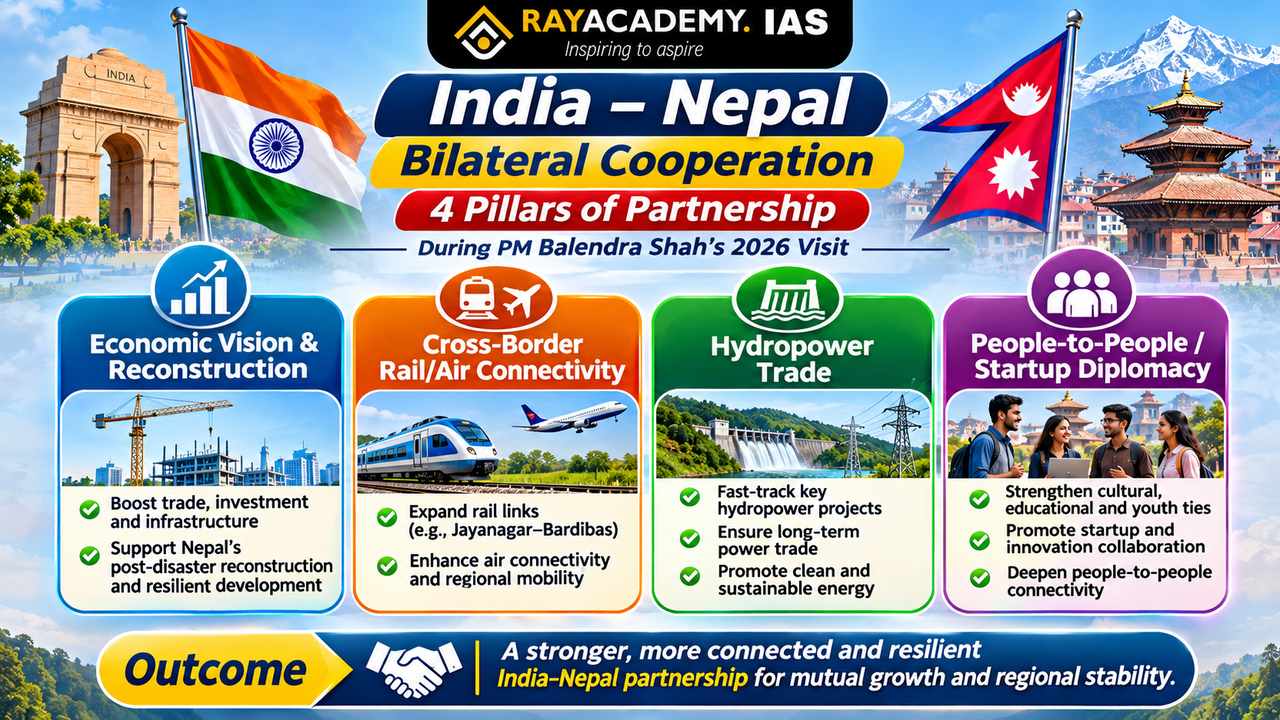
Economic Vision & Post-Flood Reconstruction: The two nations are set to unveil a forward-looking Economic Vision Document, a dedicated financial assistance package for post-flood reconstruction in Nepal, and virtual inaugurations of completed development partnership projects.
Multi-Sectoral Connectivity & Soft Power: Key deliverables on the bilateral agenda include Ayodhya–Janakpur rail connectivity, new air routes, hydropower and energy cooperation, an offshore IIT campus in Nepal, and capacity-building support for Nepal’s startups and cricket team.
Static-Current Linkage: Treaty Foundations, Neighbourhood First, and Sub-Regional Integration
Decoding the trajectory of India-Nepal relations requires linking historical treaties and geographical realities with India’s contemporary Neighbourhood First Policy and SAGAR / MAHASAGAR regional connectivity frameworks:
1. Foundational Legal & Historical Architecture . India-Nepal Bilateral Relations
1950 Treaty of Peace and Friendship: Forms the bedrock of special bilateral ties, granting reciprocal national treatment to citizens in residence, property ownership, trade, and movement across the open border (visa-free regime). In recent years, the Eminent Persons' Group (EPG) report (2018) examined updating aspects of the 1950 treaty to reflect contemporary aspirations.
Mahakali Treaty (1996) & Kosi/Gandak Agreements: Govern bilateral water-resource sharing, flood control, and multi-purpose hydropower development (including the Pancheshwar Multipurpose Project).
Roti-Beti ka Rishta: Deep-rooted civilizational, linguistic, religious (Hindu-Buddhist heritage circuits like Pashupatinath–Kashi Vishwanath and Lumbini–Bodh Gaya), and kinship ties bind the two societies.
2. Evolution of Energy & Cross-Border Connectivity
Long-Term Power Trade Agreement (2024): Under this landmark pact, India committed to importing 10,000 MW of hydropower from Nepal over 10 years, positioning clean energy as the primary anchor of Nepal’s export economy.
Cross-Border Transmission & Pipelines: Operationalization of the 400 kV Muzaffarpur–Dhalkebar transmission line and the Motihari–Amlekhgunj petroleum pipeline (South Asia’s first cross-border petroleum pipeline) has integrated energy infrastructure.
Integrated Check Posts (ICPs) & Rail Links: Functional ICPs at Birgunj–Raxaul, Biratnagar–Jogbani, and Nepalgunj, alongside the Jaynagar–Kurtha–Bijalpura cross-border railway and the proposed Raxaul–Kathmandu broad-gauge rail link, operationalize seamless transit for landlocked Nepal.
Prelims Focus: High-Yield Objective Facts for UPSC
Quick Revision Fact Box:
India-Nepal Geography, Borders & Bilateral ProjectsBorder Length & Indian States: India shares an open 1,751-km land border with Nepal across five Indian states: Uttarakhand, Uttar Pradesh, Bihar, West Bengal, and Sikkim.Border Guarding Force: Guarded by the Sashastra Seema Bal (SSB) under the Ministry of Home Affairs (MHA) (raised in 1963; mandated for Indo-Nepal and Indo-Bhutan borders).
Major Bilateral Hydropower Projects:Arun-III (900 MW) & Lower Arun (669 MW) on the Arun River (Sankhuwasabha district, implemented by SJVN).Upper Karnali (900 MW) on the Karnali River.West Seti (750 MW) & Seti River-6 (450 MW) (NHPC).Phukot Karnali (480 MW) & Pancheshwar Multipurpose Project (5,040 MW) on the Mahakali (Sharda) River.
Key Boundary Disputes:Kalapani–Limpiyadhura–Lipulekh Tri-Junction: Located in Pithoragarh district (Uttarakhand) near the Mahakali River source (1816 Treaty of Sugauli).
Susta Territory: Located along the changing course of the Gandak (Narayani) River on the Bihar–Nepal border.Multilateral Groupings: Both India and Nepal are founding members of SAARC, BIMSTEC, and the BBIN (Bangladesh-Bhutan-India-Nepal) sub-regional motor vehicles framework.
Mains Analytical Breakdown
Significance of the 2026 Bilateral Reset
Engaging a New Generation of Nepali Leadership: PM Balendra Shah’s transition from Mayor of Kathmandu to Prime Minister represents a generational shift in Nepali politics. Early, constructive summit diplomacy allows New Delhi to build trust beyond traditional party elites.
Developmental Diplomacy & Economic Integration: Combining a post-flood reconstruction package with an Economic Vision Document and Ayodhya–Janakpur rail connectivity links cultural tourism (Ramayana Circuit) with tangible economic prosperity.
Youth-Centric Soft Power: Establishing an offshore IIT campus in Nepal and supporting Nepali tech startups and cricket directly resonates with Nepal’s aspirational youth demographic, countering negative geopolitical narratives.
Clean Energy & Sub-Regional Grid Security: Hydropower trade helps India meet its non-fossil fuel energy targets while helping Nepal narrow its chronic bilateral trade deficit with India.
Multi-Dimensional Challenges in India-Nepal Ties
Geopolitical Balancing & External Presence (Strategic): Nepal’s deepening engagement with China under the Belt and Road Initiative (BRI)—and Chinese investments in Nepali infrastructure and airports—creates security sensitivities along India’s open northern frontier.
Unresolved Boundary Issues (Political): Residual sensitivities over the Kalapani–Lipulekh and Susta boundary stretches occasionally fuel nationalist rhetoric in Kathmandu, requiring quiet, institutionalized diplomatic resolution.
Project Execution Delays & Trust Deficit (Administrative & Economic): Historical delays in mega-projects like the Pancheshwar Multipurpose Project and restrictions on Indian currency notes (₹500/₹2000 post-demonetization) have periodically caused friction in trade and tourism.
Transboundary Floods & Climate Vulnerability (Environmental): Shared Himalayan river basins (Kosi, Gandak, Ghaghara/Karnali) experience recurrent Glacial Lake Outburst Floods (GLOFs) and monsoon devastation, necessitating integrated basin-wide early warning systems rather than fragmented embankment works.
Open Border Security Challenges (Internal Security): While facilitating livelihoods, the porous 1,751-km border remains vulnerable to third-country infiltration, counterfeit currency, narcotics, and human trafficking.
Way Forward: Anchored in Authoritative Frameworks
To sustain momentum under India’s Neighbourhood First Policy and operationalize the Gujral Doctrine’s principle of non-reciprocal generosity toward smaller neighbours, four steps are vital:
Institutionalize Boundary Dialogue (Foreign Secretary-Level Boundary Working Group): Depoliticize territorial differences over Kalapani and Susta by activating technical joint boundary committees grounded in historical cartography and the 1816 Treaty of Sugauli.
Fast-Track Trilateral Power Grid & BBIN Transit (NITI Aayog & Sub-Regional Integration): Operationalize the India–Nepal–Bangladesh trilateral power trade framework (allowing Nepal to export hydroelectricity to Bangladesh via Indian transmission lines) and revive the BBIN Motor Vehicles Agreement to unlock landlocked Nepal’s market access.
Joint Himalayan Disaster Resilience & Flood Management (NDMA & Joint Commission on Water Resources): Establish real-time telemetry data sharing, joint catchment area treatment, and GLOF early warning networks across the Kosi, Gandak, and Mahakali basins to mitigate recurring flood losses.
Strengthen Youth, Education, and Digital Public Infrastructure (DPI) Ties: Accelerate the operationalization of the offshore IIT campus, cross-border UPI digital payment interoperability, and startup incubation bridges to anchor bilateral ties in 21st-century knowledge economies.
Value Addition Snippet (For Mains Introductions & Conclusions)
Bilateral Trade & Connectivity Benchmarks:
India is Nepal’s largest trading partner and primary source of foreign investment, accounting for nearly two-thirds of Nepal’s total merchandise trade and almost 100% of its petroleum supplies (via the Motihari–Amlekhgunj pipeline).
Under the Long-Term Power Trade Agreement, India aims to import 10,000 MW of clean hydropower from Nepal within a decade, transforming Nepal from a power-deficit state into a net regional electricity exporter.
Diplomatic Catchphrase for Mains Answers: "By blending civilizational kinship ('Roti-Beti') with modern economic anchors—hydropower grids, Ayodhya–Janakpur rail links, and an offshore IIT campus—India and Nepal can build a resilient, mutually beneficial neighbourhood partnership."
Active Recall: UPSC Practice Questions
1. Prelims Practice Question (Multi-Statement Format)
With reference to India-Nepal geographical and bilateral relations, consider the following statements:
India shares a land border with Nepal across five Indian states: Uttarakhand, Uttar Pradesh, Bihar, West Bengal, and Sikkim.
The Sashastra Seema Bal (SSB) under the Ministry of Defence is the designated border-guarding force deployed along the India–Nepal border.
The Motihari–Amlekhgunj pipeline is South Asia’s first cross-border petroleum product pipeline connecting India and Nepal.
Which of the statements given above is/are correct?
(a) 1 and 2 only
(b) 1 and 3 only
(c) 2 and 3 only
(d) 1, 2, and 3
Correct Answer: (b) 1 and 3 only
Explanation:
Statement 1 is correct: The 1,751-km India–Nepal border touches five Indian states—Uttarakhand, Uttar Pradesh, Bihar, West Bengal, and Sikkim.
Statement 2 is incorrect: While the Sashastra Seema Bal (SSB) guards the India–Nepal and India–Bhutan borders, it is a Central Armed Police Force functioning under the administrative control of the Ministry of Home Affairs (MHA) (not the Ministry of Defence).
Statement 3 is correct: Inaugurated in 2019, the 69-km Motihari–Amlekhgunj pipeline is South Asia’s first cross-border petroleum pipeline, transporting fuel from Bihar (India) to Amlekhgunj (Nepal).
2. Mains Practice Question (150 Words | 10 Marks)
Q. "Connectivity, clean energy trade, and youth-centric institutional partnerships offer the most durable pathway to overcome historical sensitivities in India–Nepal relations." Discuss in the context of recent bilateral engagements. (150 words)
Model Answer Structure Hint:
Introduction: Contextualize Nepal PM Balendra Shah’s November 2026 state visit to India and the proposed Economic Vision Document, reflecting New Delhi’s outreach to a new generation of Nepali leadership under the Neighbourhood First Policy.
Body:
Economic, Energy & Youth Pillars: Highlight 10,000 MW hydropower trade, cross-border rail/air connectivity (Ayodhya–Janakpur rail link), post-flood reconstruction aid, and soft-power initiatives like an offshore IIT campus and startup cooperation.
Persistent Sensitivities: Briefly note boundary disputes (Kalapani, Susta), 1950 Treaty revision demands, project execution delays, and third-party geopolitical competition.
Conclusion: Conclude with the need for time-bound project delivery, depoliticized boundary dialogue, and joint Himalayan flood/climate resilience to secure shared regional prosperity.
Take this article with you
Save a reading copy for offline study.


