

Memorandum of Procedure (MoP)
Supreme Court Issues Notice to Centre and CJI: A Supreme Court Bench of Justices M.M. Sundresh and P.B. Varale issued notice to the Union Government and the Chief Justice of India (CJI) (in his administrative capacity) on a Public Interest Litigation (PIL) filed by the NGO Lok Prahari seeking directions to finalize the long-pending revised Memorandum of Procedure (MoP) for appointing judges to the Supreme Court and High Courts.
UPSC Syllabus Mapping:
General Studies Paper II (Indian Polity & Governance): Structure, organization and functioning of the Executive and the Judiciary; Appointment to various Constitutional posts, powers, functions and responsibilities of various Constitutional Bodies; Separation of powers between various organs, dispute redressal mechanisms and institutions; Transparency and accountability in governance (RTI Act).
Over a Decade of Impasse Since the 2015 NJAC Judgment: The petition highlights that the revision of the 1999 MoP has remained stalled since December 2015, when a five-judge Constitution Bench—after striking down the 99th Constitutional Amendment Act and the National Judicial Appointments Commission (NJAC)—entrusted the Union Government with finalizing a revised MoP in consultation with the CJI.
Demand for RTI Transparency & Collegium Accountability: Alongside time-bound finalization of the MoP, the plea seeks to bring Collegium deliberations and decisions within the ambit of the Right to Information (RTI) Act, 2005, raising fresh constitutional questions over judicial independence, executive delays, and institutional transparency.
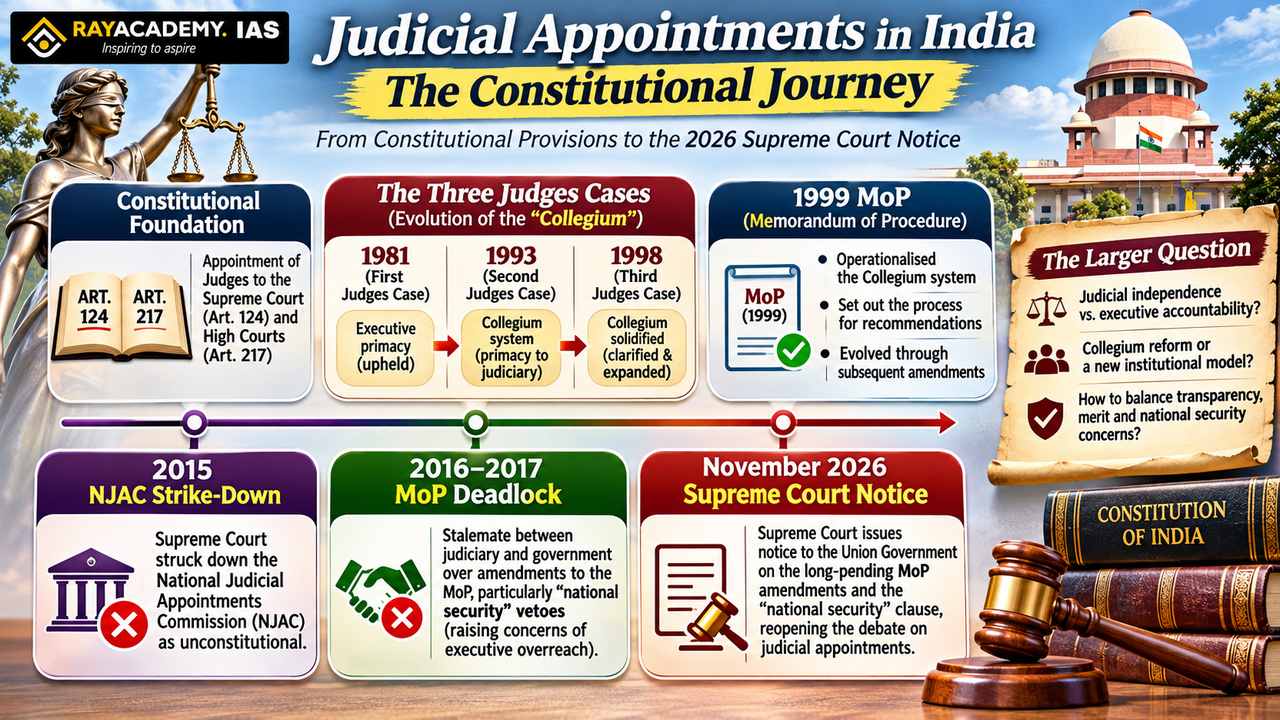
Static-Current Linkage: Constitutional Articles, Three Judges Cases, and the MoP Impasse
Understanding the ongoing friction over the Memorandum of Procedure (MoP) requires linking the text of the Constitution with landmark Supreme Court jurisprudence on separation of powers and judicial primacy.
1. Constitutional Provisions Governing Higher Judiciary Appointments
Article 124(2) (Supreme Court Judges): Provides that every Judge of the Supreme Court shall be appointed by the President by warrant under his hand and seal "after consultation with such of the Judges of the Supreme Court and of the High Courts in the States as the President may deem necessary", with mandatory consultation with the CJI for appointments other than the Chief Justice.
Article 217(1) (High Court Judges): Mandates that every Judge of a High Court shall be appointed by the President after consultation with the Chief Justice of India, the Governor of the State, and, in the case of appointment of a Judge other than the Chief Justice, the Chief Justice of the High Court.
Article 50 (Directive Principles of State Policy): Directs the State to take steps to separate the judiciary from the executive in the public services of the State—anchoring the doctrine of judicial independence as part of the Basic Structure of the Constitution.
2. Evolution of the Collegium System (The Three Judges Cases)
First Judges Case (S.P. Gupta v. Union of India, 1981): Held that the word "consultation" in Articles 124 and 217 did not mean "concurrence", giving the Executive primacy in judicial appointments.
Second Judges Case (Supreme Court Advocates-on-Record Association v. Union of India, 1993): Overruled the 1981 verdict, interpreting "consultation" as "concurrence" to protect judicial independence, and birthed the Collegium System (CJI + two senior-most SC judges), establishing judicial primacy.
Third Judges Case (In re: Special Reference 1 of 1998): Expanded the Supreme Court Collegium to five members (the CJI plus four senior-most judges of the Supreme Court) and clarified that if even two judges give an adverse opinion, the CJI should not send the recommendation to the Government.
3. The 1999 MoP, 2015 NJAC Verdict, and the Stalled Revision
Original 1999 MoP: Drawn up on June 30, 1999, following the Third Judges Case, it codifies the step-by-step administrative procedure for initiating, vetting, and notifying judicial appointments and transfers.
Fourth Judges Case / NJAC Judgment (October 16, 2015): A five-judge Constitution Bench struck down the 99th Constitutional Amendment Act, 2014 and the NJAC Act, 2014 by a 4–1 majority as violative of judicial independence and the Basic Structure.
December 16, 2015 Order & Post-2016 Deadlock: To address systemic flaws within the Collegium, the Bench directed the Union Government to finalize a revised MoP in consultation with the CJI covering four parameters: eligibility criteria, transparency in process, a permanent Secretariat, and a complaint-redressal mechanism. However, consultations stalled in 2016–2017 over two flashpoints:
The Centre’s demand for a "national security" veto allowing it to reject Collegium recommendations unilaterally.
The composition and role of a permanent Secretariat and search-cum-evaluation committees (revisited in the Law Ministry’s 2023 proposal for government nominees). As of February 2026, the Union Law Ministry informed Parliament that the revised MoP remains "under consideration", leaving appointments governed by the 1999 MoP.
Prelims Focus: High-Yield Objective Facts
UPSC Prelims Quick-Revision Box:
Judicial Appointments, MoP & RTI JurisprudenceMemorandum of Procedure (MoP):Not a statute passed by Parliament, but a set of mutually agreed-upon administrative conventions/guidelines between the Executive and the Judiciary governing appointments and transfers to the SC and HCs.
Initiation of Proposals (1999 MoP): Initiated by the CJI (with the 4 senior-most SC judges) for Supreme Court appointments, and by the Chief Justice of the High Court (in consultation with the two senior-most puisne judges of that HC) for High Court appointments.
Collegium Composition Comparison:Supreme Court Appointments: CJI + 4 senior-most SC judges.High Court Appointments (at SC level): CJI + 2 senior-most SC judges.Transfer of High Court Judges (Article 222): CJI + 4 senior-most SC judges + Chief Justices of the two concerned High Courts.
Judiciary & the Right to Information (RTI) Act, 2005:In Central Public Information Officer, Supreme Court of India v. Subhash Chandra Agarwal (2019), a five-judge Constitution Bench held that the Office of the Chief Justice of India is a "public authority" under Section 2(h) of the RTI Act, 2005, subject to balancing transparency against judicial independence and fiduciary/personal privacy exemptions under Section 8(1).
Nodal Administrative Department: Department of Justice, Ministry of Law and Justice, Government of India.
Mains Analytical Breakdown: Significance and Multi-Dimensional Challenges
Significance of Finalizing the Revised MoP and Judicial Scrutiny
Curbing Pocket Vetoes and Executive Delays: A codified, time-bound MoP establishes fixed deadlines for the Union Government to process, return for reconsideration, or notify Collegium recommendations—eliminating unexplained administrative delays and selective segregation of names that distort seniority.
Institutionalizing Objective Selection Criteria: Incorporating clear benchmarks for merit, integrity, domain expertise, and social/regional diversity reduces perceptions of opacity and favouritism within the Collegium system.
Strengthening Judicial Capacity & Reducing Pendency: Timely appointments under a transparent MoP directly address chronic judge vacancies in High Courts, accelerating case disposal and upholding citizens' Article 21 right to speedy justice.
Reinforcing Constitutional Checks and Balances: Judicial oversight of the decade-long delay in finalizing the MoP ensures that neither branch undermines the constitutional mandate through administrative inaction.
Multi-Dimensional Challenges in Judicial Appointment Governance
Executive–Judiciary Deadlock Over "National Security" Veto (Political & Constitutional): While the Union Government seeks authority to reject candidates on grounds of national security or public interest, the Judiciary fears such an unreviewable veto would effectively restore executive primacy, nullifying the 1993, 1998, and 2015 Constitution Bench rulings.
Lack of Time Limits in the 1999 MoP (Procedural): Because the 1999 MoP specifies no binding timeline for the Centre to act after the Collegium reiterates a recommended name, files often remain pending indefinitely—creating a de facto pocket veto.
Opacity and Perceived Nepotism in Collegium Deliberations (Ethical & Institutional): Critics point out that the Collegium system operates without formal written criteria, public minutes, or an independent screening secretariat—leading to concerns over opaque rejections, transfers, and the "uncle judge" syndrome (kinship ties in higher judiciary).
Balancing RTI Transparency With Judicial Independence (Legal): Extending blanket RTI disclosures to raw Intelligence Bureau (IB) inputs or candid peer evaluations of sitting judges could deter frank assessments and compromise the dignity and independence of judicial candidates.
Diversity Deficit in the Higher Judiciary (Social): The absence of codified diversity guidelines in the MoP has contributed to persistent under-representation of women, Scheduled Castes (SCs), Scheduled Tribes (STs), and Other Backward Classes (OBCs) on the Bench.
Way Forward: Reform-Oriented Roadmap
Enforce Binding Timelines for Executive Processing (Supreme Court Precedents – PLR Projects & M.L. Sharma): The revised MoP must prescribe strict, enforceable timelines (e.g., 6 to 8 weeks) for the Centre to either notify a recommendation or return it with specific, recorded objections—and mandate notification within 3 to 4 weeks once unanimously reiterated by the Collegium, eliminating pocket vetoes.
Operationalize a Permanent, Independent Collegium Secretariat (2015 Constitution Bench Mandate): While the Supreme Court has begun maintaining performance logs, establishing a full-fledged independent Secretariat staffed by dedicated legal researchers and administrative personnel is vital to systematically compile judgments, integrity records, and candidate dossiers.
Establish a Balanced "National Security" Protocol Without Unilateral Veto: Where the Executive possesses credible intelligence or national security inputs against a candidate, those materials should be placed formally before the Collegium with structured opportunities for dialogue—preserving final decisional primacy with the Judiciary while ensuring national security concerns are never ignored.
Calibrated Transparency Under the Subhash Chandra Agarwal (2019) Framework: Publish objective eligibility criteria, broad reasons for final selection/non-elevation, and anonymized statistical disclosures on Collegium resolutions on the Supreme Court website—balancing RTI accountability with confidentiality of sensitive IB/personal records.
Broaden Diversity & Talent Pool (Law Commission Report No. 230 & 2nd ARC): Actively consider meritorious advocates from diverse social backgrounds alongside district judges, and implement Law Commission recommendations on raising retirement ages and strengthening judicial infrastructure to attract top legal talent.
Value Addition: Official Data Points for Mains Answers
High Court Vacancy & Pendency Benchmark (Department of Justice / NJDG, 2026): Against a sanctioned strength of 1,122 judges across India’s 25 High Courts, nearly 30% to 33% of posts remain vacant, contributing to a backlog of over 6.2 million pending cases in High Courts—making timely MoP-driven appointments an urgent governance imperative.
Gender Representation Deficit (Supreme Court / Department of Justice Data): Women constitute less than 14% of sitting High Court judges and have historically accounted for under 4% of all Supreme Court judges since 1950, underscoring the need for structured diversity parameters in the revised MoP.
Administrative Catchphrase for Mains Conclusions: "Judicial independence and institutional accountability are complementary pillars of constitutionalism; finalizing a transparent, time-bound Memorandum of Procedure is essential to replace executive-judiciary friction with harmonious constitutional trust."
Practice Questions for Active Recall
Prelims Practice Question (Multi-Statement Format)
Q. With reference to the appointment of judges and the Memorandum of Procedure (MoP) in India, consider the following statements:
The Memorandum of Procedure (MoP) is a statutory code enacted by Parliament under Article 124(2) of the Constitution to regulate the Collegium system.
Under the 1999 MoP, proposals for the appointment of High Court judges are initiated by the Chief Justice of the concerned High Court in consultation with the two senior-most puisne judges of that High Court.
In Subhash Chandra Agarwal (2019), the Supreme Court held that the Office of the Chief Justice of India falls within the definition of a "public authority" under the Right to Information (RTI) Act, 2005.
Which of the statements given above is/are correct?
(a) 1 and 2 only
(b) 2 and 3 only
(c) 1 and 3 only
(d) 1, 2, and 3
Correct Answer: (b) 2 and 3 only
Explanation:
Statement 1 is incorrect: The Memorandum of Procedure (MoP) is not a statute enacted by Parliament; it is a set of mutually agreed-upon administrative guidelines/conventions framed jointly by the Executive and the Judiciary following the Second and Third Judges Cases.
Statement 2 is correct: Under the 1999 MoP, the Chief Justice of a High Court, in consultation with the two senior-most puisne judges of that High Court, initiates proposals for appointment of judges to that High Court.
Statement 3 is correct: In CPIO, Supreme Court of India v. Subhash Chandra Agarwal (2019), a five-judge Constitution Bench ruled that the Office of the CJI is a "public authority" under Section 2(h) of the RTI Act, 2005, subject to statutory exemptions protecting judicial independence and privacy.
Mains Practice Question (150 Words | 10 Marks)
Q. "The decade-long impasse over revising the Memorandum of Procedure (MoP) reflects an unresolved tension between judicial primacy and executive accountability in judicial appointments." Examine the key bottlenecks in the current appointment process and suggest institutional reforms. (150 words)
Model Answer Structure:
Introduction: Contextualize the November 2026 Supreme Court notice to the Centre and CJI on finalizing the revised Memorandum of Procedure (MoP), pending since the 2015 NJAC judgment.
Body Paragraph 1 (Key Bottlenecks): Highlight the deadlock over the Centre’s demand for a "national security" veto, absence of binding timelines in the 1999 MoP (enabling pocket vetoes and selective segregation of reiterated names), lack of a full-fledged screening secretariat, and RTI transparency debates.
Body Paragraph 2 (Institutional Reforms): Recommend prescribing strict timelines for executive processing and mandatory notification upon reiteration, operationalizing a permanent independent Collegium Secretariat, sharing intelligence inputs transparently with the Collegium, and publishing objective selection criteria under the Subhash Chandra Agarwal framework.
Conclusion: Conclude with Article 50 and constitutional checks and balances—harmonizing judicial independence with transparency and timely justice delivery.
Take this article with you
Save a reading copy for offline study.


