

ASEAN-India Maritime Conclave
Inauguration of Two-Day Conclave in Visakhapatnam: The two-day ASEAN-India Maritime Conclave (November 23–24, 2026) commenced in Visakhapatnam, Andhra Pradesh, organized by the India Foundation in partnership with the Ministry of External Affairs (MEA).
UPSC Syllabus Mapping:
General Studies Paper II (International Relations): Bilateral, regional and global groupings and agreements involving India and/or affecting India’s interests; India and its neighbourhood- relations; Effect of policies and politics of developed and developing countries on India’s interests.
General Studies Paper III (Economy & Security): Infrastructure: Energy, Ports, Roads, Airports, Railways etc.; Security challenges and their management in border areas (coastal and maritime security).
Securing Indo-Pacific Trade & Blue Economy: Bringing together diplomats from all 11 ASEAN member nations, senior policymakers, and naval leadership—including Union MoS for External Affairs Pabitra Margherita, Chief of the Naval Staff Admiral Krishna Swaminathan, former Naval Chief Admiral Dinesh Kumar Tripathi, and Andhra Pradesh Minister Nara Lokesh—the conclave called for deeper regional cooperation to safeguard Indo-Pacific sea lanes, build a resilient Blue Economy, and counter geopolitical uncertainties.
Advancing the 2026 ASEAN-India Year of Maritime Cooperation: Following Prime Minister Narendra Modi’s participation at the Manila ASEAN-India Summit, the conclave focuses on port modernization, Maritime Domain Awareness (MDA), coastal resilience, and disaster management across the Bay of Bengal and wider Indo-Pacific.
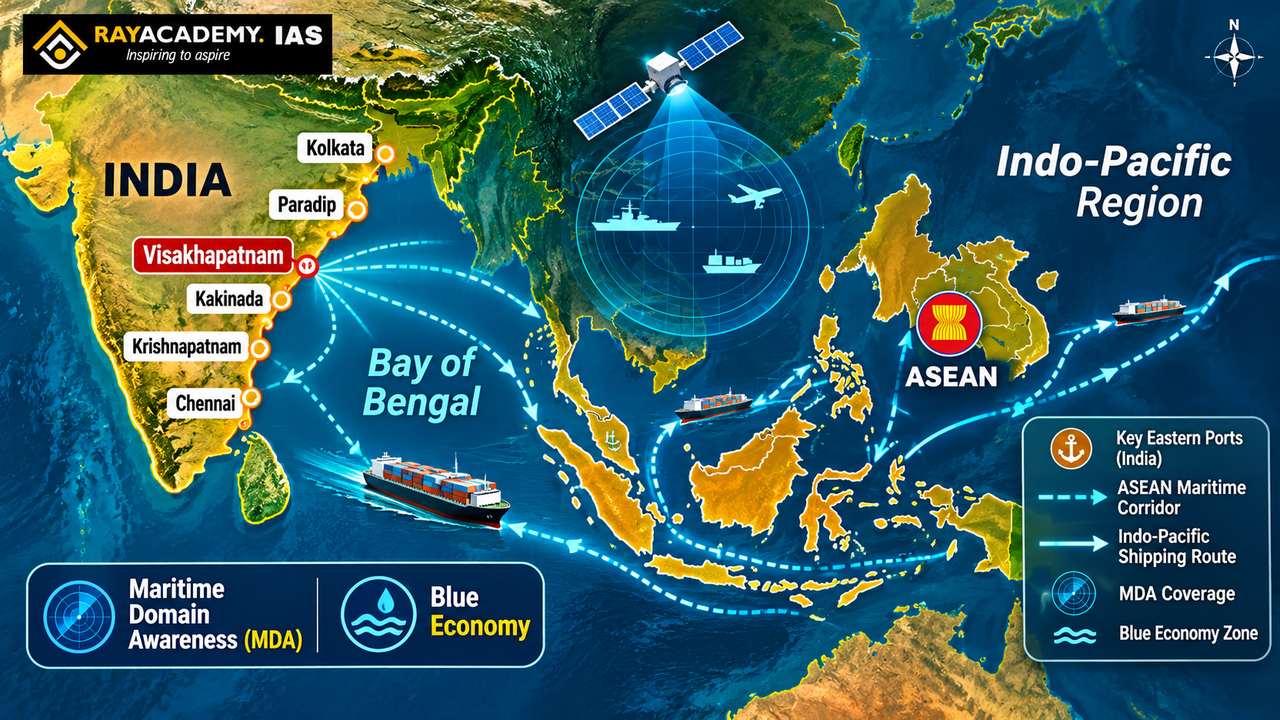
Static-Current Linkage: Act East Policy, SAGAR/MAHASAGAR, and Maritime Law
Evaluating the strategic significance of the ASEAN-India Maritime Conclave requires linking India’s evolving maritime doctrine with international legal frameworks and historical civilizational ties across the Bay of Bengal.
1. Doctrinal Evolution: From Look East to Act East and MAHASAGAR
Look East (1992) to Act East Policy (2014): Upgraded from a trade-centric outreach to a multidimensional strategic, connectivity, and security doctrine, India’s Act East Policy places ASEAN Centrality at the core of its Indo-Pacific engagement.
SAGAR (2015) to MAHASAGAR Vision: Building on the 2015 Security and Growth for All in the Region (SAGAR) vision, India’s expanded MAHASAGAR (Mutual and Holistic Advancement for Security and Growth Across Regions) framework promotes cooperative maritime security, capacity building, and sustainable ocean governance across the Indo-Pacific.
Indo-Pacific Oceans Initiative (IPOI) & AOIP Synergy: Launched at the 2019 East Asia Summit, India’s seven-pillar IPOI closely aligns with the ASEAN Outlook on the Indo-Pacific (AOIP), prioritizing maritime ecology, maritime connectivity, and disaster risk reduction.
2. Historical & Civilizational Bay of Bengal Linkages
For millennia, India’s eastern coast—historically known as Kalinga and the Coromandel coast—served as the maritime gateway to Southeast Asia (Suvarnabhumi). Ancient monsoon-driven maritime trade networks connected ports like Tamralipti, Palur, Kalingapatnam, and Visakhapatnam with Srivijaya, Champa, and Angkor, fostering shared cultural, linguistic, and Buddhist heritage.
3. International Maritime Legal Architecture (UNCLOS 1982)
United Nations Convention on the Law of the Sea (UNCLOS), 1982: Establishes the legal regime governing Territorial Seas (12 nautical miles), Contiguous Zones (24 nautical miles), Exclusive Economic Zones (EEZ up to 200 nautical miles), and Freedom of Navigation and Overflight across international straits and high seas. Both India and ASEAN littoral states rely on UNCLOS to uphold a rules-based maritime order in the South China Sea and Indian Ocean.
Prelims Focus: High-Yield Objective Facts
UPSC Prelims Quick-Revision Box:
ASEAN-India Maritime Architecture & Visakhapatnam ConclaveConclave Organizers & Venue: Organized by India Foundation in partnership with the Ministry of External Affairs (MEA) at Visakhapatnam, Andhra Pradesh (November 23–24, 2026), commemorating the 2026 ASEAN-India Year of Maritime Cooperation.
ASEAN Membership (11 Nations): Brunei, Cambodia, Indonesia, Laos, Malaysia, Myanmar, Philippines, Singapore, Thailand, Vietnam, and Timor-Leste (11th member).Information Fusion Centre – Indian Ocean Region (IFC-IOR): Hosted by the Indian Navy at Gurugram (Haryana); facilitates real-time Maritime Domain Awareness (MDA) and white-shipping information exchange with partner nations, including ASEAN littoral states.
Key Maritime Chokepoints Connecting India & ASEAN:Strait of Malacca: Narrow waterway between Peninsular Malaysia and Sumatra (Indonesia), linking the Andaman Sea (Indian Ocean) with the South China Sea.Sunda Strait & Lombok Strait: Critical deep-water alternatives in Indonesia connecting the Indian Ocean to the Java Sea and Pacific Ocean.
Six-Degree & Ten-Degree Channels: Strategic sea lanes near the Andaman and Nicobar Islands (home to India's first tri-service Andaman and Nicobar Command).
Major Indian East Coast Maritime Hubs: Visakhapatnam Port (deepest natural/landlocked-harbour major port on India's east coast; headquarters of the Eastern Naval Command), Paradip, Kakinada, Machilipatnam, and Chennai/Kamarajar.
Mains Analytical Breakdown: Significance and Multi-Dimensional Challenges
Strategic, Economic, and Ecological Significance
Operationalizing Paradiplomacy & Coastal-Led Growth: Engaging coastal states like Andhra Pradesh (which possesses a 1,053-km coastline and plans new ports at Ramayapatnam, Mulapeta, Machilipatnam, and Kakinada alongside a proposed shipbuilding cluster at Dugarajapatnam) integrates state-level infrastructure with national foreign policy.
Securing Sea Lines of Communication (SLOCs): Over 55% of India’s merchandise trade transits through the Strait of Malacca and the South China Sea. Institutionalizing Maritime Domain Awareness (MDA), joint naval drills (such as the ASEAN-India Maritime Exercise and MILAN), and white-shipping agreements deters piracy, maritime terrorism, and illegal, unreported, and unregulated (IUU) fishing.
Unlocking a Sustainable Blue Economy: Moving beyond traditional port handling toward green shipping corridors, coastal tourism, marine biotechnology, offshore wind, and sustainable fisheries creates resilient economic value chains across the Bay of Bengal.
Disaster Resilience & HADR Cooperation: Because the Bay of Bengal and Southeast Asia are highly vulnerable to tropical cyclones, tsunamis, and sea-level rise, institutionalized Humanitarian Assistance and Disaster Relief (HADR) protocols transform India into the region's preferred First Responder.
Multi-Dimensional Challenges in ASEAN-India Maritime Cooperation
Geopolitical & Security Rivalries (Strategic): Intensifying major-power contestation and assertive maritime claims in the South China Sea test ASEAN unity, making some Southeast Asian states cautious about overt security alignment despite valuing India’s balancing presence.
Infrastructural & Port Logistics Gaps (Economic): Despite the ASEAN-India Trade in Goods Agreement (AITIGA), bilateral trade remains constrained by non-tariff barriers, uneven port turnaround times, inadequate direct container shipping lines between Indian east coast ports and ASEAN hubs, and delays in terrestrial links like the India–Myanmar–Thailand (IMT) Trilateral Highway.
Submarine Cable & Cyber Vulnerabilities (Technological): Modern digital trade and financial connectivity depend on undersea optical fibre cables traversing the Indian Ocean and South China Sea, which face rising physical sabotage and cyber-espionage risks.
Marine Ecological Degradation & Climate Stress (Environmental): Unregulated port expansion, coastal erosion, marine plastic pollution, and warming ocean temperatures threaten fragile mangrove ecosystems (like Coringa and Sundarbans) and artisanal coastal livelihoods.
Way Forward: Anchored in Authoritative Frameworks
Expedite AITIGA Review & Direct East-Coast Shipping Corridors (NITI Aayog & Sagarmala Framework): Conclude the review of the ASEAN-India Trade in Goods Agreement (AITIGA) with reciprocal market access while operationalizing dedicated short-sea shipping and green maritime corridors linking Visakhapatnam, Paradip, and Chennai with Port Klang, Singapore, and Laem Chabang.
Institutionalize Regional Maritime Domain Awareness (Indian Maritime Doctrine & IFC-IOR): Expand liaison officer postings from all ASEAN littoral states at the Information Fusion Centre – Indian Ocean Region (IFC-IOR) in Gurugram and develop joint protocols for protecting critical undersea telecommunications infrastructure.
Operationalize the Blue Economy & Maritime Amrit Kaal Vision 2047: Leverage Maritime India Vision 2030 and Amrit Kaal Vision 2047 to foster joint ventures in green shipbuilding, port automation, and marine spatial planning with maritime leaders like Singapore, Malaysia, and Vietnam.
Strengthen Bay of Bengal HADR & Early Warning Grids (NDMA & CDRI): Integrate the Indian National Centre for Ocean Information Services (INCOIS) tsunami and cyclone early-warning architecture with ASEAN’s AHA Centre (ASEAN Coordinating Centre for Humanitarian Assistance on Disaster Management) to build collective coastal resilience.
Value Addition: Official Data Points for Mains Answers
Trade & Maritime Chokepoint Dependence (MEA / Ministry of Ports, Shipping and Waterways): India–ASEAN bilateral merchandise trade stands at approximately $128 billion, while over 55% of India’s external trade and nearly 80% of global seaborne oil trade transit through Indo-Pacific sea lanes including the Strait of Malacca.
Port Capacity Benchmark: Under the Sagarmala Programme, India’s major ports have nearly doubled their cargo-handling capacity over the past decade, with Visakhapatnam Port handling a record 91.17 million tonnes of cargo in FY 2025–26 (~10% YoY growth), anchoring India's eastern maritime gateway.
Administrative Catchphrase for Mains Conclusions: "Transforming the Bay of Bengal from a geographic divide into an integrated bridge of commerce, coastal resilience, and rules-based maritime order lies at the heart of India’s Act East Policy."
Practice Questions for Active Recall
Prelims Practice Question (Multi-Statement Format)
With reference to India’s maritime security architecture and ASEAN-India cooperation, consider the following statements:
The Information Fusion Centre – Indian Ocean Region (IFC-IOR), established to enhance Maritime Domain Awareness, is hosted by the Indian Navy at Visakhapatnam.
Under the United Nations Convention on the Law of the Sea (UNCLOS), a coastal state’s Exclusive Economic Zone (EEZ) extends up to 200 nautical miles from its baseline.
The Indo-Pacific Oceans Initiative (IPOI) launched by India aligns with the ASEAN Outlook on the Indo-Pacific (AOIP) in upholding ASEAN Centrality.
Which of the statements given above is/are correct?
(a) 1 and 2 only
(b) 2 and 3 only
(c) 1 and 3 only
(d) 1, 2, and 3
Correct Answer: (b) 2 and 3 only
Explanation:
Statement 1 is incorrect: While Visakhapatnam hosts the headquarters of the Eastern Naval Command, the Information Fusion Centre – Indian Ocean Region (IFC-IOR) is located at Gurugram, Haryana.
Statement 2 is correct: Under Part V of UNCLOS (1982), a coastal state may claim an Exclusive Economic Zone (EEZ) extending up to 200 nautical miles from the territorial sea baseline, granting sovereign rights over living and non-living marine resources.
Statement 3 is correct: Launched at the 14th East Asia Summit (2019), India’s IPOI complements the AOIP by emphasizing open, inclusive regional cooperation grounded in ASEAN Centrality and international law.
Mains Practice Question (150 Words | 10 Marks)
Q. "Strengthening maritime connectivity and sustainable Blue Economy partnerships with ASEAN is indispensable for operationalizing India’s Act East Policy and securing a rules-based Indo-Pacific." Discuss in the context of the 2026 ASEAN-India Maritime Conclave. (150 words)
Model Answer Structure:
Introduction: Contextualize the November 2026 ASEAN-India Maritime Conclave in Visakhapatnam (held during the ASEAN-India Year of Maritime Cooperation), linking it to India’s Act East Policy and MAHASAGAR maritime vision.
Body Paragraph 1 (Strategic & Economic Imperatives): Highlight securing vital sea lanes (Strait of Malacca, South China Sea), enhancing Maritime Domain Awareness via IFC-IOR, modernizing east-coast ports (Visakhapatnam, Sagarmala), and scaling Blue Economy and HADR cooperation.
Body Paragraph 2 (Key Bottlenecks): Note the overdue AITIGA review, non-tariff barriers, inadequate direct shipping links, submarine cable vulnerabilities, and South China Sea geopolitical tensions.
Conclusion: Conclude with a forward-looking roadmap—expediting AITIGA reforms, operationalizing green shipping corridors, and aligning IPOI with AOIP under UNCLOS norms.
Take this article with you
Save a reading copy for offline study.


