

92nd Annual Meeting of the Indian Academy of Sciences
500-Metre Crewed Trial Scheduled: Speaking on the sidelines of the 92nd Annual Meeting of the Indian Academy of Sciences (IASc) at the National Centre for Earth Science Studies (NCESS) in Thiruvananthapuram, Ministry of Earth Sciences (MoES) Secretary Srinivasa Kumar Tummala announced that India’s indigenous deep-ocean submersible Matsya-6000 will undergo its 500-metre depth trial dive in the Bay of Bengal in January–February 2027.
UPSC Syllabus Mapping:
General Studies Paper III (Science & Technology, Economy, and Environment): Achievements of Indians in science & technology; Indigenization of technology and developing new technology; Infrastructure: Energy, Ports, Roads, Airports, Railways etc. (Blue Economy); Conservation, environmental pollution and degradation, environmental impact assessment.
Built in phases under the Samudrayaan Project, the initial 500-metre trial paves the way for India’s flagship crewed scientific descent to 6,000 metres, carrying three humans inside a compact 2.1-metre diameter spherical hull.
ISRO–NIOT Technological Synergy: While the National Institute of Ocean Technology (NIOT) leads the design and aquanaut training, the Indian Space Research Organisation (ISRO) is collaborating closely to fabricate the precision 2.1-metre titanium alloy personnel sphere—a capability mastered by only a handful of nations worldwide.
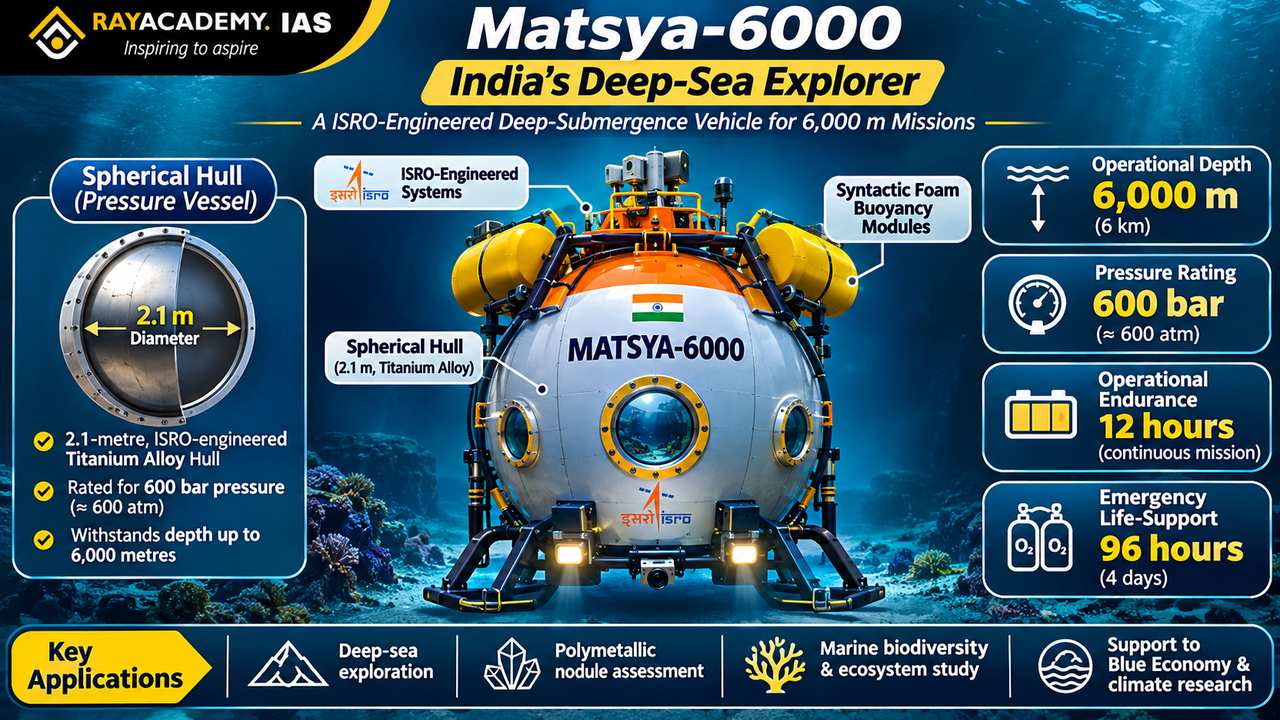
Static-Current Linkage.Matsya-6000
Deep Ocean Mission (DOM) Architecture: Approved in 2021 with an outlay of ₹4,077 crore, the Deep Ocean Mission is a central sector scheme implemented by the Ministry of Earth Sciences (MoES) to advance India’s Blue Economy and align with the UN Decade of Ocean Science for Sustainable Development (2021–2030). It comprises six thematic pillars:
Development of Technologies for Deep-Sea Mining and Manned Submersible (Samudrayaan)
Development of Ocean Climate Change Advisory Services
Technological Innovations for Exploration and Conservation of Deep-Sea Biodiversity
Deep Ocean Survey and Exploration (hydrothermal sulphides)
Energy and Freshwater from the Ocean (OTEC desalination)
Advanced Marine Station for Ocean Biology
Samudrayaan & Matsya-6000 Engineering: Samudrayaan is India’s first crewed deep-ocean scientific mission. Matsya-6000 is designed to transport three aquanauts (two NIOT pilots and one scientist) to 6,000 metres—where hydrostatic pressure reaches ~600 bar (600 times atmospheric pressure at sea level). Because only a few countries (such as the United States, Russia, China, Japan, and France) possess ultra-deep crewed submersible capabilities, ISRO’s electron-beam welding of an 80 mm-thick titanium alloy sphere bridges space and marine engineering.
UNCLOS & International Seabed Authority (ISA): Under the United Nations Convention on the Law of the Sea (UNCLOS), 1982, the seabed beyond national jurisdiction (known as "The Area") and its mineral resources are the "Common Heritage of Mankind." The International Seabed Authority (ISA) (headquartered in Kingston, Jamaica) regulates mineral exploration contracts in international waters. India holds ISA exploration contracts in the Central Indian Ocean Basin (CIOB) for polymetallic nodules (rich in manganese, nickel, cobalt, copper, and rare earths) and in the Indian Ocean Ridge for polymetallic sulphides.
Prelims Focus: High-Yield Objective Facts
Dimension / Institution | Key Facts & Specifications for UPSC Prelims |
Nodal Ministry & Institutes | Ministry of Earth Sciences (MoES); implemented by National Institute of Ocean Technology (NIOT), Chennai, in collaboration with ISRO (Vikram Sarabhai Space Centre). |
Matsya-6000 Specifications | • Crew Capacity: 3 humans (aquanauts). |
• Hull: 2.1-metre diameter spherical hull (steel sphere for 500 m phase; titanium alloy for 6,000 m phase).
• Endurance: 12 hours normal operation; 96 hours emergency life-support backup.
• 2027 Trial Location: Bay of Bengal (500 m trial in Jan–Feb 2027). | | Polymetallic Nodules (PMNs) | Also called manganese nodules; potato-shaped mineral concretions found on abyssal plains (4,000–6,000 m depth) containing manganese, iron, nickel, cobalt, copper, and rare earth elements. | | International Seabed Authority (ISA) | Autonomous international organization established under UNCLOS (1982) and the 1994 Implementation Agreement; headquartered in Kingston, Jamaica. | | Maritime Zones Under UNCLOS | • Territorial Sea: Up to 12 nautical miles (nm).
• Contiguous Zone: Up to 24 nm.
• Exclusive Economic Zone (EEZ): Up to 200 nm (India's EEZ spans ~2.37 million sq. km). |
Mains Analytical Breakdown
Significance of Samudrayaan and Deep-Sea Exploration
Critical Minerals Security & Import Substitution: Exploring polymetallic nodules and hydrothermal sulphides at 4,000–6,000 m depths provides long-term access to cobalt, nickel, manganese, and copper—vital inputs for electric vehicle batteries, solar panels, and defense electronics, reducing strategic import dependence.
Advancing India’s Blue Economy Vision: With a 7,516.6 km coastline (revised to ~11,098 km under updated Survey of India coastal methodologies) and a 2.37 million sq. km EEZ, indigenous ocean engineering unlocks sustainable marine biotechnology, offshore energy, and seabed resource mapping.
Strategic & Geopolitical Parity: Joining the elite group of nations capable of crewed 6,000-metre ocean dives strengthens India’s Indian Ocean Region (IOR) maritime domain awareness, MAHASAGAR vision, and scientific leadership in the Global South.
Cross-Sectoral Technological Spin-Offs: Just as Gaganyaan advances human spaceflight, Samudrayaan drives breakthroughs in ultra-high-pressure metallurgy, syntactic foam composites, acoustic underwater telemetry, and closed-loop life-support systems.
Multi-Dimensional Challenges
Engineering & Material Precision: At 6,000 metres, hydrostatic pressure (~600 bar) leaves zero margin for structural error; sourcing aerospace-grade titanium alloys and achieving flawless electron-beam welding of the 2.1-metre sphere involve complex technical tolerances.
Life Support & Underwater Communication Constraints: Radio waves attenuate rapidly in seawater, forcing reliance on low-bandwidth acoustic communication, while maintaining breathable oxygen, CO₂ scrubbing, and thermal regulation inside a confined 2.1-metre sphere tests crew endurance.
Environmental — Fragile Abyssal Ecosystems: Deep-sea benthic habitats host slow-growing, endemic organisms and hydrothermal vent ecosystems; invasive seabed mining risks sediment plumes, biodiversity loss, and disruption of deep-ocean carbon sequestration.
International Legal & Regulatory Uncertainty: The International Seabed Authority (ISA) is still finalizing its Mining Code for commercial exploitation, amid growing global calls by several nations for a precautionary pause or moratorium on deep-sea mining until environmental baselines are established.
Public Outreach & Capital Intensity: As MoES officials noted, Samudrayaan has received less public attention than ISRO’s Gaganyaan despite comparable engineering complexity and long-gestation capital requirements.
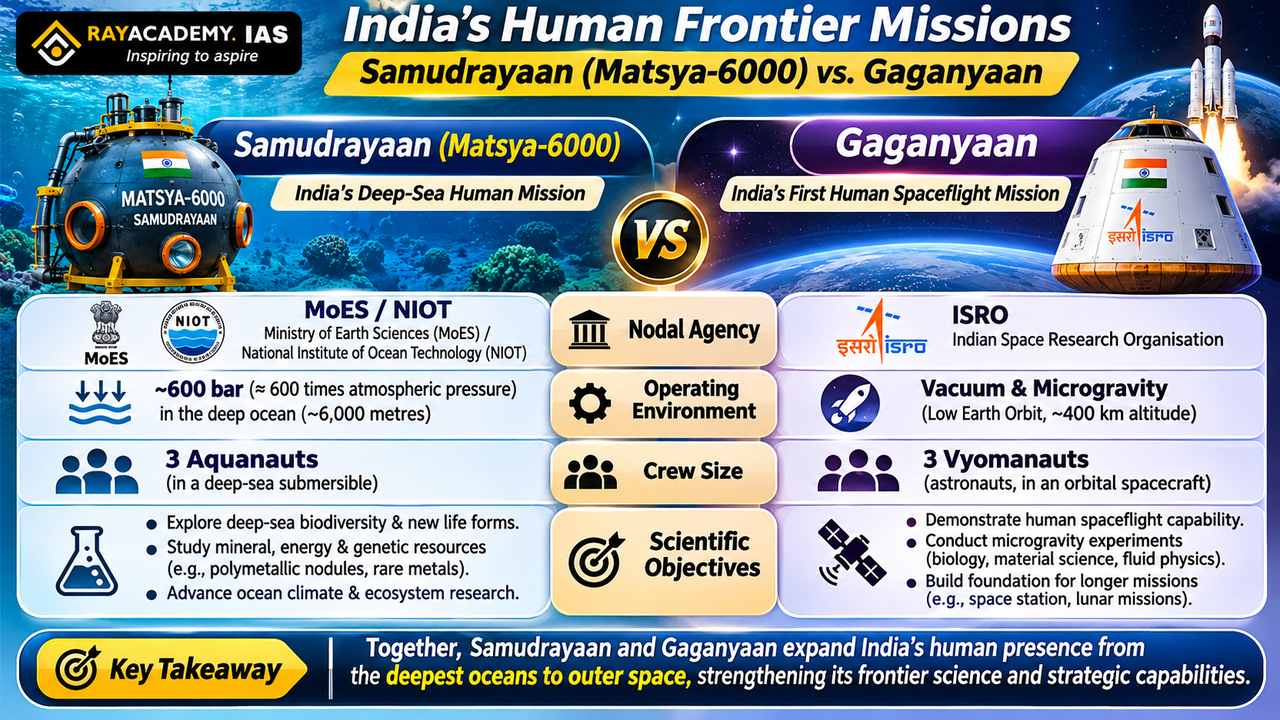
Way Forward
Strict adherence to Phased Certification & Safety Protocols: Execute the January–February 2027 500-metre Bay of Bengal trials with rigorous structural, ballast, and emergency drop-weight validation before progressing to full 6,000-metre titanium-hull descents.
Adopt a "Science-First, Precaution-Led" Environmental Framework: Align deep-sea exploration with Environmental Impact Assessment (EIA) protocols and ISA environmental guidelines, prioritizing non-invasive biodiversity mapping and baseline ecological studies before any commercial nodule harvesting.
Institutionalize Inter-Agency R&D Synergies: Formalize a joint MoES–ISRO–DRDO–CSIR marine-aerospace technology consortium to share testing facilities, titanium metallurgy, and autonomous underwater robotics, lowering R&D duplication.
Strengthen Industry-Academia Participation in the Blue Economy: Encourage Indian startups and private shipyards to co-develop underwater sensors, Remotely Operated Vehicles (ROVs), and Ocean Thermal Energy Conversion (OTEC) components under NITI Aayog’s Blue Economy Policy framework.
Shape Global Seabed Governance Norms: Actively participate in ISA Council negotiations to advocate transparent environmental standards, equitable benefit-sharing for developing nations, and protection of marine genetic resources under the UN High Seas Treaty (BBNJ Agreement).
Value Addition for Mains
Official Mission & Engineering Benchmark (MoES, Nov 2026): Under the ₹4,077 crore Deep Ocean Mission, NIOT and ISRO are developing Matsya-6000—featuring a 2.1-metre diameter titanium spherical hull for three aquanauts to dive to 6,000 metres, preceded by 500-metre Bay of Bengal trials in Jan–Feb 2027.
Blue Economy & Constitutional Anchor: India’s Draft Blue Economy Policy projects the ocean sector to contribute significantly toward Viksit Bharat 2047, operationalizing Article 51A(h) (scientific temper and spirit of inquiry) and Article 48A (environmental stewardship) across India’s 2.37 million sq. km EEZ.
Practice Questions for Active Recall
Prelims Practice MCQ
With reference to India’s Samudrayaan Project and deep-ocean governance, consider the following statements:
Matsya-6000 is an indigenous crewed submersible being developed by the National Institute of Ocean Technology (NIOT) in collaboration with ISRO to carry three humans to a depth of 6,000 metres.
The International Seabed Authority (ISA), which regulates mineral exploration in international seabed areas, was established under the United Nations Convention on the Law of the Sea (UNCLOS).
Under the Deep Ocean Mission, India conducts polymetallic nodule exploration exclusively within its 200-nautical-mile Exclusive Economic Zone (EEZ).
Which of the statements given above are correct?
(a) 1 and 2 only
(b) 2 and 3 only
(c) 1 and 3 only
(d) 1, 2, and 3
Correct Answer: (a) 1 and 2 only
Explanation:
Statement 1 is correct: Matsya-6000 is India’s crewed deep-ocean scientific submersible developed by NIOT (under MoES) with ISRO building the 2.1-metre titanium spherical hull to carry three aquanauts to 6,000 metres.
Statement 2 is correct: The International Seabed Authority (ISA) is an autonomous intergovernmental body established under UNCLOS (1982) to organize, regulate, and control all mineral-related activities in the international seabed area beyond national jurisdiction.
Statement 3 is incorrect: India’s polymetallic nodule exploration contract (covering 75,000 sq. km) is located in the Central Indian Ocean Basin (CIOB) in international waters (beyond India’s 200 nm EEZ), granted under contract with the ISA.
Mains Practice Question (GS Paper III — 150 Words | 10 Marks)
"India’s Samudrayaan Project represents a strategic convergence of aerospace engineering and marine science to unlock the Blue Economy, yet ultra-deep ocean exploration demands strict adherence to ecological precaution." Discuss the technological and economic significance of Matsya-6000 alongside the environmental and engineering challenges involved.
Answer Structure Hints:
Introduction: Contextualize the announcement of Matsya-6000’s 500-metre trial dive in the Bay of Bengal in early 2027, paving the way for a 6,000-metre crewed mission with three aquanauts under the Deep Ocean Mission.
Body Part 1 (Technological & Economic Significance): Highlight NIOT–ISRO collaboration on the 2.1-metre titanium spherical hull, mapping polymetallic nodules (cobalt, nickel, manganese) for critical mineral security, deep-sea biodiversity research, and advancing India’s Blue Economy.
Body Part 2 (Engineering & Environmental Challenges): Address extreme hydrostatic pressure (~600 bar), electron-beam welding tolerances, underwater acoustic communication limits, and risks to fragile abyssal ecosystems pending finalization of the ISA Mining Code.
Conclusion: Conclude with a science-first, precaution-led approach combining phased safety validation, EIA compliance, and international cooperation under UNCLOS.
Take this article with you
Save a reading copy for offline study.


