

Retail Inflation Breaches
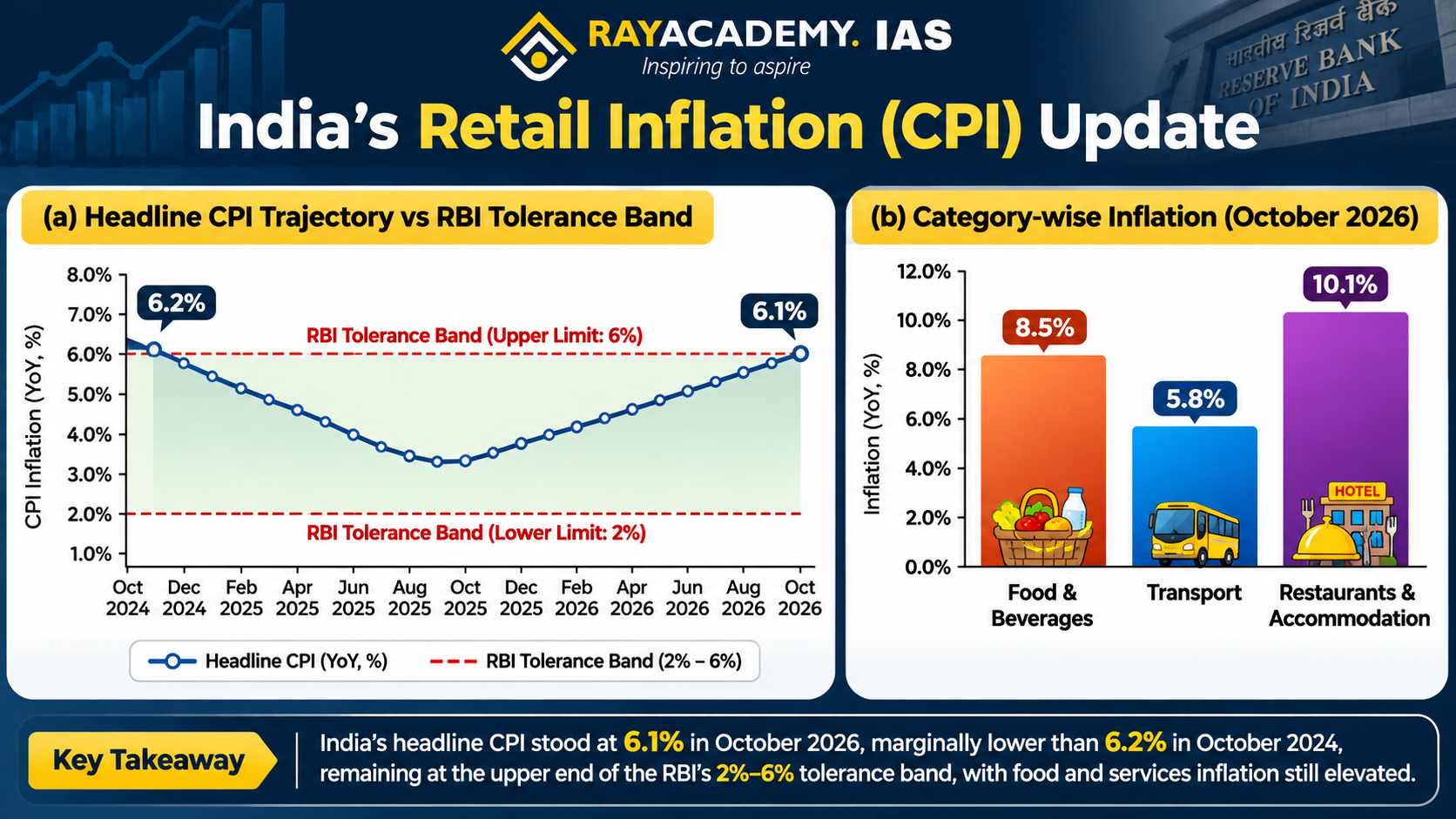
India’s retail inflation, measured by the All-India Consumer Price Index (CPI), accelerated to 6.09% (6.1%) in October 2026, breaching the Reserve Bank of India (RBI)’s upper tolerance threshold of 6% for the first time in two years (since October 2024, when it stood at 6.2%)
UPSC Syllabus Mapping:
General Studies Paper III (Indian Economy): Indian Economy and issues relating to planning, mobilization of resources, growth, development and employment; Inclusive growth and issues arising from it; Monetary Policy, Inflation Targeting, and Price Stability.
According to provisional data released by the Ministry of Statistics and Programme Implementation (MoSPI) under the updated CPI series (Base Year 2024=100), price pressures have broadened across nearly all consumption categories. While food and beverages inflation surged to 8.5% (with the Consumer Food Price Index hitting 8.94%) and transport inflation reached a series high of 5.8%, restaurant and accommodation services crossed into double digits at 10.1%. This broad-based uptick—combining supply-side shocks with festive-season demand pull—complicates the Monetary Policy Committee (MPC)’s upcoming December 2026 rate trajectory following its recent 25-basis-point repo rate hike to 5.50%.
Static-Current Linkage: Flexible Inflation Targeting (FIT) and the Updated CPI (2024=100) Architecture
Understanding the macroeconomic significance of a 6.1% CPI print requires linking statutory monetary governance under the RBI Act, 1934 with recent statistical reforms in price measurement.
Statutory Framework of Flexible Inflation Targeting (FIT). Retail Inflation Breaches RBI’s 6% Upper Limit
Following the recommendations of the Urjit Patel Committee (2014), the Government of India amended the Reserve Bank of India Act, 1934 (via the Finance Act, 2016) to establish a statutory Monetary Policy Framework.
Inflation Target (Section 45ZA): Under Section 45ZA of the RBI Act, 1934, the Union Government, in consultation with the RBI, fixes the inflation target once every five years. For the 2026–2031 block, the target remains anchored at 4% headline CPI inflation, with an upper tolerance limit of 6% and a lower tolerance limit of 2% .
Definition of Policy Failure (Section 45ZN): A single monthly breach above 6% does not constitute a statutory failure. Under Section 45ZN of the RBI Act and Rule 7 of the MPC Rules, 2016, the RBI is deemed to have failed to meet its target only if average inflation remains above 6% or below 2% for three consecutive quarters. In such an event, the RBI must submit a formal report to the Central Government explaining the reasons for failure, proposed remedial actions, and an estimated timeline to restore price stability. Retail Inflation Breaches RBI’s 6% Upper Limit
Statistical Transition to CPI Base Year 2024=100 .
In 2026, MoSPI transitioned India’s retail inflation measurement from the outdated 2012 base year to the modernized CPI series (Base Year 2024=100), calibrated using findings from the Household Consumption Expenditure Survey (HCES) 2022–23 and 2023–24.
Structural Re-weighting: Reflecting rising per-capita incomes and changing household consumption baskets, the weight of Food and Beverages in the combined CPI basket was reduced from 45.86% (in the 2012 series) to 36.75% (in the 2024 series), while services—such as transport, healthcare, education, and restaurants—received higher representation.
Broad-Based Spillover Signal: Because food carries a lower weight in the 2024 series than before, an overall headline print of 6.09% confirms that inflationary pressures are no longer isolated to vegetable price spikes; they have spilled over into core services and non-food sectors.
India's Retail inflation
Prelims Focus: High-Yield Objective Facts
Nodal Compilation Agency: National Statistics Office (NSO) under the Ministry of Statistics and Programme Implementation (MoSPI) compiles All-India Rural, Urban, and Combined CPI on a monthly basis (collecting weekly price quotations from 1,407 urban markets and 1,465 villages).
CPI Base Year 2024=100: Replaced the 2012=100 series; incorporates 12 COICOP divisions (Classification of Individual Consumption According to Purpose), lowering the combined weight of Food and Beverages to 36.75%.
Inflation Target Mandate: 4% based on CPI (Combined)—not Wholesale Price Index (WPI)—fixed every five years by the Central Government in consultation with the RBI under Section 45ZA of the RBI Act, 1934.
Monetary Policy Committee (MPC): Statutory 6-member body under Section 45ZB of the RBI Act (3 RBI officials including the Governor as Chairperson with a casting vote, and 3 external members appointed by the Central Government for a 4-year non-renewable term); required to meet at least 4 times a year.
CPI vs. WPI Key Distinctions: CPI includes services (housing, education, healthcare, transport, restaurants) and reflects indirect taxes paid by consumers; WPI (compiled by the Office of the Economic Adviser, Ministry of Commerce and Industry, base year 2011–12) tracks only goods at the wholesale/producer level and excludes services.
Key October 2026 Inflation Metrics: Headline Combined CPI: 6.09% (Rural: 6.63%, Urban: 5.41%); Consumer Food Price Index (CFPI): 8.94%; Driven by sharp spikes in onion (+116.2%) and garlic (+60.7%), despite deflation in potato (-14.2%).
Mains Analytical Breakdown
Significance of Breaching the 6% Upper Tolerance Threshold
Early Warning Against Second-Round Inflationary Effects: Crossing the 6% psychological and statutory ceiling signals that persistent food and fuel shocks are feeding into wage-price spirals and service-sector pricing (evidenced by 10.1% inflation in restaurants and accommodation).
Testing Credibility of the New CPI Series: With sectoral back-series data under the 2024 base year extending only to January 2026, October’s series-high readings across multiple categories provide the MPC with critical empirical evidence on how modern Indian households experience cost-of-living pressures.
Anchoring Inflation Expectations: Prompt acknowledgment of the breach prevents household and business inflation expectations from becoming unanchored, which is essential to keep long-term bond yields stable and protect sovereign credit ratings.
Multi-Dimensional Challenges
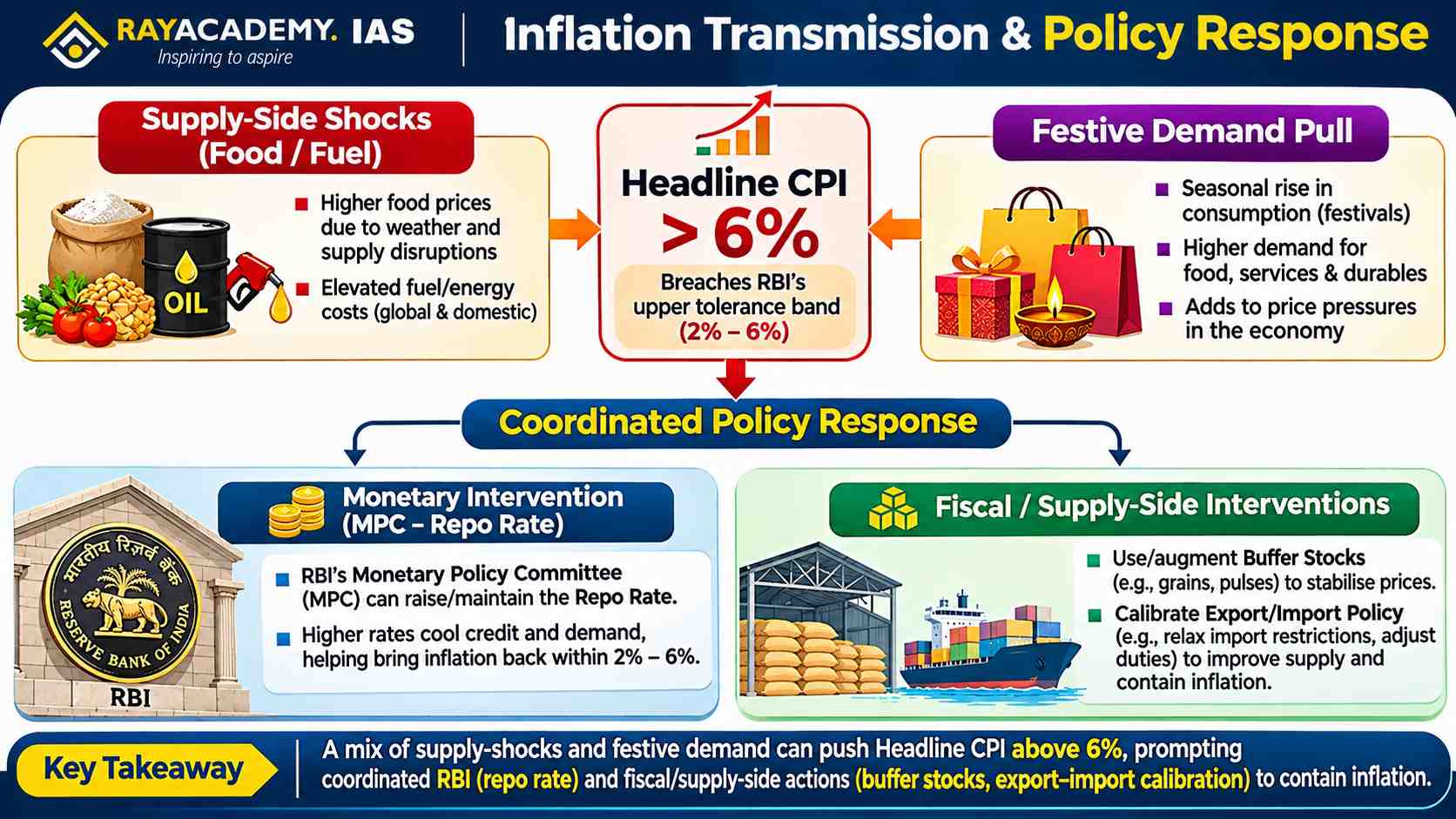
Monetary Policy Dilemma (Growth vs. Inflation Trade-Off): As noted by economists, October’s price surge reflects both cost-push supply shocks (food and crude oil) and demand-pull pressures (festive-season consumption). Raising the repo rate beyond 5.50% curbs aggregate demand and defends the Rupee, but excessive monetary tightening risks dampening private capital expenditure and credit flow to MSMEs.
Social & Distributional Regressivity: Retail inflation acts as a regressive hidden tax on low-income households. With rural CPI (6.63%) outpacing urban CPI (5.41%) and food inflation nearing 9%, daily-wage earners and unorganized workers—whose wages adjust with a lag—suffer acute erosion in real purchasing power and nutritional security.
Supply-Chain & Climate Vulnerability: Recurring spikes in horticultural perishables (onions, garlic, ginger) highlight structural deficits in cold-chain logistics, erratic monsoon patterns, and extreme weather events that blunt the efficacy of interest rate hikes.
External & Geopolitical Spillovers: Rising global crude oil prices and imported input costs immediately pass through to domestic transport inflation (5.8%) and logistics expenses, narrowing the fiscal space available for excise duty cuts.
Statistical & Policy Calibration Constraints: Because the new 2024=100 CPI series has a limited historical time series (starting January 2026), econometric forecasting models face temporary calibration challenges when estimating seasonal adjustment factors.
Inflation Transmission
Way Forward
Synchronized Monetary-Fiscal Policy Coordination: Following the Economic Survey and RBI Monetary Policy Report frameworks, monetary tightening via the repo rate must be paired with non-inflationary fiscal consolidation. The Union and State governments should avoid populist, untargeted cash transfers that stoke demand-pull pressures while maintaining capital expenditure quality.
Structural Agricultural Supply-Chain Reforms (Dalwai Committee Framework): In line with the Ashok Dalwai Committee on Doubling Farmers’ Income, policy must shift from knee-jerk export bans to structural investments in irradiation facilities, scientific onion/horticulture storage silos, and Operation Greens value chains to dampen seasonal price volatility.
Dynamic Buffer Stock Management and Open Market Interventions: Operationalize the Price Stabilisation Fund (PSF) using predictive satellite crop-acreage forecasting to execute timely Open Market Sale Scheme (OMSS) releases of pulses, cereals, and essential vegetables before retail prices breach tolerance thresholds.
Calibrated Fuel Taxation and Logistics Efficiency: Rationalize central excise duties and state Value Added Tax (VAT) on petrol and diesel in coordination with the GST Council—or evaluate phased inclusion of aviation turbine fuel and natural gas under GST—to reduce cascading transport costs across the economy.
Strengthening Granular Price Data Infrastructure: Expand MoSPI’s digital market intelligence and high-frequency wholesale-to-retail price monitoring portals to identify localized hoarding and supply bottlenecks in real time across rural and Tier-2 markets.
Value Addition for Mains
Official CPI & Sectoral Benchmark (MoSPI, Nov 2026): Under the CPI (Base 2024=100) series, India’s retail inflation crossed the 6% RBI ceiling for the first time in 24 months at 6.09% in October 2026, driven by Food & Beverages (8.51%), Transport (5.84%), and Restaurants & Accommodation (10.06%)—demonstrating that modern inflation management requires addressing both farm-gate supply bottlenecks and service-sector price stickiness.
Theoretical & Institutional Anchor: As former RBI Governor C. Rangarajan emphasized in the context of developing economies, "Price stability is not an end in itself, but the indispensable foundation for sustained growth and social equity"—reinforcing why safeguarding the statutory 4% Flexible Inflation Targeting framework remains vital for India’s Viksit Bharat 2047 trajectory.
Practice Questions for Active Recall
Prelims Practice MCQ
With reference to the Consumer Price Index (CPI) and the Flexible Inflation Targeting (FIT) framework in India, consider the following statements:
Under the Reserve Bank of India Act, 1934, if headline retail inflation exceeds the 6% upper tolerance limit in any single month, the RBI is statutorily required to submit an explanation report to the Central Government.
Under the updated All-India CPI series (Base Year 2024=100), the combined weightage of the "Food and Beverages" division has decreased compared to the earlier 2012=100 series.
Unlike the Wholesale Price Index (WPI), the Consumer Price Index (CPI) captures price changes in services such as healthcare, education, and accommodation.
Which of the statements given above are correct?
(a) 1 and 2 only
(b) 2 and 3 only
(c) 1 and 3 only
(d) 1, 2, and 3
Correct Answer: (b) 2 and 3 only
Explanation:
Statement 1 is incorrect: Under Section 45ZN of the RBI Act, 1934, the RBI is deemed to have failed its inflation mandate—and must submit a formal report to the Government—only if average inflation remains above 6% or below 2% for three consecutive quarters, not for a single monthly breach.
Statement 2 is correct: Based on updated consumption patterns from the Household Consumption Expenditure Survey (HCES), the 2024=100 CPI series reduced the combined weight of Food and Beverages from 45.86% (in the 2012 series) to 36.75%.
Statement 3 is correct: CPI tracks retail prices of both goods and services (including housing, health, education, transport, and restaurants), whereas WPI measures only wholesale prices of goods and excludes services.
Mains Practice Question (GS Paper III — 150 Words | 10 Marks)
"When retail inflation breaches the Reserve Bank of India’s upper tolerance band due to a combination of supply-side food shocks and broad-based service price pressures, monetary policy alone proves insufficient." Examine the drivers behind India's recent retail inflation surge and suggest a coordinated monetary-fiscal strategy to restore price stability without stifling economic growth.
Answer Structure Hints:
Introduction: Contextualize India’s October 2026 retail inflation hitting 6.09% under the 2024=100 CPI series, crossing the RBI's 6% upper tolerance ceiling for the first time in two years.
Body Part 1 (Drivers & Limits of Monetary Policy): Highlight the dual drivers—cost-push shocks in food (8.5%) and fuel/transport (5.8%), alongside demand-pull pressures in services like restaurants/accommodation (10.1%). Explain why repo rate hikes (currently 5.50%) cannot directly grow more onions or fix supply chains, and overly aggressive tightening risks hurting investment.
Body Part 2 (Coordinated Strategy): Propose calibrated MPC liquidity management paired with fiscal/supply-side actions—timely buffer stock releases via the Price Stabilisation Fund, modern cold-chain storage (Dalwai Committee), rationalized fuel duties, and fiscal prudence.
Conclusion: Conclude with the statutory 4% Flexible Inflation Targeting framework, emphasizing that synchronized monetary and supply-side governance is vital for inclusive, non-inflationary growth.
Take this article with you
Save a reading copy for offline study.


