

Global Tuberculosis Report 2026
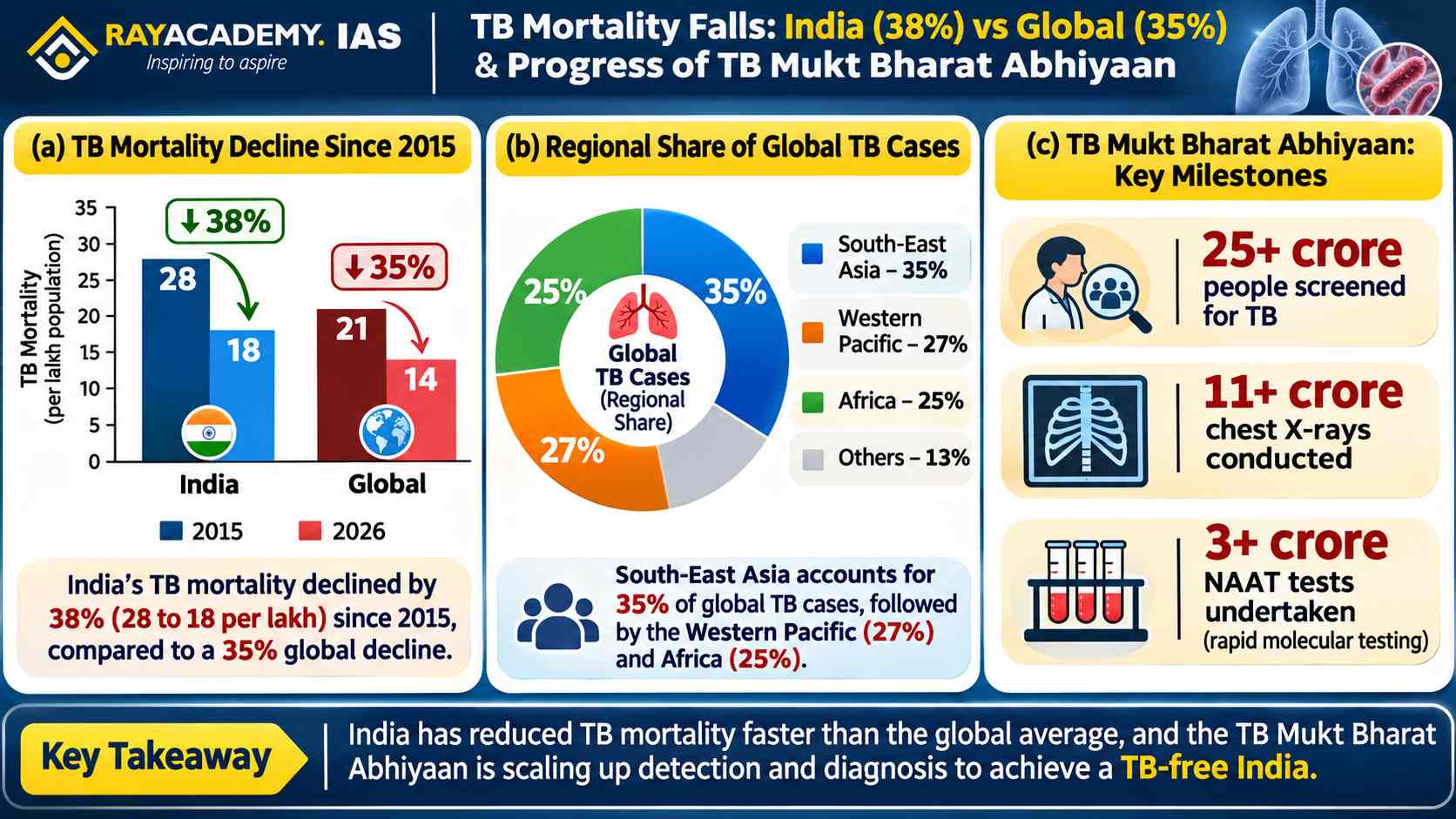
According to the World Health Organization (WHO)’s Global Tuberculosis Report 2026, India has achieved a 38% reduction in tuberculosis (TB) mortality since 2015 (bringing the mortality rate down from 28 per lakh population in 2015 to 18 per lakh in 2025), outpacing the global average decline of 35%.
UPSC Syllabus Mapping:
General Studies Paper II (Social Justice & Governance): Issues relating to development and management of Social Sector/Services relating to Health, Education, Human Resources; Welfare schemes for vulnerable sections of the population by the State and the performance of these schemes.
General Studies Paper III (Science & Technology): Science and Technology—developments and their applications and effects in everyday life; Achievements of Indians in science & technology; Indigenization of technology (AI-enabled diagnostics and molecular testing).
The report also highlights a 94% treatment success rate among patients with drug-susceptible TB in India. Simultaneously, the Union Ministry of Health and Family Welfare announced that under the intensified TB Mukt Bharat Abhiyaan (between December 7, 2024, and November 8, 2026), over 25 crore individuals were screened, detecting 48.64 lakh new cases—including 14.97 lakh asymptomatic infections—through AI-enabled handheld X-rays and rapid molecular testing. Despite these strides, India still accounts for roughly one-quarter of global new TB cases, keeping elimination efforts at the forefront of public health governance.
Static-Current Linkage: Etiology of Tuberculosis, Constitutional Mandates, and India’s Elimination Architecture
Evaluating India’s TB progress requires linking the biomedical science of Mycobacterium tuberculosis with constitutional health obligations and the evolving institutional architecture of the National Tuberculosis Elimination Programme (NTEP).
Biomedical Principles and Drug Resistance
Tuberculosis is a contagious airborne infectious disease caused by the rod-shaped bacterium Mycobacterium tuberculosis, primarily affecting the lungs (pulmonary TB) but capable of impacting other organs (extrapulmonary TB).
Transmission & Risk Factors: Spread through aerosol droplets when infected individuals cough or sneeze, TB disproportionately affects immunocompromised populations—particularly individuals living with HIV, undernutrition, diabetes mellitus, and tobacco users.
Antimicrobial Resistance (AMR) Spectrum: Incomplete or erratic treatment drives mutations leading to Multidrug-Resistant TB (MDR-TB) (resistant to first-line drugs Isoniazid and Rifampicin) and Extensively Drug-Resistant TB (XDR-TB), posing a severe public health security threat.
Constitutional and Policy Frameworks
Article 21 & Article 47: Under Article 21 (Paschim Banga Khet Mazdoor Samity v. State of West Bengal, 1996), the Supreme Court affirmed that the Right to Health and timely medical care are integral to the Right to Life. Article 47 (Directive Principles of State Policy) directs the State to raise the level of nutrition and standard of living and improve public health as among its primary duties.
National Strategic Plan (NSP) for TB Elimination: In 2020, India renamed the Revised National Tuberculosis Control Programme (RNTCP) as the National Tuberculosis Elimination Programme (NTEP) to align with its ambitious national target of achieving TB elimination—five years ahead of the UN Sustainable Development Goal (SDG 3.3) target of ending the TB epidemic by 2030.
Prelims Focus: High-Yield Objective Facts
Nodal Ministry & Programme: Central TB Division, Ministry of Health and Family Welfare (MoHFW) implements the National Tuberculosis Elimination Programme (NTEP) under the National Health Mission (NHM).
Global TB Burden (WHO Report 2026):
Global Deaths (2025): 1.13 million people died from TB globally in 2025.
Regional Share of New Cases: South-East Asia Region (35%) recorded the largest share, followed by the Western Pacific Region (27%) and African Region (25%).
High-Burden Concentration: 30 high-burden countries accounted for 88% of all new cases globally—led by India (~25%), Indonesia (10%), the Philippines (6.8%), China (6.5%), Pakistan (6.4%), Nigeria (4.9%), DR Congo (3.9%), and Bangladesh (3.7%).
Key Indian Digital & Welfare Initiatives:
Ni-kshay Portal: Unified digital surveillance and case-notification ecosystem tracking public and private sector TB patients; data from Ni-kshay and RGI’s Sample Registration System (SRS) informed the WHO 2026 assessment.
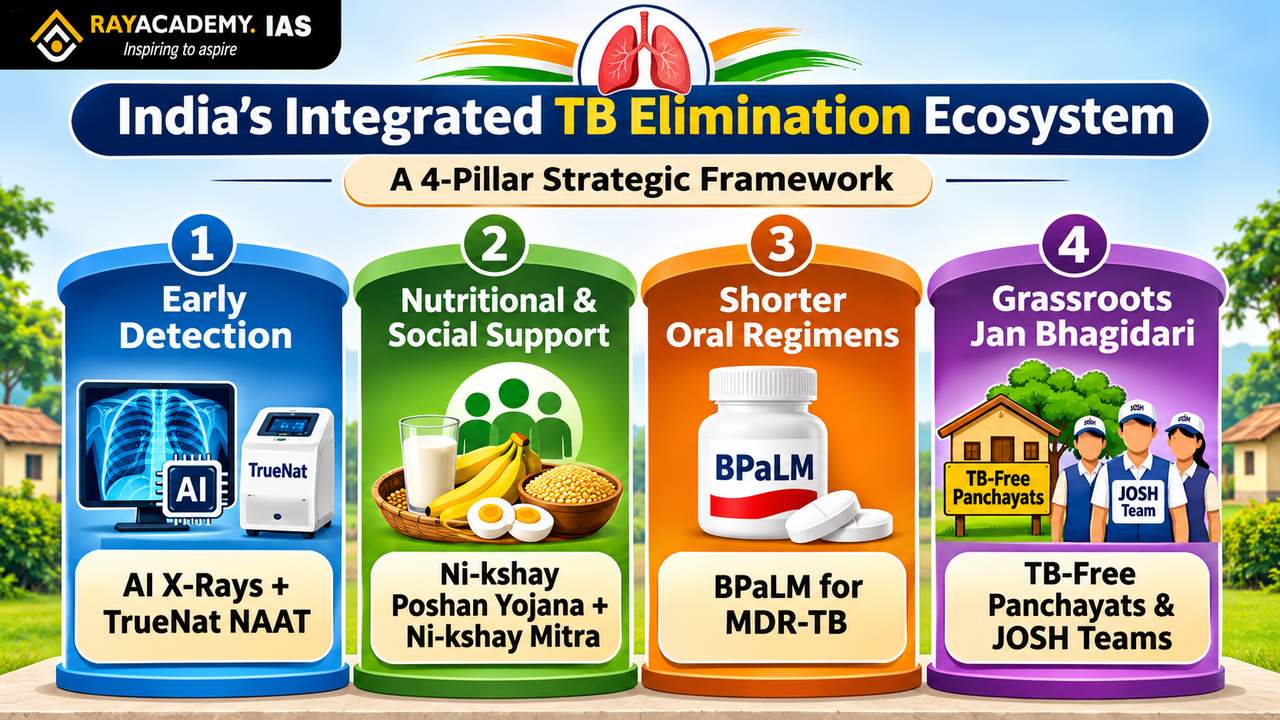
Ni-kshay Poshan Yojana: Direct Benefit Transfer (DBT) scheme providing ₹1,000 per month (enhanced from ₹500) to every notified TB patient for nutritional support throughout treatment.
Pradhan Mantri TB Mukt Bharat Abhiyaan (Ni-kshay Mitra): Community mobilization initiative enabling individuals, NGOs, and corporates to adopt TB patients for nutritional, diagnostic, and vocational support.
Diagnostic & Therapeutic Innovations:
NAAT (Nucleic Acid Amplification Tests): Rapid molecular tests (such as TrueNat—an indigenous battery-operated chip-based PCR test—and CBNAAT/GeneXpert) that detect TB and Rifampicin resistance within hours.
BPaLM Regimen: Shorter, all-oral 6-month regimen (Bedaquiline, Pretomanid, Linezolid, and Moxifloxacin) rolled out in India for MDR-TB, replacing painful 18–24 month injectable regimens.
BCG Vaccine: Bacille Calmette-Guérin (live-attenuated vaccine derived from Mycobacterium bovis), administered at birth under India’s Universal Immunization Programme to prevent severe childhood TB (TB meningitis and miliary TB).
Mains Analytical Breakdown
Significance of India’s Mortality Reduction and Treatment Success
Validation of Proactive, Tech-Enabled Case Finding: Shifting from passive clinic-based detection to doorstep screening via AI-enabled portable chest X-rays and NAAT enabled early diagnosis of nearly 15 lakh asymptomatic cases, interrupting silent community transmission chains.
Success of Differentiated and Nutritional Care: Pairing medical regimens with Ni-kshay Poshan Yojana DBT transfers and Ni-kshay Mitra community adoption has pushed drug-susceptible treatment success to 94%, demonstrating that addressing social determinants directly improves clinical adherence.
Domestic Financial Self-Reliance & Grassroots Governance: With 96% of TB programme funding met through domestic resources and over 67,900 Gram Panchayats certified TB-free, India has built a decentralized, Jan Bhagidari-driven public health model.
Multi-Dimensional Challenges
Persistent High Incidence Share: Accounting for roughly one-fourth of all global TB cases means that high population density, urban slums, and migrant labor corridors continue to sustain active transmission pools.
Catastrophic Household Economic Burden: Globally, approximately 50% of TB-affected households face catastrophic total costs (direct medical expenses, non-medical transport/food costs, and indirect wage losses exceeding 20% of total household income), pushing vulnerable families into debt traps.
Comorbidity Syndemic (Undernutrition, Diabetes, and HIV): As highlighted by the ICMR RATIONS trial, undernutrition is the single largest population-attributable risk factor for TB in India, compounded by rising diabetes prevalence and tobacco consumption.
Multidrug-Resistant TB (MDR-TB) Threat: Drug-resistant TB remains a complex public health security challenge due to diagnostic delays in remote areas, adverse drug reactions, and private-sector prescription variability.
Social Stigma and Gender Disparities: Persistent social ostracization—particularly affecting women of marriageable age and informal-sector workers—delays care-seeking behavior and leads to concealed diagnoses.
Way Forward
Address Undernutrition as a Primary Preventive Vaccine: Scaling up the findings of the ICMR–NIRT RATIONS (Reducing Activation of Tuberculosis by Improvement of Nutritional Status) trial, integrate targeted food basket supplementation for household contacts of TB patients with the Public Distribution System (PDS) and POSHAN Abhiyaan to prevent latent TB progression.
Eliminate Catastrophic Out-of-Pocket Expenditure (OOPE): Link every notified TB household automatically to Ayushman Bharat – Pradhan Mantri Jan Arogya Yojana (AB-PMJAY) for inpatient complications and expand state-level wage-compensation schemes for daily-wage earners during the intensive treatment phase.
Universalize Point-of-Care Molecular Testing and BPaLM Access: Aligning with NITI Aayog’s Health System Strengthening framework, deploy indigenous TrueNat machines and AI-assisted digital radiography down to every Ayushman Arogya Mandir (Health and Wellness Centre) to ensure universal Drug Susceptibility Testing (UDST) at initial diagnosis.
Strengthen Private Sector Engagement via PPSA: Expand Patient Provider Support Agencies (PPSA) across urban and semi-urban districts to ensure private practitioners adhere to Standards for TB Care in India (STCI), notify all cases on Ni-kshay, and provide free quality-assured drugs.
Accelerate R&D for Adult TB Vaccines: Fast-track Phase-III clinical trials of indigenous adult TB vaccine candidates (such as recombinant BCG / VPM1002 and Immuvac) led by ICMR and DBT, alongside sustained youth mobilization through MY Bharat and NCC JOSH teams to eradicate social stigma.
Value Addition for Mains
Official WHO & MoHFW Benchmark (Nov 2026): Per the WHO Global Tuberculosis Report 2026, India reduced TB mortality by 38% since 2015 (from 28 to 18 deaths per lakh population) against a 35% global decline, while achieving a 94% treatment success rate and screening 25+ crore people under the TB Mukt Bharat Abhiyaan—demonstrating how digital surveillance (Ni-kshay) and nutritional DBT can transform infectious disease outcomes.
Constitutional & Ethical Anchor: Operationalizing Article 21 (Right to Health) and Article 47 (Public Health and Nutrition) requires viewing TB not merely as a biomedical infection, but as a socio-economic equity challenge—where protecting households from catastrophic health costs (>20% of income) is central to inclusive Viksit Bharat 2047.
Practice Questions for Active Recall
Prelims Practice MCQ
With reference to Tuberculosis epidemiology and India’s National Tuberculosis Elimination Programme (NTEP), consider the following statements:
According to the WHO Global Tuberculosis Report 2026, the South-East Asia Region recorded the largest share of new global TB cases, with India accounting for roughly a quarter of the global burden.
Under the Ni-kshay Poshan Yojana, financial assistance is provided exclusively to patients diagnosed with Multidrug-Resistant TB (MDR-TB) and excludes drug-susceptible TB patients.
TrueNat is an indigenous, portable, chip-based nucleic acid amplification test (NAAT) used in India for rapid diagnosis of TB and detection of Rifampicin resistance.
Which of the statements given above are correct?
(a) 1 and 2 only
(b) 1 and 3 only
(c) 2 and 3 only
(d) 1, 2, and 3
Correct Answer: (b) 1 and 3 only
Explanation:
Statement 1 is correct: Per the WHO Global Tuberculosis Report 2026, the South-East Asia Region (35%) accounted for the largest share of new TB cases, and India represented roughly one-quarter (~25%) of global cases.
Statement 2 is incorrect: The Ni-kshay Poshan Yojana provides monthly Direct Benefit Transfer (DBT) nutritional support (₹1,000/month) to all notified TB patients (both drug-susceptible and drug-resistant) registered on the Ni-kshay portal for the entire duration of their treatment.
Statement 3 is correct: TrueNat (developed by Molbio Diagnostics in Goa and validated by ICMR) is a battery-operated, point-of-care molecular NAAT platform widely deployed across Indian health centres for rapid TB and Rifampicin-resistance detection.
Mains Practice Question (GS Paper II — 150 Words | 10 Marks)
"While India’s 38% reduction in tuberculosis mortality and 94% treatment success rate reflect significant strides in diagnostic and community-led healthcare, eliminating TB requires addressing its underlying socio-economic and nutritional determinants." Critically examine this statement in light of the WHO Global Tuberculosis Report 2026.
Answer Structure Hints:
Introduction: Contextualize the WHO Global Tuberculosis Report 2026, highlighting India’s 38% TB mortality decline since 2015 (outpacing the 35% global average) and 94% treatment success rate.
Body Part 1 (Key Drivers of Progress): Mention proactive doorstep screening under TB Mukt Bharat Abhiyaan (25+ crore screened), AI-enabled X-rays, rapid NAAT diagnostics, Ni-kshay Poshan Yojana, and Ni-kshay Mitra community support.
Body Part 2 (Persistent Socio-Economic & Clinical Hurdles): Highlight India’s ~25% share of global cases, catastrophic household costs (>20% of income), undernutrition and diabetes comorbidities, MDR-TB risks, and social stigma.
Conclusion: Recommend scaling household food supplementation (ICMR RATIONS model), expanding AB-PMJAY and wage-loss protection, and fast-tracking adult TB vaccines to realize Article 47 and a TB-Mukt Bharat.
Take this article with you
Save a reading copy for offline study.


