

Microsoft’s 365 Productivity
A massive global outage hit Microsoft’s 365 productivity and email suite (including Outlook, Teams, and Copilot) between November 12 and 14, 2026, disrupting operations across over 70 countries for tens of millions of users, hospitals, financial institutions, airlines, and government departments. Attributing the disruption to a faulty network capacity upgrade and an overwhelmed networking gateway process rather than a cyberattack, the episode has reignited urgent policy debates over the dangers of hyper-centralising the internet’s architecture.
UPSC Syllabus Mapping:
General Studies Paper III (Science & Technology and Internal Security): Awareness in the fields of IT, Space, Computers, robotics, nano-technology, bio-technology; Challenges to internal security through communication networks, basics of cyber security; Critical Information Infrastructure (CII) protection and digital resilience.
General Studies Paper II (Governance): Important aspects of governance, transparency and accountability, e-governance applications, models, successes, limitations, and potential.
As enterprises and public agencies increasingly migrate workloads onto a handful of hyperscale cloud platforms—and as AI data centres accelerate this concentration—the incident underscores why cyber sovereignty requires architectural resilience rather than merely swapping one dominant vendor for another.
Static-Current Linkage: Internet Architecture, Cloud Concentration, and India’s Legal Safeguards
Evaluating systemic cloud outages requires linking the foundational design of the internet with India’s statutory cybersecurity and critical infrastructure governance frameworks.
Distributed Design vs. Hyperscale Cloud Centralisation
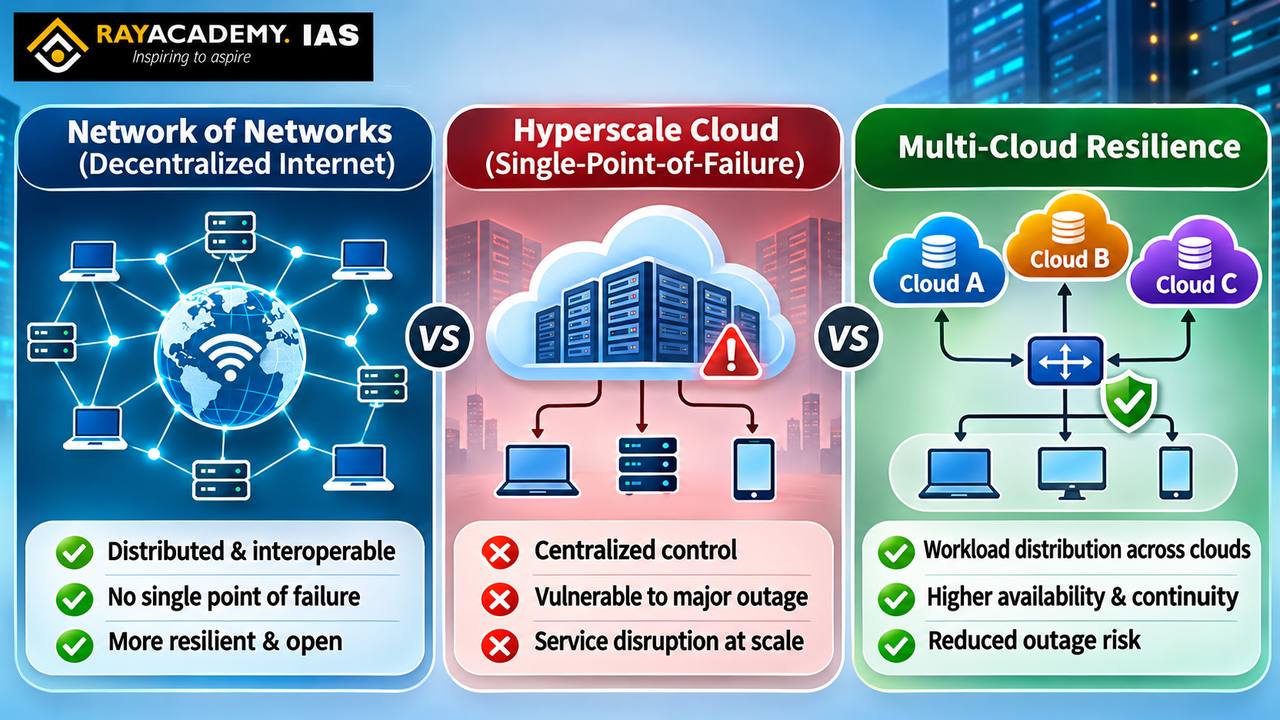
The Original Internet Architecture: Pioneered as a decentralized "network of networks" (built on ARPANET and TCP/IP protocols), the early internet was engineered so that a localized failure in one node would not trigger a cascading collapse across the entire system.
Economics of Cloud Concentration: Over the past two decades, prohibitive capital costs of maintaining dedicated on-premise servers drove businesses and governments toward shared cloud infrastructure (SaaS/PaaS/IaaS). While economies of scale lowered per-user costs, they concentrated global digital workflows into a few single points of failure (SPOFs)—meaning a routine configuration bug in one hyperscaler can cascade simultaneously across critical sectors worldwide.
Statutory & Institutional Frameworks in India
Information Technology Act, 2000 (Section 70 & Section 70A):
Section 70 empowers the Central Government to declare any computer resource that directly or indirectly affects national security, economy, public health, or safety as Critical Information Infrastructure (CII) (spanning power, banking/BFSI, telecom, transport, and government systems).
Section 70A established the National Critical Information Infrastructure Protection Centre (NCIIPC) as the nodal agency for CII protection.
CERT-In (Section 70B of IT Act, 2000): The Indian Computer Emergency Response Team (CERT-In) mandates incident reporting (including major IT outages and service disruptions) within 6 hours under its 2022 Cyber Security Directions, and issues advisories for system hardening.
MeitY’s MeghRaj (GI Cloud) & Sovereign Cloud Guidelines: India’s MeghRaj cloud initiative and MeitY’s Empanelment Guidelines for Cloud Service Providers mandate data localization, security audits (STQC), and disaster recovery protocols for government ministries.
Prelims Focus: High-Yield Objective Facts for UPSC
Key Objective Pointers for Prelims
Nodal Ministry: Ministry of Electronics and Information Technology (MeitY) governs national IT, cloud empanelment, and cybersecurity frameworks.
NCIIPC: Established under Section 70A of the IT Act, 2000; functions under the National Technical Research Organisation (NTRO) to protect Critical Information Infrastructure (CII).
CERT-In: Statutory national nodal agency under Section 70B of the IT Act, 2000 (under MeitY) responsible for incident response, vulnerability notes, and cyber crisis management.
Single Point of Failure (SPOF): A component of a system that, upon failing, stops the entire system from working—a primary systemic risk in monoculture cloud deployments.
Business Continuity Plan (BCP) & Disaster Recovery (DR): Institutional frameworks ensuring critical operations continue during IT/cloud outages via multi-cloud redundancy, air-gapped backups, and offline fallback protocols.
Mains Analytical Breakdown: Significance and Multi-Dimensional Challenges. Global Microsoft Outlook Outage
Strategic & Governance Significance
Re-evaluating Cyber Sovereignty Beyond Vendor Nationality: True cyber sovereignty is not achieved merely by replacing a foreign cloud provider with a domestic monopoly; it requires architectural decentralization, interoperability, and open standards so no single entity controls an irreversible choke point.
Validating Multi-Cloud and Hybrid Resilience: The outage demonstrates that high-profile Service Level Agreements (SLAs) from major tech vendors cannot eliminate human or software configuration errors—making multi-cloud failover and offline operational continuity indispensable for essential services.
Pre-Empting AI Infrastructure Concentration: As next-generation AI data centres and foundation models demand massive compute clusters, the global economy risks an even deeper layer of centralisation unless fault-tolerant governance is embedded early.
Multi-Dimensional Challenges
Cascading Disruptions Across Critical Sectors (Economic & Operational): Because hospitals, banking desks, aviation check-ins, and government offices rely on unified cloud suites, a single network upgrade error rapidly spills over into real-world economic losses and delayed public services.
Vendor Lock-In and Monoculture Risk (Market & Regulatory): Proprietary software ecosystems and high data-egress fees create vendor lock-in, preventing organizations from seamlessly switching providers during prolonged outages.
Asymmetric Impact on Smaller Institutions (Social & Equity): While large corporations may afford bespoke redundancy, public hospitals, municipal bodies, and MSMEs depend on standardized cloud suites with zero offline fallback, leaving vulnerable citizens exposed when digital services halt.
Accountability and Transparency Deficits (Governance & Ethical): Complex abstraction layers in global cloud networks often delay root-cause disclosures and complicate regulatory liability when cross-border outages disrupt domestic essential services.
Way Forward: Anchored in Institutional & Regulatory Frameworks
Mandate Multi-Cloud & Offline Fallback for CII (NCIIPC & RBI Frameworks): Building on the RBI’s Master Direction on IT Governance, Risk, Controls and Assurance Practices and NCIIPC guidelines, critical sectors (healthcare, banking, aviation, power, and e-governance) must adopt multi-vendor architectures, local offline caching, and regular chaos-engineering / disaster-recovery drills.
Promote Open-Source & Interoperable Digital Public Infrastructure (DPI): Aligning with India’s Policy on Adoption of Open Source Software for Government of India and Digital Public Infrastructure (DPI) philosophy, public agencies should prioritize open standards and federated protocols (such as NIC’s indigenous email/office suites) to eliminate proprietary single-vendor lock-in.
Regulate Systemic Cloud Concentration (Digital Competition Law & MeitY Audits): In line with the Committee on Digital Competition Law (CDCL) recommendations and global frameworks like the EU’s Digital Operational Resilience Act (DORA), designate systemically important cloud service providers for mandatory concentration-risk stress tests and zero-egress-fee portability.
Embed Decentralization in the IndiaAI Mission: Under the IndiaAI Mission, ensure sovereign compute infrastructure is distributed across geographically dispersed data centres with federated failover protocols rather than concentrated in single monolithic hubs.
Value Addition for Mains
Empirical Scale Benchmark (Nov 2026): The November 2026 Microsoft 365 outage impacted users across over 70 countries (affecting a platform used by ~430 million people globally) for more than 24 hours due to an internal network gateway defect—demonstrating how non-malicious technical failures can rival cyberattacks in systemic disruption.
Governance & Constitutional Anchor: Operationalizing Article 21 (right to uninterrupted essential services such as healthcare and banking in a digital society) and Section 70 of the IT Act, 2000 requires shifting public-sector IT policy from "efficiency through centralisation" to "resilience through distributed architecture."
Practice Questions for Active Recall
Prelims Practice MCQ
With reference to Critical Information Infrastructure (CII) and cybersecurity governance in India, consider the following statements:
Under Section 70 of the Information Technology Act, 2000, the Central Government is empowered to declare any computer resource affecting national security, economy, or public health as Critical Information Infrastructure.
The National Critical Information Infrastructure Protection Centre (NCIIPC) functions as a statutory body under the administrative control of the Ministry of Home Affairs.
The Indian Computer Emergency Response Team (CERT-In) is designated as the national agency for responding to computer security incidents under Section 70B of the IT Act, 2000.
Which of the statements given above are correct?
(a) 1 and 2 only
(b) 1 and 3 only
(c) 2 and 3 only
(d) 1, 2, and 3
Correct Answer: (b) 1 and 3 only
Explanation:
Statement 1 is correct: Section 70 of the IT Act, 2000 authorizes the Central Government (via Official Gazette notification) to designate critical computer systems as Protected Systems / Critical Information Infrastructure (CII).
Statement 2 is incorrect: Established under Section 70A of the IT Act, 2000, the NCIIPC functions under the National Technical Research Organisation (NTRO) (under the Prime Minister's Office), not the Ministry of Home Affairs.
Statement 3 is correct: CERT-In operates under Section 70B of the IT Act, 2000 (under MeitY) as India’s national nodal agency for cybersecurity incident response and vulnerability management.
Mains Practice Question (GS Paper III — 150 Words | 10 Marks)
"Global cloud outages demonstrate that the hyper-centralisation of digital infrastructure creates systemic single points of failure across critical sectors, even in the absence of malicious cyberattacks." Examine the governance and security risks posed by cloud concentration and suggest institutional measures to build digital resilience in India.
Answer Structure Hints:
Introduction: Contextualize the November 2026 global Microsoft Outlook/365 outage caused by a network upgrade flaw, illustrating how the internet’s shift from a decentralized "network of networks" to centralized cloud platforms creates systemic fragility.
Body Part 1 (Governance & Security Risks): Highlight cascading disruptions across hospitals, finance, and government offices; vendor lock-in; erosion of cyber sovereignty; and heightened concentration risks from emerging AI data centres.
Body Part 2 (Institutional Measures): Recommend multi-cloud redundancy and offline Business Continuity Plans (BCP) for CII under NCIIPC and RBI norms, promoting open-source/federated DPI, regulating cloud concentration risk, and conducting regular disaster-recovery drills.
Conclusion: Conclude with Section 70 of the IT Act, 2000, emphasizing that architectural decentralization and operational resilience—not mere vendor substitution—are vital to safeguarding India’s digital economy.
Take this article with you
Save a reading copy for offline study.


