

2026 Nobel Peace Prize
2026 Nobel Peace Prize Trigger: On October 9, 2026, while attending the Nuremberg Forum in Courtroom 600 (birthplace of modern international criminal justice), South African jurist of Indian origin Judge Navanethem 'Navi' Pillay was awarded the 2026 Nobel Peace Prize for advancing peace through international law.
UPSC Syllabus Mapping:
General Studies Paper II (Indian Polity & Governance): Indian Constitution—historical underpinnings, evolution, features, amendments, significant provisions and basic structure; Structure, organization and functioning of the Executive and the Judiciary; Separation of powers between various organs.
General Studies Paper II (International Relations): Important International institutions, agencies and fora—their structure, mandate; India and international legal obligations under treaties and conventions.
Call Against Impunity: Dedicating the honour to survivors of international crimes, Judge Pillay urged nations to ensure "impunity will not be allowed to reign"—sparking renewed legal and policy introspection on India’s domestication of International Criminal Law (ICL).
India’s Statutory Vacuum: Legal commentators have highlighted that despite ratifying foundational instruments like the 1948 Genocide Convention and the 1949 Geneva Conventions, India lacks standalone domestic legislation criminalizing genocide, crimes against humanity, and war crimes in non-international armed conflicts.
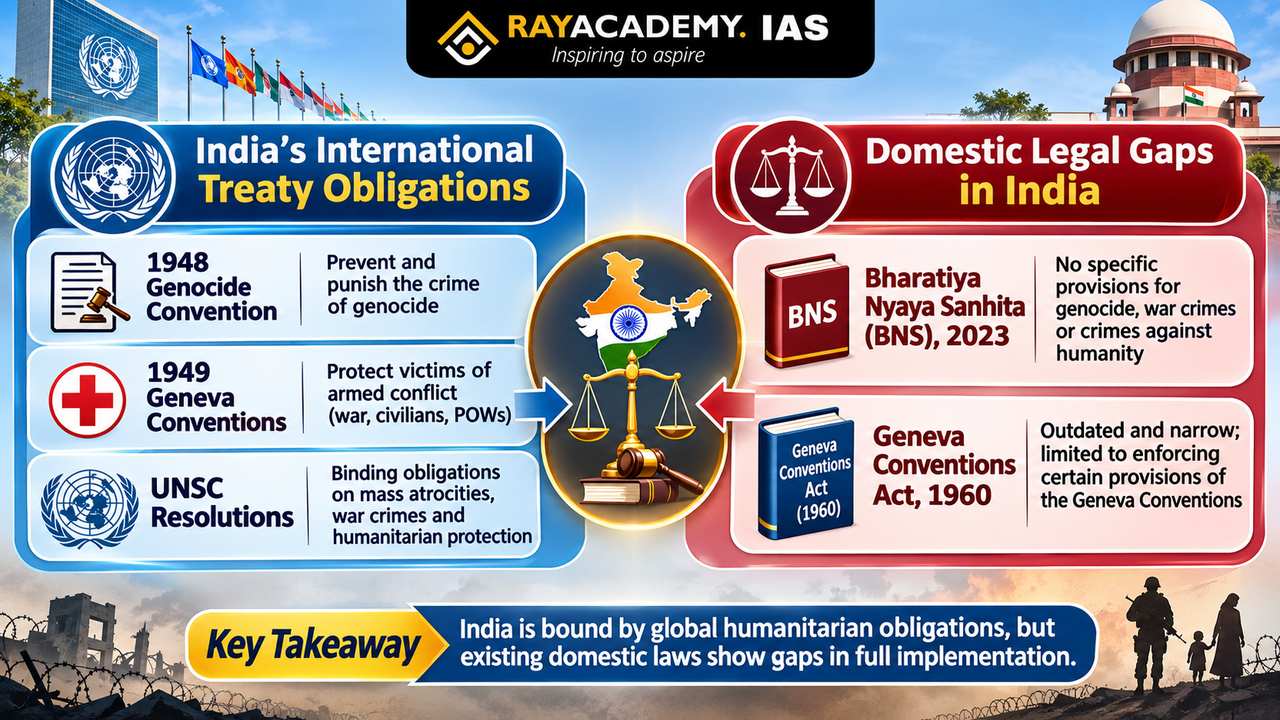
Static-Current Linkage: Dualism, Treaty Ratification, and India’s Legal Architecture .International Criminal Law
Evaluating India’s justice deficit on mass atrocity crimes requires linking constitutional treaty-making provisions with domestic criminal statutes and International Humanitarian Law (IHL) jurisprudence:
1. Constitutional Framework: Dualist Approach to International Law
Article 253 & Union List (Entries 13 & 14): India follows the dualist doctrine of international law. While the Union Executive can sign and ratify international treaties under Article 73, treaties do not automatically become enforceable domestic law unless Parliament enacts implementing legislation under Article 253.
Article 51(c): Directs the State to foster respect for international law and treaty obligations in the dealings of organized peoples with one another.
Judicial Interpretation (Vishaka v. State of Rajasthan, 1997 & Maganbhai Ishwarbhai Patel, 1969): The Supreme Court has held that international conventions not inconsistent with Fundamental Rights may be read into domestic law to fill legislative vacuums—yet criminal liability requires explicit statutory enactment under Article 20(1).
2. Core International Treaties & Domestic Implementation Gaps
1948 Genocide Convention (Ratified by India in 1959): Defines genocide as acts committed with intent to destroy, in whole or in part, a national, ethnical, racial, or religious group. Despite Article V obligating signatories to enact domestic penal legislation, India has no standalone anti-genocide law.
1949 Geneva Conventions & The Geneva Conventions Act (GCA), 1960: Out of 24 International Humanitarian Law (IHL) conventions ratified by India, only three have implementing statutes. The GCA, 1960 criminalizes only "grave breaches" applicable strictly to international armed conflicts, leaving customary war crimes and non-international armed conflicts (NIACs) uncovered.
Rome Statute of the International Criminal Court (ICC), 1998: India is not a party to the Rome Statute, citing concerns over the subordination of national judicial sovereignty, UN Security Council referral powers, and the non-inclusion of cross-border terrorism and nuclear weapons use.
Prelims Focus: High-Yield Objective Facts for UPSC
Quick Revision Fact Box:
International Criminal Law, Navi Pillay & Indian StatutesJudge Navi Pillay (2026 Nobel Peace Prize Laureate): Served as President of the International Criminal Tribunal for Rwanda (ICTR), Judge of the International Criminal Court (ICC), UN High Commissioner for Human Rights (2008–2014), and ad hoc Judge at the ICJ in The Gambia v. Myanmar (Rohingya genocide case).
Nuremberg Courtroom 600: Located in the Palace of Justice, Nuremberg, Germany; venue of the International Military Tribunal (1945–1946) which established individual criminal responsibility for war crimes, crimes against peace, and crimes against humanity.
Geneva Conventions Act, 1960: Administered by the Ministry of External Affairs / Ministry of Defence; bars courts from taking cognizance of any offence under the Act except upon a complaint by the Central Government (upheld in Rev. Monteiro v. State of Goa, 1969), and has recorded zero prosecutions across 66 years.
Key Judicial Precedents Cited:State v. Sajjan Kumar (2018, Delhi HC): Justice S. Muralidhar observed that neither "crimes against humanity" nor "genocide" forms part of India’s domestic criminal law, urging legislative recognition in light of the 1984 anti-Sikh violence.
Nandini Sundar v. State of Chhattisgarh (2011, SC): Held the deployment and arming of Salwa Judum (special police officers) against Maoists unconstitutional, though IHL/war crimes provisions were not invoked.
Sikkim v. Jasbir Singh (2022, SC): Clarified concurrent jurisdiction between criminal courts and courts-martial under the Army Act, noting courts-martial can impose lower punishments for civil offences.
Mains Analytical Breakdown
Significance of Domesticating International Criminal Law (ICL)
Upholding the Principle of "Fair Labelling": Prosecuting mass atrocities under ordinary provisions of the Bharatiya Nyaya Sanhita (BNS), 2023—such as murder, grievous hurt, or promoting enmity—fails to capture the collective intent and gravity of genocide or crimes against humanity, violating the criminal law principle of fair labelling.
Norm-Signalling & Deterrence: Statutory recognition of mass atrocity crimes serves a vital preventive and norm-signalling function, deterring state and non-state actors from weaponizing communal or ethnic violence.
Strengthening Global Standing & Moral Leadership: As India aspires to global leadership (Vishwaguru), aligning domestic statutes with treaties India has voluntarily ratified reinforces its commitment to the rule of law without requiring accession to the ICC.
Closing Substantive Penal Gaps: Ordinary offences under the BNS carry lower sentencing thresholds (e.g., up to five years for wrongful confinement versus 14 years under the GCA) and fail to criminalize specific IHL violations like forcible deportation of protected populations.
Multi-Dimensional Challenges & Impediments
Sovereignty & "Internal Affairs" Apprehensions (Political): Policymakers often resist domesticating IHL due to concerns that acknowledging non-international armed conflicts (NIACs) in insurgencies (such as Left-Wing Extremism or Northeast militancy) could legitimize armed insurgents or invite external diplomatic scrutiny.
Executive Gatekeeping & Lack of Victim Recourse (Legal & Institutional): Under the Geneva Conventions Act, 1960, private citizens cannot initiate prosecutions without prior Central Government sanction, creating an institutional conflict of interest when state functionaries are implicated.
Limitations of Military Justice Frameworks (Administrative): Courts-martial under the Army, Navy, and Air Force Acts try offences primarily as "civil offences" or breaches of military discipline rather than distinct war crimes against civilians, resulting in lenient sentencing or non-prosecution.
Evidentiary & Prosecutorial Burden (Judicial): Proving specialized mens rea—such as the "intent to destroy, in whole or in part" required for genocide—demands higher evidentiary thresholds than ordinary penal offences, prompting prosecutors to prefer simpler BNS charges.
Perceived Double Standards in Global Justice (Geopolitical & Ethical): Selective enforcement of international criminal justice by Western powers often breeds domestic skepticism, though legal scholars note that external hypocrisy should not deprive Indian citizens of domestic legal protections.
Way Forward: Reform-Oriented Roadmap
To fulfill its constitutional mandate under Articles 51 and 253 and uphold human dignity under Article 21, India can adopt four calibrated legal reforms without compromising national sovereignty:
Enact a Standalone "Prevention of Mass Atrocity Crimes Act" (Law Commission & Delhi HC Observations): Act on Justice S. Muralidhar’s recommendation in State v. Sajjan Kumar (2018) by codifying genocide and crimes against humanity as distinct offences in Indian penal law, incorporating command responsibility and victim reparations.
Modernize the Geneva Conventions Act, 1960 (ICRC & IHL Standards): Amend the GCA to cover customary war crimes, ratify Additional Protocols I and II (1977) to the Geneva Conventions, and establish objective intensity-and-organization criteria for non-international armed conflicts (clarifying that IHL application confers zero political legitimacy on insurgents).
Reform Executive Sanction & Establish Independent Oversight (2nd ARC Principles): Following the 2nd Administrative Reforms Commission’s emphasis on accountability in public administration, replace absolute executive veto over war-crimes prosecutions with judicial screening by a designated High Court Special Bench to prevent impunity.
Harmonize Armed Forces Acts with IHL Effective Penal Sanctions: Align the Army Act, 1950 and allied service statutes with international humanitarian standards so grave violations against civilians are tried with proportionate, transparent penal sanctions rather than minor disciplinary charges.
Value Addition Snippet (For Mains Introductions & Conclusions)
Treaty & Statutory Benchmark: Out of 24 International Humanitarian Law (IHL) conventions ratified by India, only three possess domestic implementing legislation, and the Geneva Conventions Act, 1960 has recorded zero prosecutions across 66 years and seven international armed conflicts.
Judicial & Philosophical Quote for GS-2 / GS-4: Quoting ICJ Judge Dire Tladi—"The Court is only a court; opposing it must not deprive our citizens of the rule of international criminal law"—alongside Article 21 provides a compelling conclusion distinguishing sovereign reservations toward the ICC from India’s moral duty to protect its own citizens domestically.
Active Recall: UPSC Practice Questions
1. Prelims Practice Question (Multi-Statement Format)
With reference to International Criminal Law, treaty implementation in India, and recent global developments, consider the following statements:
Under Article 253 of the Constitution of India, Parliament has the exclusive power to make any law for the whole or any part of the territory of India for implementing any international treaty, agreement, or convention.
India has ratified the 1948 Genocide Convention as well as the Rome Statute of the International Criminal Court (ICC).
The Geneva Conventions Act, 1960 allows any aggrieved citizen to directly file a private criminal complaint before a Sessions Court for grave breaches of the Geneva Conventions.
Which of the statements given above is/are correct?
(a) 1 only
(b) 1 and 2 only
(c) 2 and 3 only
(d) 1, 2, and 3
Correct Answer: (a) 1 only
Explanation:
Statement 1 is correct: Article 253 empowers Parliament to legislate on any subject—even those enumerated in the State List—to give effect to international treaties, agreements, or conventions.
Statement 2 is incorrect: While India ratified the 1948 Genocide Convention (in 1959) and the 1949 Geneva Conventions (in 1950), India has neither signed nor ratified the Rome Statute establishing the International Criminal Court (ICC).
Statement 3 is incorrect: Under Section 17 of the Geneva Conventions Act, 1960, no court can take cognizance of any offence under the Act except upon a complaint by, or under authority from, the Central Government (barring private complaints).
2. Mains Practice Question (150 Words | 10 Marks)
"Despite ratifying foundational international humanitarian and human rights conventions, the absence of domestic criminal legislation on mass atrocities creates a significant justice deficit in India." Discuss the constitutional and statutory gaps in India’s domestication of International Criminal Law and suggest suitable legal reforms.
Model Answer Structure Hint:
Introduction: Contextualize Judge Navi Pillay’s 2026 Nobel Peace Prize and India’s dualist framework (Article 253), noting that while India ratified the 1948 Genocide Convention and 1949 Geneva Conventions, domestic penal law lacks specific atrocity crimes.
Body:
Legal Gaps: Highlight the absence of genocide and crimes against humanity in the BNS, 2023 (violating fair labelling, as noted in State v. Sajjan Kumar), limitations of the Geneva Conventions Act, 1960 (confined to international armed conflicts and executive-vetted prosecutions), and gaps in military justice.
Way Forward: Recommend enacting a standalone mass-atrocity statute, amending the GCA to include customary war crimes and non-international armed conflicts, and introducing judicial screening for sanctions.
Conclusion: Conclude with Articles 21 and 51, noting that domesticating international criminal norms strengthens domestic rule of law without compromising national sovereignty.
Take this article with you
Save a reading copy for offline study.


