

Bilkis Bano Case
Suspension of Life Sentences in the Bilkis Bano Case: A Supreme Court Bench of Justices M.M. Sundresh and Prasanna B. Varale suspended the life sentences of two of the 11 convicts—Bipinchand Kanhaiyalal Joshi and Pradip Ramanlal Modhiya—in the 2002 Bilkis Bano gang-rape and murder case, granting them bail pending the disposal of their appeals on October 28, 2026.
UPSC Syllabus Mapping:
General Studies Paper II (Indian Polity & Governance): Indian Constitution—historical underpinnings, evolution, features, amendments, significant provisions and basic structure (Articles 14 & 21); Structure, organization and functioning of the Executive and the Judiciary; Criminal justice system reforms and victimology.
General Studies Paper IV (Ethics, Integrity, and Aptitude): Ethics and Human Interface; Probity in Governance; Compassion and empathy toward vulnerable sections in judicial and administrative decision-making.
Subsequent Similar Relief: On November 23, 2026, the same Bench granted similar interim bail to Siraj Pada, one of the convicts in the Sabarmati Express coach fire case, citing prolonged incarceration and pending appellate hearings.
Procedural Controversy Over Victim’s Right to Be Heard: The orders have sparked an intense constitutional and legal debate on victimology and procedural fairness, as survivor Bilkis Bano stated she was neither notified nor heard before the convicts were released on bail—raising critical questions regarding the statutory gap in Section 389 of the CrPC (now Section 430 of the Bharatiya Nagarik Suraksha Sanhita, 2023).
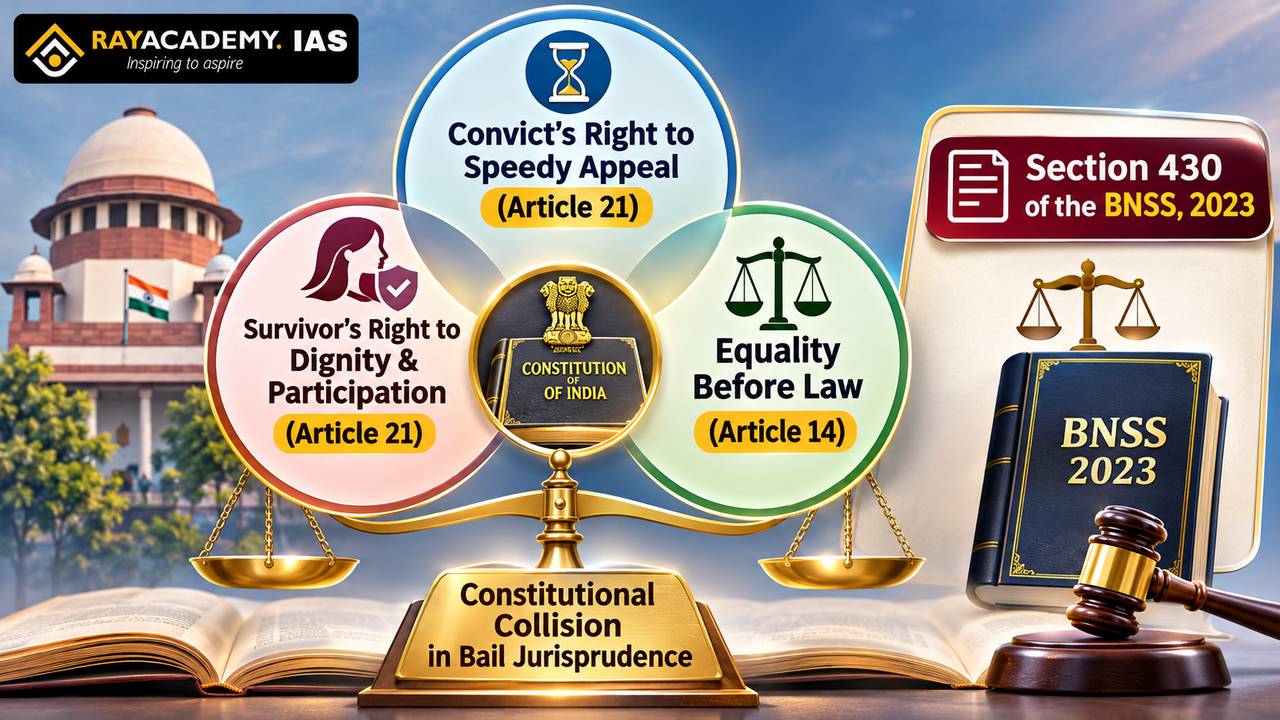
Static-Current Linkage: Constitutional Rights, Criminal Procedure, and Victimology
Analyzing the debate surrounding the Bilkis Bano bail order requires linking Articles 14 and 21 of the Constitution with statutory provisions governing appellate bail under the CrPC, 1973 and the Bharatiya Nagarik Suraksha Sanhita (BNSS), 2023.
1. Three Colliding Constitutional Tests (Articles 14 & 21)
Right to Speedy Trial and Prompt Appeal (Article 21): Since Hussainara Khatoon v. State of Bihar (1979), the Supreme Court has held that the right to a speedy trial—later extended to a reasonably prompt appeal—is an intrinsic part of personal liberty under Article 21. Where an appellant has undergone prolonged incarceration (over 17 years in the present instance) and the appeal is unlikely to be heard soon, appellate courts weigh liberty against delayed adjudication.
Survivor’s Right to Dignity and Participatory Justice (Article 21): Equally, Article 21 protects the dignity, security, and trauma-free life of a crime survivor. In serious sexual violence and mass-crime cases, releasing convicts without notice undermines the survivor’s sense of safety and procedural dignity.
Equality Before Law and Equal Protection (Article 14): Article 14 obligates the State and justice institutions to balance competing interests fairly without treating one side of the criminal justice process with greater institutional solicitude than the other.
2. Statutory Gap: Section 389 CrPC / Section 430 BNSS, 2023
Suspension of Sentence Pending Appeal: Section 389 of the Code of Criminal Procedure, 1973—reproduced as Section 430 of the Bharatiya Nagarik Suraksha Sanhita (BNSS), 2023—empowers an appellate court, for reasons recorded in writing, to suspend the execution of a sentence and release a convicted person on bail pending appeal.
Absence of Mandatory Victim Notice: Where an offence is punishable with death, imprisonment for life, or imprisonment for not less than 10 years, the proviso to Section 430 BNSS mandates that the appellate court shall give an opportunity to the Public Prosecutor to show cause in writing against such release. Crucially, the statute names only the prosecutor and omits any mandatory requirement to notify or hear the victim.
3. Judicial Evolution of Victim Rights in India
2009 CrPC Amendment (Section 2(wa)): Parliament formally defined "victim" in Section 2(wa) of the CrPC (now Section 2(1)(y) of the BNSS) and inserted the proviso to Section 372 (now Section 413 BNSS), granting victims an independent statutory right to appeal against acquittals, inadequate sentences, or inadequate compensation.
Key Supreme Court Precedents:
Mallikarjun Kodagali v. State of Karnataka (2018): The Supreme Court adopted a progressive, victim-centric interpretation of the proviso to Section 372, affirming that victims do not need special leave to appeal against acquittals.
Jagjeet Singh and Ors. v. Ashish Mishra @ Monu and Anr. (2022): A three-judge Bench explicitly held that a victim has a legally vested right to be heard at every stage of criminal proceedings—from investigation to bail, trial, and appeal—emphasizing that "a victim is not a mute spectator".
Bilkis Yakub Rasool v. Union of India (January 8, 2024): The Supreme Court quashed the Gujarat government’s August 2022 remission order releasing all 11 convicts, holding that the State where the trial was transferred (Maharashtra) was the sole "appropriate government" competent to decide remission under Section 432(7) CrPC.
Prelims Focus: High-Yield Objective Facts
UPSC Prelims Quick-Revision Box:
Victim Rights, BNSS Provisions & Landmark CasesBharatiya Nagarik Suraksha Sanhita (BNSS), 2023 Key Provisions:Section 2(1)(y): Defines "victim" as a person who has suffered any loss or injury caused by reason of the act or omission of the accused, including the victim's guardian or legal heir.
Section 430 (Corresponding to Section 389 CrPC): Governs suspension of sentence pending appeal and release of the appellant on bail; requires written notice to the Public Prosecutor for offences punishable with death, life imprisonment, or 10+ years, but lacks a statutory mandate for victim notice.
Section 413 (Corresponding to Section 372 CrPC): Grants victims the right to prefer an appeal against acquittal, conviction for a lesser offence, or inadequate compensation. Section 193(3)(ii): Mandates police to inform the informant or victim of the progress of investigation within 90 days.Difference Between Bail, Suspension of Sentence, and Remission:Bail (Pre-Conviction): Presumption of innocence applies until guilt is proven.
Suspension of Sentence (Section 430 BNSS): Post-conviction interim relief granted by an appellate court; conviction remains intact while execution of sentence is temporarily halted pending appeal.
Remission (Article 72 / Article 161 & Section 473 BNSS): Executive power to reduce the duration of a sentence without changing its character, subject to statutory concurrence and judicial review.
Mains Analytical Breakdown: Balancing Liberty, Finality, and Victimology
Significance of the Constitutional and Legal Debate
Reaffirming Personal Liberty Against Systemic Appellate Delays: Allowing bail where appellants have spent over 17 years in custody while appeals remain pending addresses chronic judicial pendency in higher courts and prevents prolonged pre-finality incarceration from becoming punitive without appellate scrutiny.
Spotlighting the Legislative Blind Spot in BNSS: The controversy exposes an incomplete transition toward victim-centric criminal jurisprudence—demonstrating that while Parliament enacted the BNSS, 2023 to replace colonial criminal procedure, Section 430 retained the prosecution-centric text of Section 389 CrPC without integrating the Jagjeet Singh mandate.
Clarifying Distinction Between Suspension and Acquittal: Legally, suspending a sentence pending appeal neither overturns the trial court’s conviction nor dilutes the concurrent findings of guilt upheld by the High Court; it merely stays execution until final adjudication.
Multi-Dimensional Challenges
Procedural and Legal Deficit (Statutory): Under Section 430 BNSS, courts are legally required to hear only the Public Prosecutor. When a survivor is neither made a party nor served notice, the court loses the survivor’s direct perspective on threat perception, witness intimidation, and post-release safety.
Psychological and Social Impact on Survivors (Social): In cases involving heinous sexual violence and mass communal crimes, repeated releases of convicts without prior intimation inflict secondary trauma and erode survivors’ faith in institutional protection.
Erosion of Judicial Consistency (Institutional): When a Bench grants suspension of sentence without hearing the victim despite binding three-judge Bench precedent in Jagjeet Singh v. Ashish Mishra (2022), it creates doctrinal tension between discretionary bail orders and established victimology principles.
High Threshold for Post-Conviction Bail (Jurisprudential): Settled Supreme Court jurisprudence holds that once a person is convicted—especially where guilt has been affirmed by two courts—the presumption of innocence ceases, and suspension of a life sentence in grave crimes must be an exception backed by compelling reasons, not routine relief.
Ethical Deficit in Administration of Justice (Ethical): As philosopher John Rawls noted, "Justice is the first virtue of social institutions". Mechanical adherence to procedural formalism without empathy for a survivor who fought for over two decades creates a perception of justice deferred.
Way Forward: Reform-Oriented Roadmap
Amend Section 430 of the BNSS, 2023 (Law Commission & Parliamentary Reform): Parliament should amend the proviso to Section 430 BNSS to mandate compulsory prior notice and an opportunity of hearing to the victim/survivor before any appellate court suspends a sentence in offences punishable with death, life imprisonment, or 10+ years—codifying the Supreme Court’s ruling in Jagjeet Singh v. Ashish Mishra (2022).
Issue Uniform Practice Directions for Appellate Courts (Supreme Court Guidelines): The Supreme Court and High Courts should issue binding procedural rules requiring registries to verify proof of victim service and threat-assessment reports before listing applications for suspension of sentence in heinous crimes.
Establish Dedicated Fast-Track Criminal Appellate Benches (Malimath Committee & Law Commission Reports): Implementing recommendations of the Malimath Committee on Reforms of Criminal Justice System (2003) and Law Commission Report No. 245, High Courts and the Supreme Court should constitute dedicated criminal appeal benches to dispose of life-sentence appeals within a fixed timeframe (e.g., 2–3 years), eliminating the root cause of 17-year appellate delays.
Strengthen Witness and Victim Protection Schemes (National Scheme 2018): State governments must operationalize District-level Witness and Victim Protection Cells with automatic post-bail police monitoring and grievance redressal whenever convicts in grave offences are released on interim bail or parole.
Value Addition: Official Data Points for Mains Answers
Appellate Pendency in Higher Judiciary (National Judicial Data Grid / Economic Survey): Over 6.2 million cases are pending across India’s High Courts, with criminal appeals accounting for roughly 28% of total High Court pendency—frequently resulting in convicts serving 10 to 17 years before their first or second appeals are finally adjudicated.
Crimes Against Women & Conviction Context (NCRB Crime in India Report): Despite heightened statutory punishments post-2013 and 2018 amendments, the overall conviction rate in IPC/BNS crimes against women hovers around 25%–27%, underscoring why preserving the hard-won credibility of rare successful convictions in mass-violence cases is vital for public trust.
Administrative Catchphrase for Mains Conclusions: "True criminal justice reform requires harmonizing the accused’s Article 21 right to expeditious appeal with the victim’s substantive right to participatory dignity—ensuring that liberty does not eclipse accountability."
Practice Questions for Active Recall
Prelims Practice Question (UPSC Standard)
Q. With reference to the suspension of sentence pending appeal and victim rights in India, consider the following statements:
Under Section 430 of the Bharatiya Nagarik Suraksha Sanhita (BNSS), 2023, an appellate court is statutorily required to give written notice to both the Public Prosecutor and the victim before suspending a life sentence.
Suspension of sentence pending appeal temporarily stays the execution of punishment without setting aside the underlying conviction.
In Jagjeet Singh v. Ashish Mishra (2022), the Supreme Court held that a victim has a legally vested right to be heard at every stage of criminal proceedings, including bail hearings.
Which of the statements given above is/are correct?
(a) 1 and 2 only
(b) 2 and 3 only
(c) 1 and 3 only
(d) 1, 2, and 3
Correct Answer: (b) 2 and 3 only
Explanation:
Statement 1 is incorrect: The proviso to Section 430 of the BNSS, 2023 (mirroring Section 389 CrPC) mandates giving an opportunity to show cause in writing only to the Public Prosecutor in cases punishable with death, life imprisonment, or 10+ years; it does not yet contain a mandatory statutory requirement to notify the victim.
Statement 2 is correct: Suspension of sentence is an interim appellate measure that halts the execution of the sentence while the appeal is pending; the finding of guilt remains intact unless overturned upon final hearing.
Statement 3 is correct: In Jagjeet Singh and Ors. v. Ashish Mishra @ Monu and Anr. (2022), a three-judge Supreme Court Bench affirmed that victims possess participatory rights at all stages of criminal proceedings, including bail.
Mains Practice Question (150 Words | 10 Marks)
Q. "While the right to an expeditious appeal is integral to Article 21, post-conviction bail jurisprudence must equally safeguard the participatory dignity of crime survivors." Discuss in light of recent Supreme Court orders suspending life sentences. (150 words)
Model Answer Structure:
Introduction: Introduce the constitutional tension highlighted by the Supreme Court’s October–November 2026 orders suspending life sentences in the Bilkis Bano and Sabarmati Express cases without prior notice to the survivor.
Body Paragraph 1 (Constitutional & Statutory Framework): Contrast the convict’s Article 21 right to speedy appeal (Hussainara Khatoon) with the survivor’s Article 21 right to dignity and Article 14 equality, pointing out the statutory omission of mandatory victim notice in Section 430 BNSS despite the Jagjeet Singh (2022) precedent.
Body Paragraph 2 (Key Concerns): Highlight how prolonged appellate delays (17+ years) force interim bail, yet releasing convicts in heinous crimes without victim hearing inflicts secondary trauma and weakens victim-centric justice.
Conclusion: Recommend amending Section 430 BNSS to mandate victim notice and establishing dedicated fast-track criminal appellate benches to resolve appeals swiftly.
Take this article with you
Save a reading copy for offline study.


