

Record 100-Day Unprorogued Period
Both Houses of Parliament—the Lok Sabha and the Rajya Sabha—have remained unprorogued for a record 100 days following their adjournment sine die on August 13, 2026 (at the conclusion of the Monsoon Session), marking the longest unprorogued interval in Indian constitutional history.
UPSC Syllabus Mapping:
General Studies Paper II (Indian Polity & Governance): Parliament and State Legislatures—structure, functioning, conduct of business, powers & privileges and issues arising out of these; Indian Constitution—historical underpinnings, evolution, features, amendments, significant provisions and basic structure; Structure, organization and functioning of the Executive and the Judiciary.
Exceeding Past Precedents: The current 100-day gap surpasses the previous longest unprorogued spell of 87 days in 2008, as well as shorter 41-to-76-day intervals recorded between 1963 and 1987.
Short-Notice Reconvening Speculation: Because a House adjourned sine die without formal prorogation remains technically in session and can be reconvened at short notice by the Presiding Officers, political observers had speculated that the session was kept live to pass a contentious Constitution Amendment Bill on delimitation before the regular Winter Session.
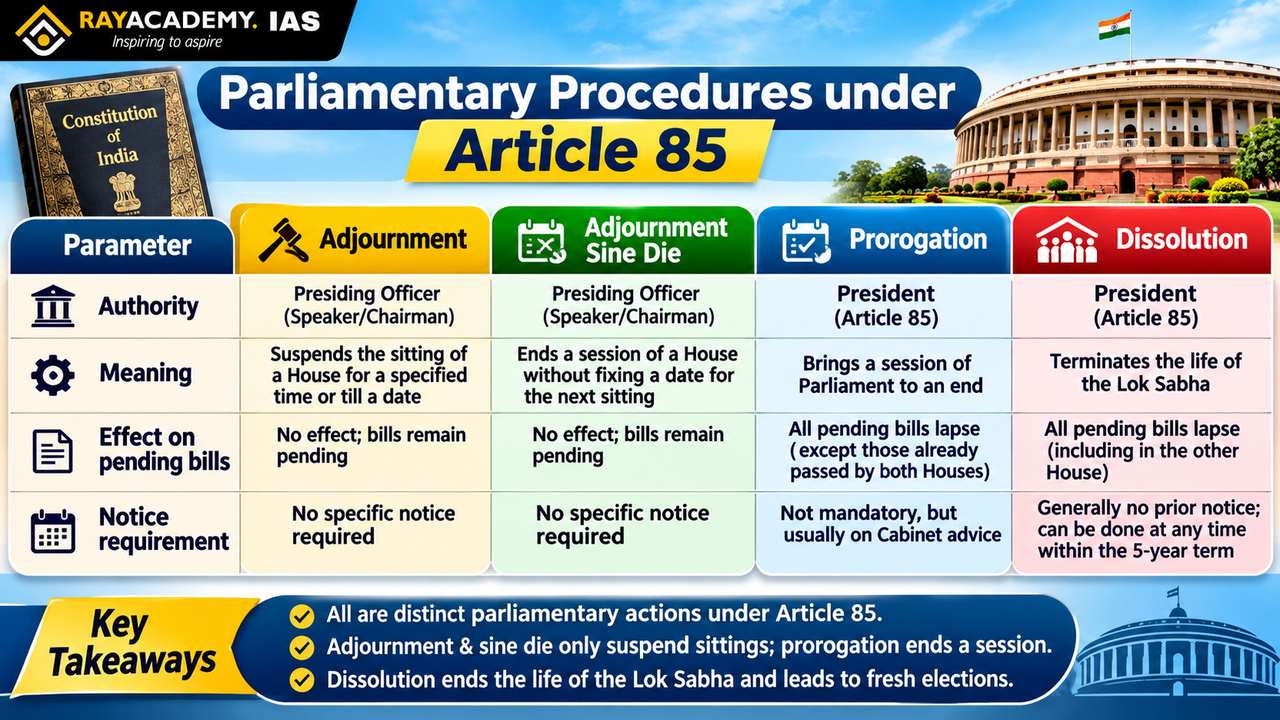
Static-Current Linkage: Article 85 and Parliamentary Session Mechanics . Prorogation of Parliament
Decoding the constitutional significance of an unprorogued Parliament requires linking Article 85 with the Rules of Procedure and Conduct of Business in both Houses:
1. Constitutional Mandate Under Article 85
Article 85(1) – Summoning of Parliament: Mandates that the President shall, from time to time, summon each House of Parliament to meet at such time and place as the President thinks fit, provided that six months shall not intervene between the last sitting in one session and the date appointed for the first sitting in the next session. Thus, the Constitution requires at least two sessions a year, though India follows the convention of three sessions (Budget, Monsoon, and Winter).
Article 85(2) – Prorogation and Dissolution: Empowers the President to (a) prorogue the Houses or either House from time to time, and (b) dissolve the House of the People (Lok Sabha). Under Article 74, the President exercises these powers strictly on the aid and advice of the Union Council of Ministers.
2. Adjournment Sine Die vs. Prorogation
Adjournment: Terminates a sitting of the House for a specified time (hours, days, or weeks).
Adjournment Sine Die: Means terminating a sitting of Parliament for an indefinite period without naming a day for reassembly. This power rests exclusively with the Presiding Officer of the House (Speaker in Lok Sabha; Chairman in Rajya Sabha).
Prorogation: Formally terminates a session of the House. Issued by the President via a notification in the Official Gazette—typically within a few days of adjournment sine die—prorogation ends both the sitting and the session itself.
3. Reconvening Without Prorogation: Rule 15 of Lok Sabha
Normal Summoning Convention: While Article 85 prescribes no minimum notice period for summoning a fresh session, constitutional convention mandates at least 14 days' notice prior to a new session.
Short-Notice Reconvening: Under Rule 15 of the Rules of Procedure and Conduct of Business in Lok Sabha, the Speaker may call a sitting of the House at any time after it has been adjourned sine die, provided the House has not been prorogued. Similarly, Rajya Sabha rules empower the Chairman to direct when the House shall sit. By convention, such sittings can be convened at a short notice of even two days.
Prelims Focus: High-Yield Objective Facts for UPSC
Quick Revision Fact Box:
Sessions, Prorogation & Lapsing of BillsConstitutional Articles: Article 85 governs sessions of Parliament, prorogation, and dissolution; Article 174 contains identical provisions for State Legislatures (exercised by the Governor).
Effect on Pending Bills (Article 107):
Adjournment & Prorogation: Do NOT lapse any pending Bill or motion in either House. Pending notices (other than those for introducing Bills) lapse upon prorogation, requiring fresh notice in the next session.
Dissolution of Lok Sabha: Lapses Bills pending in Lok Sabha (whether originating there or transmitted by Rajya Sabha) and Bills passed by Lok Sabha but pending in Rajya Sabha. A Bill pending in Rajya Sabha that has not been passed by Lok Sabha does not lapse.
Parliamentary Privileges (Article 105): Members of Parliament (and State Legislatures under Article 194) continue to enjoy parliamentary privileges—including freedom from arrest in civil cases during a session and 40 days before and after—even during extended unprorogued periods.
Mains Analytical Breakdown
Significance & Administrative Utility of Delayed Prorogation
Operational Flexibility for Urgent Legislation: Keeping a session alive after adjournment sine die provides the Executive and Presiding Officers with institutional agility to reconvene Parliament at 48 hours' notice to address national emergencies, security crises, or urgent constitutional/legislative business without undergoing the 14-day summoning cycle.
Continuity of Pending Notices & House Business: Avoiding immediate prorogation prevents pending parliamentary notices, questions, and motions from lapsing, saving administrative time when sittings resume.
Constitutional Permissibility: Because Article 85 imposes no rigid time limit between adjournment sine die and prorogation—requiring only that the inter-session gap not exceed six months—delayed prorogation remains strictly within the letter of the Constitution.
Multi-Dimensional Challenges & Democratic Concerns
Erosion of Constitutional Conventions (Political & Governance): While legally permissible, keeping Houses unprorogued for 100 days weakens well-established parliamentary conventions that distinguish distinct legislative sessions (Budget, Monsoon, Winter).
Risk of Legislative Surprise & Reduced Scrutiny (Deliberative Democracy): Reconvening Parliament at a two-day notice to introduce far-reaching legislation—such as a delimitation Constitution Amendment Bill—curtails time for Opposition preparation, public consultation, and Department-Related Parliamentary Standing Committee (DRSC) scrutiny.
Declining Annual Parliamentary Sitting Days (Institutional): Preoccupation with procedural technicalities often obscures a deeper structural malaise—India’s annual average parliamentary sittings have plummeted from ~135 days during the First Lok Sabha (1952–57) to roughly 55 days per year today, weakening executive accountability.
Ambiguity in Parliamentary Privileges & Ordinances (Legal & Ethical): Indefinite unprorogued intervals blur the operational boundaries of civil arrest immunity (40 days before/after a session) and complicate the President’s ordinance-making power under Article 123 (which can only be exercised when at least one House is not in session).
Way Forward: Strengthening Parliamentary Governance
To preserve constitutional conventions and revitalize Parliament as the premier forum of democratic accountability, reforms should draw upon authoritative committees and constitutional jurisprudence:
Mandate Minimum Annual Sitting Days (National Commission to Review the Working of the Constitution – NCRWC): Implement the NCRWC (Venkatachaliah Commission) recommendation mandating a statutory minimum of 100–120 sitting days per year for Lok Sabha and 90–100 days for Rajya Sabha to reverse the slide from 135 to 55 days.
Codify Clear Timelines for Prorogation & Summoning Notice (2nd ARC & Rules Committees): Amend the Rules of Procedure to establish a standard 7-to-14-day window for prorogation after adjournment sine die, reserving unprorogued extensions strictly for certified national emergencies.
Mandatory Referral of Major Bills to Standing Committees (Rajya Sabha Secretariat & PRS Reforms): Institutionalize automatic referral of all Constitution Amendment Bills and complex legislation to Department-Related Parliamentary Standing Committees (DRSCs) so short-notice sittings cannot bypass committee scrutiny.
Publish an Annual Parliamentary Calendar (Vice-President & Presiding Officers’ Conferences): Adopt a fixed, pre-announced annual calendar of parliamentary sittings—similar to the UK House of Commons—ensuring predictability for legislators, ministries, and citizens.
Value Addition Snippet (For Mains Introductions & Conclusions)
Parliamentary Productivity Benchmark: The average number of annual sitting days of India’s Parliament has declined by nearly 60%, dropping from around 135 days in the First Lok Sabha to 55 days at present. Meanwhile, the 100-day unprorogued interval following the August 13, 2026 Monsoon Session adjournment sine die set an all-time record, surpassing the 87-day gap in 2008.
Constitutional Catchphrase for Mains Answers: "Procedural flexibility under Article 85 must serve the cause of deeper legislative deliberation, not become a substitute for regular, predictable, and well-scrutinized parliamentary sittings."
Active Recall: UPSC Practice Questions
1. Prelims Practice Question (Multi-Statement Format)
With reference to the sessions and prorogation of Parliament under the Constitution of India, consider the following statements:
Under Article 85, the power to adjourn a House of Parliament sine die is exercised by the President on the aid and advice of the Council of Ministers.
Under Rule 15 of the Rules of Procedure and Conduct of Business in Lok Sabha, the Speaker may call a sitting of the House after it has been adjourned sine die, provided the House has not been prorogued.
Prorogation of a House by the President causes all pending Bills in that House to lapse immediately.
Which of the statements given above is/are correct?
(a) 1 and 2 only
(b) 2 only
(c) 2 and 3 only
(d) 1, 2, and 3
Correct Answer: (b) 2 only
Explanation:
Statement 1 is incorrect: The power to adjourn a House or adjourn it sine die rests with the Presiding Officer of that House (the Speaker in Lok Sabha and the Chairman in Rajya Sabha), whereas the President exercises the power to summon and prorogue the Houses under Article 85.
Statement 2 is correct: Rule 15 of Lok Sabha rules explicitly empowers the Speaker to call a sitting of the House at any time after it has been adjourned sine die, provided the House has not been prorogued.
Statement 3 is incorrect: Prorogation terminates only a session of the House and does not affect pending Bills or any other business pending before the House (unlike dissolution of the Lok Sabha).
2. Mains Practice Question (150 Words | 10 Marks)
Q. Distinguish between 'adjournment sine die' and 'prorogation' of Parliament under the Indian Constitution. Discuss the democratic and governance implications of keeping Parliament unprorogued for extended periods. (150 words)
Model Answer Structure Hint:
Introduction: Define adjournment sine die (indefinite termination of a sitting by the Presiding Officer) and prorogation (termination of a session by the President under Article 85), contextualizing the record 100-day unprorogued period after the August 2026 Monsoon Session.
Body:
Key Distinctions: Contrast authority (Presiding Officer vs. President), scope (sitting vs. session), and reconvening rules (Rule 15 of Lok Sabha allowing short-notice sittings before prorogation).
Governance & Democratic Implications: Note operational agility for urgent business versus weakening of parliamentary conventions, reduced scrutiny of contentious Bills (like delimitation), ordinance-making ambiguities under Article 123, and the broader decline in annual sitting days (from 135 to 55).
Conclusion: Recommend codifying prorogation timelines, mandating 100+ annual sitting days (NCRWC), and strengthening committee scrutiny to uphold deliberative democracy.
Take this article with you
Save a reading copy for offline study.


