

Ministry of Petroleum and Natural Gas
4–5 Year Turnaround Projection by Petroleum Ministry: An internal analytical note prepared by the Ministry of Petroleum and Natural Gas (MoPNG) projects that India’s domestic oil and gas production will witness a sustained rebound over the next four to five years, attributing the current output contraction to exploration and capital-allocation decisions made over a decade ago.
UPSC Syllabus Mapping:
General Studies Paper III (Indian Economy & Infrastructure): Infrastructure: Energy, Ports, Roads, Airports, Railways etc.; Investment models; Indian Economy and issues relating to planning, mobilization of resources, growth, development and employment.
General Studies Paper I (Geography): Distribution of key natural resources across the world (including South Asia and the Indian sub-continent).
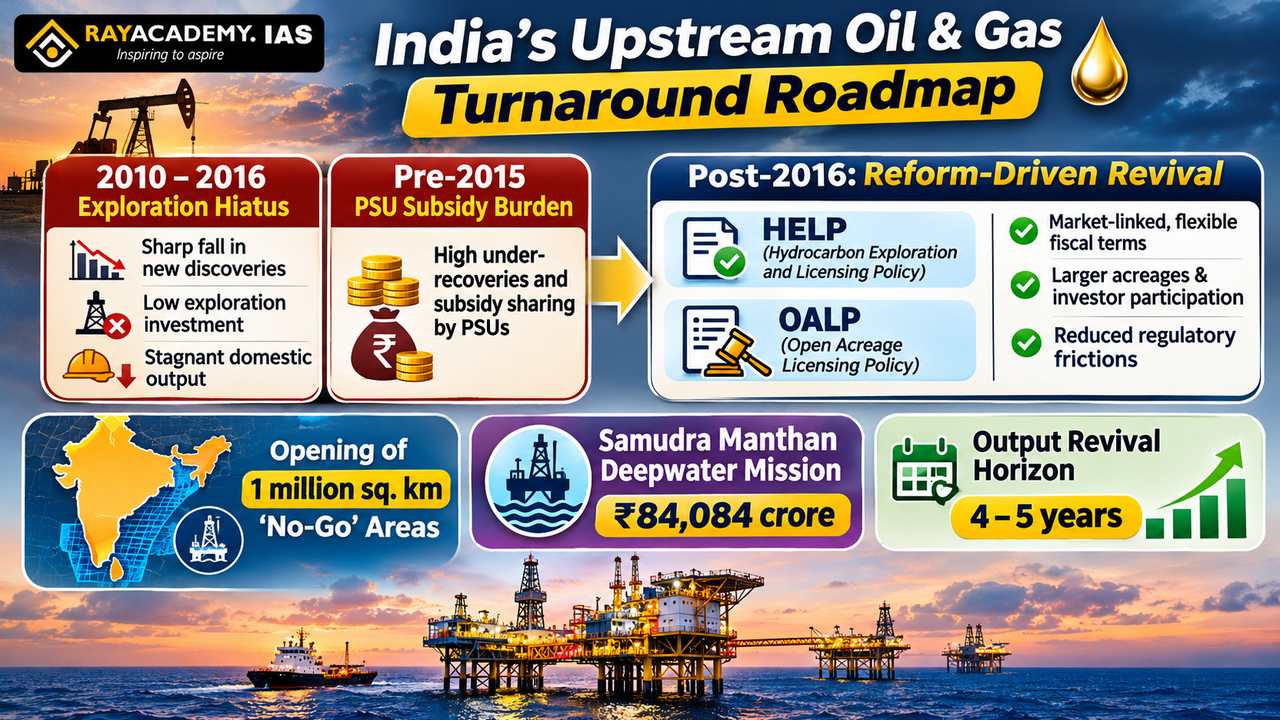
Long Gestation Lag & Policy Overhaul: Explaining why crude oil output fell 4.1% in October 2026—marking 22 and 28 consecutive months of contraction in the oil and gas segments of the Index of Eight Core Industries (ICI)—the Ministry noted that hydrocarbon projects require 5 to 10 years from block award to commercial production.
Record Drilling & Deepwater Push: Freed from heavy retail fuel subsidy burdens since 2015–16, upstream public sector undertakings (ONGC and Oil India) have sharply scaled up capital expenditure—drilling a 35-year high of 578 wells in 2024–25 and 501 wells in 2025–26, alongside launching the ₹84,084-crore Samudra Manthan mission and opening 1 million sq. km of erstwhile 'No-Go' offshore areas.
Static-Current Linkage: Hydrocarbon Licensing Regimes, Constitutional Ownership, and Energy Security
Evaluating India’s upstream hydrocarbon trajectory requires linking the evolution of licensing policies with constitutional resource governance and petroleum geology.
1. Constitutional & Statutory Ownership of Hydrocarbons
Article 297 of the Constitution of India: Vests all lands, minerals, and other things of value underlying the ocean within the territorial waters, continental shelf, or Exclusive Economic Zone (EEZ) of India exclusively in the Union of India.
Entry 53 of the Union List (Seventh Schedule): Empowers Parliament to regulate and develop oilfields and mineral oil resources, petroleum, and petroleum products.
Oilfields (Regulation and Development) Act, 1948 (Amended in 2024–25): Provides the statutory framework for granting petroleum mining leases, stabilizing fiscal terms, and decriminalizing operational compliance to attract global deepwater explorers.
2. Evolution of India’s Exploration Licensing Regimes. Oil and Gas Production
NELP (New Exploration Licensing Policy, 1997–2016): Introduced international competitive bidding and Production Sharing Contracts (PSCs) based on cost-recovery models. However, disputes over gold-plating of costs and regulatory delays led to an exploration hiatus between the 9th NELP round (2010) and 2016—directly causing the mature-field production decline experienced a decade later in 2026.
HELP (Hydrocarbon Exploration and Licensing Policy, 2016): Replaced NELP with a transparent Revenue Sharing Contract (RSC) model, a Uniform Licensing Policy covering conventional and unconventional hydrocarbons (shale, coal-bed methane, gas hydrates), marketing and pricing freedom, and the Open Acreage Licensing Policy (OALP) allowing companies to carve out blocks year-round.
3. Upstream Subsidy Burden vs. Internal Resource Mobilization
Pre-2015 Under-Recovery Sharing: Until FY 2014–15, upstream PSUs like ONGC and Oil India were mandated to subsidize diesel, LPG, and kerosene by offering steep discounts on crude sold to Oil Marketing Companies (OMCs). For instance, ONGC paid ₹49,421 crore in 2012–13 (against a profit of ₹20,926 crore) and ₹56,384 crore in 2013–14 (against a profit of ₹22,095 crore)—more than double its net earnings—starving exploration budgets. Ending this upstream subsidy burden in 2015–16 restored internal capital for deepwater drilling.
Prelims Focus: High-Yield Objective Facts
UPSC Prelims Quick-Revision Box:
Upstream Oil & Gas, Samudra Manthan & Sedimentary BasinsSamudra Manthan Mission (National Deepwater Exploration Mission):Outlay (Phase I): ₹84,084 crore dedicated to seismic surveys, drilling 60+ deepwater wells, and developing shared offshore infrastructure.
Risk-Sharing Mechanism: The Union Government bears up to 50% of the cost of a deepwater exploratory well to de-risk frontier offshore exploration. Unlocking of 'No-Go' Offshore Areas: Approximately 1 million square kilometres of offshore area (primarily in the Andaman–Nicobar, Mahanadi, and Krishna-Godavari basins) previously restricted due to defence/space clearances has been opened for OALP bidding.
Reserve Replacement Ratio (RRR): Measures the amount of proved reserves added to a company’s reserve base during the year relative to the amount of oil and gas extracted. An RRR above 1.0 indicates that a company is adding more reserves than it produces (ONGC achieved an RRR of 1.17 in FY 2025–26 alongside three new offshore discoveries).
Index of Eight Core Industries (ICI): Compiled monthly by the Office of the Economic Adviser (DPIIT, Ministry of Commerce & Industry) with base year 2011–12; includes Coal, Crude Oil, Natural Gas, Refinery Products, Fertilizers, Steel, Cement, and Electricity (together accounting for 40.27% of the IIP weight).
India’s Major Sedimentary Basins: India has 26 sedimentary basins covering ~3.4 million sq. km; Category-I (established commercial production) basins include Mumbai Offshore, Cambay, Assam Shelf, Krishna-Godavari (KG), Cauvery, Rajasthan (Barmer), and Assam-Arakan Fold Belt.
Mains Analytical Breakdown: Significance and Multi-Dimensional Challenges
Strategic and Economic Significance of Upstream Revival
Insulating Macro-Economy from Import Volatility: India imports over 87–88% of its crude oil requirements, making the Current Account Deficit (CAD), Rupee stability, and domestic inflation acutely vulnerable to West Asian geopolitical shocks. Boosting domestic production directly conserves foreign exchange.
Long-Term Payoff of Policy Stability: Retaining PSU profits within upstream balance sheets, modernizing the Oilfields (Regulation and Development) Act, and shifting to Revenue Sharing Contracts demonstrate how predictable regulatory regimes unlock capital-intensive infrastructure investments.
Supporting Gas-Based Economy Transition: Increasing domestic natural gas output from deepwater blocks (such as KG-DWN-98/2 and Andaman basins) is critical to raising natural gas’s share in India’s primary energy mix from ~6% to 15% by 2030, acting as a cleaner bridge fuel for fertilizers, city gas distribution (CGD), and industry.
Reviving Legacy Assets via Enhanced Oil Recovery (EOR): Deploying advanced Enhanced Oil Recovery (EOR) and field redevelopment in mature giant fields like Mumbai High slows natural reservoir decline while extending asset life.
Multi-Dimensional Challenges in the Upstream Sector
Natural Reservoir Depletion in Mature Fields (Geological): Most of India’s current production comes from decades-old fields that naturally lose 7–8% of output annually as reservoir pressure drops—requiring massive new discoveries merely to offset baseline decline.
Steep Contraction Among Private Operators (Economic & Operational): According to MoPNG data, the sharpest production drop has occurred in mature fields operated by private producers, which recorded double-digit declines over the past year due to aging reservoirs and cautious capex.
High Capital Risk and Technological Complexity in Deepwater (Technical): Frontier deepwater and ultra-deepwater exploration (beyond 400–1,500 metres water depth) involves extreme geological uncertainty, high drilling costs, and dependence on specialized global offshore rigs and subsea technology.
Long Gestation Timelines & Stranded Asset Risks (Strategic): Because deepwater discoveries take 5 to 10 years to reach commercial production, projects initiated today must navigate global energy transition headwinds and long-term decarbonization trajectories.
Marine Ecology & Coastal Livelihood Sensitivity (Environmental): Expanding seismic surveys and offshore drilling across 1 million sq. km of newly opened marine zones requires stringent Environmental Impact Assessments (EIA) to protect coral reefs, marine biodiversity, and artisanal fishing communities.
Way Forward: Reform-Oriented Roadmap
Operationalize Joint Ventures with Global Deepwater Majors (NITI Aayog Energy Security Framework): Leverage the amended Oilfields (Regulation and Development) Act and Samudra Manthan’s 50% risk-sharing mechanism to attract international oil companies (IOCs) possessing ultra-deepwater drilling and subsea engineering expertise into the Andaman–Nicobar and Kerala-Konkan basins.
Mandate Enhanced Oil Recovery (EOR) & Field Redevelopment Plans (DGH Oversight): The Directorate General of Hydrocarbons (DGH) should enforce time-bound EOR/IOR (Improved Oil Recovery) adoption—including polymer/chemical flooding and horizontal multilateral drilling—across both PSU and private mature fields to arrest double-digit declines.
Establish Shared Offshore Infrastructure Hubs (Samudra Manthan Phase I): Develop common subsea pipelines, floating production storage and offloading (FPSO) hubs, and onshore gas-processing terminals along the eastern coast so smaller marginal deepwater discoveries become commercially viable.
Streamline Single-Window Clearances & Marine Spatial Planning: Integrate environmental, coastal regulation zone (CRZ), and defence clearances on the PARIVESH portal alongside marine spatial planning to balance rapid exploration with coastal biodiversity protection.
Pair Domestic Upstream Expansion with Strategic Reserves & Clean Transition: Synchronize domestic output growth with Phase II expansion of underground Strategic Petroleum Reserves (ISPRL) and green hydrogen/biofuel blending to build comprehensive, multi-fuel energy security.
Value Addition: Official Data Points for Mains Answers
Upstream Capex & Drilling Turnaround (MoPNG Note, Nov 2026): ONGC drilled 578 wells in FY 2024–25 (highest in 35 years) and 501 wells in FY 2025–26 (including 100 exploratory wells), achieving a Reserve Replacement Ratio (RRR) of 1.17—reversing the pre-2015 era when ONGC paid ₹1.05 lakh crore in combined crude subsidies across FY13 and FY14 against ₹43,021 crore in net profits.
Import Dependence & Core Sector Weight (PPAC & DPIIT): India remains the world’s third-largest oil consumer with crude import dependence exceeding 87%, while Crude Oil (8.98%) and Natural Gas (6.88%) together hold 15.86% weight in the Index of Eight Core Industries.
Administrative Catchphrase for Mains Conclusions: "In the hydrocarbon sector, the policy and exploration choices of one decade determine the energy security of the next; pairing risk-shared deepwater exploration under Samudra Manthan with Enhanced Oil Recovery is vital to bridge India’s clean-energy transition."
Practice Questions for Active Recall
Prelims Practice Question (Multi-Statement Format)
Q. With reference to India’s upstream oil and gas sector and recent policy initiatives, consider the following statements:
The Samudra Manthan mission provides for the Union Government to bear up to 50% of the cost of drilling a deepwater exploratory well.
Under the Hydrocarbon Exploration and Licensing Policy (HELP), India transitioned from a Production Sharing Contract (PSC) model to a Revenue Sharing Contract (RSC) model.
A Reserve Replacement Ratio (RRR) of less than 1.0 indicates that an exploration company has added more proved hydrocarbon reserves than it extracted during the year.
Which of the statements given above is/are correct?
(a) 1 and 2 only
(b) 2 and 3 only
(c) 1 and 3 only
(d) 1, 2, and 3
Correct Answer: (a) 1 and 2 only
Explanation:
Statement 1 is correct: Phase I of the Samudra Manthan mission (₹84,084 crore outlay) supports seismic surveys, over 60 deepwater wells, and shared offshore infrastructure, with the government bearing up to 50% of the cost of a deepwater well.
Statement 2 is correct: Introduced in 2016 to replace NELP, HELP shifted India to a transparent Revenue Sharing Contract (RSC) regime with a uniform licence and Open Acreage Licensing Policy (OALP).
Statement 3 is incorrect: A Reserve Replacement Ratio (RRR) greater than 1.0 (such as ONGC’s 1.17 in FY 2025–26) signifies that proved reserves added exceed the volume produced; an RRR below 1.0 indicates net reserve depletion.
Mains Practice Question (150 Words | 10 Marks)
Q. "In the upstream hydrocarbon sector, the policy and investment decisions of one decade shape the energy security of the next." Analyze the structural reasons behind India’s recent contraction in domestic oil and gas production and evaluate how recent policy reforms aim to reverse this trend. (150 words)
Model Answer Structure:
Introduction: Contextualize the Ministry of Petroleum and Natural Gas’s projection of an upstream production rebound in 4–5 years, noting how a 5–10 year gestation lag links today’s output contraction to past policy bottlenecks.
Body Paragraph 1 (Reasons for Current Contraction): Explain the 2010–2016 licensing hiatus after NELP-IX, heavy pre-2015 upstream subsidy burdens on ONGC/Oil India that starved exploration capex, and 7–8% annual natural reservoir decline in mature fields (especially double-digit drops in private fields).
Body Paragraph 2 (Turnaround Catalysts): Highlight HELP/OALP revenue-sharing reforms, retention of PSU profits driving record drilling (578 wells in FY25), unlocking 1 million sq. km of 'No-Go' offshore areas, and the ₹84,084-crore Samudra Manthan deepwater mission.
Conclusion: Conclude with integrating Enhanced Oil Recovery (EOR), global deepwater JVs, and Strategic Petroleum Reserves to secure India’s energy transition.
Take this article with you
Save a reading copy for offline study.


