

National space security doctrine
Strategic analysts and defence experts have renewed calls for India to formulate a comprehensive national space security doctrine as outer space rapidly transitions from a scientific frontier into critical economic and military infrastructure. While India possesses overarching frameworks such as the Indian Space Policy, 2023, and annual monitoring through ISRO’s Indian Space Situational Awareness Report (ISSAR-2025), experts highlight an urgent policy gap regarding non-kinetic counter-space threats—including jamming, spoofing, cyber interference, and electronic warfare. Establishing clear thresholds for hostile disruption, attribution standards, and crisis-response protocols is increasingly viewed as vital to protecting both defence operations and commercial satellite networks.
UPSC Syllabus Mapping:
General Studies Paper III (Science & Technology and Internal Security): Awareness in the fields of IT, Space, Computers, robotics, nano-technology, bio-technology; Achievements of Indians in science & technology; Challenges to internal security through communication networks, basics of cyber security; Security challenges and their management in border areas.
Static-Current Linkage: Outer Space Governance, Institutional Architecture, and Non-Kinetic Warfare
Understanding the imperative for an Indian space security doctrine requires linking international space law with India’s evolving institutional ecosystem and modern counter-space capabilities.
1. International Legal Framework for Outer Space
Outer Space Treaty (1967): Forms the cornerstone of international space law (ratified by India), declaring outer space the "province of all mankind," prohibiting the placement of Weapons of Mass Destruction (WMDs) in orbit, and mandating peaceful exploration. However, it lacks binding verification mechanisms against conventional or non-kinetic counter-space weapons.
Liability Convention (1972) & Registration Convention (1975): Establish state responsibility for space objects and damage caused by them, forming the legal baseline for orbital governance.
UN Open-Ended Working Group (OEWG) on Space Threats: Deliberates on norms, rules, and principles of responsible behaviours in outer space to prevent miscalculation and orbital debris creation.
2. Evolution of India’s Space Security and Policy Ecosystem
Mission Shakti (2019): Demonstrated India’s kinetic Anti-Satellite (ASAT) interceptor capability in Low Earth Orbit (LEO), signaling credible deterrence while testing at a low altitude (~300 km) to ensure rapid debris decay.
Defence Space Agency (DSA) & Defence Space Research Agency (DSRO): Established in 2019 as tri-service institutions to integrate military space assets, intelligence, surveillance, and reconnaissance (ISR), and counter-space research.
Indian Space Policy, 2023 & IN-SPACe: Opened the space sector to Non-Governmental Entities (NGEs), positioning private operators as vital providers of communication, Earth observation, and navigation infrastructure.
ISRO’s NETRA & ISSAR-2025: Project NETRA (Network for Space Object Tracking and Analysis) tracks orbital objects and space debris, documented annually in the Indian Space Situational Awareness Report (ISSAR).
3. Shift from Kinetic Destruction to Non-Kinetic Disruption
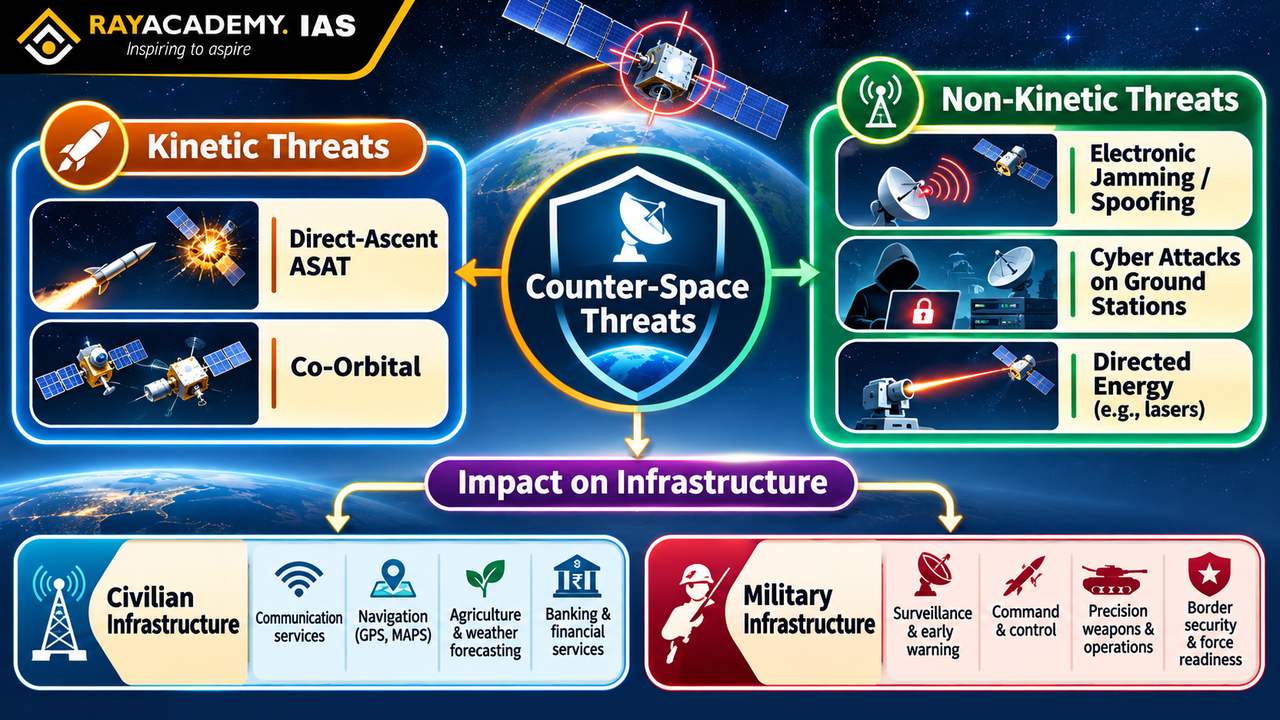
Modern counter-space competition increasingly relies on reversible, below-threshold gray-zone tactics rather than physical destruction:
Electronic Warfare (Jamming & Spoofing): Deliberate radio-frequency interference that blocks satellite signals (jamming) or transmits falsified positioning/timing data (spoofing) to disrupt navigation systems like NavIC.
Cyber Interference: Targeting satellite telemetry, tracking, and command (TT&C) links, ground stations, or commercial cloud networks.
Co-Orbital & Directed-Energy Threats: Proximity operations by inspector satellites or dazzling optical sensors with ground-based lasers
Prelims Focus: High-Yield Facts for UPSC CSE
Nodal Civilian & Regulatory Bodies: Department of Space (DoS), Indian Space Research Organisation (ISRO), and IN-SPACe (Indian National Space Promotion and Authorisation Centre, autonomous single-window nodal agency).
Military Space Institutions: Defence Space Agency (DSA) (tri-service agency headquartered in Bengaluru) and Defence Space Research Organisation (DSRO).
Space Situational Awareness (SSA) Initiatives: Project NETRA (ISRO’s early warning system in space to detect debris and hazards to Indian satellites) and IS4OM (ISRO System for Safe and Sustainable Space Operations Management).
Navigation Constellation: NavIC (Navigation with Indian Constellation / IRNSS), providing Position, Navigation, and Timing (PNT) services across India and up to 1,500 km beyond its borders—critical for banking, power grids, and military operations.
Key International Treaties: Outer Space Treaty (1967), Rescue Agreement (1968), Liability Convention (1972), Registration Convention (1975), and Moon Agreement (1979) (India has signed but not ratified the Moon Agreement).
Mains Analytical Breakdown: Strategic Imperatives and Governance Challenges
Significance of a Comprehensive Space Security Doctrine
Protecting Critical National Infrastructure: Banking transactions, power grid synchronization, disaster warnings, agriculture, and military command-and-control rely heavily on space-based Position, Navigation, and Timing (PNT) and satellite communications.
Establishing Clear Deterrence and Escalation Thresholds: Defining what constitutes a hostile act—distinguishing accidental interference from deliberate jamming, spoofing, or cyberattacks—prevents both strategic paralysis and inadvertent crisis escalation.
Securing the Commercial Space Ecosystem: With private satellite operators powering civilian and defence services under the Indian Space Policy, 2023, a formal doctrine integrates commercial networks into national cyber and space resilience protocols.
Preserving Peaceful Use and Strategic Autonomy: A doctrine focused on resilience, attribution, and rapid reconstitution protects India’s national interests without triggering an unconstrained orbital arms race or space weaponisation.
Multi-Dimensional Challenges in Space Security Governance
The Attribution Dilemma in Gray-Zone Warfare (Strategic & Technical): Non-kinetic attacks (cyber intrusion or localized spoofing) rarely leave physical signatures and can be routed through third-party networks, complicating timely and credible attribution.
Fragmented Civil–Military–Commercial Coordination (Institutional): While ISRO manages civilian assets, DSA oversees defence requirements, and private startups operate commercial constellations, India lacks a unified statutory mechanism for real-time threat intelligence sharing.
Dual-Use Ambiguity and Legal Gaps (International & Legal): Technologies such as active debris removal (ADR) and on-orbit servicing possess inherent dual-use capabilities, creating legal ambiguity under the 1967 Outer Space Treaty.
Orbital Congestion and Space Debris (Environmental): Proliferation of mega-constellations in Low Earth Orbit (LEO) heightens collision risks (Kessler Syndrome) and complicates distinguishing natural anomalies from hostile proximity maneuvers.
Supply-Chain and Ground-Segment Vulnerabilities (Economic & Cyber): Vulnerabilities often lie not in the spacecraft itself, but in terrestrial ground stations, user terminals, and imported electronic components.
Way Forward: Reform-Oriented Roadmap
Promulgate a Unified National Space Security Doctrine: Articulate clear attribution standards, proportionality norms, and cross-domain response principles covering kinetic, electronic, and cyber disruptions in outer space.
Institutionalize Civil–Military–Commercial Fusion: Establish a joint Space Threat Information Sharing and Analysis Centre (Space-ISAC) linking DSA, ISRO, CERT-In, IN-SPACe, and private satellite operators for real-time anomaly reporting.
Invest in Space-Domain Awareness (SDA) and Rapid Reconstitution: Expand indigenous optical telescopes, space-tracking radars, and orbital sensors under Project NETRA, while developing responsive launch capabilities (such as SSLV) to rapidly replace disrupted satellites.
Embed Resilience by Design in Satellite Architecture: Mandate anti-jamming encryption, quantum key distribution (QKD), multi-orbit redundancy (LEO/MEO/GEO), and ground-station hardening across government and commercial constellations.
Lead Global Norm-Building for Responsible Space Behaviour: Actively shape international transparency and confidence-building measures (TCBMs) at the UN COPUOS and UN OEWG to deter non-kinetic interference and preserve outer space as a global commons.
Value Addition for Mains
Institutional & Operational Anchor: Under ISRO’s Indian Space Situational Awareness Report (ISSAR-2025) and IS4OM, India continuously monitors close-approach conjunctions for its operational fleet (over 50 active satellites across LEO and GEO) and executes collision-avoidance maneuvers to safeguard critical national infrastructure.
Strategic Doctrinal Principle: As strategic experts note, "The measure of space security should not be the accumulation of offensive capabilities alone, but the capacity to preserve functions, withstand shocks, and recover quickly".
Mains Conclusion Snippet: "By anchoring a comprehensive space security doctrine in resilience, space-domain awareness, and public-private synergy, India can safeguard its critical infrastructure and strategic autonomy while upholding the peaceful use of outer space."
Practice Questions for Active Recall
Prelims Practice MCQ
With reference to India’s space governance and space situational awareness architecture, consider the following statements:
Project NETRA is an early warning system developed by ISRO to detect space debris and other hazards to Indian satellites.
The Defence Space Agency (DSA) is a tri-service institution established to operate military space assets and formulate space warfare strategies.
Under the Outer Space Treaty of 1967, signatory states are strictly prohibited from launching any military communications or reconnaissance satellites into Earth’s orbit.
Which of the statements given above are correct?
(a) 1 and 2 only
(b) 2 and 3 only
(c) 1 and 3 only
(d) 1, 2, and 3
Correct Answer: (a) 1 and 2 only
Explanation:
Statement 1 is correct: Project NETRA (Network for Space Object Tracking and Analysis) is ISRO’s dedicated space situational awareness network designed to track orbital debris and potential collision threats to Indian space assets.
Statement 2 is correct: Set up in 2019 alongside the Defence Space Research Organisation (DSRO), the Defence Space Agency (DSA) is a tri-service agency headquartered in Bengaluru tasked with managing India’s military space capabilities.
Statement 3 is incorrect: Article IV of the Outer Space Treaty (1967) prohibits placing nuclear weapons or other Weapons of Mass Destruction (WMDs) in orbit and restricts celestial bodies to exclusively peaceful purposes—it does not ban passive military support satellites (such as communications, navigation, or reconnaissance satellites).
Mains Practice Question (GS Paper III — 150 Words | 10 Marks)
"As space-enabled services become deeply embedded in civilian critical infrastructure and military operations, the primary threat has shifted from physical satellite destruction to non-kinetic disruption." Examine the need for a comprehensive Indian space security doctrine and outline its key pillars.
Answer Structure Hints:
Introduction: Contextualize India’s growing reliance on space assets (communications, NavIC, banking, defence ISR) alongside rising non-kinetic threats (jamming, spoofing, cyber interference).
Body Part 1 (Need for a Doctrine): Explain how existing frameworks (Indian Space Policy, 2023; ISSAR-2025) lack explicit attribution standards, escalation thresholds, and civil–military–commercial protocols to handle gray-zone disruptions without inadvertent conflict.
Body Part 2 (Key Pillars of the Doctrine): Detail Resilience & Redundancy (multi-orbit architecture, cyber-hardening), Space-Domain Awareness (SDA) (Project NETRA), Clear Attribution & Response Thresholds, and Rapid Reconstitution via public-private partnerships.
Conclusion: Conclude that a resilience-centric doctrine safeguards India’s strategic autonomy and critical infrastructure while upholding the peaceful use of outer space under the 1967 Outer Space Treaty.
Take this article with you
Save a reading copy for offline study.


