

AI-based blood test
An indigenous AI-based blood test named CancerSpot, developed by Bengaluru-based genomics company Strand Life Sciences, has demonstrated the capability to detect multiple types of cancer through a single blood sample by analyzing DNA methylation patterns.
UPSC Syllabus Mapping:
General Studies Paper III (Science & Technology): Science and Technology—developments and their applications and effects in everyday life; Achievements of Indians in science & technology; Indigenization of technology and developing new technology (Genomics, Artificial Intelligence in Healthcare, and Epigenetics).
General Studies Paper II (Social Justice & Governance): Issues relating to development and management of Social Sector/Services relating to Health, Education, Human Resources; Government policies and interventions for development in various sectors and issues arising out of their design and implementation.
Published in the peer-reviewed journal Proceedings of the National Academy of Sciences (PNAS), the four-year clinical validation study (titled EMERGE) evaluated 1,480 participants across 43 Indian hospitals. The test achieved a 72% overall detection sensitivity across 14 cancer types with a remarkably low false-positive rate of 1.4%, offering a non-invasive liquid biopsy alternative prior to conventional tissue biopsies.
Static-Current Linkage: Epigenetics, Liquid Biopsy, and Public Health Architecture
Understanding the administrative and scientific significance of CancerSpot requires linking molecular biology principles with India’s epidemiological transition and constitutional health mandates.
1. Scientific Principle: Cell-Free DNA (cfDNA) and Epigenetic Methylation
Human cells continuously shed tiny fragments of genetic material into the bloodstream, known as circulating or cell-free DNA (cfDNA). In oncology patients, a subset of this cfDNA—termed circulating tumour DNA (ctDNA)—originates directly from malignant cells.
Rather than looking solely at genetic mutations, CancerSpot examines DNA methylation—an epigenetic modification where methyl groups attach to DNA molecules and regulate gene expression without altering the underlying nucleotide sequence. Because tumour cells exhibit distinct hyper-methylation and hypo-methylation signatures compared to healthy cells, machine learning algorithms can differentiate cancerous signals from millions of normal background DNA fragments and predict the tissue of origin (TOO).
2. Constitutional & Policy Context of Preventive Oncology
Under Article 47 of the Directive Principles of State Policy (DPSP), the State is mandated to regard the improvement of public health as among its primary duties, while the Supreme Court has repeatedly affirmed the Right to Health as an integral facet of Article 21 (Right to Life).
Currently, India’s National Programme for Prevention and Control of Non-Communicable Diseases (NP-NCD) conducts population-level screening primarily for three common cancers—oral, breast, and cervical—using clinical examination and cytology. Multi-cancer early detection (MCED) technologies bridge a critical diagnostic gap for deep-seated malignancies (such as pancreatic, ovarian, liver, and lung cancers) that lack routine screening protocols.
Prelims Focus: High-Yield Objective Facts
Test Name & Developer: CancerSpot, developed by Strand Life Sciences (Bengaluru) and published in PNAS.
Core Biomarker: DNA methylation patterns in circulating cell-free DNA (cfDNA).
Clinical Performance: 72% sensitivity (true positive detection) and 98.6% specificity (1.4% false-positive rate) across 14 cancer types in the validation cohort.
Liquid Biopsy vs. Tissue Biopsy: A liquid biopsy analyzes tumour biomarkers in blood or body fluids, offering a minimally invasive, repeatable screening method compared to surgical tissue biopsies.
Statutory & Institutional Ecosystem:
Central Drugs Standard Control Organisation (CDSCO): Regulates in-vitro diagnostic (IVD) medical devices under the Medical Devices Rules, 2017 (framed under the Drugs and Cosmetics Act, 1940).
Department of Biotechnology (DBT): Nodal agency under the Ministry of Science and Technology driving genomics initiatives like the Genome India Project and BioE3 Policy.
National Cancer Grid (NCG): Network of major cancer centres funded by the Department of Atomic Energy (DAE) to establish uniform standards of cancer care across India.
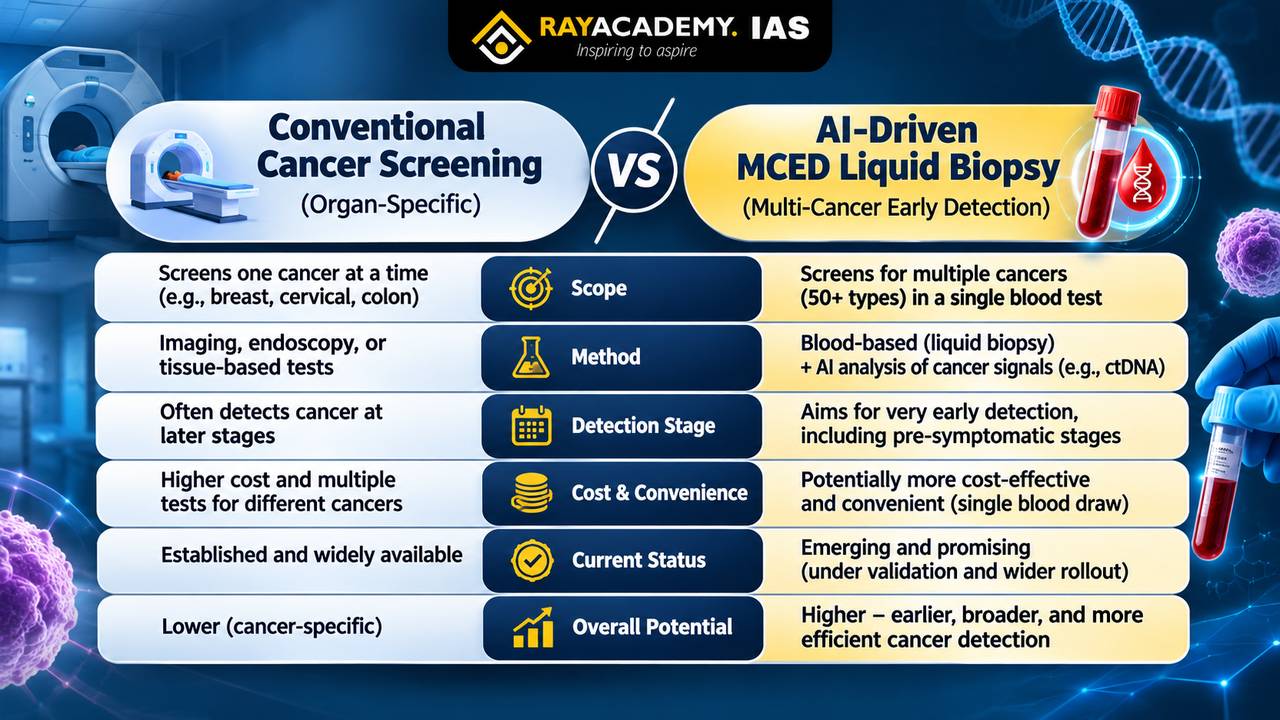
Mains Analytical Breakdown
Significance of AI-Driven Multi-Cancer Screening
Down-Staging Cancer Diagnosis: In India, nearly 75–80% of cancer patients are diagnosed at advanced stages (Stage III or IV), where five-year survival rates plummet. Shifting detection to Stage I or II dramatically improves clinical cure rates and reduces treatment morbidity.
Indigenous Genomic Calibration: Western genomic and methylation datasets often underrepresent South Asian genetic diversity. Validating CancerSpot across 43 Indian hospitals ensures algorithmic robustness tailored to Indian epidemiological and ethnic profiles.
Minimizing Iatrogenic Harm: A 1.4% false-positive rate is crucial in population screening because high false positives trigger patient anxiety, unnecessary radiation exposure from PET-CT scans, and invasive follow-up biopsies in healthy individuals.
Strengthening Bio-Economy & Indigenization: The breakthrough demonstrates India’s transition from generic pharmaceutical manufacturing to high-value precision medicine, next-generation sequencing (NGS), and AI-enabled diagnostics, aligning with the BioE3 (Biotechnology for Economy, Environment, and Employment) Policy.
Multi-Dimensional Challenges
Economic & Equity Barriers: Currently priced around ₹22,000–₹25,000 in the private market, NGS-based liquid biopsies remain out of reach for low-income households, risking a diagnostic divide where early detection becomes an urban elite privilege.
Screening vs. Definitive Diagnosis Limitations: MCED tests are screening tools, not definitive diagnostics. A 72% sensitivity implies that 28% of cancers may still be missed (false negatives), which could create a false sense of security and delay symptomatic care.
Secondary Healthcare Bottlenecks: Identifying a positive methylation signal requires downstream confirmation via targeted imaging, endoscopy, and histopathology. Rural districts often lack tertiary cancer care infrastructure and trained oncologists to act on early signals.
Ethical & Data Privacy Concerns: Whole-genome and epigenetic sequencing generate sensitive biological metadata. Without strict adherence to the Digital Personal Data Protection (DPDP) Act, 2023, patients face risks of genetic discrimination by health insurers or employers.
Regulatory & Overdiagnosis Risks: Detecting indolent, slow-growing tumours that might never cause clinical harm (overdiagnosis) can lead to overtreatment and catastrophic out-of-pocket expenditure (OOPE) unless clear clinical pathways are standardized.
Way Forward
Public-Private R&D & Cost Reduction: Leverage DBT-BIRAC (Biotechnology Industry Research Assistance Council) grants and Production Linked Incentive (PLI) schemes for medical devices to localize sequencing reagents, bringing test costs below ₹5,000 for mass scalability.
Tiered Integration with Ayushman Bharat: Following NITI Aayog’s Health Systems for a New India roadmap, pilot MCED screening for high-risk cohorts (e.g., individuals above 50 or with strong family/tobacco histories) through Ayushman Arogya Mandirs and National Cancer Grid hubs.
Standardized Clinical Validation by ICMR: The Indian Council of Medical Research (ICMR) should establish prospective randomized trial benchmarks to evaluate whether MCED screening reduces population-level cancer mortality, beyond mere stage-shift metrics.
Algorithmic Audits & Genomic Privacy: CDSCO and the Ministry of Electronics and Information Technology (MeitY) must enforce mandatory third-party audits of healthcare AI models alongside strict anonymization protocols under the DPDP Act, 2023 and the Ayushman Bharat Digital Mission (ABDM).
Value Addition for Mains
Epidemiological Data (ICMR-NCDIR National Cancer Registry Programme): India recorded an estimated 14.61 lakh new cancer cases in 2022 (crude incidence rate of 100.4 per 1,00,000 population), with 1 in 9 Indians likely to develop cancer in their lifetime and cases projected to rise by 12.8% by 2025.
Economic Burden (Economic Survey & WHO): Non-communicable diseases account for over 63% of all deaths in India, and late-stage cancer treatment is a leading driver of catastrophic health expenditure, pushing millions of households below the poverty line annually.
Practice Questions for Active Recall
Prelims Practice MCQ
With reference to "Liquid Biopsy" and DNA methylation-based cancer screening, consider the following statements:
Circulating cell-free DNA (cfDNA) consists exclusively of genetic fragments released by malignant tumour cells into the bloodstream.
DNA methylation alters gene expression without changing the underlying nucleotide sequence of the DNA.
A low false-positive rate in a screening test corresponds to high diagnostic specificity.
Which of the statements given above is/are correct?
(a) 1 and 2 only
(b) 2 and 3 only
(c) 1 and 3 only
(d) 1, 2, and 3
Correct Answer: (b) 2 and 3 only
Explanation:
Statement 1 is incorrect: Healthy cells in the body also continuously release small fragments of DNA into the bloodstream (called cfDNA); only a fraction of cfDNA in cancer patients originates from tumour cells (called ctDNA).
Statement 2 is correct: DNA methylation is an epigenetic modification involving chemical modifications to DNA that regulate how genes function without altering the actual DNA sequence.
Statement 3 is correct: Specificity measures the ability of a test to correctly identify healthy individuals without the disease; hence, a low false-positive rate (such as 1.4%) directly indicates high specificity.
Mains Practice Question (GS Paper III — 150 Words | 10 Marks)
"Advances in genomics and Artificial Intelligence are shifting oncology from reactive late-stage treatment to proactive multi-cancer early detection." Discuss the scientific significance of DNA methylation-based liquid biopsies in India and examine the socio-economic and regulatory challenges in integrating them into public healthcare.
Answer Structure Hints:
Introduction: Contextualize India’s rising cancer burden (1 in 9 lifetime risk, 75–80% late-stage detection) and the emergence of indigenous AI-driven liquid biopsies like CancerSpot.
Body Part 1 (Scientific & Public Health Significance): Explain cfDNA methylation profiling for early Stage I–II detection across multiple organs, indigenous Indian cohort calibration, and reduced invasive procedures due to low false positives.
Body Part 2 (Socio-Economic & Regulatory Challenges): Highlight high out-of-pocket costs (~₹22,000+), sensitivity gaps (false negatives), rural secondary diagnostic deficits, and genomic data privacy risks under the DPDP Act, 2023.
Conclusion: Recommend DBT-BIRAC R&D support for cost localization, ICMR mortality trials, and phased integration into Ayushman Bharat to fulfill Article 47.
Take this article with you
Save a reading copy for offline study.


