

Digital Service Outages
The global Microsoft 365 and Outlook outage on November 12–13, 2026—which disrupted email and productivity operations across businesses, government offices, and Indian airlines such as IndiGo, Akasa Air, and Air India due to a network capacity upgrade fault—has exposed a critical regulatory blind spot in India’s digital governance.
UPSC Syllabus Mapping:
General Studies Paper II (Governance & Polity): Government policies and interventions for development in various sectors and issues arising out of their design and implementation; Important aspects of governance, transparency and accountability, e-governance applications, models, successes, limitations, and potential; Statutory, regulatory and various quasi-judicial bodies.
General Studies Paper III (Internal Security & Science and Technology): Challenges to internal security through communication networks, basics of cyber security; Awareness in the fields of IT, Space, Computers, robotics, nano-technology, bio-technology.
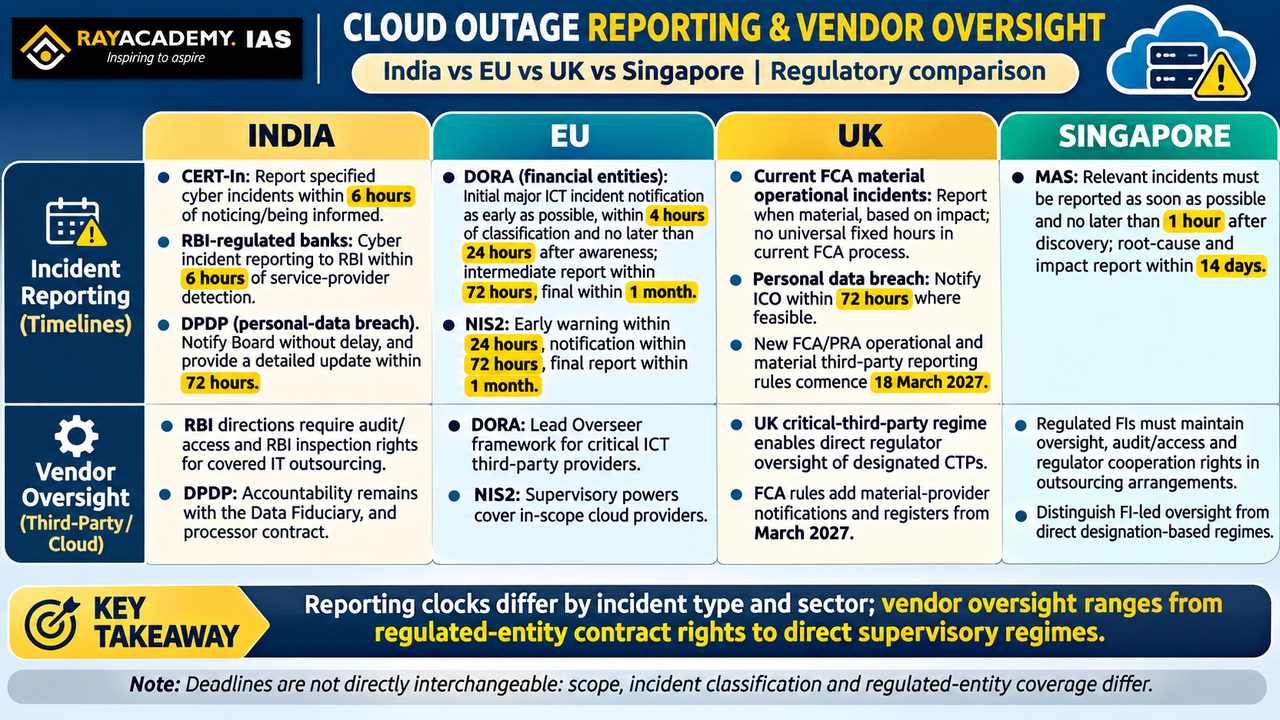
While millions of users were locked out of essential enterprise software, legal scrutiny revealed that none of India’s three primary digital regulatory regimes—CERT-In’s 2022 Directions, the Reserve Bank of India’s (RBI) IT Outsourcing Directions, or the Digital Personal Data Protection (DPDP) Act, 2023—explicitly mandate cloud service providers to report non-malicious technical service outages. In contrast to jurisdictions like the European Union (DORA and NIS2), the United Kingdom, and Singapore, India currently lacks clear outage-reporting thresholds and direct regulatory oversight over hyperscale cloud infrastructure.
Static-Current Linkage: India’s Statutory Architecture vs. Global Cloud Regulation
Evaluating how India addresses digital service interruptions requires analyzing the interplay between domestic IT and data protection laws alongside emerging international operational resilience frameworks.
India’s Three-Tier Regulatory Framework and Its Gaps
CERT-In Cyber Security Directions (April 28, 2022) under the IT Act, 2000:
Issued under Section 70B of the Information Technology Act, 2000, these directions require covered entities to report specified cyber incidents within 6 hours of noticing them.
The Gap: The mandatory reporting list focuses on malicious cyber attacks, unauthorized access, malware, and data breaches—not service outages caused by routine technical faults or network upgrades. While Section 70B(6) empowers CERT-In to call for information and seek explanations from providers like Microsoft, there is no automatic duty on cloud vendors to self-report technical downtime.
RBI Master Directions on Managing Risks and Code of Conduct in Outsourcing of Financial Services / IT Services (2023 & November 28, 2025):
Regulated entities (banks and NBFCs) utilizing cloud services must conduct supplier due diligence, maintain exit strategies, and report cyber/operational incidents to the RBI.
The Gap: The RBI holds the regulated financial institution—not the cloud vendor directly—accountable for continuity, leaving banks dependent on bilateral contractual Service Level Agreements (SLAs) to demand explanations from hyperscalers.
Digital Personal Data Protection (DPDP) Act, 2023 & Rules (Coming into force in May 2027):
Defines a "personal data breach" to include an accidental "loss of access to personal data," requiring Data Fiduciaries to notify the Data Protection Board of India (DPBI) and affected individuals (with penalties up to ₹200 crore for non-reporting).
The Gap: It remains legally ambiguous whether a temporary cloud outage constitutes a reportable "loss of access," and the compliance onus falls on the customer organization (Data Fiduciary) rather than the underlying cloud processor.
Comparative Global Cloud Accountability Frameworks
European Union (DORA & NIS2): Under the Digital Operational Resilience Act (DORA) (with 19 critical ICT third-party providers—including Microsoft and Tata Consultancy Services—designated under EU financial regulators' oversight on November 18, 2025) and the broader NIS2 Directive (October 2024 Rules), cloud providers across sectors must report "significant incidents" (complete unavailability $>30$ minutes, or partial failure $>1$ hour affecting >5% or $>1$ million EU users) within 24 hours, followed by a detailed report within 72 hours.
United Kingdom (Bank of England Critical Third Parties Regime): As of July 13, 2026, the UK placed Microsoft and three other cloud providers under direct Bank of England prudential supervision for services rendered to financial firms.
Singapore (Digital Infrastructure Act, October 7, 2026) & South Korea: Singapore mandates licensing and incident reporting for large data centres and cloud firms, while South Korea—following the October 2022 KakaoTalk data centre fire—requires large platforms and data centres to submit statutory disaster management plans since July 2023.
Prelims Focus: High-Yield Objective Facts for UPSC
Key Objective Pointers for Prelims
CERT-In Statutory Mandate: Functions under Section 70B of the Information Technology Act, 2000 (under MeitY); Section 70B(6) empowers it to requisition information from service providers.
DPDP Act, 2023 Penalties: Failure to notify the Data Protection Board of India (DPBI) and affected Data Principals of a personal data breach attracts a monetary penalty of up to ₹200 crore (breach notification provisions take full effect in May 2027).
EU DORA vs. NIS2: DORA applies specifically to the financial sector's critical ICT third-party providers, whereas NIS2 covers cloud computing and essential entities across all critical sectors.
Sovereign Gov-Tech Migration: As informed to the Lok Sabha in December 2025, 12.68 lakh official government email accounts in India migrated to an indigenous platform operated by Chennai-based Zoho, reducing reliance on foreign software vendors.
Customer Recourse under SLAs: In the absence of statutory outage compensation, enterprise cloud customers rely on contractual Service Level Agreements (SLAs), which typically offer only service credits (discounts on future bills) rather than direct damages.
Mains Analytical Breakdown: Significance and Multi-Dimensional Challenges
Governance & Strategic Significance
Protecting Essential Public & Economic Infrastructure: Modern aviation (airline support/email), banking, healthcare, and public administration depend on continuous cloud uptime. Clear outage-reporting norms enable systemic risk mapping across interconnected sectors.
Establishing Direct Regulatory Accountability for Hyperscalers: Bringing systemically important cloud providers under statutory oversight bridges the power asymmetry between dominant global tech platforms and domestic enterprises.
Enhancing Consumer & Institutional Trust: Transparent root-cause disclosures and mandatory disaster-recovery audits strengthen confidence in India’s Digital Public Infrastructure (DPI) and enterprise digitization.
Multi-Dimensional Challenges
Regulatory Ambiguity & Fragmented Jurisdiction (Governance): Responsibilities are split across MeitY (CERT-In), the Data Protection Board, and sectoral regulators (RBI, DGCA, SEBI), with none explicitly defining duration or user-impact thresholds for non-malicious technical outages.
Asymmetric Liability Between Data Fiduciaries and Cloud Processors (Legal): Under the DPDP Act, 2023, legal liability for reporting rests on the user organization that collected the data, even when the infrastructure failure occurs entirely on the cloud vendor’s servers.
Weak Contractual Recourse for Customers (Economic): Standard cloud SLAs shift operational risk onto enterprises and consumers by limiting remedies to minor future billing credits while capping liability for consequential business losses.
Concentration Risk Even with Domestic Vendors (Strategic): While shifting 12.68 lakh government email accounts to domestic platforms like Zoho enhances data sovereignty, indigenous providers also currently lack statutory obligations to self-report technical outages to CERT-In.
Way Forward: Anchored in Regulatory & Global Best Practices
Expand CERT-In Directions to Cover Major Technical Outages (MeitY & Section 70B IT Act): Amend the 2022 CERT-In Directions to mandate reporting of significant service disruptions—irrespective of whether caused by cyberattacks or technical upgrades—based on objective downtime duration and affected user thresholds (modeled on EU NIS2 rules).
Designate "Systemically Important Digital Infrastructure Providers" (CDCL & RBI-SEBI Joint Framework): Drawing from the EU DORA, UK Bank of England regime, and Singapore’s Digital Infrastructure Act, establish a joint RBI–MeitY–NCIIPC oversight mechanism for critical cloud and data centre providers, requiring annual disaster-recovery plans and stress tests.
Issue Clear Clarifications Under the DPDP Act Before May 2027: The Data Protection Board of India and MeitY should clarify whether temporary service unavailability constitutes a reportable "loss of access" under the DPDP Rules and delineate shared reporting responsibilities between Data Fiduciaries and Data Processors.
Enforce Multi-Cloud Redundancy & Fair SLA Standards: Update government procurement guidelines (GeM/MeitY cloud empanelment) and sectoral regulations to mandate multi-region failover, offline continuity protocols for essential services (aviation, banking, hospitals), and enforceable SLA remedies for both foreign and domestic vendors.
Value Addition for Mains
Official Policy & Governance Benchmark (Lok Sabha Data & Global Thresholds): While India migrated 12.68 lakh official email accounts to an indigenous platform by December 2025 to bolster digital sovereignty, clear statutory outage rules—such as EU NIS2’s 30-minute full outage / 1-hour partial outage (5% or 1 million users) reporting trigger—remain essential to ensure accountability across all cloud providers.
Constitutional & Administrative Anchor: Operationalizing Article 21 (uninterrupted access to essential services in a digital economy) and 2nd ARC’s 11th Report (Promoting e-Governance) requires pairing digital adoption with statutory operational resilience, ensuring private infrastructure providers remain accountable to public interest.
Practice Questions for Active Recall
Prelims Practice MCQ
With reference to the regulation of digital service outages and cloud accountability in India and globally, consider the following statements:
Under CERT-In’s April 2022 Directions issued under Section 70B of the Information Technology Act, 2000, cloud service providers are mandatorily required to report all technical service outages within six hours, even if no cyberattack or intrusion occurred.
Under the Digital Personal Data Protection (DPDP) Act, 2023, failure to report a personal data breach to the Data Protection Board of India can attract a monetary penalty of up to ₹200 crore.
The European Union’s Digital Operational Resilience Act (DORA) places designated critical ICT third-party service providers directly under the oversight of financial regulators.
Which of the statements given above are correct?
(a) 1 and 2 only
(b) 2 and 3 only
(c) 1 and 3 only
(d) 1, 2, and 3
Correct Answer: (b) 2 and 3 only
Explanation:
Statement 1 is incorrect: CERT-In’s 2022 Directions mandate reporting of cyber security incidents (attacks, intrusions, breaches) within 6 hours, not service outages caused by non-malicious technical faults (though CERT-In can seek information under Section 70B(6)).
Statement 2 is correct: Under the DPDP Act, 2023, failure to notify the Data Protection Board and affected individuals of a personal data breach (including accidental loss of access) attracts a penalty of up to ₹200 crore.
Statement 3 is correct: Under the EU’s Digital Operational Resilience Act (DORA), European financial supervisors exercise direct oversight over designated critical ICT third-party providers (including major cloud firms).
Mains Practice Question (GS Paper II & GS Paper III — 150 Words | 10 Marks)
"While India’s digital economy increasingly relies on hyperscale cloud infrastructure, existing legal frameworks exhibit critical blind spots in regulating non-malicious service outages." Examine the shortcomings in India’s current regulatory architecture and suggest reforms drawing from global best practices.
Answer Structure Hints:
Introduction: Contextualize the November 2026 global Microsoft 365/Outlook outage (impacting Indian airlines and enterprises) which exposed gaps in India’s outage-reporting laws.
Body Part 1 (Regulatory Shortcomings): Analyze limitations across CERT-In’s 2022 Directions (covers cyberattacks, not technical faults), RBI IT Outsourcing Directions (holds banks, not cloud vendors, directly accountable), and the DPDP Act, 2023 (ambiguity over temporary "loss of access" and burden on Data Fiduciaries).
Body Part 2 (Global Best Practices & Reforms): Cite EU NIS2 (24-hour reporting based on downtime/user thresholds), EU DORA / UK Bank of England direct oversight of critical cloud vendors, and Singapore’s Digital Infrastructure Act. Recommend expanding CERT-In rules to technical outages, designating systemically important cloud providers, and issuing DPDP clarifications before May 2027.
Conclusion: Conclude that binding, threshold-based reporting rules across both foreign and domestic cloud providers will strengthen operational resilience and consumer trust.
Take this article with you
Save a reading copy for offline study.


