

Index of Core Industries
Series-High Core Sector Growth: Official data released by the Office of the Economic Adviser (OEA) under the Ministry of Commerce and Industry showed that India’s Index of Core Industries (ICI) jumped to a series high of 10.9% (YoY) in October 2026 (Base Year 2022–23), accelerating from 8.2% in September 2026.
UPSC Syllabus Mapping:
General Studies Paper III (Indian Economy): Indian Economy and issues relating to planning, mobilization of resources, growth, development and employment; Inclusive growth and issues arising from it; Infrastructure: Energy, Ports, Roads, Airports, Railways etc.; Effects of liberalization on the economy, changes in industrial policy and their effects on industrial growth.
Role of Favourable Base Effect & Capex: While construction-linked sectors—iron ore (26.4%), coal (23.1%), electricity (21.6%), cement (15.4%), and steel (7.3%)—recorded strong expansion, economists point out that the headline spike was heavily amplified by a statistical low base effect from October 2025 (when overall ICI grew just 0.8%, while coal and electricity had contracted by ~8.5% and ~7%, respectively).
Chronic Oil and Gas Contraction: Even with a low base, India’s upstream hydrocarbon sectors failed to recover—crude oil output contracted by 4.1% (its 22nd consecutive month of decline) and natural gas shrank by 7.6% (a series-worst performance and 28th straight month of contraction), widening India’s imported fuel dependence and inflationary vulnerability.
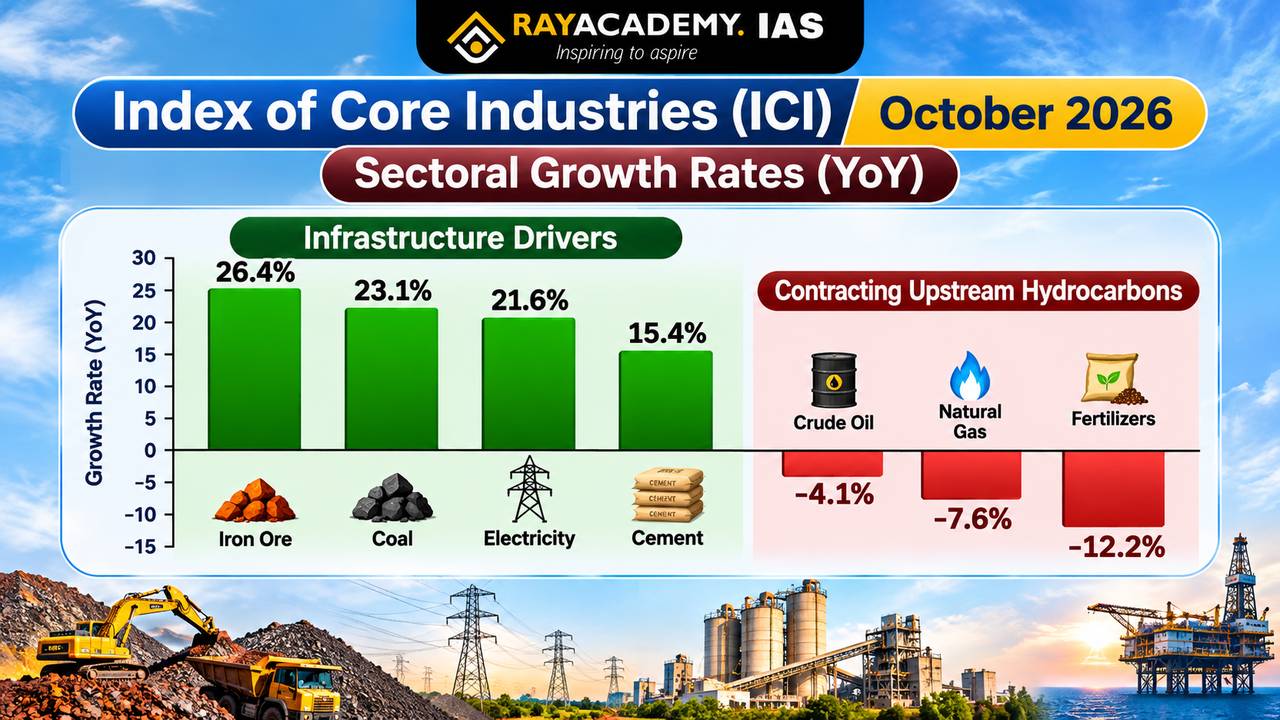
Static-Current Linkage: Macroeconomic Indicators, Statistical Base Effect, and Hydrocarbon Governance
Decoding the October 2026 core sector divergence requires linking statistical methodology in industrial indices with India’s upstream energy policy architecture:
1. Index of Core Industries (ICI) vs. Index of Industrial Production (IIP)
Compounding Macroeconomic Weight: The Index of Core Industries (ICI) tracks the monthly production volume of nine core infrastructure industries (revised from eight following the 2022–23 base year revision) and carries a combined weight of 40.27% (approx. 40.3%) in the broader Index of Industrial Production (IIP) compiled by the National Statistical Office (NSO).
Understanding the Base Effect Anomaly: In year-on-year (YoY) macroeconomic calculations, a base effect occurs when an unusually low or negative output reading in the reference month of the previous year artificially inflates the percentage growth rate in the current year, even if sequential (month-on-month) momentum is moderate. In India, shifting dates of the October–November festive calendar routinely distort single-month YoY comparisons across manufacturing and power demand.
2. Evolution of Upstream Oil & Gas Exploration Policy
From NELP to HELP (2016): To overcome rigid profit-sharing disputes under the New Exploration Licensing Policy (NELP), India introduced the Hydrocarbon Exploration and Licensing Policy (HELP) in 2016. HELP features a Uniform Licensing Policy (covering conventional oil/gas, coal-bed methane, and shale under one licence), a Revenue Sharing Model, marketing and pricing freedom, and an Open Acreage Licensing Policy (OALP) allowing companies to carve out blocks year-round.
Oilfields (Regulation and Development) Amendment Act, 2025: Modernized the 1948 statute by delinking mineral oils from general mining laws, introducing stable Petroleum Leases, decriminalizing minor operational defaults, and facilitating international arbitration to attract global upstream exploration capital.
Prelims Focus: High-Yield Objective Facts for UPSC
Quick Revision Fact Box
Index of Core Industries (Base Year 2022–23)Compiling Agency: Released monthly (on the 20th of the following month) by the Office of the Economic Adviser (OEA), Department for Promotion of Industry and Internal Trade (DPIIT), Ministry of Commerce and Industry.
Revised Base Year (2022–23): Recently updated from 2011–12 to 2022–23, expanding coverage from eight to nine core sectors with the addition of Iron Ore.
Descending Order of Sectoral Weights (Base Year 2022–23):Electricity (~30.93%)Refinery Products (~22.57%)Steel (~17.58%)Crude Oil (~7.43%)Coal (~5.60%)Iron Ore (~4.91%)Cement (~4.41%)Natural Gas (~3.84%)Fertilizers (~2.73%)
Major Sedimentary Basins in India: India has 26 sedimentary basins covering 3.4 million sq. km; Category-I (commercially producing) basins include Mumbai Offshore, Cambay, Assam Shelf, Krishna-Godavari (KG), Cauvery, Rajasthan (Barmer), and Assam-Arakan Fold Belt.
Key Regulatory Body: Directorate General of Hydrocarbons (DGH), established in 1993 under the Ministry of Petroleum and Natural Gas (MoPNG) as the technical upstream regulator.
Mains Analytical Breakdown
Significance of the Infrastructure-Led Core Expansion
Validation of Public Capital Expenditure (Capex): Strong real growth in iron ore (26.4%) and cement (15.4%) reflects sustained central and state government capital expenditure on highways, railways, and urban housing, crowding in domestic construction activity.
Domestic Mineral & Power Resilience: Double-digit expansion in coal (23.1%) and electricity (21.6%) ensures reliable baseload power availability for manufacturing units and reduces thermal coal import dependence.
Multiplier Effect on Downstream IIP: Because core industries supply primary intermediate inputs to capital goods, automobiles, and consumer durables, sustained momentum across six of the nine core sectors anchors broader industrial recovery.
Multi-Dimensional Challenges Behind the Core Sector Divergence
Statistical Illusion & Policy Complacency Risk (Macroeconomic): Over-celebrating headline YoY spikes driven by base-effect anomalies risks masking underlying private consumption sluggishness until sequential November–December data smooth out festive distortions.
Chronic Upstream Hydrocarbon Stagnation (Energy Security): Nearly two-and-a-half years of unbroken contraction in natural gas (28 months) and crude oil (22 months) highlights ageing mature fields (such as Mumbai High) and underperformance of upstream Public Sector Undertakings (PSUs).
Imported Inflation & Current Account Pressure (External Sector): Falling domestic crude and gas production forces India—which imports over 85% of its crude oil and nearly 50% of its natural gas—to rely heavily on volatile global energy markets, elevating input costs, squeezing corporate profit margins, and stoking cost-push inflation.
Over-Reliance on Government Capex (Fiscal): With private corporate investment still recovering cautiously, sustaining industrial growth relies disproportionately on public infrastructure spending, leaving little fiscal room for error.
Carbon Intensity & Transition Dilemma (Environmental): Rapid expansion in coal, cement, and steel output—while essential for infrastructure—increases industrial greenhouse gas emissions, necessitating parallel investments in clean energy and industrial decarbonization.
Way Forward: Anchored in Authoritative Frameworks
To decouple industrial growth from statistical base distortions and reverse upstream hydrocarbon decline, policy intervention should focus on four pillars:
Enforce PSU Accountability & Enhanced Oil Recovery (Parliamentary Standing Committee on Petroleum & Natural Gas): The Ministry of Petroleum and Natural Gas must institute transparent, field-level performance audits for upstream PSUs (ONGC and Oil India Limited), mandating targeted deployment of Enhanced Oil Recovery (EOR) and Improved Oil Recovery (IOR) technologies in mature Category-I basins.
Fast-Track Deepwater & Frontier Exploration (NITI Aayog Energy Security Strategy): Expedite statutory environmental and defence clearances in unexplored deepwater basins (Andaman-Nicobar, Mahanadi, and Kerala-Konkan) under OALP rounds, leveraging the Oilfields (Regulation and Development) Amendment Act, 2025 to attract global deep-sea technical operators.
Adopt Seasonally Adjusted & Moving-Average Macro Tracking (RBI & MoSPI Frameworks): Policymakers and analysts should evaluate 3-month moving averages and seasonally adjusted sequential (MoM) indices alongside YoY headline figures to eliminate festive calendar and low-base statistical noise.
Accelerate Gas-Based Economy & Bio-Energy Blending (Kirit Parikh Committee Recommendations): Expand the National Gas Grid, incentivize Compressed Biogas (CBG) under the SATAT initiative, and scale green hydrogen in refining and fertilizers to structurally curb imported fossil fuel vulnerability.
Value Addition Snippet (For Mains Introductions & Conclusions)
Macroeconomic & Energy Benchmarks:
Under the revised 2022–23 base year, Electricity (30.93%), Refinery Products (22.57%), and Steel (17.58%) together account for over 71% of the total weight in the Index of Core Industries.
Cumulative ICI growth for April–October 2026 stood at 6.0% (compared to 2.3% in April–October 2025), underscoring steady medium-term infrastructure momentum despite single-month volatility.
Analytical Catchphrase for Mains Answers: "True macroeconomic resilience requires looking beyond flattering statistical base effects to fix structural supply-side bottlenecks in India’s upstream energy sector."
Active Recall: UPSC Practice Questions
1. Prelims Practice Question (Multi-Statement Format)
With reference to the Index of Core Industries (ICI) in India, consider the following statements:
It is compiled and released monthly by the National Statistical Office (NSO) under the Ministry of Statistics and Programme Implementation.
Under the revised 2022–23 base year series, the Index tracks nine core industries, with Electricity carrying the highest individual weight.
The Index of Core Industries accounts for roughly 40% of the total weight of items included in the Index of Industrial Production (IIP).
Which of the statements given above is/are correct?
(a) 1 and 2 only
(b) 2 and 3 only
(c) 3 only
(d) 1, 2, and 3
Correct Answer: (b) 2 and 3 only
Explanation:
Statement 1 is incorrect: While the Index of Industrial Production (IIP) is compiled by the National Statistical Office (NSO), the Index of Core Industries (ICI) is compiled and released by the Office of the Economic Adviser (OEA), Department for Promotion of Industry and Internal Trade (DPIIT), Ministry of Commerce and Industry.
Statement 2 is correct: Under the revised 2022–23 base year, the ICI tracks nine core sectors (coal, crude oil, natural gas, refinery products, fertilizers, steel, cement, electricity, and iron ore), with Electricity (~30.93%) holding the highest weight, followed by Refinery Products (~22.57%) and Steel (~17.58%).
Statement 3 is correct: The nine core industries collectively represent 40.27% (approx. 40.3%) of the weight of items included in the IIP.
2. Mains Practice Question (150 Words | 10 Marks)
Q. "Headline surges in India’s Index of Core Industries often mask underlying structural vulnerabilities in domestic energy production." Critically examine this statement in light of recent core sector trends and suggest measures to strengthen upstream hydrocarbon output. (150 words)
Model Answer Structure Hint:
Introduction: Contextualize the 10.9% YoY surge in the Index of Core Industries (October 2026), noting how a low statistical base and public capex boosted construction/power sectors even as crude oil (-4.1%) and natural gas (-7.6%) remained in prolonged contraction.
Body:
Why Headline Numbers Mask Vulnerabilities: Explain the statistical base effect (low October 2025 base and festive calendar shifts) versus real structural decline in upstream hydrocarbons (22+ months of contraction), leading to higher fuel imports, corporate margin pressure, and cost-push inflation.
Measures to Strengthen Upstream Output: Suggest enforcing PSU accountability and deploying Enhanced Oil Recovery (EOR) in mature fields, accelerating deepwater exploration under HELP/OALP and the 2025 Oilfields Amendment Act, and expanding compressed biogas/gas infrastructure.
Conclusion: Conclude that sustainable industrial growth demands pairing infrastructure capex with structural upstream energy reforms to safeguard macroeconomic stability.
Take this article with you
Save a reading copy for offline study.


