

FICCI Centenary Convention
PM’s Challenge to India Inc. at FICCI Centenary Convention: Addressing the centenary convention of the Federation of Indian Chambers of Commerce and Industry (FICCI) in New Delhi on November 19, 2026, Prime Minister Narendra Modi directly questioned corporate leaders on whether successive corporate tax cuts and policy reforms had translated into higher worker pay and hiring.
UPSC Syllabus Mapping:
General Studies Paper III (Indian Economy): Indian Economy and issues relating to planning, mobilization of resources, growth, development and employment; Inclusive growth and issues arising from it; Effects of liberalization on the economy, changes in industrial policy and their effects on industrial growth.
General Studies Paper II (Social Justice & Governance): Government policies and interventions for development in various sectors and issues arising out of their design and implementation.
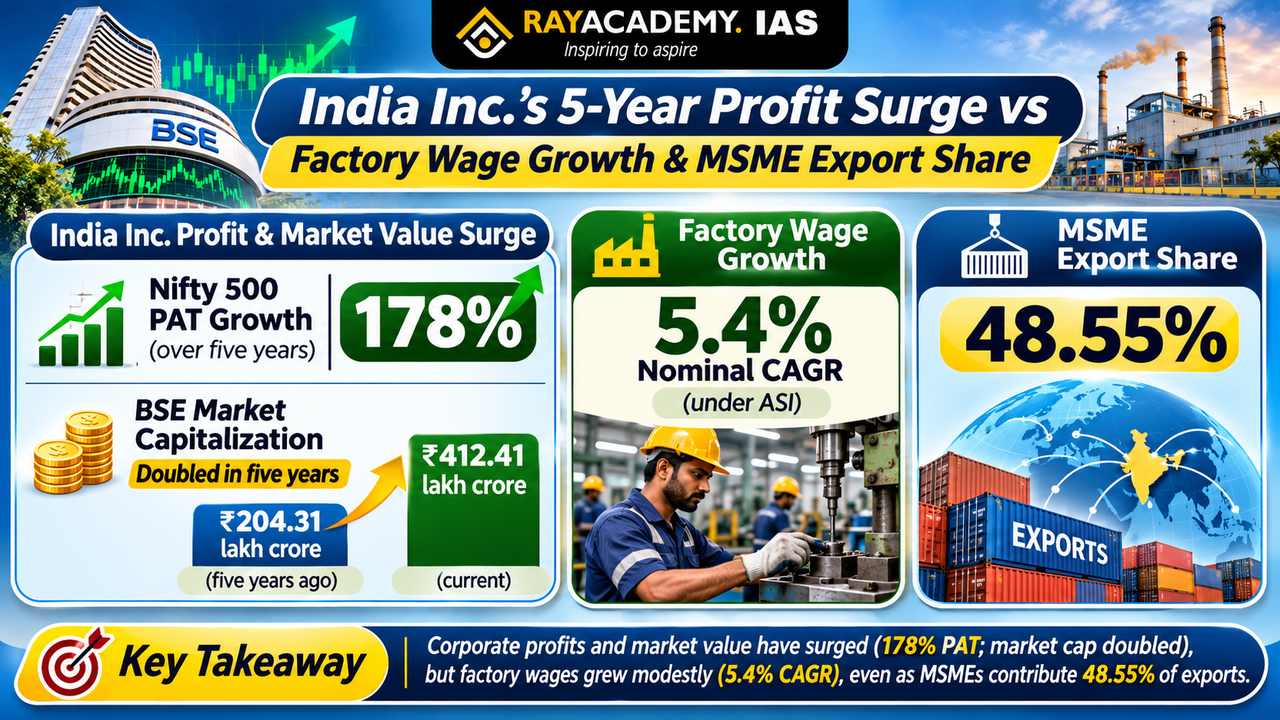
Stark Corporate Profit vs. Wage Divergence: While Nifty 500 aggregate Profit After Tax (PAT) surged by 178% over five years (from ₹6.51 lakh crore in FY2020–21 to ₹18.10 lakh crore in FY2025–26, a 22.7% CAGR), annual wages per factory worker in the Annual Survey of Industries (ASI) grew at a modest 5.4% nominal annual rate (from ₹1.75 lakh in 2019–20 to ₹2.28 lakh in 2024–25)—leaving real purchasing power strained by inflation.
Virtuous Cycle of Demand & Export Quality: Economic policymakers emphasize that profit sharing, Employee Stock Ownership Plans (ESOPs), and capability investment in Micro, Small, and Medium Enterprises (MSMEs)—which drive 48.55% of India’s merchandise exports—are essential to lift domestic consumption demand and improve global export quality.
Static-Current Linkage: Wage-Led Growth, Constitutional Directive Principles, and Industrial Statistics
Understanding why worker compensation is central to India’s macroeconomic trajectory requires linking constitutional economic mandates with labour jurisprudence and industrial survey frameworks:Corporate Profit Sharing
1. Constitutional Mandate for Fair Wages and Worker Participation
Article 39(b) & 39(c) (Directive Principles of State Policy): Direct the State to ensure that the ownership and control of material resources are distributed to subserve the common good, and that the operation of the economic system does not result in the concentration of wealth and means of production to the common detriment.
Article 43: Mandates that the State shall endeavour to secure, by suitable legislation or economic organization, a living wage and conditions of work ensuring a decent standard of life for all workers.
Article 43A (Inserted by the 42nd Amendment Act, 1976): Directs the State to take steps to secure the participation of workers in the management of undertakings, establishments, or other organizations engaged in any industry.
2. Macroeconomic Theory: Wage-Led Demand & Henry Ford’s Virtuous Cycle
Circular Flow of Income: In a consumption-driven developing economy like India (where Private Final Consumption Expenditure accounts for ~60% of GDP), "one company’s workers are another company’s customers". Suppressing wage growth to maximize short-term corporate margins depresses aggregate demand, leading to underutilized industrial capacity and sluggish private capital expenditure (Capex).
Efficiency Wage Hypothesis: Higher real wages and profit-linked incentives reduce employee attrition, incentivise skill acquisition, and raise Total Factor Productivity (TFP)—enabling firms to meet stringent international quality standards.
3. Statutory Frameworks & Industrial Data Sources
Annual Survey of Industries (ASI): Conducted annually by the National Statistical Office (NSO) under the Ministry of Statistics and Programme Implementation (MoSPI) under the statutory provisions of the Collection of Statistics Act, 2008. It covers factories registered under Sections 2m(i) and 2m(ii) of the Factories Act, 1948 (employing 10 or more workers with power, or 20 or more without power).
Code on Wages, 2019 & Payment of Bonus Act, 1965: Consolidated four central labour laws to universalize minimum wages and statutory profit-linked bonuses across organized and unorganized sectors.
Prelims Focus: High-Yield Objective Facts for UPSC
Quick Revision Fact Box:
Industrial Surveys, Corporate Metrics & MSME ExportsAnnual Survey of Industries (ASI) 2024–25 Highlights:
Nodal Ministry: Ministry of Statistics and Programme Implementation (MoSPI).
Registered Manufacturing Employment: Rose 7.19% year-on-year to 2.10 crore persons in 2024–25.
Average Annual Wages per Worker: Increased from ₹1.75 lakh (2019–20) to ₹2.28 lakh (2024–25) (a 30% cumulative rise over five years).
Top 5 Manufacturing GVA States: Maharashtra, Gujarat, Tamil Nadu, Karnataka, and Uttar Pradesh together account for over 54% of India’s registered manufacturing Gross Value Added (GVA).
Economic Survey 2025–26 Factory Scale Finding: Employment in larger factories grew at ~6% per annum between 2013–14 and 2023–24, three times faster than the ~2% annual growth in smaller factories.
MSME Contribution to Merchandise Exports: Products associated with MSMEs accounted for 48.55% of India’s merchandise exports in 2024–25, rising from 43.59% two years earlier.
Corporate Tax Reform Reference: In 2019 (via the Taxation Laws Amendment Act), the Union Government slashed the base corporate tax rate from 30% to 22% (and 15% for new manufacturing units) to stimulate private investment and job creation.
Mains Analytical Breakdown
Significance of Corporate Profit Sharing & Supplier Upgradation
Reviving Broad-Based Domestic Demand: Passing productivity and profit gains to workers expands middle- and lower-income purchasing power, creating self-sustaining domestic demand for consumer goods, housing, and services.
Enhancing Global Export Competitiveness: Investing in worker training and quality testing enables Indian manufacturers to reduce export shipment rejection rates and secure repeat orders from global value chains.
Scaling Formal Employment in Larger Enterprises: As highlighted by the Economic Survey 2025–26, larger factories generate three times faster employment growth and higher productivity than subscale units, allowing training and compliance costs to be amortized over larger order volumes.
Aligning Employee Stakes via ESOPs: Broadening Employee Stock Ownership Plans (ESOPs) beyond top executives to shop-floor and technical personnel aligns workforce retention with long-term corporate value creation.
Multi-Dimensional Challenges in Wage & MSME Transmission
Asymmetric Profit-to-Wage Transmission (Economic): SBI Research data across ~4,000 listed entities showed Profit After Tax rising 31.7% in 2023–24 while employee expenses rose just 13%—reflecting capital-intensive growth models and rising contractualization of labour.
Inflation Erosion of Nominal Wage Gains (Social): A 5.4% nominal annual wage increase under ASI leaves minimal real wage growth once retail inflation is accounted for, constraining household savings and human capital investments in health and education.
Pre-Shipment Compliance & Testing Costs for MSMEs (Structural): Small suppliers driving 48.55% of merchandise exports must bear heavy upfront costs for component traceability and international product certification before realizing export revenues.
Tax & Vesting Hurdles in Employee Share Plans (Regulatory): Complex vesting schedules, perquisite taxation at exercise, and liquidity restrictions often limit the real take-home benefit of ESOPs for middle-tier employees.
K-Shaped Recovery & Inequality Concerns (Ethical): Widening divergence between surging equity market valuations (BSE market cap doubling to ₹412.41 lakh crore) and stagnant real shop-floor wages risks deepening socio-economic inequality.
Way Forward: Anchored in Authoritative Frameworks
To bridge the corporate profit–wage gap and strengthen India’s manufacturing export ecosystem, coordinated corporate governance and policy reforms are required:
Mandatory Corporate Disclosure of Real Median Pay (SEBI BRSR & Corporate Governance Reforms): Require listed corporate boards under SEBI’s Business Responsibility and Sustainability Reporting (BRSR) framework to disclose inflation-adjusted median employee pay growth, net formal hiring, and output per employee alongside executive remuneration.
Broad-Based Profit Sharing & Simplified ESOP Taxation (NITI Aayog & Tax Policy): Rationalize ESOP perquisite taxation (deferring tax liability until actual share sale across all sectors, not just eligible startups) and encourage multi-year profit-linked bonus pools alongside higher base pay where productivity gains endure.
Shared Testing Infrastructure & Export Certification Support (Ministry of MSME & Commerce): Establish industry-association-led common testing and traceability laboratories, expand access to Technology Centres, and co-finance international product certification for small suppliers so costs do not fall disproportionately before first shipments.
Negotiate Mutual Recognition Agreements (MRAs) in FTAs (Foreign Trade Policy 2023): Incorporate Mutual Recognition Agreements (MRAs) for equivalent laboratory testing and standards in bilateral Free Trade Agreements (FTAs) to lower non-tariff barriers and reduce shipment rejections for Indian MSME exporters.
Value Addition Snippet (For Mains Introductions & Conclusions)
Official Data Points for GS-3 Answers:
Corporate Profit vs. Wage Gap: Nifty 500 aggregate PAT rose 178% over five years (₹6.51 lakh crore in FY21 to ₹18.10 lakh crore in FY26; 22.7% CAGR), whereas ASI factory wages per worker rose 5.4% annually (₹1.75 lakh in FY20 to ₹2.28 lakh in FY25).
Scale & Export Benchmarks: Economic Survey 2025–26 notes that employment in larger factories grew at ~6% per year (2013–14 to 2023–24) versus 2% in smaller factories, while MSMEs accounted for 48.55% of India’s merchandise exports in 2024–25.
Economic Catchphrase for Mains Answers: "Higher worker compensation and supplier capability investment are not corporate charity—they are strategic investments in domestic aggregate demand and global export competitiveness."
Active Recall: UPSC Practice Questions
1. Prelims Practice Question (Multi-Statement Format)
With reference to industrial statistics and manufacturing trends in India, consider the following statements:
The Annual Survey of Industries (ASI) is conducted by the National Statistical Office (NSO) under the statutory provisions of the Collection of Statistics Act, 2008.
According to the Economic Survey 2025–26, annual employment growth in smaller factories outpaced that of larger factories between 2013–14 and 2023–24.
Products associated with Micro, Small, and Medium Enterprises (MSMEs) accounted for more than 45% of India’s total merchandise exports in 2024–25.
Which of the statements given above is/are correct?
(a) 1 and 2 only
(b) 1 and 3 only
(c) 2 and 3 only
(d) 1, 2, and 3
Correct Answer: (b) 1 and 3 only
Explanation:
Statement 1 is correct: The Annual Survey of Industries (ASI) is conducted by the NSO (MoSPI) under the Collection of Statistics Act, 2008, covering registered manufacturing units under the Factories Act, 1948.
Statement 2 is incorrect: The Economic Survey 2025–26 found the exact opposite—employment in larger factories grew at ~6% per year between 2013–14 and 2023–24, three times faster than the ~2% annual growth in smaller factories.
Statement 3 is correct: Official trade tracking indicates that MSME-linked products accounted for 48.55% of India’s merchandise exports in 2024–25 (up from 43.59% two years earlier).
2. Mains Practice Question (150 Words | 10 Marks)
Q. "Sharing corporate productivity gains with workers and investing in small suppliers is essential to sustain both domestic consumption demand and export competitiveness in India." Examine this statement in light of recent corporate profit and wage trends. (150 words)
Model Answer Structure Hint:
Introduction: Contextualize the divergence between strong corporate profitability (Nifty 500 PAT up 178% over five years) and sluggish real factory wage growth (ASI nominal wage growth at 5.4% annually), highlighted at FICCI’s 2026 centenary convention.
Body:
Why Profit Sharing & Supplier Investment Matter: Explain the circular flow of demand ("one company's workers are another's customers"), productivity gains in larger factories (6% annual job growth per Economic Survey 2025–26), and quality compliance for MSMEs (48.55% of merchandise exports).
Key Bottlenecks: Note inflation erosion of wages, high pre-shipment testing/certification costs for small firms, and ESOP tax/vesting friction.
Conclusion: Suggest board disclosures on real median pay, broad-based ESOP/profit-sharing plans, shared testing labs for MSMEs, and Mutual Recognition Agreements (MRAs) in trade pacts.
Take this article with you
Save a reading copy for offline study.


