

Food inflation in India
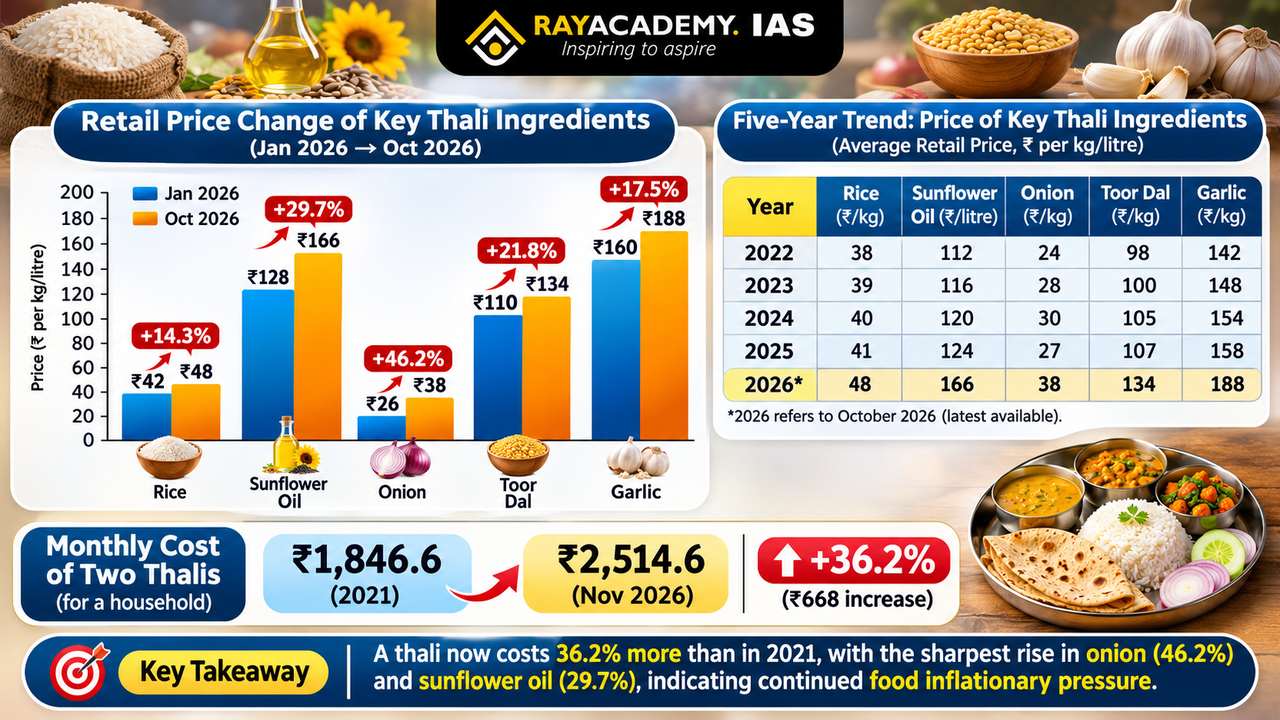
Retail food inflation in India surged sharply to 8.9% in October 2026—the highest level recorded in at least 22 months of the revised Consumer Price Index (CPI) series—pushing up the average cost of a home-cooked vegetarian thali by 16% in less than ten months (between March and November 2026).
UPSC Syllabus Mapping:
General Studies Paper III (Indian Economy & Agriculture): Indian Economy and issues relating to planning, mobilization of resources, growth, development and employment; Inclusive growth and issues arising from it; Storage, transport and marketing of agricultural produce and issues and related constraints; Public Distribution System—objectives, functioning, limitations, revamping; issues of buffer stocks and food security.
An empirical price assessment using data from the Department of Consumer Affairs, the National Horticulture Board (NHB), and the Centre for Monitoring Indian Economy (CMIE) reveals that preparing two thalis daily for a month now costs a household ₹2,514.6 (as of November 2026), compared to ₹2,205.2 a year ago and ₹1,846.6 five years ago. Steep price spikes in onions (over 100%), garlic (22%), and rice (11%)—compounded by Strait of Hormuz disruptions affecting crude oil and fertilizer supplies—have forced Indian households to spend a larger share of their wages on basic meals.
Static-Current Linkage: Engel’s Law, CPI Food Weightage, and Supply-Chain Economics
Analyzing how thali inflation erodes real household purchasing power requires linking classical microeconomic laws with India’s inflation-measurement architecture and agricultural supply-chain vulnerabilities.
1. Engel’s Law & Welfare Erosion
Proposed by 19th-century German statistician Ernst Engel, Engel’s Law states that as household income rises, the proportion of income spent on food falls—and conversely, lower-income households spend a far higher share of their earnings on food.
Even though CMIE data shows average monthly wages rose by 11% between November 2025 and September 2026 (to ₹26,310), the monthly cost of two daily thalis rose faster (13.4% over the year), pushing the food-expenditure share of wages up from 9.3% to 9.6% for salaried workers—and imposing a far steeper burden on unorganized daily-wage earners who lack paid rest days.
2. Structural Drivers of Food Inflation in India
Weightage in Consumer Price Index (CPI): Food and beverages carry the single largest weight in India’s CPI (Combined) basket (historically ~45.86%, recalibrated in the CPI Base Year 2024=100 series), meaning volatile TOP (Tomato, Onion, Potato) and pulse prices disproportionately drive headline retail inflation and constrain the Reserve Bank of India’s (RBI) Monetary Policy Committee (MPC).
Imported Cost-Push Shocks (Crude & Fertilizers): Geopolitical blockades in the Strait of Hormuz inflate global crude oil, liquefied natural gas (LNG), and imported fertilizer (urea, DAP, MOP) prices—raising farm-gate cultivation costs as well as diesel-based agricultural freight charges.
Prelims Focus: High-Yield Objective Facts
Thali Cost Assessment Methodology (2026): Tracks retail prices of 13 core ingredients required for two vegetarian servings (125 g white rice, 250 g wheat atta, 125 g toor dal, 36.3 ml sunflower oil, 300 g potato, 250 g brinjal, 250 g cabbage, 100 g tomato, 100 g onion, 25 g garlic, 25 g red chilli, 12.8 g salt, and 7.5 g ginger)—excluding spices and ghee.
Key Data Institutions Referenced:
Department of Consumer Affairs (Ministry of Consumer Affairs, Food & Public Distribution): Tracks daily retail and wholesale prices of 22+ essential food commodities across hundreds of centres and manages the Price Stabilisation Fund (PSF).
National Horticulture Board (NHB): Autonomous organization set up in 1984 under the Ministry of Agriculture and Farmers Welfare (headquartered in Gurugram) to promote integrated horticulture development and cold-chain infrastructure.
Centre for Monitoring Indian Economy (CMIE): Independent economic think tank conducting the Consumer Pyramids Household Survey (CPHS) tracking wages, employment, and household consumption.
Buffer Stock & Price Stabilization Instruments:
Price Stabilisation Fund (PSF): Created in 2014–15 to regulate price volatility in agri-horticultural commodities (onions, potatoes, pulses) through strategic procurement and calibrated market release.
Operation Greens: Launched in 2018–19 (initially for TOP—Tomato, Onion, Potato—and later expanded to TOTAL crops) under the Ministry of Food Processing Industries (MoFPI) to stabilize prices and build value chains.
Mains Analytical Breakdown
Significance of Tracking Household Thali Inflation
Capturing Real Cost-of-Living Stress Beyond Headline GDP: While macroeconomic aggregates may indicate nominal wage growth, a commodity-level thali index accurately reflects the lived erosion of real disposable income experienced by middle- and low-income families.
Highlighting Vulnerability to External Geopolitical Shocks: The linkage between the U.S.–Iran conflict / Strait of Hormuz blockade and domestic sunflower oil, fertilizer, and freight costs underscores how West Asian instability directly transmits into Indian kitchen budgets.
Pinpointing Horticultural & Pulse Supply Bottlenecks: Identifying specific inflationary culprits—such as onions (>100% surge), garlic (22%), and toor dal—helps policymakers target buffer-stock interventions rather than relying solely on blunt interest-rate hikes.
Multi-Dimensional Challenges
Contraction of Non-Essential Consumption (Economic): When regular salaried households allocate a higher share of income (9.6%+) to basic meals, they cut back on discretionary spending (apparel, consumer durables, services)—dampening broader private final consumption expenditure (PFCE) and industrial demand.
Acute Distress Among Informal & Daily-Wage Workers (Social & Equity): Unlike salaried employees assumed to earn across 30 days, informal daily-wage labourers face unpaid rest days and irregular work, meaning a 35% five-year jump in meal costs (from ₹1,846.6 to ₹2,514.6) severely compresses their real living standards.
Nutritional Compromise & "Hidden Hunger" (Health & Ethical): Because the thali metric excludes non-vegetarian proteins, dairy/ghee, and fruits, sustained inflation in toor dal and vegetables pushes vulnerable families toward calorie-dense, nutrient-poor staples—worsening protein-energy malnutrition and micronutrient deficiencies.
Limitations of Monetary Policy Against Cost-Push Shocks (Macroeconomic): Repo rate hikes by the RBI Monetary Policy Committee cannot immediately augment domestic onion harvests or clear maritime chokepoints, creating a stagflationary dilemma where high food inflation stalls rate cuts needed to support growth.
Post-Harvest Losses & Storage Deficits (Agricultural): Extreme weather variability and inadequate scientific cold-chain and controlled-atmosphere storage cause cyclical gluts and acute seasonal shortages in perishable crops like onions, tomatoes, and garlic.
Way Forward
Expand Dynamic Buffer Stocks & Price Stabilisation Fund (PSF) Operations: Strengthen pre-emptive procurement and retail intervention (via NAFED, NCCF, and Bharat Brand outlets) for onions, pulses (toor/urad), and edible oils, backed by irradiation and modern cold-storage facilities to curb post-harvest losses.
Scale Cold-Chain & Processing Infrastructure (Dalwai Committee Roadmap): Operationalize the Ashok Dalwai Committee on Doubling Farmers’ Income recommendations by accelerating Operation Greens, farmer-producer organization (FPO)-managed pack-houses, and dehydrated onion/tomato processing to absorb seasonal gluts.
Boost Domestic Oilseed & Pulse Self-Sufficiency: Fast-track the National Mission on Edible Oils – Oilseeds (NMEO-Oilseeds) and PM-AASHA price-deficiency mechanisms to reduce India’s ~55–60% edible oil import dependence and insulate domestic cooking oil prices from external shocks.
Strengthen Food & Nutritional Security Safety Nets: Pair Pradhan Mantri Garib Kalyan Anna Yojana (PMGKAY) free cereal distribution with State-level inclusion of pulses, fortified edible oil, and millets in the Public Distribution System (PDS) to protect low-income nutrition during inflationary spikes.
De-Risk Fertilizer & Energy Supply Chains: Expand domestic Nano Urea/Nano DAP adoption, diversify long-term fertilizer and crude import contracts away from single maritime chokepoints, and rationalize logistics bottlenecks under PM Gati Shakti.
Value Addition for Mains
Official & Empirical Benchmarks for Mains Answers:
Thali Cost Trajectory (2021–2026): Monthly cost of two daily vegetarian thalis rose 14% year-on-year (from ₹2,205.2 to ₹2,514.6 in November 2026) and 35% over five years (from ₹1,846.6), while retail food inflation hit 8.9% in October 2026.
Household Consumption Context (MoSPI Household Consumption Expenditure Survey): Food accounts for roughly 46% of total monthly per capita consumption expenditure (MPCE) in rural India and 39% in urban India, explaining why sustained food inflation directly undermines inclusive growth and poverty reduction.
Practice Questions for Active Recall
Prelims Practice MCQ
With reference to food inflation management and agricultural price stabilization mechanisms in India, consider the following statements:
The Price Stabilisation Fund (PSF) is administered by the Ministry of Consumer Affairs, Food and Public Distribution to moderate price volatility in select agri-horticultural commodities such as onions, potatoes, and pulses.
The National Horticulture Board (NHB) is a statutory body established under the Essential Commodities Act, 1955.
According to Engel’s Law, as household income increases, the percentage of income spent on food decreases, even if absolute expenditure on food rises.
Which of the statements given above are correct?
(a) 1 and 2 only
(b) 1 and 3 only
(c) 2 and 3 only
(d) 1, 2, and 3
Correct Answer: (b) 1 and 3 only
Explanation:
Statement 1 is correct: The Price Stabilisation Fund (PSF) was initially set up under the Ministry of Agriculture in 2014–15 and later transferred to the Department of Consumer Affairs (Ministry of Consumer Affairs, Food and Public Distribution) to build strategic buffer stocks of onions, potatoes, and pulses.
Statement 2 is incorrect: The National Horticulture Board (NHB) was set up in 1984 by the Government of India as an autonomous society registered under the Societies Registration Act, 1860 (not a statutory body under the Essential Commodities Act, 1955).
Statement 3 is correct: Engel’s Law establishes an inverse relationship between household income and the budget share allocated to food—making lower-income households disproportionately vulnerable to food inflation.
Mains Practice Question (GS Paper III — 150 Words | 10 Marks)
"Persistent food inflation acts as a regressive tax on low-income households while constraining monetary policy flexibility." Examine the domestic and external drivers behind rising household meal costs in India and suggest structural supply-side measures to ensure price stability.
Answer Structure Hints:
Introduction: Cite recent empirical trends—retail food inflation surging to 8.9% and the cost of a home-cooked thali jumping 16% in 10 months (35% over five years)—to highlight real wage erosion.
Body Part 1 (Drivers & Socio-Economic Impact): Detail domestic horticultural/pulse shocks (onions >100%, garlic 22%, rice 11%) alongside external Strait of Hormuz crude/fertilizer disruptions. Explain disproportionate impacts on daily-wage earners (Engel’s Law), nutrition compression, and non-essential consumption slowdown.
Body Part 2 (Structural Supply-Side Remedies): Recommend modern cold-storage and Operation Greens expansion, dynamic Price Stabilisation Fund (PSF) buffer operations, NMEO-Oilseeds for edible oil self-sufficiency, and diversifying PDS baskets with pulses and millets.
Conclusion: Emphasize synchronizing RBI’s Flexible Inflation Targeting with resilient agricultural value chains to safeguard household food security and inclusive growth.
Take this article with you
Save a reading copy for offline study.


