

On this page
First SCO Civilisational Dialogue Forum at Purana Qila
First SCO Civilisational Dialogue Forum at Purana Qila: Beginning November 20, 2026, Culture Ministers of the Shanghai Cooperation Organisation (SCO) alongside dialogue partners from over 25 countries convened inside New Delhi’s historic Purana Qila for the inaugural SCO Civilisational Dialogue Forum, jointly organized by the Ministry of Culture and the Ministry of External Affairs (MEA).
OPSC Syllabus Mapping:
General Studies Paper II (International Relations): Bilateral, regional and global groupings and agreements involving India and/or affecting India’s interests; Effect of policies and politics of developed and developing countries on India’s interests; India and its neighbourhood- relations.
General Studies Paper I (Indian Heritage & Culture): Indian culture will cover the salient aspects of Art Forms, Literature and Architecture from ancient to modern times (Pluralistic civilisational heritage, Silk Route exchanges, and cultural syncretism).
Strategic Contestation Over "Civilisational" Narrative: Foreign policy analysts observe that hosting this forum—originally proposed by Prime Minister Narendra Modi at the 2025 Tianjin SCO Summit—represents India’s calibrated soft-power counter-narrative to China’s Global Civilization Initiative (GCI) within Eurasia.
Multi-Alignment in Action: The conclave forms part of India’s broader 2026 diplomatic calendar—spanning the AI Impact Summit, BRICS Chairmanship, the 7th India–EU Strategic Partnership Review (November 9, 2026), and the Quad Leaders’ Summit in Manila (November 17, 2026)—demonstrating how New Delhi balances civilisational outreach with hard-power partnerships.
[IMAGE PLACEHOLDER 1: Strategic infographic illustrating India’s dual-track diplomacy—Soft Power Civilisational Outreach within SCO (Purana Qila, Buddhist & Sufi circuits) vs. Hard-Power & Tech Partnerships (Quad, India-EU Strategic Partnership, Semiconductor & Supply Chain Alliances)]
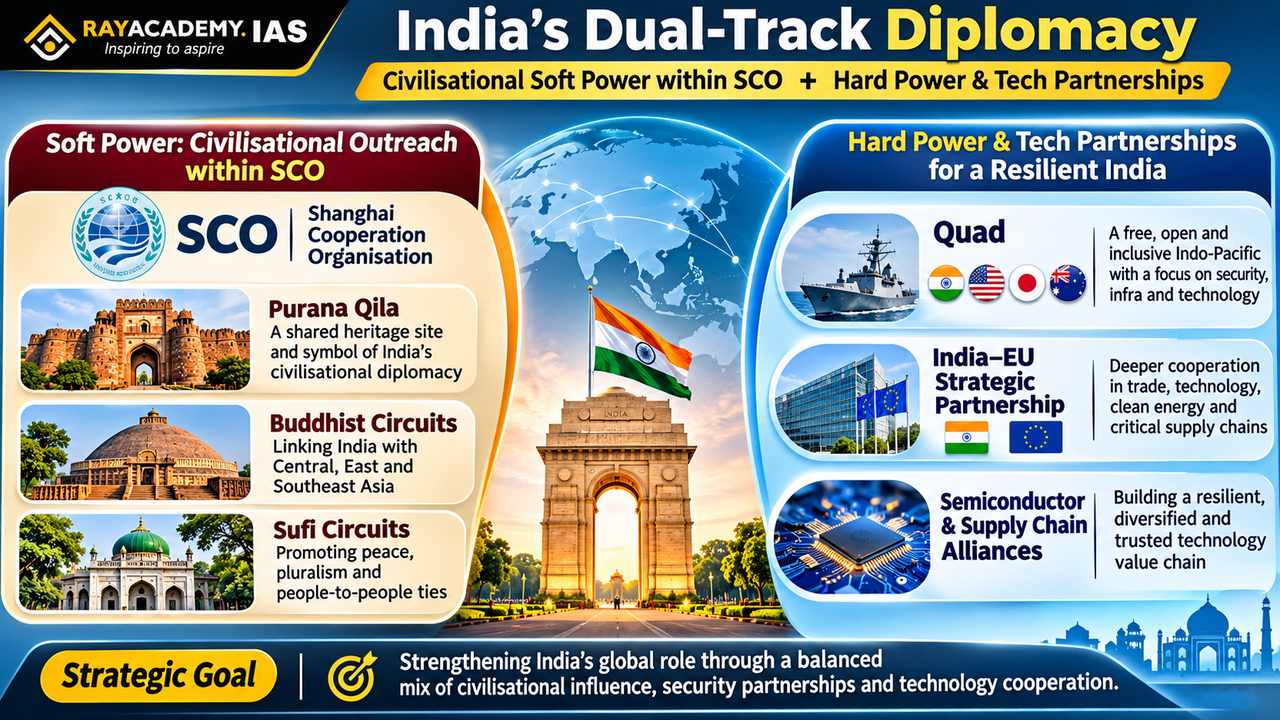
Static-Current Linkage: Civilisational Statecraft, SCO Architecture, and Foreign Policy
From Westphalian Universalism to Civilisational Relativism
For two decades following the Cold War, Western powers held an unchallenged monopoly over the normative vocabulary of global governance—democracy, free markets, and universal human rights. Emerging powers have increasingly challenged this normative dominance by invoking civilisational diversity:
China’s Global Civilization Initiative (GCI, 2023): Unveiled by President Xi Jinping, the GCI promotes "modernity with multiple pathways" and was institutionalized through the UN-designated International Day for Dialogue among Civilizations (June 10), the Ministerial Global Civilizations Dialogue (July 2025), and the Nishan Forum on World Civilizations (September 2026) at Confucius’s birthplace.
India’s Pluralistic Civilisational Counter-Narrative: Unlike authoritarian models that invoke ancient continuity to justify centralized uniformity, India frames its civilisational identity around democratic pluralism, layered syncretism, and open intellectual debate—symbolized by Purana Qila (built by Sher Shah Suri over ancient Indraprastha archaeological strata).
India’s Institutional Footprint Within the SCO
Admitted as a full member alongside Pakistan in 2017 (Astana Summit), India has historically remained a cautious participant inside the Beijing-headquartered SCO due to its rejection of China’s Belt and Road Initiative (BRI), persistent friction with Pakistan, and the lingering shadow of the 2020 Galwan border clash. Launching a flagship Civilisational Dialogue Forum gives New Delhi institutional agenda-setting authorship inside Eurasia rather than mere reactive veto power.
Multi-Alignment vs. Non-Alignment
India’s contemporary grand strategy has evolved from Cold War Non-Alignment to Multi-Alignment—the diplomatic art of participating actively across overlapping, sometimes competing coalitions (BRICS, SCO, Quad, EU, G20) without ceding strategic autonomy to any single power bloc.
Prelims Focus: High-Yield Objective Facts
China’s Three Global Initiatives:
Global Development Initiative (GDI) – Launched in 2021.
Global Security Initiative (GSI) – Launched in 2022.
Global Civilization Initiative (GCI) – Launched in 2023.
International Day for Dialogue among Civilizations: Observed annually on June 10, adopted by the UN General Assembly in 2024 following a resolution proposed by China.
Horizon Europe: The European Union’s flagship €95.5 billion research and innovation funding programme; India and the EU concluded talks on India’s association/membership ahead of their 7th Strategic Partnership Review in November 2026.
Historical Silk Route & Civilisational Nodes: Taxila (ancient Gandhara learning centre), Samarkand (Timurid cultural hub in Uzbekistan), Kucha, and Dunhuang formed the trans-Eurasian Buddhist and commercial corridors linking India with Central Asia.
Purana Qila (New Delhi): Constructed in the 16th century by Sher Shah Suri (Shergarh) and Mughal Emperor Humayun (Dinpanah), resting atop continuous archaeological deposits dating back to ancient Indraprastha.
Mains Analytical Breakdown
Strategic Objectives and Significance for India
Reclaiming Cultural & Soft-Power Authorship in Eurasia: While India cannot match China’s financial outlays in Central Asia, it possesses unmatched historical legitimacy across Buddhist circuits, Sufi lineages, and ancient Taxila–Samarkand trade routes, denying Beijing a monopoly over Eurasia’s civilisational discourse.
Demonstrating Compatibility of Antiquity and Democracy: By hosting the forum as the world’s largest constitutional democracy, India counters the narrative that civilisational states must be authoritarian, proving that deep historical continuity and democratic pluralism are mutually reinforcing.
Bridging the Global South, Central Asia, and the West: India’s parallel engagements—hosting BRICS and the SCO Civilisational Forum while deepening semiconductor supply chains with the U.S. and Japan, maritime security via the Quad (Manila Summit), and research integration with the EU (Horizon Europe)—position New Delhi as an indispensable diplomatic bridge.
Strategic Leverage on Buddhist Heritage: Highlighting India’s authentic custodianship of Buddhism strengthens New Delhi’s normative standing across Asia, carrying subtle geopolitical resonance on sensitive questions such as the succession of the Dalai Lama.
Multi-Dimensional Challenges and Diplomatic Risks
1. Risk of Legitimizing Authoritarian "Civilisational" Alibis
Normative Co-optation Dilemma: Critics warn that framing international politics around "civilisational relativism" is frequently used by authoritarian regimes to dismiss universal human rights and democratic accountability as "Western impositions". Hosted by a vibrant democracy like India, an SCO civilisational forum risks inadvertently lending democratic credibility to Beijing’s ideological vocabulary.
2. Pitfall of Competitive "Civilisational Chauvinism"
Inclusivity vs. Rival Claims of Antiquity: As international relations scholars caution, multipolarity does not automatically guarantee inclusivity. If India uses the forum to assert cultural superiority or compete over "ownership" of antiquity rather than celebrating shared, syncretic heritage, it risks walking into a zero-sum nationalist trap.
3. Structural Hard-Power Asymmetry in Eurasia
Soft Power Cannot Substitute for Hard Capabilities: Cultural summitry cannot offset China’s massive infrastructure, trade, and security footprint across Central Asia, nor can it resolve bilateral border deadlocks or state-sponsored terrorism within the SCO.
Way Forward
Anchor Civilisational Diplomacy in Pluralism and Syncretism: Frame the SCO Civilisational Dialogue Forum around shared, absorbent heritage—showcasing how Indian civilisation thrived by embracing and synthesizing diverse traditions rather than claiming exclusive cultural ownership.
Balance Soft-Power Outreach with Hard-Power and Tech Hedging: Pair cultural diplomacy in Eurasia with concrete technological, commercial, and regulatory statecraft—accelerating semiconductor resilience with the U.S. and Japan, R&D integration under Horizon Europe, and maritime deterrence via the Quad.
Operationalize Tangible Connectivity Projects: Translate civilisational goodwill into economic and people-to-people reality by fast-tracking the International North-South Transport Corridor (INSTC), Chabahar Port, and integrated Buddhist–Sufi heritage tourism visas across Central Asia.
Maintain Strategic Guardrails Against Normative Dilution: Ensure India’s civilisational discourse consistently upholds constitutional values, UN Charter principles, and sovereign territorial integrity (opposing non-consensual projects like CPEC).
Value Addition for Mains Answers
Foreign Policy Analytical Insight: "In contemporary statecraft, agenda-setting—not mere attendance—is the real currency of soft power. India’s success lies in constructing an inclusive Asian identity where civilisational depth reinforces democratic pluralism rather than authoritarian order."
Multi-Alignment Portfolio (2026): India’s simultaneous leadership in BRICS Chairmanship, SCO Civilisational Forum, India–EU Strategic Partnership (Horizon Europe), and the Manila Quad Summit exemplifies hedged multi-alignment across economic, technological, maritime, and cultural tracks.
Practice Questions for Active Recall
Prelims Practice MCQ
Consider the following statements regarding recent international initiatives and India’s multilateral engagements:
The Global Civilization Initiative (GCI) was unveiled by China in 2023, following which the UN General Assembly designated June 10 as the International Day for Dialogue among Civilizations.
Horizon Europe, with which India concluded association talks in 2026, is a joint maritime domain awareness initiative of the Quad nations.
Purana Qila in New Delhi, the venue of the First SCO Civilisational Dialogue Forum, was constructed in the 16th century by Sher Shah Suri and rests over archaeological strata identified with ancient Indraprastha.
Which of the statements given above is/are correct? A. 1 and 2 only
B. 1 and 3 only
C. 2 and 3 only
D. 1, 2 and 3
Correct Answer: B
Explanation:
Statement 1 is correct: China launched the Global Civilization Initiative (GCI) in 2023 and subsequently sponsored the UNGA resolution designating June 10 as the International Day for Dialogue among Civilizations.
Statement 2 is incorrect: Horizon Europe is the European Union’s (EU) flagship research and innovation framework programme, not a Quad maritime initiative.
Statement 3 is correct: Purana Qila was built during the 16th century by Sher Shah Suri (and Humayun) atop ancient archaeological layers associated with Indraprastha.
Mains Practice Question (GS Paper II – 150 Words / 10 Marks)
"In an era of contested multilateralism, civilisational diplomacy has emerged as an instrument of soft-power agenda-setting in Eurasia." Examine India’s strategic objectives in hosting the SCO Civilisational Dialogue Forum (2026) and discuss the caveats it must navigate.
Answer Structure Hint:
Introduction: Contextualize the inaugural SCO Civilisational Dialogue Forum at Purana Qila (November 2026) against China’s Global Civilization Initiative (GCI) and India’s multi-alignment strategy.
Body: Outline India’s three core objectives—(i) leveraging soft-power connectivity (Buddhist/Sufi/Silk Route heritage) in Central Asia, (ii) establishing agenda-setting authorship inside the SCO beyond reactive vetoes, and (iii) demonstrating that civilisational depth is compatible with democratic pluralism. Discuss key caveats—avoiding lending democratic legitimacy to authoritarian "civilisational relativism", steering clear of zero-sum cultural chauvinism, and complementing soft power with hard-power tech/maritime hedging (Quad, EU, U.S.–Japan supply chains).
Conclusion: Conclude with how an inclusive, syncretic civilisational vision enables India to bridge the Global South, Central Asia, and the West.
Take this article with you
Save a reading copy for offline study.


