

On this page
- ₹161 crore tribal development package.
- Static-Current Linkage: Birsa Munda’s Legacy, Fifth Schedule Architecture, and Tribal Education
- Prelims Focus: High-Yield Objective Facts.ribal Welfare and Infrastructure Development
- Mains Analytical Breakdown
- Way Forward
- Value Addition for Mains
- Practice Questions for Active Recall
₹161 crore tribal development package.
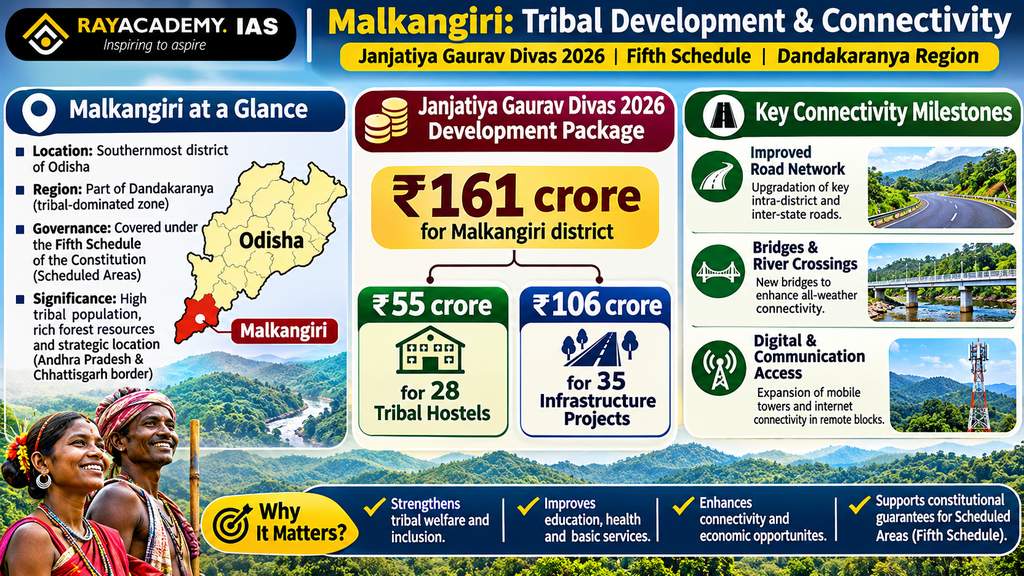
Addressing a state-level celebration of Janjatiya Gaurav Divas (November 15, 2026) in Malkangiri district, Odisha—commemorating the 151st birth anniversary of tribal freedom fighter Bhagwan Birsa Munda—Odisha Chief Minister Mohan Charan Majhi announced a comprehensive ₹161 crore tribal development package.
OPSC Syllabus Mapping:
General Studies Paper II (Social Justice & Governance): Welfare schemes for vulnerable sections of the population by the State and the performance of these schemes; Mechanisms, laws, institutions and bodies constituted for the protection and betterment of these vulnerable sections; Issues relating to development and management of Social Sector/Services relating to Health, Education, Human Resources.
General Studies Paper III (Internal Security): Linkages between development and spread of extremism; Security challenges and their management in border and backward areas.
The package comprises the inauguration of 28 newly constructed tribal hostels worth ₹55 crore to strengthen educational access for tribal students and the foundation stone laying for 35 infrastructure development projects worth ₹106 crore. Reaffirming that a developed India cannot be realized without tribal empowerment, the initiative highlights the critical role of residential educational infrastructure and last-mile connectivity in transforming historically marginalized and formerly Left-Wing Extremism (LWE)-affected districts.
Static-Current Linkage: Birsa Munda’s Legacy, Fifth Schedule Architecture, and Tribal Education
Evaluating targeted development packages in districts like Malkangiri requires linking anti-colonial tribal resistance with constitutional safeguards and India’s development–security nexus.
Historical Legacy of Bhagwan Birsa Munda and Tribal Resistance
The Ulgulan (1899–1900): Born on November 15, 1875, in Ulihatu (present-day Jharkhand), Birsa Munda spearheaded the Ulgulan (Great Tumult) against British agrarian exploitation, forced labour (beth begari), and land alienation by outside moneylenders (dikus), directly leading to the Chotanagpur Tenancy (CNT) Act, 1908.
Odisha’s Tribal Freedom Fighters: Odisha shares a rich legacy of early anti-colonial tribal uprisings, including Laxman Nayak (of Malkangiri/Koraput during the Quit India Movement), Dora Bisoi and Chakra Bisoi (Ghumsur/Kondh uprisings), and Veer Surendra Sai.
Janjatiya Gaurav Divas: Instituted by the Union Government in 2021 on November 15, the day honors the sacrifices of tribal freedom fighters and promotes inclusive tribal development.
Constitutional & Statutory Safeguards for Scheduled Areas
Fifth Schedule (Article 244(1)): Governs the administration and control of Scheduled Areas and Scheduled Tribes in mainland states including Odisha (where districts like Malkangiri, Koraput, Rayagada, and Mayurbhanj are notified Scheduled Areas). It provides for Tribes Advisory Councils (TACs) and special gubernatorial powers to restrict land transfer and regulate moneylending.
Article 46 (Directive Principles of State Policy): Mandates that the State shall promote with special care the educational and economic interests of the weaker sections, particularly the Scheduled Castes and Scheduled Tribes, and protect them from social injustice and all forms of exploitation.
PESA Act, 1996 & Forest Rights Act (FRA), 2006: Empower the Gram Sabha in Fifth Schedule villages over community resources, minor forest produce, and individual/community forest land tenure.
Bridging the Development–Security Deficit
Malkangiri, situated in southern Odisha’s Dandakaranya belt bordering Chhattisgarh and Andhra Pradesh, historically faced geographical isolation (such as the erstwhile Swabhiman Anchal cut off by the Balimela reservoir) that was exploited by Left-Wing Extremism (LWE). Sustained infrastructure saturation—roads, bridges (like the Gurupriya Setu), and residential hostels—exemplifies the National Policy and Action Plan to Address LWE (2015), which pairs security consolidation with socio-economic inclusion.
Prelims Focus: High-Yield Objective Facts.ribal Welfare and Infrastructure Development
Dimension / Institution | Key Facts & Specifications for OPSC Prelims |
Malkangiri Geographical Specifics | Southernmost district of Odisha; shares borders with Chhattisgarh (west) and Andhra Pradesh (south/east); drained by the Sabari, Sileru, and Machkund rivers; home to the Balimela Reservoir and Bondo and Koya tribal communities. |
Particularly Vulnerable Tribal Groups (PVTGs) in Odisha | Odisha has the highest number of PVTGs in India (13 out of 75 PVTGs)—including the Bondo, Didayi, Juang, Dongria Kondh, Kutia Kondh, Lanjia Saora, and Mankidia—many residing in the Malkangiri–Koraput–Rayagada belt. |
Janjatiya Gaurav Divas | Celebrated annually on November 15 since 2021 on the birth anniversary of Birsa Munda (2026 marks his 151st birth anniversary). |
National Commission for Scheduled Tribes (NCST) | Constitutional body under Article 338A (inserted by the 89th Constitutional Amendment Act, 2003); investigates and monitors all matters relating to constitutional and legal safeguards for STs. |
Key Central Tribal Education & Saturation Schemes | • Eklavya Model Residential Schools (EMRS): Quality residential education for ST students in tribal-dominated blocks. |
• PM-JANMAN (2023): ₹24,104 crore mission for holistic saturation of 75 PVTGs (including PVTG hostels and road connectivity).
• Dharti Aaba Janjatiya Gram Utkarsh Abhiyan (2024): ₹79,156 crore mission covering 63,843 tribal villages. |
Mains Analytical Breakdown
Significance of Targeted Educational and Infrastructure Packages
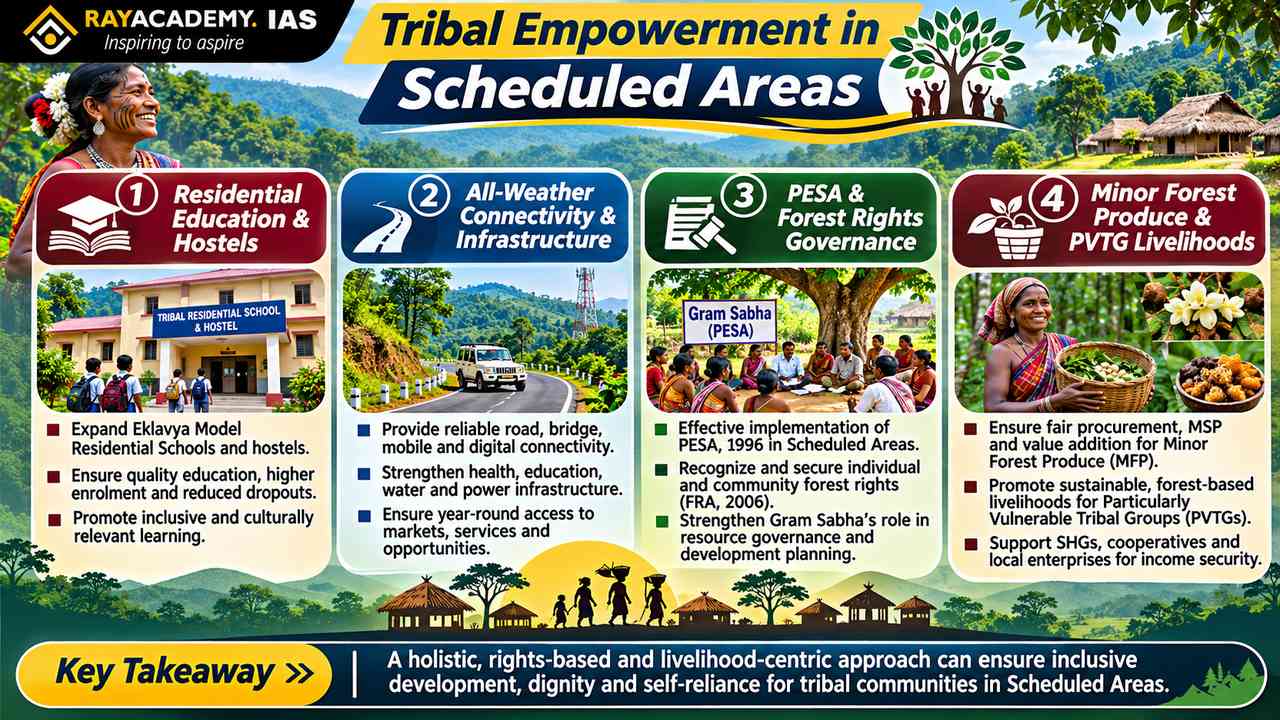
Overcoming Spatial Barriers to Tribal Education: Scattered hamlets across hilly and forested terrain make daily school commutes difficult for tribal children. Establishing 28 new residential hostels (₹55 crore) directly reduces school dropout rates, improves secondary transition, and narrows the ST–non-ST literacy gap.
Catalyzing Economic Integration & Service Delivery: Investing ₹106 crore across 35 infrastructure projects improves all-weather rural connectivity, market access for Minor Forest Produce (MFP), and doorstep delivery of healthcare and banking services in remote blocks.
Consolidating Peace in Former LWE Strongholds: Visible state presence through schools, hostels, and public infrastructure strengthens institutional trust among Adivasi citizens, permanently eroding the ideological and logistical space for Maoist extremism.
Multi-Dimensional Challenges
Maintenance, Safety, and Quality in Residential Hostels (Governance & Social): While constructing physical hostel buildings is vital, ensuring adequate warden staffing, nutritious food, clean drinking water, healthcare monitoring, and culturally sensitive, mother-tongue-based multilingual education remains an ongoing administrative challenge.
Last-Mile Execution & Terrain Bottlenecks (Administrative): Remote forested topography, monsoon disruptions, and contractor shortages often delay infrastructure completion and inflate maintenance costs in districts like Malkangiri.
Balancing Infrastructure Growth with Ecological & Forest Rights (Environmental & Legal): Road and civil infrastructure expansion in Fifth Schedule districts must strictly comply with the Forest Rights Act, 2006, PESA (1996), and environmental safeguards to avoid involuntary displacement or ecological fragmentation.
Livelihood & Skill Mismatch Beyond Schooling (Economic): Educational attainment in tribal hostels must be seamlessly linked with vocational skilling, local agro-forestry value chains, and formal employment opportunities to prevent educated youth underemployment. ribal Welfare and Infrastructure Development
Way Forward
Institutionalize Quality Audits & Multilingual Pedagogy in Tribal Hostels (NEP 2020 & Xaxa Committee): Pair the inauguration of the 28 new hostels in Malkangiri with dedicated warden training, regular social audits by School Management Committees (SMCs), health check-ups, and mother-tongue-based multilingual education (MLE) in early grades to improve learning outcomes.
Integrate Infrastructure Planning with Gram Sabha Consent (PESA & FRA): Execute the 35 infrastructure projects in strict consultation with Gram Sabhas under PESA (1996) and the Forest Rights Act (2006), ensuring transparent land clearance and community ownership of public assets.
Converge State Packages with Central Saturation Missions (NITI Aayog Aspirational Districts Framework): Align state outlays with PM-JANMAN, Dharti Aaba Janjatiya Gram Utkarsh Abhiyan, and EMRS funds to achieve 100% saturation of piped water, electricity, 4G telecom, and sickle-cell screening among PVTGs like the Bondo and Didayi.
Strengthen Minor Forest Produce (MFP) & Agro-Forestry Value Chains: Leverage improved road infrastructure to expand Van Dhan Vikas Kendras, cold storage, and MSP procurement for tamarind, mahua, sal seeds, and hill brooms—boosting local household incomes.
Institutionalize Geo-Tagged Monitoring for Time-Bound Execution: Utilize PM Gati Shakti spatial planning and geo-tagged MIS dashboards to prevent cost overruns and ensure timely completion of all 35 foundation-laid projects.
Value Addition for Mains
Official Development & Demographic Benchmark: Odisha is home to 64 Scheduled Tribe communities (accounting for 22.85% of the State’s population per the 2011 Census) and 13 of India’s 75 PVTGs—the highest in the country. Targeted interventions such as the ₹161 crore Malkangiri development package (₹55 crore for 28 hostels and ₹106 crore for 35 infrastructure works) operationalize Article 46 by attacking both educational exclusion and spatial isolation simultaneously.
Constitutional & Ethical Anchor: True tribal empowerment rests on Jawaharlal Nehru’s Tribal Panchsheel and Article 244 (Fifth Schedule)—ensuring that infrastructure and education expand capabilities while respecting Adivasi cultural identity, land rights, and grassroots self-governance.
Practice Questions for Active Recall
Prelims Practice MCQ
With reference to tribal communities, geographical features, and constitutional provisions associated with southern Odisha, consider the following statements:
Malkangiri district in Odisha shares interstate borders with both Chhattisgarh and Andhra Pradesh and is drained by the Sabari and Sileru rivers.
Odisha has the highest number of Particularly Vulnerable Tribal Groups (PVTGs) among all Indian states.
Under the Fifth Schedule of the Constitution of India, the Governor is empowered to make regulations prohibiting or restricting the transfer of land by or among members of the Scheduled Tribes in a Scheduled Area.
Which of the statements given above are correct?
(a) 1 and 2 only
(b) 2 and 3 only
(c) 1 and 3 only
(d) 1, 2, and 3
Correct Answer: (d) 1, 2, and 3
Explanation:
Statement 1 is correct: Malkangiri is the southernmost district of Odisha, bordering Chhattisgarh to the west and Andhra Pradesh to the south/east, and is drained by the Sabari, Sileru, and Machkund rivers.
Statement 2 is correct: Out of the 75 PVTGs identified across India, Odisha has 13 PVTGs (such as the Bondo, Didayi, Dongria Kondh, and Juang)—the largest number in any state.
Statement 3 is correct: Under Paragraph 5(2) of the Fifth Schedule, the Governor (in consultation with the Tribes Advisory Council) may make regulations prohibiting or restricting the transfer of tribal land to non-tribals and regulating moneylending in Scheduled Areas.
Mains Practice Question (GS Paper II & GS Paper III — 150 Words | 10 Marks)
"Expanding residential educational infrastructure and all-weather connectivity in Scheduled Areas is essential not only for realizing Article 46 of the Constitution, but also for permanently consolidating peace in regions historically affected by Left-Wing Extremism." Discuss in the context of recent tribal development initiatives in districts like Malkangiri.
Answer Structure Hints:
Introduction: Contextualize the ₹161 crore development package announced in Malkangiri on Janjatiya Gaurav Divas (Nov 15, 2026)—comprising 28 tribal hostels (₹55 crore) and 35 infrastructure projects (₹106 crore)—honouring Bhagwan Birsa Munda’s legacy.
Body Part 1 (Educational & Security Impact): Explain how residential hostels overcome spatial barriers in forested terrain to curb dropouts (advancing Article 46), while roads and civic infrastructure eliminate governance vacuums exploited by Left-Wing Extremism (LWE).
Body Part 2 (Implementation & Governance Imperatives): Highlight the need for quality hostel management, mother-tongue multilingual education, strict adherence to PESA (1996) and FRA (2006) during land clearances, and convergence with PM-JANMAN for PVTGs.
Conclusion: Conclude that combining human capital creation with participatory Fifth Schedule governance transforms remote tribal districts into engines of inclusive growth.
Take this article with you
Save a reading copy for offline study.


