

Robotics laboratories in 807 government schools
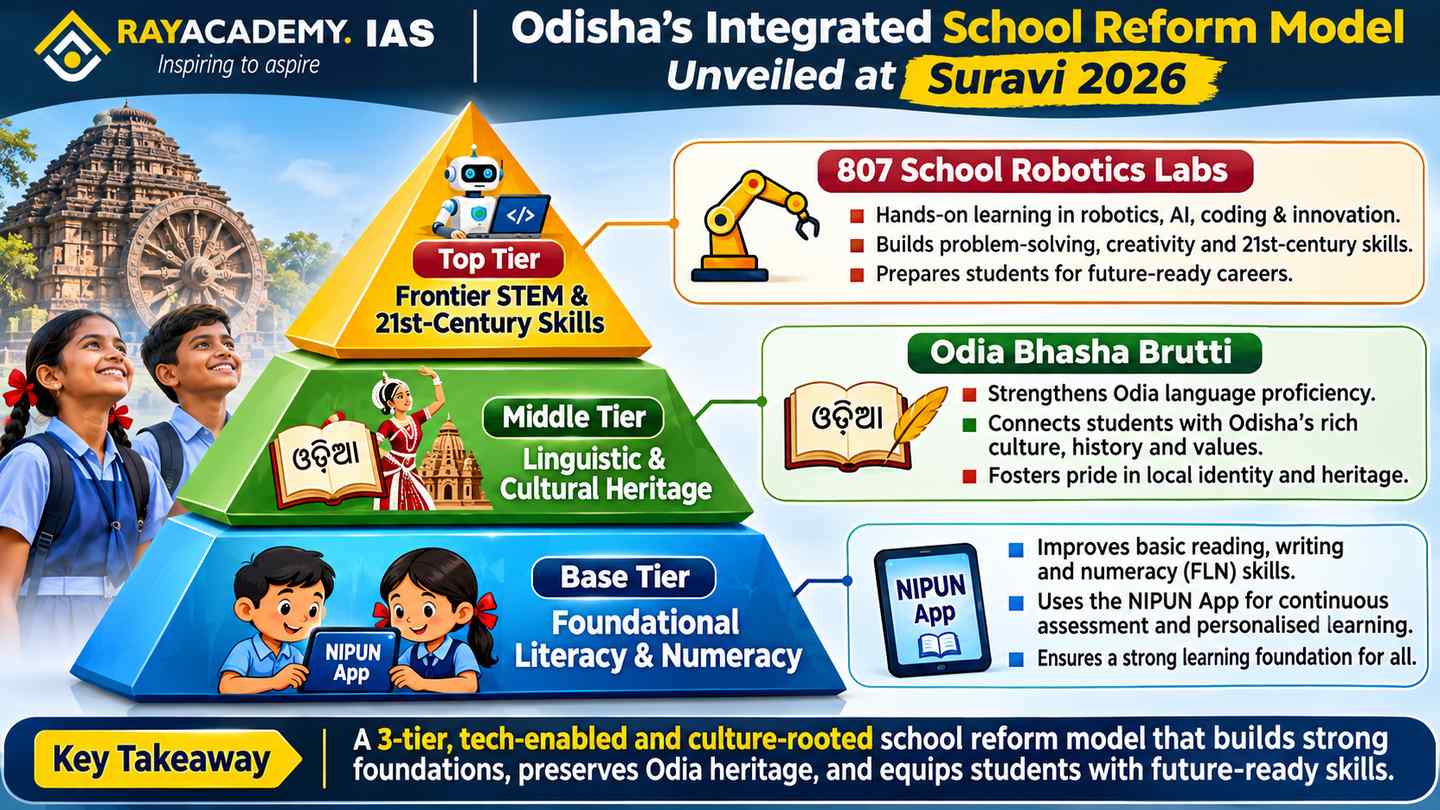
Odisha Chief Minister Mohan Charan Majhi inaugurated modern robotics laboratories in 807 government schools across the state (with an investment of ₹164.33 crore) and launched the NIPUN App during the inauguration of Suravi 2026, the three-day state-level children’s festival in Bhubaneswar organized by the School and Mass Education (S&ME) Department under the theme “Prosperous Language, Prosperous Odisha” (Samruddha Bhasha, Samruddha Odisha).
OPSC Syllabus Mapping:
General Studies Paper II (Social Justice & Governance): Issues relating to development and management of Social Sector/Services relating to Health, Education, Human Resources; Government policies and interventions for development in various sectors and issues arising out of their design and implementation.
General Studies Paper III (Science & Technology): Awareness in the fields of IT, Space, Computers, robotics, nano-technology, bio-technology; Indigenization of technology and developing new technology.
Designed for students in Classes VI to X, each robotics lab provides hands-on training in robotics, coding, Artificial Intelligence (AI), machine learning, and 3D printing (equipped with robots, robotics kits, computers, and 3D printers). Simultaneously, the Chief Minister conferred the Mukhyamantri Shiksha Puraskar (earmarking ₹138.97 crore across block-to-state levels) upon 375 teachers, students, and institutions—recognizing Nabarangpur, Cuttack, and Kalahandi districts—and distributed the Mukhyamantri Odia Bhasha Brutti (₹7,500 annual scholarship to 7,350 students) to promote mother-tongue proficiency alongside frontier STEM skills.
Static-Current Linkage: National Education Policy (NEP) 2020, NIPUN Bharat Mission, and Constitutional Mandates
Evaluating Odisha’s dual push on frontier STEM laboratories and foundational learning requires linking constitutional provisions for education with India’s national educational transformation frameworks.
Constitutional Provisions Governing School Education
Article 21A (Right to Education): Inserted by the 86th Constitutional Amendment Act, 2002, Article 21A mandates free and compulsory education for all children aged 6 to 14 years, operationalized through the Right of Children to Free and Compulsory Education (RTE) Act, 2009.
Concurrent List Status (Entry 25): Originally a State subject, Education was transferred to the Concurrent List (List III) via the 42nd Constitutional Amendment Act, 1976, enabling synergistic Union-State policy alignment while allowing states to innovate regionally.
Article 350A (Mother-Tongue Instruction): Directs every State and local authority to endeavor to provide adequate facilities for instruction in the mother-tongue at the primary stage of education to children belonging to linguistic minority groups—a principle reinforced by Odisha’s Mukhyamantri Odia Bhasha Brutti and Suravi 2026 theme.
National Education Policy (NEP) 2020 & NIPUN Bharat Architecture . Odisha Launches Robotics Labs
Experiential STEM & Coding (NEP 2020): NEP 2020 restructures school pedagogy into the 5+3+3+4 curricular design, mandating early exposure to coding, computational thinking, Artificial Intelligence, and experiential hands-on learning starting from the Middle Stage (Classes VI to VIII) to bridge the gap between theoretical curricula and 21st-century industry demands.
NIPUN Bharat Mission: Launched in July 2021 by the Union Ministry of Education under the Samagra Shiksha Abhiyan, the National Initiative for Proficiency in Reading with Understanding and Numeracy (NIPUN Bharat) aims to achieve universal Foundational Literacy and Numeracy (FLN) for every child by the end of Grade 3. Odisha’s newly launched NIPUN App operationalizes real-time classroom observation and competency tracking to fulfill this national target. Odisha Launches Robotics Labs.
Prelims Focus: High-Yield Objective Facts
Nodal Implementing Bodies: Department of School and Mass Education (S&ME) and Odisha School Education Programme Authority (OSEPA) at the state level; Ministry of Education (Department of School Education & Literacy) at the Union level.
NIPUN Bharat Mission: Launched in 2021 under Samagra Shiksha (a Centrally Sponsored Scheme); targets universal Foundational Literacy and Numeracy (FLN) by the end of Class 3 (covering children aged 3 to 9 years).
Atal Tinkering Labs (ATLs): Flagship national counterpart run by Atal Innovation Mission (AIM), NITI Aayog, establishing STEM/robotics workspaces in schools (Classes VI–XII) to foster curiosity, creativity, and imagination.
Key Components of Odisha’s Suravi 2026 Rollout:
807 School Robotics Labs: Outlay of ₹164.33 crore; covers Classes VI to X; imparts hands-on skills in robotics, coding, AI, machine learning, and 3D printing.
NIPUN App: Free Android-based digital platform for early-grade competency tracking and foundational learning assessment.
Mukhyamantri Odia Bhasha Brutti: Annual financial scholarship of ₹7,500 awarded to 7,350 meritorious students excelling in Odia language studies.
Mukhyamantri Shiksha Puraskar: Outlay of ₹138.97 crore rewarding teachers, students, schools, and top-performing districts (Nabarangpur, Cuttack, and Kalahandi).
Classical Language Status of Odia: Odia was accorded Classical Language status in 2014 (the 6th Indian language and the first from the Indo-Aryan linguistic family to receive the distinction).
Mains Analytical Breakdown
Significance of Integrating Frontier STEM with Foundational Learning
Democratizing Access to Emerging Technologies: Setting up 807 robotics and AI laboratories in government schools—including aspirational and tribal districts like Nabarangpur and Kalahandi—bridges the urban-rural digital and technological divide, ensuring public-school students are not left behind in the Fourth Industrial Revolution.
Balancing Global Tech Skills with Mother-Tongue Roots: Pairing AI/3D printing labs with Odia language scholarships operationalizes NEP 2020’s multilingualism mandate, demonstrating that cognitive mastery in one’s mother tongue enhances conceptual grasp of complex scientific disciplines.
Shifting from Rote Degrees to Competency-Based Learning: By combining real-time FLN tracking (NIPUN App) with hands-on maker spaces and teacher incentives, the policy targets both ends of the learning crisis—preventing early learning deficits while nurturing employable problem-solving skills.
Multi-Dimensional Challenges
Teacher Capacity and Pedagogical Readiness: Installing sophisticated hardware (robots, 3D printers, AI kits) in 807 schools risks underutilization unless accompanied by continuous, specialized upskilling of government school STEM teachers and dedicated lab instructors.
Operations, Maintenance, and Consumables Sustainability: Beyond initial capital expenditure (₹164.33 crore), robotics and 3D printing facilities require recurring annual budgets for filament consumables, software updates, high-speed internet connectivity, and hardware repairs in remote rural blocks.
Digital Distraction and Information Literacy Risks: As highlighted during the launch, expanding student exposure to mobile apps and digital tools requires cultivating critical digital literacy so students use technology for structured learning rather than passive entertainment or falling prey to misinformation.
Equity Gaps in Last-Mile Infrastructure: Unreliable rural electricity supply and bandwidth bottlenecks in remote tribal habitations can create disparities between urban government schools and interior schools in accessing cloud-based AI/coding modules.
Risk of Tokenistic Implementation: Without periodic outcome audits—measuring actual student prototypes, coding proficiency, and FLN learning gains—hardware rollouts can degenerate into locked "showcase labs" rarely accessed by students.
Way Forward
Institutionalize Continuous STEM Teacher Training (NISHTHA Integration): Align state teacher training modules with the Union Government’s NISHTHA (National Initiative for School Heads' and Teachers' Holistic Advancement) framework, partnering with premier institutions like IIT Bhubaneswar, NIT Rourkela, and state engineering universities to mentor school lab coordinators.
Ring-Fence Recurring Operations & Maintenance (O&M) Funds: Establish a dedicated annual maintenance and consumables grant per school alongside BharatNet / Odisha State Wide Area Network (OSWAN) high-speed broadband guarantees so all 807 labs remain functional year-round.
Adopt Hub-and-Spoke Cluster Sharing: Convert the 807 robotics-equipped schools into cluster resource hubs (as envisioned under NEP 2020’s School Complex model), allowing students from neighboring upper-primary and high schools to access lab sessions on a rotational schedule.
Embed Digital Hygiene and Media Literacy in Curricula: Integrate structured modules on cyber safety, digital citizenship, and fact-checking into the middle-school timetable to help students distinguish authentic knowledge from digital misinformation.
Conduct Independent Third-Party Learning Audits (ASER / PARAKH Model): Benchmark student outcomes using standardized assessments aligned with PARAKH (Performance Assessment, Review, and Analysis of Knowledge for Holistic Development) and ASER (Annual Status of Education Report) metrics to track tangible improvements in both Grade 3 FLN and Grade 10 computational skills.
Value Addition for Mains
Empirical Learning Benchmark (ASER & PARAKH): National assessments such as ASER have repeatedly underscored that early deficits in basic reading and arithmetic cascade into high secondary-school dropout rates. Odisha’s twin investment—deploying the NIPUN App for Grade 1–3 foundational mastery alongside ₹164.33 crore for 807 robotics/AI labs in Classes VI–X—provides a replicable two-pronged human capital model for Indian states.
Constitutional & Philosophical Anchor: Operationalizing Article 21A (Right to Education) and Article 51A(h) (developing scientific temper, humanism, and the spirit of inquiry) requires transforming classrooms from passive rote-memorization spaces into active laboratories of curiosity—realizing Swami Vivekananda’s vision of education as "the manifestation of the perfection already in man."
Practice Questions for Active Recall
Prelims Practice MCQ
With reference to school education governance and initiatives in India, consider the following statements:
Education was transferred from the State List to the Concurrent List of the Seventh Schedule by the 42nd Constitutional Amendment Act, 1976.
The NIPUN Bharat Mission aims to ensure that every child achieves foundational literacy and numeracy by the end of Grade 8.
Under the National Education Policy (NEP) 2020, exposure to coding and computational thinking is introduced from the Middle Stage (Classes VI to VIII) onwards.
Which of the statements given above are correct?
(a) 1 and 2 only
(b) 1 and 3 only
(c) 2 and 3 only
(d) 1, 2, and 3
Correct Answer: (b) 1 and 3 only
Explanation:
Statement 1 is correct: Originally placed in the State List, Education was moved to Entry 25 of the Concurrent List by the 42nd Constitutional Amendment Act, 1976.
Statement 2 is incorrect: Launched in July 2021 under Samagra Shiksha, the NIPUN Bharat Mission targets universal Foundational Literacy and Numeracy (FLN) by the end of Grade 3 (not Grade 8).
Statement 3 is correct: NEP 2020 introduces coding, experiential STEM activities, and computational thinking starting in the Middle Stage (Classes VI–VIII).
Mains Practice Question (GS Paper II — 150 Words | 10 Marks)
"Reaping India’s demographic dividend requires simultaneously strengthening foundational literacy in primary grades and democratizing access to frontier STEM technologies in public secondary schools." Examine how recent state-level educational interventions align with the National Education Policy (NEP) 2020, and discuss the institutional challenges in sustaining technology-enabled school infrastructure.
Answer Structure Hints:
Introduction: Contextualize the dual imperative of human capital formation—citing Odisha’s launch of 807 school robotics/AI labs (Classes VI–X) alongside the NIPUN App for foundational learning at Suravi 2026.
Body Part 1 (Alignment with NEP 2020): Explain how these initiatives fulfill Article 21A, Article 350A (mother-tongue scholarships), NIPUN Bharat’s Grade 3 FLN target, and NEP 2020’s emphasis on experiential coding, AI, and computational thinking in rural government schools.
Body Part 2 (Institutional & Sustainability Challenges): Highlight bottlenecks such as specialized STEM teacher shortages, recurring O&M and internet connectivity costs, hardware underutilization, and digital distraction risks.
Conclusion: Recommend continuous teacher upskilling (NISHTHA), hub-and-spoke school complexes, ring-fenced O&M budgets, and PARAKH-aligned learning audits to build a future-ready workforce.
Take this article with you
Save a reading copy for offline study.


