

Cyclone Akvan
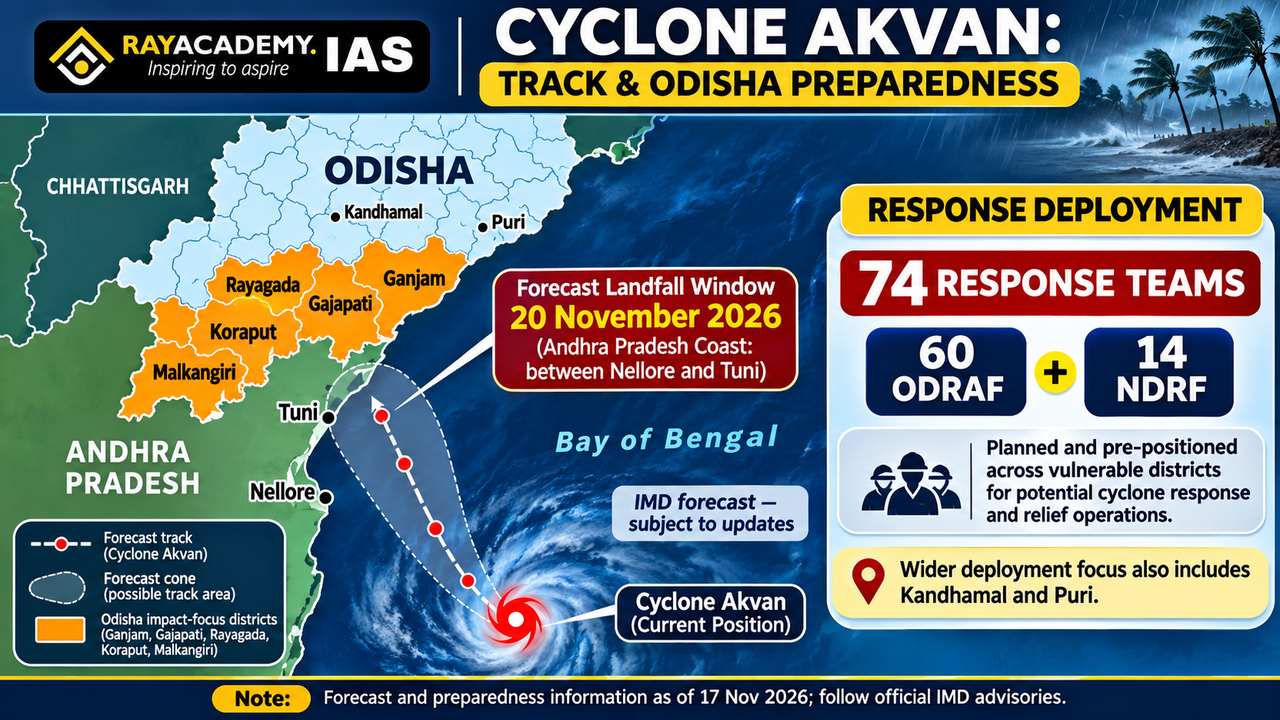
The Government of Odisha has placed its state-wide disaster management apparatus on high alert and deployed 74 specialized emergency response teams—comprising 60 Odisha Disaster Rapid Action Force (ODRAF) units and 14 National Disaster Response Force (NDRF) teams—ahead of Cyclonic Storm Akvan intensifying over the Bay of Bengal.
OPSC Syllabus Mapping:
General Studies Paper I (Physical Geography): Important Geophysical phenomena such as earthquakes, Tsunami, Volcanic activity, cyclone etc., geographical features and their location-changes in critical geographical features.
General Studies Paper III (Disaster Management): Disaster and disaster management; Early warning systems, institutional frameworks (NDMA, NDRF, ODRAF), pre-emptive evacuation, and coastal resilience.
Following a high-level preparedness review chaired by Odisha Revenue and Disaster Management Minister Suresh Pujari and Chief Secretary Anu Garg, authorities operationalized round-the-clock District Emergency Operation Centres (DEOCs) across vulnerable southern and western districts (including Ganjam, Gajapati, Puri, Kandhamal, Rayagada, Koraput, and Malkangiri).
According to the India Meteorological Department (IMD), Cyclone Akvan—named by Iran—is forecast to intensify into a Very Severe Cyclonic Storm and cross the Andhra Pradesh and Yanam coasts between Nellore and Tuni around November 20, 2026, with sustained wind speeds of 120–130 kmph (gusting up to 145 kmph), bringing heavy to very heavy rainfall to southern and western Odisha.
Static-Current Linkage: Tropical Cyclone Climatology, Naming Mechanism, and Statutory Disaster Governance
Evaluating Odisha’s proactive response to Cyclone Akvan requires linking tropical meteorology in the North Indian Ocean with India’s statutory disaster management architecture.
Meteorological Mechanics of Bay of Bengal Cyclones
Conditions for Tropical Cyclogenesis: Tropical cyclones form over warm ocean waters (sea surface temperature ≥ 26.5°C up to a depth of 50–60 m), requiring sufficient Coriolis force (generally beyond 5° latitude from the equator), low vertical wind shear, high mid-tropospheric humidity, and a pre-existing low-pressure disturbance.
Why the Bay of Bengal Experiences More Cyclones than the Arabian Sea: The Bay of Bengal receives massive freshwater influx from major peninsular and Himalayan rivers (Ganga, Brahmaputra, Mahanadi, Godavari, Krishna), keeping surface waters warmer and less saline (inhibiting vertical mixing), while its semi-enclosed basin traps atmospheric moisture and absorbs remnant typhoons migrating westward from the South China Sea.
Post-Monsoon Bimodal Peak (October–December): North Indian Ocean cyclones exhibit a bimodal frequency distribution—peaking in May (pre-monsoon) and October–November (post-monsoon) when vertical wind shear drops following the retreat of the southwest monsoon.
WMO/ESCAP Tropical Cyclone Naming Protocol
Cyclone Akvan is the third cyclonic storm to form in the Bay of Bengal within three weeks (following Cyclones Arnab and Murasu), and its name was proposed by Iran under the WMO/ESCAP Panel on Tropical Cyclones (comprising 13 member nations: Bangladesh, India, Iran, Maldives, Myanmar, Oman, Pakistan, Qatar, Saudi Arabia, Sri Lanka, Thailand, UAE, and Yemen), where IMD serves as the Regional Specialized Meteorological Centre (RSMC), New Delhi.
Constitutional & Statutory Disaster Management Architecture
Disaster Management Act, 2005: Enacted under Entry 23 of the Concurrent List (Social security and social insurance), the Act institutionalized a three-tier proactive governance shift from post-disaster relief to pre-disaster prevention, mitigation, and preparedness:
National Level: National Disaster Management Authority (NDMA) chaired by the Prime Minister (Section 3) and National Disaster Response Force (NDRF) (Section 44).
State Level: State Disaster Management Authority (SDMA) chaired by the Chief Minister (Section 14), State Executive Committee (SEC) headed by the Chief Secretary, and specialized state forces like ODRAF (pioneered by Odisha after the 1999 Super Cyclone).
District Level: District Disaster Management Authority (DDMA) chaired by the District Collector/Magistrate (Section 25), operating through 24x7 District Emergency Operation Centres (DEOCs).
Prelims Focus: High-Yield Objective Facts for OPSC
Key Objective Pointers for PrelimsCyclone Akvan Naming & Track: Proposed by Iran; formed over the south and adjoining west-central Bay of Bengal; forecast to intensify into a Very Severe Cyclonic Storm (wind speed 118–165 kmph per IMD classification) and make landfall between Nellore and Tuni (Andhra Pradesh–Yanam coast).IMD Cyclone Intensity Classification (Sustained Wind Speed):Depression: 31–49 kmph | Deep Depression: 50–61 kmphCyclonic Storm: 62–88 kmph | Severe Cyclonic Storm: 89–117 kmphVery Severe Cyclonic Storm: 118–165 kmph | Extremely Severe Cyclonic Storm: 166–221 kmph | Super Cyclonic Storm: ≥ 222 kmph.IMD Colour-Coded Weather Alerts: Green (No action), Yellow (Be updated), Orange (Be prepared—issued for Andhra Pradesh and south Odisha coasts for Akvan), and Red (Take action).NDRF & ODRAF: NDRF is a statutory specialized response force constituted under Section 44 of the Disaster Management Act, 2005 (under the Ministry of Home Affairs); ODRAF was established by Odisha in 2001 following the devastating 1999 Odisha Super Cyclone as India’s first state-level rapid disaster response force.Sendai Framework for Disaster Risk Reduction (2015–2030): Global non-binding agreement adopted in 2015 (succeeding the Hyogo Framework), emphasizing early warning systems, zero-casualty evacuation, and Build Back Better.
Mains Analytical Breakdown: Significance and Multi-Dimensional Challenges
Strategic & Administrative Significance of Odisha’s "Zero-Casualty" Model
Institutionalized Pre-Emptive Evacuation & Last-Mile Reach: By mapping vulnerable zones early and prioritizing high-risk demographics—children, senior citizens, persons with disabilities (PwDs), and pregnant women—district administrations operationalize inclusive, people-centric disaster governance.
Multi-Departmental Convergence Before Landfall: Synchronizing Water Resources (reservoir/embankment monitoring), Works & Rural Development (weak bridges/culverts), Food Supplies (dry rations/fuel), and Panchayati Raj (drinking water/backup generators in cyclone shelters) prevents cascading infrastructure failures.
Rapid Deployment of Localized Response Forces: Pre-positioning 60 ODRAF and 14 NDRF teams alongside round-the-clock DEOCs minimizes golden-hour response delays during heavy rain and inland flooding.
Proactive Landslide Mitigation in Hilly Districts: Prioritizing early evacuation from pre-identified landslide-prone areas in Eastern Ghats districts (Gajapati, Rayagada, Koraput, Malkangiri) addresses secondary multi-hazard risks triggered by heavy cyclonic rainfall.
Multi-Dimensional Challenges
Compounding Multi-Hazard Stress from Back-to-Back Cyclones (Climate & Environmental): Akvan is the third cyclonic storm in the Bay of Bengal within three weeks (following Arnab and Murasu), reflecting rising ocean heat content due to anthropogenic climate change that saturates soils, fills reservoirs, and erodes recovery windows between storms.
Inland Flash Floods and Landslides Beyond Coastal Zones (Geographical): Even when landfall occurs across neighbouring Andhra Pradesh (Nellore–Tuni), outer rainbands dump intense precipitation over southern and western Odisha’s Eastern Ghats, triggering hill-slope failures and riverine flash floods in non-coastal tribal districts.
Agrarian & Livelihood Vulnerability (Economic): November coincides with the harvesting window for standing Kharif paddy and horticultural crops, exposing small and marginal farmers to severe crop lodging, post-harvest spoilage, and distress sales.
Shelter Fatigue and Livelihood Reluctance Among Vulnerable Communities (Social): Repeated evacuations over short intervals can cause evacuation fatigue among coastal fisherfolk and rural households worried about livestock safety, asset theft, and wage loss.
Way Forward: Anchored in NDMA, 2nd ARC, and Sendai Frameworks
Transition to Impact-Based Multi-Hazard Early Warning Systems (IMD & NDMA Framework): Move beyond wind-speed forecasts to block-level Impact-Based Forecasting (IBF) that integrates meteorological rainfall projections with hydrological reservoir inflow models and GSI landslide susceptibility maps for Eastern Ghats districts.
Scale Climate-Resilient Coastal & Power Infrastructure (NCRMP & CDRI Guidelines): Under the National Cyclone Risk Mitigation Project (NCRMP) and Coalition for Disaster Resilient Infrastructure (CDRI) principles, accelerate underground power cabling, multi-purpose cyclone shelter retrofitting (with dedicated livestock pens and disability-friendly ramps), and bio-shield mangrove restoration along the Odisha–Andhra coast.
Integrate Parametric Crop Insurance & Rapid Relief Disbursement (PMFBY & SDRF Norms): Utilize satellite remote sensing and automated weather stations under Pradhan Mantri Fasal Bima Yojana (PMFBY) to trigger rapid claim settlements for Kharif crop losses without bureaucratic delays.
Strengthen Community-Led First Responders (2nd ARC 3rd Report – Crisis Management): Institutionalize Aapda Mitra volunteers, Panchayati Raj representatives, and women’s Self-Help Groups (Mission Shakti) in shelter management, rumour control, and post-cyclone public health sanitation (preventing water-borne outbreaks).
Value Addition for Mains
Official Preparedness & Response Benchmark (Nov 2026): Ahead of Cyclone Akvan (sustained winds 120–130 kmph, gusting to 145 kmph), Odisha pre-positioned 74 specialized rescue teams (60 ODRAF + 14 NDRF) across 7+ vulnerable districts and activated 24x7 DEOCs—demonstrating how sustained institutional investment since the 1999 Super Cyclone (which claimed ~10,000 lives) transformed Odisha into a global benchmark under the UNDRR Sendai Framework.
Constitutional & Ethical Anchor: Operationalizing Article 21 (Right to Life) and Section 38 of the Disaster Management Act, 2005 (State duty to take preventive and mitigation measures) embodies administrative foresight and empathetic governance—specifically safeguarding vulnerable groups (elderly, PwDs, pregnant women, and children) during climate-induced emergencies.
Practice Questions for Active Recall
Prelims Practice MCQ
With reference to tropical cyclones in the North Indian Ocean and India’s disaster management framework, consider the following statements:
The Regional Specialized Meteorological Centre (RSMC), New Delhi, operated by the India Meteorological Department (IMD), is responsible for issuing tropical cyclone advisories and naming cyclones over the Bay of Bengal and the Arabian Sea.
According to IMD’s cyclone intensity classification, a "Very Severe Cyclonic Storm" is characterized by maximum sustained surface wind speeds between 118 kmph and 165 kmph.
The National Disaster Response Force (NDRF) was constituted as a specialized statutory force under the Environment (Protection) Act, 1986.
Which of the statements given above are correct?
(a) 1 and 2 only
(b) 2 and 3 only
(c) 1 and 3 only
(d) 1, 2, and 3
Correct Answer: (a) 1 and 2 only
Explanation:
Statement 1 is correct: IMD (RSMC New Delhi) is one of the six RSMCs globally designated by the World Meteorological Organization (WMO) to issue tropical cyclone advisories and assign names from the 13-nation WMO/ESCAP Panel list for the North Indian Ocean.
Statement 2 is correct: Under IMD’s classification, a Very Severe Cyclonic Storm (VSCS) has sustained wind speeds of 64–89 knots (118–165 kmph)—the exact intensity forecast for Cyclone Akvan prior to landfall.
Statement 3 is incorrect: The National Disaster Response Force (NDRF) was constituted under Section 44 of the Disaster Management Act, 2005 (not the Environment Protection Act, 1986) for specialist response to threatening disaster situations.
Mains Practice Question (GS Paper I & GS Paper III — 150 Words | 10 Marks)
"Odisha’s proactive deployment of specialized response forces and vulnerable-group mapping ahead of Cyclone Akvan exemplifies India’s paradigm shift from reactive relief to pre-emptive disaster risk reduction." Discuss the institutional pillars of India’s cyclone preparedness model and examine emerging multi-hazard challenges posed by climate change.
Answer Structure Hints:
Introduction: Contextualize Odisha’s high alert and pre-positioning of 74 ODRAF/NDRF teams and 24x7 DEOCs ahead of Cyclone Akvan in the Bay of Bengal, reflecting the post-1999 Super Cyclone and Disaster Management Act, 2005 shift toward zero-casualty preparedness.
Body Part 1 (Institutional Pillars): Highlight IMD early warning systems, pre-emptive evacuation prioritizing vulnerable groups (elderly, PwDs, pregnant women), multi-departmental convergence (reservoirs, cyclone shelters, rations), and dedicated ODRAF/NDRF units.
Body Part 2 (Emerging Multi-Hazard Challenges): Address back-to-back cyclones driven by ocean warming, inland heavy-rain-induced landslides in Eastern Ghats districts (Gajapati, Rayagada, Koraput), Kharif crop damage, and shelter/evacuation fatigue.
Conclusion: Conclude with Sendai Framework targets, impact-based multi-hazard forecasting, underground resilient infrastructure (NCRMP), and community-led Aapda Mitra / SHG participation.
Take this article with you
Save a reading copy for offline study.


