

On this page
- Wholesale Price Index
- Static-Current Linkage: WPI Architecture, Base Year 2022–23 Revision, and CPI Divergence
- Prelims Focus: High-Yield Objective Facts for OPSC
- Mains Analytical Breakdown: Significance and Multi-Dimensional Challenges WPI Inflation
- Way Forward: Anchored in Institutional & Policy Frameworks
- Value Addition for Mains
- Practice Questions for Active Recall
Wholesale Price Index
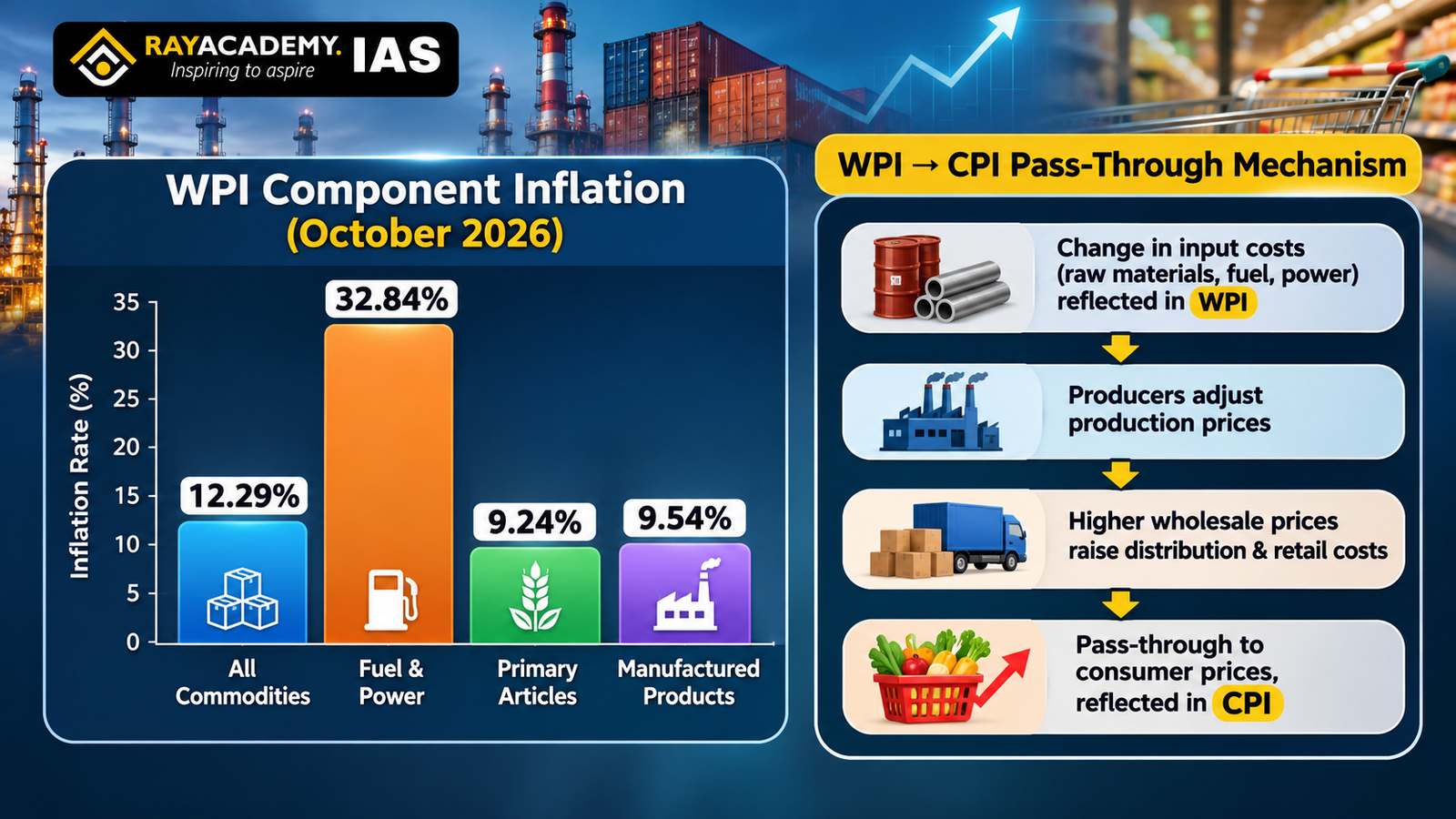
India’s Wholesale Price Index (WPI)-based inflation accelerated to 12.29% year-on-year in October 2026—up from 11.39% in September 2026—marking the highest reading in the revised WPI series (Base Year 2022–23). According to provisional data released by the Office of the Economic Adviser, Department for Promotion of Industry and Internal Trade (DPIIT), under the Ministry of Commerce and Industry, the surge was driven primarily by a sharp spike in Fuel and Power inflation (32.84%) and Primary Articles (9.24%).
OPSC Syllabus Mapping:
General Studies Paper III (Indian Economy): Indian Economy and issues relating to planning, mobilization of resources, growth, development and employment; Inclusive growth and issues arising from it; Monetary Policy, Inflation Targeting, and Price Stability.
With retail inflation (CPI) also breaching the Reserve Bank of India’s (RBI) 6% upper tolerance limit in October 2026, the double-digit wholesale price surge signals mounting cost-push inflationary pressures that could spill over into household budgets and complicate the Monetary Policy Committee’s (MPC) rate trajectory.Static-Current Linkage: WPI Architecture, Base Year 2022–23 Revision, and CPI Divergence
Analyzing wholesale price spikes requires linking macroeconomic inflation measurement frameworks with India’s statistical modernization and monetary policy transmission.
What is the Wholesale Price Index (WPI)?
The Wholesale Price Index (WPI) measures the average change in the prices of goods transacted in bulk at the wholesale (first point of bulk sale) level across India. Unlike the Consumer Price Index (CPI)—compiled by the National Statistical Office (NSO) under MoSPI to track retail prices paid by end consumers—the WPI tracks only goods and excludes services.
Key Features of the Revised WPI Series (Base Year 2022–23)
Released on June 15, 2026, based on the recommendations of the Working Group chaired by Prof. Ramesh Chand (Member, NITI Aayog), the eighth revision of the WPI updated the base year from 2011–12 to 2022–23:
Expanded Item Basket: Increased from 697 items to 957 items to capture structural shifts in India’s manufacturing and energy mix.
Three Major Commodity Groups:
Primary Articles: Food articles, non-food articles, and minerals (recorded 9.24% inflation in October 2026, up from 8.67% in September).
Fuel and Power: Mineral oils, crude petroleum and natural gas (shifted from Primary Articles to Fuel & Power in the 2022–23 series), and electricity (surged to 32.84% in October 2026 from 25.85% in September).
Manufactured Products: Basic metals, chemicals, food products, textiles, and rubber/plastic products (moderated slightly to 9.54% in October 2026 from 9.76% in September).
Parallel Producer Price Index (PPI) Rollout: Alongside the revised WPI, DPIIT introduced the Output Producer Price Index (OPPI), a Trial Input Producer Price Index (IPPI), and Service PPIs (covering banking, insurance, telecom, railways, and aviation) to gradually align India’s producer-level inflation metrics with IMF standards.
WPI vs. CPI in India’s Monetary Policy Framework
Following the Urjit Patel Committee Report (2014) and the 2016 amendment to the RBI Act, 1934, the RBI’s Monetary Policy Committee (MPC) targets headline CPI inflation at 4% (±2% tolerance band: 2% to 6%) rather than WPI. However, sustained double-digit WPI inflation acts as a leading indicator of pipeline inflation, as manufacturers eventually pass higher input, freight, and energy costs onto retail consumers.
Prelims Focus: High-Yield Objective Facts for OPSC
Key Objective Pointers for PrelimsNodal Compiling Agency: Office of the Economic Adviser (OEA), Department for Promotion of Industry and Internal Trade (DPIIT), Ministry of Commerce and Industry (released monthly on the 14th of the following month or next working day).
Current WPI Base Year: 2022–23 (effective June 15, 2026; replaced the 2011–12 series; covers 957 items). Services Coverage: WPI does NOT include services (unlike CPI and the newly introduced Service PPI).
WPI Food Index: Combines 'Food Articles' (from Primary Articles) and 'Manufacture of Food Products' (from Manufactured Products), carrying a combined weight of 24.99% in the 2022–23 series (recorded 8.58% inflation in October 2026).
GDP Deflator Role: WPI (alongside CPI) is extensively used by NSO as a deflator to convert nominal GDP estimates into real GDP at constant prices.
Mains Analytical Breakdown: Significance and Multi-Dimensional Challenges WPI Inflation
Economic & Policy Significance
Early Warning Signal for Retail Pass-Through: Tracking wholesale input costs—especially 32.84% inflation in Fuel and Power and 12.64% in Minerals—alerts policymakers before higher factory-gate prices erode retail consumers' purchasing power.
Capturing Structural Supply-Side Shocks: Because WPI assigns higher weightage to industrial inputs, metals, chemicals, and energy than CPI, it accurately isolates cost-push inflation triggered by global crude oil volatility and geopolitical supply disruptions (such as shipping disruptions in West Asia/Strait of Hormuz).
Contract Escalation & Fiscal Deflator Utility: Accurate wholesale price indices are vital for indexing long-term infrastructure contracts, estimating real manufacturing Gross Value Added (GVA), and projecting nominal tax buoyancy in the Union Budget.
Multi-Dimensional Challenges
Erosion of MSME Profit Margins (Industrial & Economic): When input costs (fuel, power, basic metals, chemicals) rise much faster than manufactured output prices (9.54%), Micro, Small, and Medium Enterprises (MSMEs) face a severe margin squeeze, dampening private capital expenditure and job creation.
Monetary Policy Dilemma—Growth vs. Inflation Trade-Off (Macroeconomic): With both WPI (12.29%) and CPI (>6%) elevated, the RBI’s MPC faces pressure to tighten liquidity or raise the policy repo rate. However, monetary tightening primarily curbs demand-pull inflation and has limited efficacy against imported energy and supply-side shocks, risking a slowdown in GDP growth.
Fiscal Pressure on Fertilizer & Energy Subsidies (Fiscal Federalism): Rising global crude petroleum, natural gas, and chemical prices inflate India’s import bill, widen the Current Account Deficit (CAD), and swell the Union government’s fertilizer and LPG subsidy outlay, straining fiscal consolidation targets.
Regressive Impact on Low-Income Households (Social & Equity): As wholesale food articles (8.26%) and fuel costs transmit into retail markets, low-income and informal-sector households—who spend a higher share of income on food and transport—suffer disproportionate real-income erosion.
Way Forward: Anchored in Institutional & Policy Frameworks
Coordinated Supply-Side and Fiscal Interventions (Economic Survey & RBI Framework): Because cost-push inflation cannot be tamed by interest rates alone, the Union and State governments must deploy targeted supply-side tools—such as rationalizing excise duties and VAT on petrol/diesel, ensuring seamless coal/power logistics, and utilizing Price Stabilization Fund (PSF) buffer stocks for essential food items.
Calibrated, Data-Dependent Monetary Policy (Urjit Patel Committee & MPC Mandate): The RBI’s MPC should maintain a calibrated, forward-looking stance that anchors inflation expectations without prematurely choking off the MSME credit cycle, while managing rupee volatility to cushion imported inflation.
Accelerate Transition to Producer Price Index (PPI) (Ramesh Chand Working Group): Operationalize full-scale Input and Output PPIs alongside Service PPIs to eliminate indirect-tax distortions and imported-price biases, giving policymakers cleaner visibility into domestic factory-gate inflation.
Strengthen Energy Security & Domestic Input Resilience: Reduce long-term vulnerability to imported fossil-fuel shocks by fast-tracking green hydrogen, renewable energy capacity, domestic oilseed/pulse self-sufficiency, and Strategic Petroleum Reserves (SPR) expansion.
Value Addition for Mains
Official Macroeconomic Benchmark (DPIIT, Nov 2026): In the revised WPI (Base Year 2022–23) series, headline wholesale inflation reached 12.29% in October 2026, propelled by 32.84% inflation in Fuel and Power and 12.64% in Minerals, while Manufactured Products stood at 9.54%—demonstrating acute upstream cost pressures.
Constitutional & Statutory Anchor: Under the amended Reserve Bank of India Act, 1934 (Section 45ZA), maintaining price stability while keeping in mind the objective of growth is the statutory mandate of the MPC, operationalizing Article 38 (minimizing inequalities in income and economic status) by shielding vulnerable citizens from inflationary erosion.
Practice Questions for Active Recall
Prelims Practice MCQ
With reference to the Wholesale Price Index (WPI) in India, consider the following statements:
The Wholesale Price Index is compiled and released monthly by the National Statistical Office (NSO) under the Ministry of Statistics and Programme Implementation.
In the revised WPI series with Base Year 2022–23, the 'Crude Petroleum and Natural Gas' group is classified under the 'Fuel and Power' category rather than 'Primary Articles'.
Unlike the Consumer Price Index (CPI), the Wholesale Price Index does not capture price changes in the services sector.
Which of the statements given above are correct?
(a) 1 and 2 only
(b) 2 and 3 only
(c) 1 and 3 only
(d) 1, 2, and 3
Correct Answer: (b) 2 and 3 only
Explanation:
Statement 1 is incorrect: The Wholesale Price Index (WPI) is compiled and released by the Office of the Economic Adviser (OEA), Department for Promotion of Industry and Internal Trade (DPIIT) under the Ministry of Commerce and Industry (whereas CPI is compiled by NSO under MoSPI).
Statement 2 is correct: Under the revised WPI Base Year 2022–23 series (launched in June 2026), 'Crude Petroleum and Natural Gas' was reclassified from Primary Articles into the 'Fuel and Power' major group.
Statement 3 is correct: WPI tracks bulk wholesale transactions of goods only and excludes services, whereas CPI and the newly introduced Service PPI capture services.
Mains Practice Question (GS Paper III — 150 Words | 10 Marks)
"Persistent double-digit Wholesale Price Index (WPI) inflation driven by energy and primary commodity shocks poses a dual challenge of squeezing industrial margins and spilling over into retail prices." Examine the drivers of India’s recent wholesale inflation surge and suggest coordinated fiscal and monetary measures to contain cost-push inflation.
Answer Structure Hints:
Introduction: Contextualize the October 2026 WPI surge to 12.29% (highest in the 2022–23 base year series), noting its potential pass-through to retail inflation.
Body Part 1 (Key Drivers & Economic Impact): Cite sharp spikes in Fuel and Power (32.84%), Minerals (12.64%), and Primary Articles (9.24%) linked to global crude/commodity pressures. Explain how input costs outpacing Manufactured Products (9.54%) squeeze MSME margins and risk retail CPI pass-through.
Body Part 2 (Fiscal & Monetary Measures): Recommend supply-side fiscal interventions (fuel tax rationalization, Price Stabilization Fund buffer releases, logistics efficiency), calibrated MPC monetary policy to anchor inflation expectations without choking growth, and transitioning toward Producer Price Indices (PPI) for sharper policy targeting.
Conclusion: Conclude with the RBI Act, 1934 mandate of balancing price stability with growth to protect household purchasing power and macroeconomic resilience.
Take this article with you
Save a reading copy for offline study.


