

First Supplementary Budget
Odisha Chief Minister Mohan Charan Majhi tabled the first Supplementary Budget of ₹24,150 crore for Financial Year (FY) 2026–27 in the Odisha Legislative Assembly on November 18, 2026, raising the State’s total budgetary provision for the fiscal year from ₹3.10 lakh crore to ₹3.34 lakh crore.
OPSC Syllabus Mapping:
General Studies Paper II (Indian Polity & Governance): Parliament and State Legislatures—structure, functioning, conduct of business, powers & privileges and issues arising out of these; Functions and responsibilities of the Union and the States, issues and challenges pertaining to the federal structure; Welfare schemes for vulnerable sections of the population by the State and the performance of these schemes.
General Studies Paper III (Indian Economy & Disaster Management): Government Budgeting; Inclusive growth and issues arising from it; Disaster and disaster management.
Presented amid heightened coastal preparedness for Cyclone Akvan in the Bay of Bengal, the supplementary statement prioritizes food security (₹8,390 crore), disaster response and management (₹5,100 crore), education (₹1,715 crore), farmers’ welfare (₹1,606 crore), women empowerment (₹1,247 crore), and healthcare (₹1,246 crore), while introducing seven new developmental initiatives.
Static-Current Linkage: Constitutional Provisions for Supplementary Grants and Sub-National Fiscal Governance
Understanding the legislative and economic mechanics of a State Supplementary Budget requires connecting Part VI of the Indian Constitution with Fiscal Responsibility and Budget Management (FRBM) rules and Finance Commission disaster-financing frameworks.
1. Constitutional Basis: Article 205 (and Article 115 for the Union)
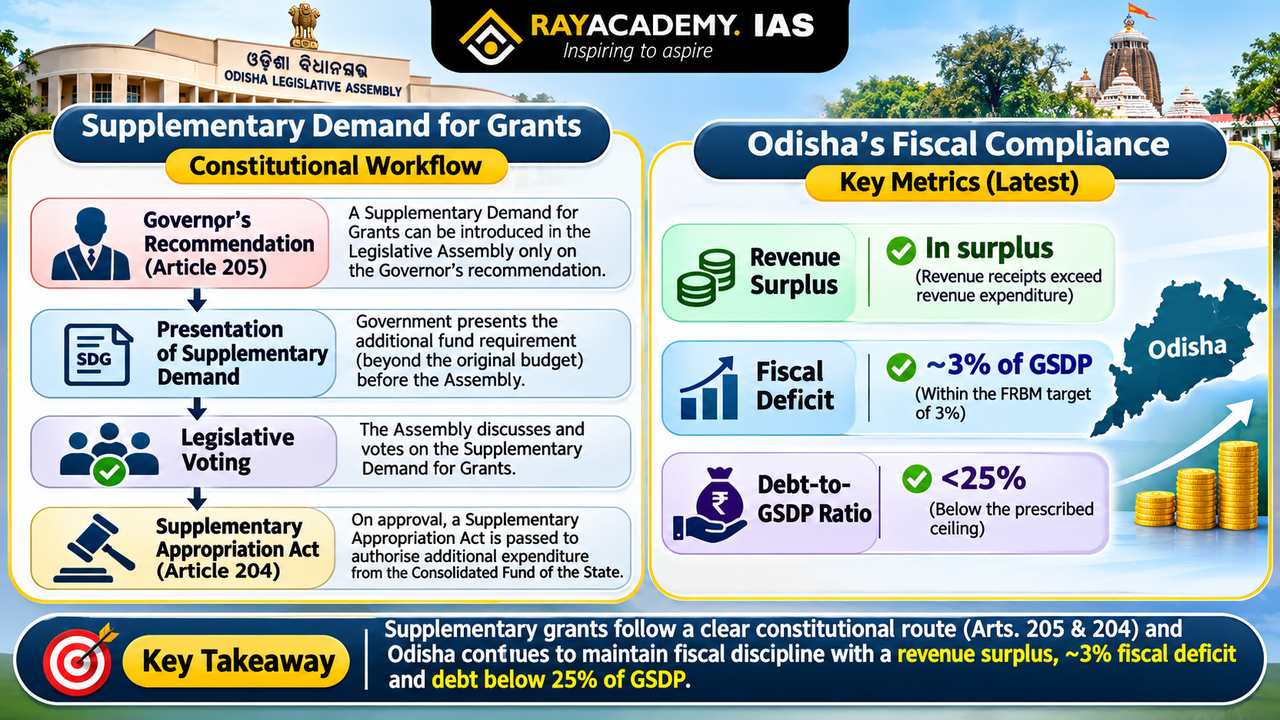
Under Article 205 of the Constitution of India, the Governor causes to be laid before the House(s) of the State Legislature a statement showing the estimated amount of additional expenditure when:
The amount authorized by the Appropriation Act (Article 204) for a particular service in the current financial year is found to be insufficient for the purposes of that year; or
A need has arisen during the current financial year for supplementary or additional expenditure upon some "new service" not contemplated in the Annual Financial Statement (Article 202) for that year.
The procedure governing Supplementary, Additional, or Excess Grants under Article 205 mirrors the Annual Financial Statement (Articles 202–204)—meaning no money can be withdrawn from the Consolidated Fund of the State (Article 266) without legislative passage of a Supplementary Appropriation Bill.
2. Fiscal Prudence & Disaster Financing Architecture
FRBM Ceiling & Debt Sustainability: Following 15th Finance Commission norms, States must maintain their fiscal deficit within 3% of Gross State Domestic Product (GSDP) (with an additional 0.5% tied to power-sector reforms) and contain their debt-to-GSDP ratio within sustainable thresholds (Odisha projects a revenue surplus, a fiscal deficit of ~3% of GSDP, and a debt-to-GSDP ratio below 25%).
State Disaster Response Fund (SDRF) & NDRF: Governed under Section 48 of the Disaster Management Act, 2005, the SDRF (cost-shared 75:25 between the Union and general States) serves as the primary fund for immediate relief, supplemented by State budgetary provisions during recurrent cyclonic events.
Prelims Focus: High-Yield Objective Facts
Key Constitutional Articles on Grants (Union vs. States):
Annual Financial Statement (Budget): Article 112 (Union) | Article 202 (States).
Appropriation Bills: Article 114 (Union) | Article 204 (States).
Supplementary, Additional or Excess Grants: Article 115 (Union) | Article 205 (States).
Votes on Account, Votes of Credit & Exceptional Grants: Article 116 (Union) | Article 206 (States).
Expenditure Breakdown of Odisha’s ₹24,150 Crore Supplementary Budget (2026–27):
Programme Expenditure: ₹17,990 crore (comprising ₹14,228 crore for State Sector Schemes, ₹3,442 crore for Centrally Sponsored Schemes, and ₹320 crore for Central Sector Schemes).
Disaster Response & Management: ₹5,100 crore.
Administrative Expenditure: ₹1,060 crore.
Targeted Social Inclusion Sub-Plans: ₹3,765 crore under Tribal Area Sub-Plan (TASP) and ₹2,646 crore under Special Component Plan for Scheduled Castes (SCSP).
Major Sectoral & New Scheme Allocations:
Food Security (₹8,390 crore): ₹8,312 crore under Mukhya Mantri Annapurna Yojana (State Food Security Scheme) and ₹71 crore under National Food Security Act (NFSA) for handling/dealer margins.
Education (₹1,715 crore): Includes ₹485 crore under Gyanodaya – Siksha ru Samruddhi providing free education from KG to PG.
Women Empowerment (₹1,247 crore): Includes ₹550 crore for Subhadra Yojana and ₹697 crore under National Rural Livelihood Mission (NRLM).
Agriculture & Allied Sectors (₹1,606 crore): Includes ₹380 crore for Samrudha Krushak Yojana, ₹120 crore for Shree Anna Abhiyan (millets), ₹101 crore for Mukhyamantri Matsyajeevi Kalyan Yojana, ₹207 crore for Prani Sampad Samruddhi Yojana, ₹90 crore for Mukhyamantri Kamadhenu Yojana, and ₹70 crore for cooperative crop-loan interest subvention via PACS.
Mains Analytical Breakdown
Significance of Mid-Year Supplementary Budgeting in State Governance
Fiscal Agility Against Climate & Disaster Shocks: For a cyclone-prone coastal state like Odisha, earmarking ₹5,100 crore for disaster response and management mid-year provides rapid liquidity for evacuation, relief, and resilient infrastructure without derailing ongoing capital works.
Strengthening Human Capital & Social Safety Nets: Substantial allocations for food security (₹8,390 crore), KG-to-PG free education (Gyanodaya), National Health Mission (₹500 crore within ₹1,246 crore health outlay), and Subhadra Yojana directly advance Sustainable Development Goals (SDGs 1, 2, 3, 4, and 5).
Targeted Equity for Marginalized Communities: Ring-fencing ₹3,765 crore under TASP and ₹2,646 crore under SCSP ensures proportional developmental investment in Scheduled Tribe and Scheduled Caste habitations.
Diversifying the Rural & Agro-Allied Economy: Supporting millets (Shree Anna Abhiyan), fisheries, dairy, poultry, and PACS crop-loan interest subvention promotes climate-resilient farming and rural income diversification.
Multi-Dimensional Challenges
Rising Revenue & Subsidy Commitments vs. Capital Outlay (Fiscal): Heavy mid-year provisions for food subsidies (₹8,312 crore) and direct cash/welfare transfers risk expanding committed revenue expenditure, potentially squeezing long-term capital expenditure (CapEx) if revenue buoyancy slows.
Execution Bottlenecks in the Final Quarter (Administrative): With supplementary grants passed in November (Q3), line departments have barely four months before March 31 to utilize ₹17,990 crore in programme funds—creating risks of "March rush" spending, hasty procurement, or unspent balances.
Leakages & Targeting Errors in Overlapping Welfare Schemes (Governance): Administering parallel State and Central schemes (such as Mukhya Mantri Annapurna Yojana alongside NFSA, or Subhadra Yojana alongside NRLM) requires robust de-duplication and DBT verification to prevent inclusion/exclusion errors.
Legislative Scrutiny Constraints (Democratic Accountability): Supplementary budgets are frequently passed with limited debate compared to the main Annual Financial Statement, weakening legislative oversight over mid-year policy shifts and New Service introductions.
Way Forward
Enforce Outcome-Based Monitoring to Curb "March Rush": Following 2nd Administrative Reforms Commission (14th Report on Strengthening Financial Management Systems) guidelines, link supplementary releases to quarterly physical milestones and Public Financial Management System (PFMS) real-time tracking rather than mere treasury drawdowns.
Institutionalize Pre-Budget Scrutiny by Departmentally Related Standing Committees (DRSCs): Strengthen legislative committee examination of Article 205 supplementary demands—especially for "New Service" schemes—to uphold executive accountability to the State Legislature.
Preserve Capital Expenditure Momentum Under FRBM Discipline: Finance supplementary welfare and disaster outlays primarily through expenditure reprioritization, savings/surrenders from slow-moving heads, and non-tax mineral revenue buoyancy so that the fiscal deficit stays within 3% of GSDP and CapEx quality remains intact.
Integrate Unified Beneficiary Registries (DBT & JAM Trinity): Converge NFSA, Mukhya Mantri Annapurna Yojana, Subhadra Yojana, and Samrudha Krushak Yojana databases with Aadhaar-seeded Social Registries to eliminate ghost beneficiaries and streamline last-mile delivery.
Embed Disaster Risk Reduction (DRR) into Regular Capital Budgeting: Operationalize 15th Finance Commission and Sendai Framework principles by shifting from reactive post-disaster relief toward pre-emptive disaster-resilient power grids, coastal embankments, and multi-purpose cyclone shelters.
Value Addition for Mains
Fiscal Federalism & FRBM Benchmark (RBI State Finances: A Study of Budgets): Across Indian States, supplementary budgets often add 8–12% over initial Budget Estimates; maintaining a revenue surplus and keeping debt-to-GSDP below 25% (compared to the all-State average of ~27–28%) exemplifies counter-cyclical fiscal space that allows a State to absorb climate shocks and fund welfare simultaneously without debt distress.
Constitutional Anchor: Article 205 operationalizes the foundational democratic principle of "No taxation or expenditure without legislative authorization," balancing executive flexibility during unforeseen emergencies (like cyclones) with legislative control over the public purse.
Practice Questions for Active Recall
Prelims Practice MCQ
With reference to Supplementary Grants in a State Legislature under the Constitution of India, consider the following statements:
Under Article 205, a Supplementary Demand for Grants can be presented when the amount authorized by the Appropriation Act for a particular service is found to be insufficient for the current financial year.
Unlike the Annual Financial Statement, Supplementary Grants do not require the passage of an Appropriation Bill to authorize withdrawal of money from the Consolidated Fund of the State.
Expenditure on a "New Service" not contemplated in the Annual Financial Statement for that year can be sought through Supplementary Grants.
Which of the statements given above are correct?
(a) 1 and 2 only
(b) 1 and 3 only
(c) 2 and 3 only
(d) 1, 2, and 3
Correct Answer: (b) 1 and 3 only
Explanation:
Statement 1 is correct: Under Article 205(1)(a), the Governor lays a supplementary statement before the State Legislature when the amount authorized under Article 204 for a particular service is insufficient for that financial year.
Statement 2 is incorrect: Under Article 205(2), the provisions of Articles 202, 203, and 204 apply to Supplementary Grants in the exact same manner as to the Annual Financial Statement—meaning a Supplementary Appropriation Bill must be passed to withdraw funds from the Consolidated Fund of the State.
Statement 3 is correct: Article 205(1)(a) explicitly covers supplementary or additional expenditure upon any "new service" not contemplated in the original Annual Financial Statement.
Mains Practice Question (GS Paper II & GS Paper III — 150 Words | 10 Marks)
"Supplementary budgets provide essential executive flexibility to address unforeseen emergencies and emerging welfare priorities, yet their growing size tests legislative oversight and fiscal discipline." Critically examine in the context of State finances in India.
Answer Structure Hints:
Introduction: Cite Article 205 of the Constitution and recent State fiscal trends (e.g., Odisha’s ₹24,150 crore Supplementary Budget for 2026–27 raising total outlay by ~7.7% to ₹3.34 lakh crore).
Body Part 1 (Significance & Need): Highlight agility for disaster response (cyclones/floods), launching mid-year welfare and human-capital schemes (food security, free education, women empowerment), and accommodating Central scheme releases.
Body Part 2 (Governance & Fiscal Challenges): Discuss risks of "March rush" spending, expansion of committed revenue subsidies over CapEx, welfare scheme duplication, and truncated legislative scrutiny.
Conclusion: Recommend 2nd ARC outcome-based PFMS tracking, DRSC review of "New Service" demands, and adherence to FRBM fiscal deficit (<3% GSDP) and debt ceilings.
Take this article with you
Save a reading copy for offline study.


