

Vice-President’s Address at Odisha Legislative Assembly
Vice-President of India C. P. Radhakrishnan commenced a two-day official visit to Odisha on November 16, 2026, where he is scheduled to address the orientation programme for newly elected members of the Odisha Legislative Assembly in Bhubaneswar, alongside inaugurating the Iconic Tower academic building at Sri Sri University in Cuttack (Kataka)
OPSC Syllabus Mapping:
General Studies Paper II (Indian Polity & Governance): Parliament and State Legislatures—structure, functioning, conduct of business, powers & privileges and issues arising out of these; Structure, organization and functioning of the Executive and the Judiciary; Important aspects of governance, transparency and accountability.
The legislative orientation programme is designed to familiarize newly elected Members of the Legislative Assembly (MLAs) with parliamentary and legislative procedures, constitutional responsibilities, and the institutional functioning of democratic legislatures—underscoring the vital link between legislative capacity building and the quality of democratic governance.
Static-Current Linkage: Office of the Vice-President, State Legislatures, and Parliamentary Procedures
Evaluating the significance of legislative orientation programmes and the Vice-President’s role in strengthening democratic institutions requires linking constitutional provisions with parliamentary governance frameworks.
Constitutional Role of the Vice-President of India
Articles 63 to 71: Article 63 establishes the Office of the Vice-President of India—the second-highest constitutional office in the country. Under Article 64 and Article 89(1), the Vice-President serves as the ex-officio Chairman of the Rajya Sabha (Council of States), functioning as the custodian of parliamentary decorum, legislative rules, and federal deliberation in the Upper House.
Acting President Mandate (Article 65): In the event of a vacancy in the Office of the President due to death, resignation, or removal, the Vice-President acts as President until a new President is elected.
Constitutional Architecture of State Legislatures.Legislative Training and Democratic Capacity Building
Articles 168 to 212 (Part VI): Govern the constitution, composition, duration, officers, procedures, and privileges of State Legislatures. Under Article 168, Odisha possesses a unicameral legislature consisting of the Governor and the Odisha Legislative Assembly (147 elected members).
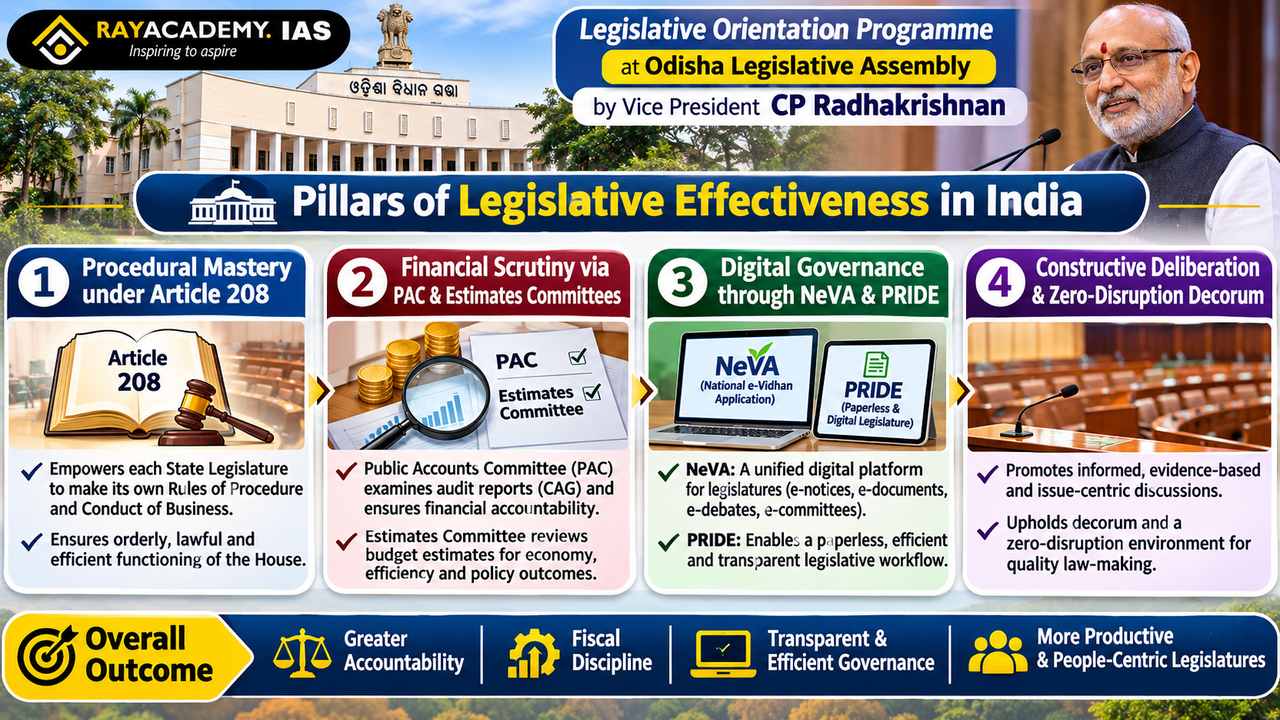
Legislative Procedures & Rules of Conduct (Article 208): Empowers each House of a State Legislature to make rules for regulating its procedure and the conduct of its business—covering Question Hour, Zero Hour, Adjournment Motions, Calling Attention Notices, Money Bills (Article 199), and Financial Committees (Public Accounts Committee, Estimates Committee, and Committee on Public Undertakings).
Legislative Privileges (Article 194): Guarantees freedom of speech inside the State Legislature and protects members from judicial proceedings in respect of anything said or any vote given in the House, enabling fearless executive accountability.
Institutional Mechanisms for Legislative Training
PRIDE (Parliamentary Research and Training Institute for Democracies): Functioning under the Lok Sabha Secretariat (formerly BPST, established in 1976), PRIDE conducts structured orientation, capacity-building, and domain-specific workshops for Members of Parliament (MPs), state legislators, and legislative secretariats across India.
National e-Vidhan Application (NeVA): Implemented by the Ministry of Parliamentary Affairs under the Digital India mission, NeVA promotes paperless legislatures ("One Nation, One Application") by digitizing legislative questions, bills, committee reports, and member handbooks. Legislative Training and Democratic Capacity Building
Prelims Focus: High-Yield Objective Facts
Dimension / Institution | Key Facts & Specifications for OPSC Prelims |
Vice-President’s Election & Removal | • Electoral College (Article 66): Elected by members of both Houses of Parliament (including nominated members; State Legislative Assemblies do NOT participate). |
• Removal (Article 67(b)): By a resolution of the Rajya Sabha passed by an effective majority (majority of all then members) and agreed to by the Lok Sabha by a simple majority (14 days' advance notice required). | | Odisha Legislative Assembly | Unicameral legislature comprising 147 seats; presided over by the Speaker (elected under Article 178); conducts sessions in Bhubaneswar. | | Key Legislative Instruments | • Question Hour: First hour of a sitting; includes Starred (oral answer + supplementaries), Unstarred (written answer), and Short Notice questions.
• Zero Hour: Indian parliamentary innovation (since 1962) not formally mentioned in Rules of Procedure; used to raise urgent matters of public importance without prior notice. | | Financial Committees in State Legislatures | • Public Accounts Committee (PAC): Audits CAG reports on state expenditure.
• Estimates Committee: Examines budget estimates and suggests administrative economies.
• Committee on Public Undertakings (CoPU): Reviews performance of State PSUs. | | PRIDE & NeVA | • PRIDE: Parliamentary Research and Training Institute for Democracies (Lok Sabha Secretariat).
• NeVA: National e-Vidhan Application (Nodal Ministry: Ministry of Parliamentary Affairs). |
Mains Analytical Breakdown
Significance of Legislative Orientation and Capacity Building
Bridging the Transition From Electoral Politics to Lawmaking: Many newly elected MLAs enter legislatures from grassroots activism, social work, or local bodies without formal legal or administrative training. Structured orientation equips them to draft Private Members’ Bills, frame pointed legislative questions, and scrutinize subordinate legislation.
Strengthening Executive Accountability & Budgetary Oversight: Informed legislators utilize Financial Committees (PAC, Estimates Committee) and Demand for Grants debates effectively—ensuring public funds are spent transparently and preventing executive overreach.
Upholding Parliamentary Decorum & Cooperative Federalism: Guidance from the Vice-President of India (Chairman of the Rajya Sabha) reinforces constitutional norms, constructive debate over disruption, and healthy institutional dialogue between Union and State legislatures.
Synergy Between Democratic Institutions and Higher Education: Coupling legislative training with engagements at higher education institutions (such as inaugurating academic infrastructure at Sri Sri University in Cuttack) underscores the role of universities in nurturing civic leadership, public policy research, and youth innovation.
Multi-Dimensional Challenges in State Legislatures
Declining Sitting Days and Shrinking Deliberative Time (Institutional): According to PRS Legislative Research, State Legislative Assemblies across India meet for an average of only 20–25 days per year (down significantly from earlier decades), leaving insufficient time for thorough clause-by-clause scrutiny of complex bills and state budgets.
Frequent House Disruptions & Procedural Bypassing (Political): Walkouts, sloganeering, and rushing bills through voice votes without referring them to Departmentally Related Standing Committees (DRSCs) or Select Committees erode deliberative democracy.
Weak Research & Legislative Support Staff (Administrative): Unlike legislators in mature democracies who have dedicated policy researchers, most Indian MLAs lack trained research assistants to analyze complex socio-economic datasets, fiscal bills, and environmental impact assessments.
Anti-Defection Constraints on Independent Voice (Constitutional): While the Tenth Schedule (52nd Amendment Act, 1985) curbed political defections, rigid party whips often restrict legislators from expressing constituency-specific views during policy debates.
Way Forward
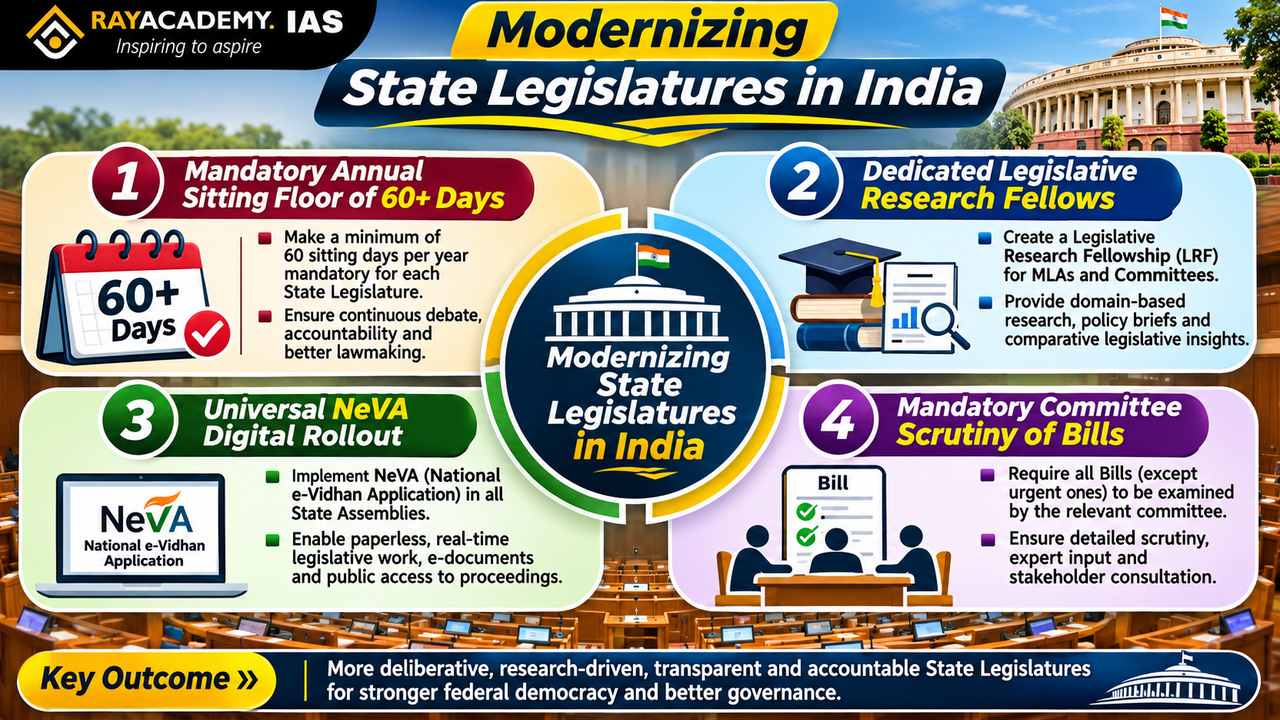
Institutionalize Mandatory Continuous Legislative Training (PRIDE & State Academies): Move beyond one-off induction workshops by establishing permanent State Legislative Research and Training Institutes in partnership with PRIDE and premier public policy universities to offer modular courses on budget analysis, constitutional law, and legislative drafting.
Mandate a Minimum Number of Annual Sitting Days (National Commission to Review the Working of the Constitution — NCRWC): Adopt the NCRWC (Venkatachaliah Commission) and All India Presiding Officers’ Conference (AIPOC) recommendations to fix a statutory minimum of 60 to 90 sitting days per year for State Legislative Assemblies.
Establish a "Legislative Research Fellowship" for MLAs: Provide every legislator with trained Legislative Research Assistants (modeled on the LAMP Fellowship) and upgrade state assembly libraries with real-time economic, climate, and social-sector databases.
Enforce Mandatory Committee Scrutiny of Bills & Universal NeVA Adoption: Amend Assembly Rules of Procedure under Article 208 so that major non-emergent bills are compulsorily referred to Subject/Select Committees for stakeholder consultation, while accelerating 100% paperless workflows via the National e-Vidhan Application (NeVA).
Uphold Ethical Conduct & Constructive Debate (2nd ARC Ethics in Governance): Enforce strict Codes of Conduct for legislators, broadcast committee proceedings where feasible to enhance transparency, and incentivize high attendance and constructive participation through parliamentary recognition awards.
Value Addition for Mains
Empirical Legislative Benchmark (PRS Legislative Research): State Legislative Assemblies in India average roughly 20–25 sitting days annually, and over 40% of state bills are frequently passed within days of introduction without committee scrutiny—making structured orientation programmes (such as the Odisha Legislative Assembly induction addressed by the Vice-President) crucial for restoring deliberative depth.
Constitutional & Ethical Anchor: As Dr. B. R. Ambedkar emphasized in the Constituent Assembly, the success of a parliamentary democracy depends not merely on constitutional text, but on cultivating constitutional morality and institutional conventions among elected representatives.
Practice Questions for Active Recall
Prelims Practice MCQ
With reference to the Vice-President of India and State Legislatures under the Constitution of India, consider the following statements:
The Vice-President of India is elected by an electoral college consisting of the elected members of both Houses of Parliament and the elected members of the Legislative Assemblies of the States.
Under Article 64 of the Constitution, the Vice-President is the ex-officio Chairman of the Council of States (Rajya Sabha) and cannot hold any other office of profit.
Under Article 208 of the Constitution, a House of the Legislature of a State is empowered to make rules for regulating its procedure and the conduct of its business.
Which of the statements given above are correct?
(a) 1 and 2 only
(b) 2 and 3 only
(c) 1 and 3 only
(d) 1, 2, and 3
Correct Answer: (b) 2 and 3 only
Explanation:
Statement 1 is incorrect: Under Article 66(1), the Vice-President is elected by an electoral college consisting of all members (both elected and nominated) of both Houses of Parliament; members of State Legislative Assemblies do not participate in the Vice-Presidential election (unlike the Presidential election under Article 54).
Statement 2 is correct: Article 64 stipulates that the Vice-President shall be the ex-officio Chairman of the Council of States (Rajya Sabha) and shall not hold any other office of profit.
Statement 3 is correct: Article 208(1) authorizes each House of a State Legislature to make rules for regulating, subject to the provisions of the Constitution, its procedure and the conduct of its business.
Mains Practice Question (GS Paper II — 150 Words | 10 Marks)
"The vitality of parliamentary democracy rests not merely on free and fair elections, but on the procedural competence, ethical conduct, and deliberative capacity of elected legislators." Discuss the significance of structured orientation programmes for newly elected MLAs and suggest institutional reforms to strengthen the functioning of State Legislatures in India.
Answer Structure Hints:
Introduction: Contextualize the Vice-President’s address at the Odisha Legislative Assembly orientation programme in Bhubaneswar (Nov 2026), highlighting how structured training bridges the gap between electoral victory and effective lawmaking.
Body Part 1 (Significance of Orientation): Explain how familiarity with Article 208 rules, Question Hour, Financial Committees (PAC, Estimates), and legislative privileges (Article 194) enhances executive accountability, budget scrutiny, and constructive debate over disruption.
Body Part 2 (Institutional Reforms): Address challenges like low annual sitting days (~20–25 days) and limited research support by recommending a minimum floor of 60 sitting days (NCRWC), dedicated Legislative Research Fellows, mandatory referral of bills to Standing/Select Committees, and full adoption of NeVA.
Conclusion: Conclude with constitutional morality, noting that empowered and well-trained state legislatures are the bedrock of responsive governance and cooperative federalism.
Take this article with you
Save a reading copy for offline study.


