

ASEAN-India Summit
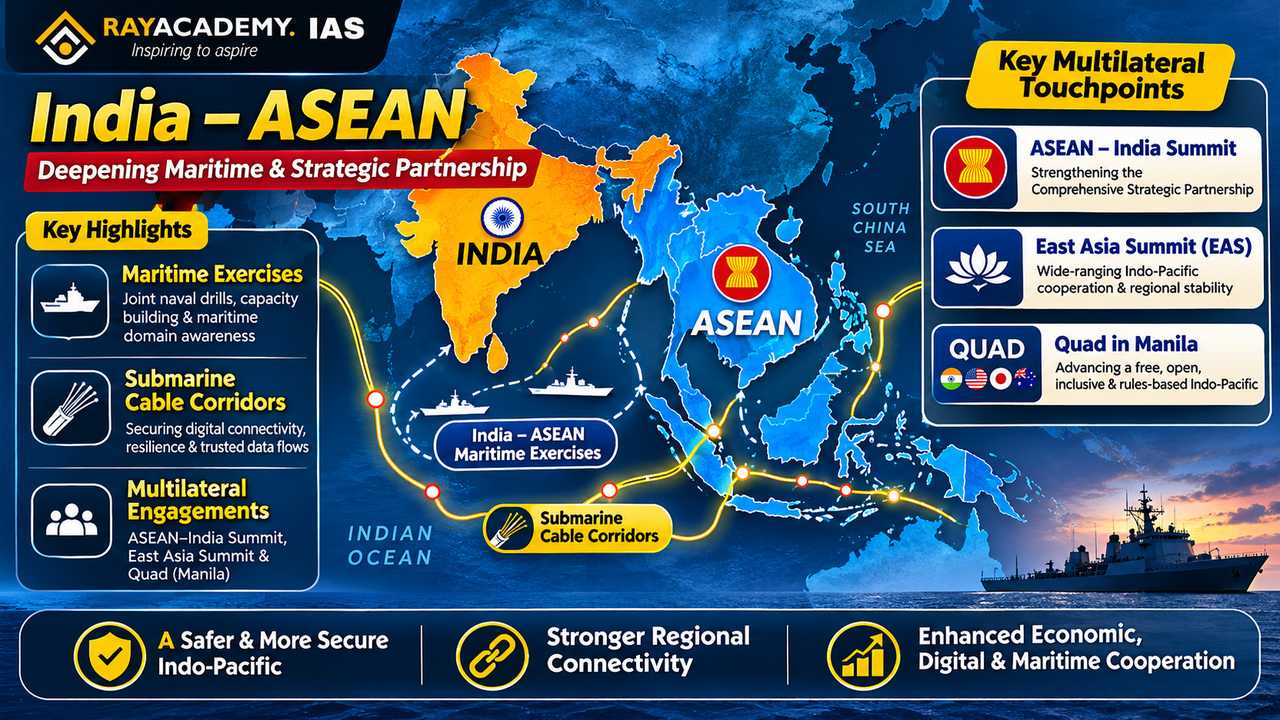
Prime Minister Narendra Modi is participating in the ASEAN-India Summit and the 21st East Asia Summit (EAS) in Manila, Philippines (November 16–17, 2026), alongside a potential Quad Leaders’ Summit on the sidelines.
UPSC Syllabus Mapping:
General Studies Paper II (International Relations): Bilateral, regional and global groupings and agreements involving India and/or affecting India’s interests; India and its neighbourhood- relations; Effect of policies and politics of developed and developing countries on India’s interests.
The visit aims to consolidate the milestones of the 2026 ASEAN-India Year of Maritime Cooperation, accelerate the overdue review of the ASEAN-India Trade in Goods Agreement (AITIGA), and infuse fresh strategic momentum into India’s Act East Policy ahead of the 35th anniversary of ASEAN-India dialogue ties in 2027.
Static-Current Linkage: Evolution of India’s Act East Policy
India’s institutional engagement with Southeast Asia evolved from the Look East Policy (1992)—launched following post-Cold War geopolitical shifts and India’s 1991 economic liberalization—into the more proactive, security- and connectivity-oriented Act East Policy (2014).
Institutional Trajectory: India became a Sectoral Dialogue Partner (1992), Full Dialogue Partner (1996), Summit-level Partner (2002), Strategic Partner (2012), and elevated ties to a Comprehensive Strategic Partnership (CSP) in 2022.
Constitutional & Doctrinal Anchor: India’s outreach operationalizes Article 51 of the Directive Principles of State Policy (promoting international peace, security, and respect for international law) alongside the SAGAR (Security and Growth for All in the Region) and Indo-Pacific Oceans Initiative (IPOI) frameworks.
ASEAN Centrality: Unlike alliance-based security models, India’s Indo-Pacific vision explicitly upholds ASEAN centrality and strategic autonomy, ensuring regional inclusivity amid intensifying great-power rivalry.
Prelims Focus: High-Yield Objective Facts.India-ASEAN Relations
Dimension / Initiative | Key Facts & Specifications for UPSC Prelims |
ASEAN Member States (11) | Brunei, Cambodia, Indonesia, Laos, Malaysia, Myanmar, Philippines, Singapore, Thailand, Vietnam, and Timor-Leste (admitted as 11th member). |
East Asia Summit (EAS) | Established in 2005 (18 members: 10/11 ASEAN states + Australia, China, India, Japan, New Zealand, Republic of Korea, Russia, and the United States). |
IFC-IOR | Information Fusion Centre – Indian Ocean Region, hosted by the Indian Navy at Gurugram (Haryana); six ASEAN countries are associated with it for maritime domain awareness. |
Project Nexus | Multilateral initiative spearheaded by the Bank for International Settlements (BIS) Innovation Hub (linking India’s UPI with instant payment systems of Malaysia, Philippines, Singapore, and Thailand). |
Maritime Exercises (2026) | MILAN 2026, International Fleet Review, and Indian Ocean Naval Symposium (IONS) hosted at Visakhapatnam; 2nd ASEAN-India Maritime Exercise. |
BRICS–ASEAN Overlap | Indonesia is a full BRICS member, while Malaysia, Thailand, and Vietnam participate as BRICS partner countries. |
Mains Analytical Breakdown
Strategic Significance of Deepening India–ASEAN Ties
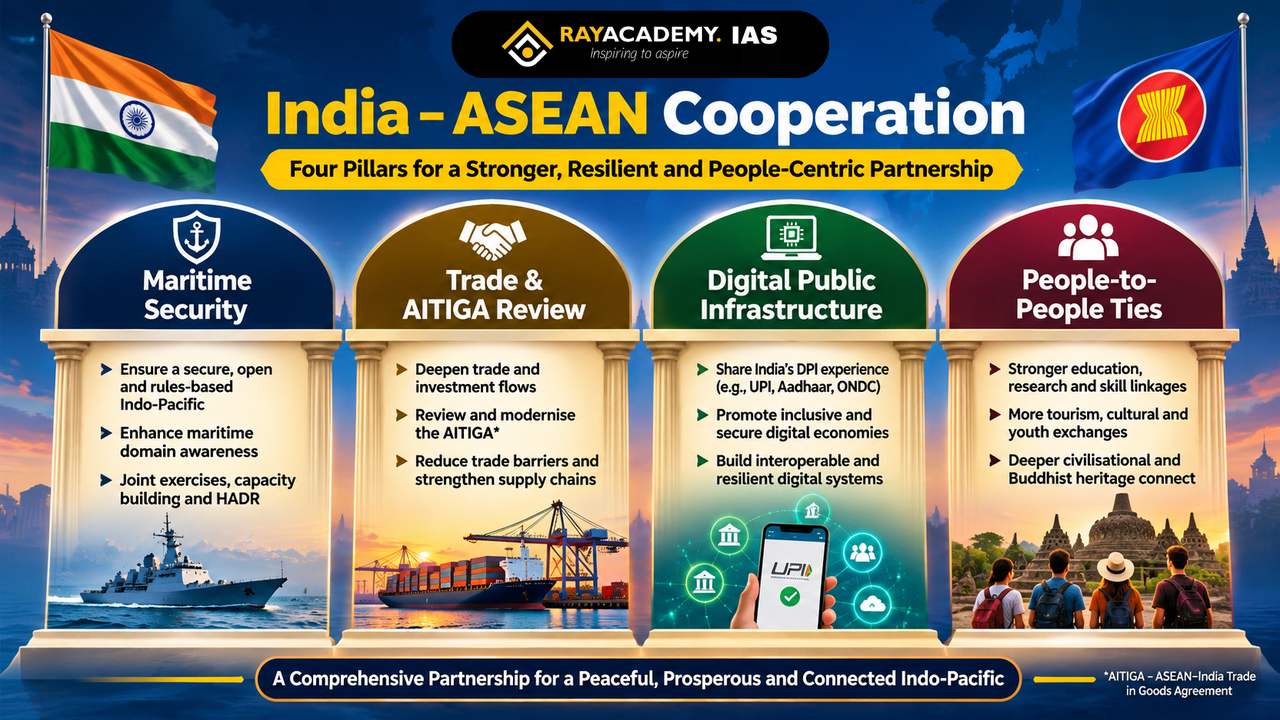
Maritime Security & Indo-Pacific Stability: Cooperation in Maritime Domain Awareness (MDA), search and rescue, Humanitarian Assistance and Disaster Relief (HADR), and protection of submarine communication cables strengthens collective deterrence against maritime coercion.
Digital Public Infrastructure (DPI) & Fintech Integration: ASEAN states view India’s DPI stack as complementary to regional digital integration. Initiatives like Project Nexus (cross-border instant payments), enhanced submarine cable connectivity, and the ASEAN-India Scale Hub in Bali (July 2026) position India as a trusted technology partner.
Multilateral Balancing & Multi-Alignment: Participating simultaneously in the East Asia Summit, Quad, and BRICS demonstrates India’s strategic autonomy, enabling dialogue across geopolitical divides in a fragmenting international order.
Soft Power & People-to-People Diplomacy: Direct air connectivity, academic scholarships at Nalanda University, and collaboration in renewable energy and healthcare convert diplomatic goodwill into tangible societal linkages. India-ASEAN Relations
Multi-Dimensional Challenges
Economic & Trade Asymmetry: While bilateral trade reached approximately $128 billion last year and Indian exports to ASEAN rose 56% in the current year (largely driven by petroleum products), persistent trade deficits and the stalled review of AITIGA remain major friction points. Non-tariff barriers, strict Rules of Origin (RoO), and third-country rerouting of cheap goods continue to concern Indian domestic industry.
Geopolitical & Security Sensitivities: Escalating tensions in the South China Sea, cross-strait uncertainty over Taiwan, and intra-ASEAN divergence regarding major powers test regional cohesion.
Connectivity Bottlenecks: Physical land connectivity projects—most notably the India–Myanmar–Thailand (IMT) Trilateral Highway and the Kaladan Multi-Modal Transit Transport Project—face severe execution delays due to ongoing civil conflict in Myanmar.
Environmental & Subsea Infrastructure Vulnerability: Growing reliance on subsea data cables across seismically active and geopolitically contested maritime chokepoints exposes both regions to natural disasters and hybrid sabotage risks.
Way Forward
Conclude the AITIGA Review with Reciprocal Market Access: Operationalize political direction from the Manila Summit to finalize a modernized, balanced AITIGA featuring stringent Rules of Origin verification, removal of non-tariff barriers, and smoother market access for Indian pharmaceuticals, engineering goods, and agricultural products.
Operationalize the ASEAN-India Plan of Action (2026–2030): Translate the achievements of the 2026 Year of Maritime Cooperation into institutionalized annual naval drills, expanded IFC-IOR liaison officer postings, and joint protocols for securing submarine optical fibre cables.
Scale Digital Public Infrastructure (DPI) Diplomacy: Fast-track the operational rollout of Project Nexus for seamless cross-border merchant remittances and expand the ASEAN-India Scale Hub to co-fund AI, clean-tech, and fintech startups.
De-Risk Physical Connectivity via Maritime & Sub-Regional Corridors: While stabilizing border infrastructure in Northeast India, prioritize maritime shipping links (such as Chennai–Vladivostok and eastern coastal port linkages with Southeast Asia) alongside BIMSTEC and Mekong-Ganga Cooperation (MGC) corridors.
Deepen Knowledge, Green Energy, and Educational Exchanges: Expand the ASEAN-India Network of Universities (AINU), joint solar/green hydrogen research under the International Solar Alliance (ISA), and disaster-resilient infrastructure partnerships via CDRI.
Value Addition for Mains
Official Trade & Diplomatic Benchmark (2026): India–ASEAN bilateral merchandise trade stands at roughly $128 billion, with Indian exports surging 56% in 2026, while six of the 11 ASEAN nations are now integrated into India’s Information Fusion Centre – Indian Ocean Region (IFC-IOR)—reflecting a decisive shift from purely commercial ties to comprehensive maritime and digital security cooperation.
Foreign Policy Doctrine Anchor: As former Ambassador Gurjit Singh notes, "India’s Act East Policy is not merely an outreach to Southeast Asia; it is increasingly about working with ASEAN to shape a stable, prosperous and inclusive Indo-Pacific"—embodying India’s commitment to plurilateralism and a rules-based international order.
Practice Questions for Active Recall
Prelims Practice MCQ
With reference to India–ASEAN engagement and regional frameworks in the Indo-Pacific, consider the following statements:
All ASEAN member states are currently integrated as partner nations with India’s Information Fusion Centre – Indian Ocean Region (IFC-IOR) in Gurugram.
Project Nexus is a multilateral initiative aimed at linking domestic instant payment systems—such as India’s UPI—with those of Southeast Asian economies to enable cross-border retail transactions.
The East Asia Summit (EAS) is an ASEAN-led forum that includes India, the United States, Russia, and China among its participating members.
Which of the statements given above are correct?
(a) 1 and 2 only
(b) 2 and 3 only
(c) 1 and 3 only
(d) 1, 2, and 3
Correct Answer: (b) 2 and 3 only
Explanation:
Statement 1 is incorrect: Currently, six ASEAN countries (not all ASEAN member states) are associated with the Information Fusion Centre – Indian Ocean Region (IFC-IOR) hosted by the Indian Navy in Gurugram.
Statement 2 is correct: Project Nexus, conceptualized by the Bank for International Settlements (BIS), connects domestic instant payment systems (including India’s UPI and counterparts in Malaysia, the Philippines, Singapore, and Thailand) for seamless cross-border payments.
Statement 3 is correct: Established in 2005, the East Asia Summit (EAS) is an ASEAN-centred strategic forum comprising ASEAN member states alongside eight dialogue partners, including India, the U.S., Russia, China, Japan, South Korea, Australia, and New Zealand.
Mains Practice Question (GS Paper II — 150 Words | 10 Marks)
"India’s Act East Policy has evolved from a trade-centric outreach into a multidimensional partnership anchored in maritime security, digital public infrastructure, and ASEAN centrality." Discuss the strategic drivers behind India’s deepening engagement with Southeast Asia and examine the key economic and connectivity hurdles that must be resolved.
Answer Structure Hints:
Introduction: Contextualize PM Modi’s participation in the ASEAN-India Summit and 21st East Asia Summit in Manila (Nov 2026) ahead of 35 years of dialogue ties in 2027, marking the transition from Look East (1992) to Act East (2014).
Body Part 1 (Strategic Drivers): Highlight maritime domain awareness (IFC-IOR, MILAN 2026, subsea cable protection), digital diplomacy (Project Nexus, Bali Scale Hub), and upholding ASEAN centrality and a rules-based Indo-Pacific amid great-power rivalry.
Body Part 2 (Economic & Connectivity Hurdles): Note the delayed AITIGA review, persistent trade deficits, non-tariff barriers, and land connectivity bottlenecks (IMT Trilateral Highway delays due to Myanmar’s instability).
Conclusion: Conclude with the ASEAN-India Plan of Action (2026–2030) and Article 51, emphasizing that concluding a fair AITIGA review and strengthening maritime-digital corridors will sustain a free, open, and inclusive Indo-Pacific.
Take this article with you
Save a reading copy for offline study.


