

Hostile Architecture
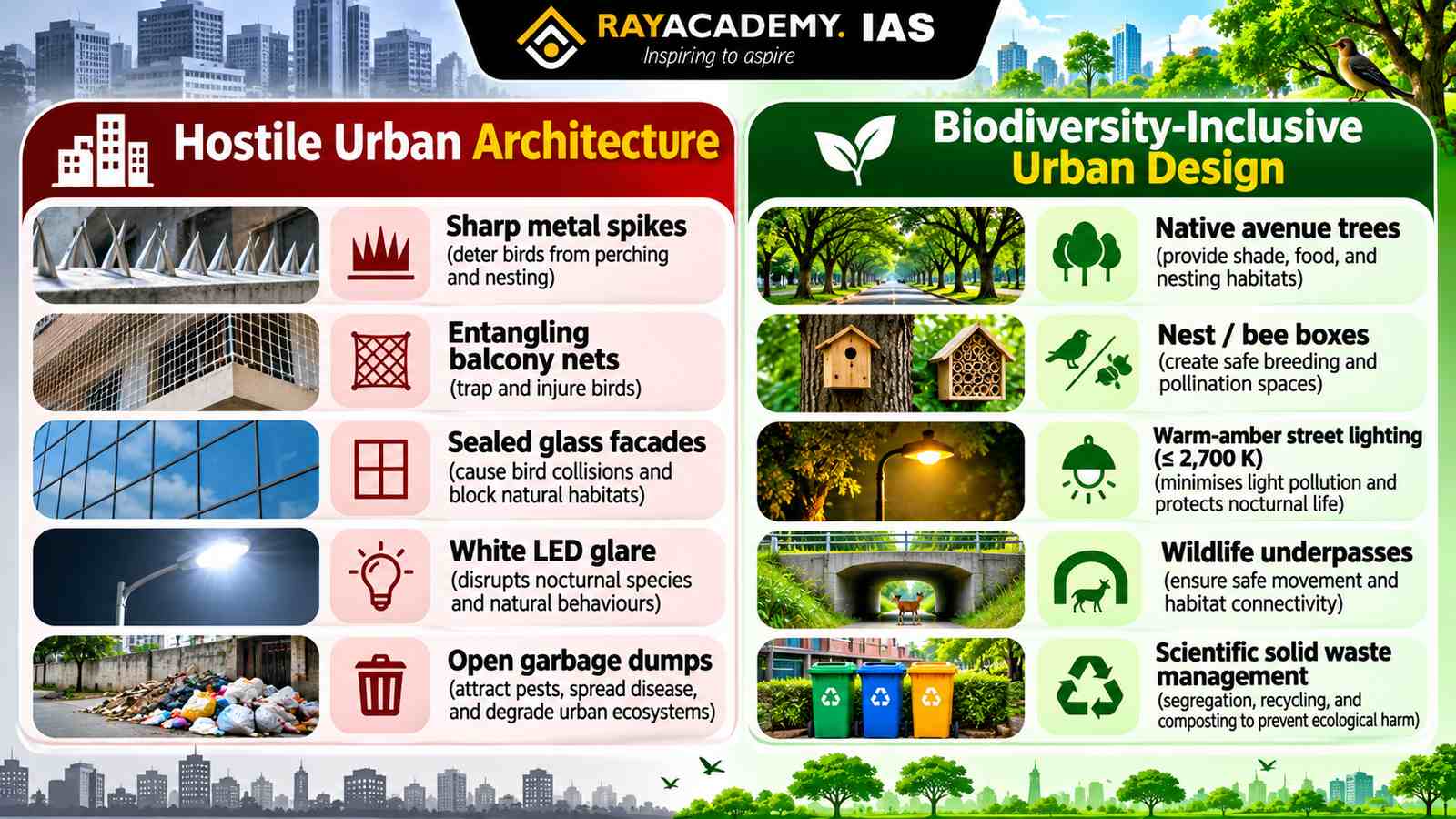
Urban ecologists, architects, and animal welfare experts have raised growing concern over the proliferation of hostile architecture across Indian cities—design interventions that physically deter, exclude, or harm urban birds and animals. Practices ranging from anti-bird spikes, poorly maintained balcony pigeon nets, broken glass shards on boundary walls, high-frequency ultrasonic repellers, and chemical repellent gels to sealed glass-and-concrete buildings and indiscriminate tree pruning are shrinking urban habitats and injuring wildlife.
UPSC Syllabus Mapping:
General Studies Paper III (Environment & Conservation): Conservation, environmental pollution and degradation, environmental impact assessment; Urban biodiversity conservation, human-wildlife interface, and statutory animal welfare frameworks.
General Studies Paper I (Urbanization & Geography): Urbanization, their problems and their remedies; Sustainable urban planning, urban heat island effect, and ecological infrastructure.
General Studies Paper IV (Ethics, Integrity, and Aptitude): Environmental ethics, compassion toward living creatures, and inter-species coexistence.
Experts from the Indian Institute for Human Settlements (IIHS) and animal rescue organisations highlight that unlike natural ecosystems, hostile urban structures offer no safe ecological corridors or alternative refuges, intensifying human-wildlife conflict, roadkill incidents, and steep declines in native urban birds such as the House Sparrow (Passer domesticus).
Static-Current Linkage: Constitutional Duties, Statutory Frameworks, and Urban Ecology Science
Understanding the ecological impact of hostile architecture requires connecting India's constitutional environmental mandate and wildlife laws with core principles of urban ecology.
Constitutional & Legal Architecture
Article 48A (Directive Principles of State Policy): Inserted by the 42nd Constitutional Amendment Act, 1976, mandates the State to endeavour to protect and improve the environment and to safeguard the forests and wildlife of the country.
Article 51A(g) (Fundamental Duties): Enjoins every citizen of India to protect and improve the natural environment including forests, lakes, rivers, and wildlife, and to have compassion for living creatures.
Wild Life (Protection) Act, 1972 (as amended in 2022): Prohibits hunting, trapping, injuring, or destroying the nests/eggs of protected wild birds and animals listed under Schedules I and II (which include urban-adapted species such as Barn Owls, Black Kites, Shikras, Peafowls, and Rhesus Macaques).
Prevention of Cruelty to Animals (PCA) Act, 1960: Under Section 11, inflicts penalties for causing unnecessary pain, suffering, trapping, or mutilation to any animal—applicable to hazardous spikes, glue traps, and negligently maintained nets that strangle birds and monkeys.
Scientific & Ecological Principles
Urban Heat Island (UHI) Effect: Replacing vegetated canopies and porous brick-lime structures with concrete, asphalt, and reflective glass traps solar radiation, elevating ambient urban temperatures and creating thermally stressful microclimates for birds, pollinators, and small mammals.
Artificial Light at Night (ALAN) & Bird-Glass Collisions: High-intensity blue-white street lighting disrupts circadian rhythms and disorients nocturnal fauna (such as owls and bats) and migratory birds along flyways, while transparent or reflective glass facades cause fatal bird-glass collisions.
Habitat Fragmentation & Edge Effects: Sealing building crevices and removing native undergrowth eliminates nesting cavities for secondary cavity-nesters like sparrows, parakeets, and barn owls, forcing animals onto unlit roads and open waste dumps.
Prelims Focus: High-Yield Objective Facts
Nodal Ministries & Statutory Bodies:
Ministry of Environment, Forest and Climate Change (MoEFCC): Apex ministry for wildlife conservation and urban biodiversity guidelines (e.g., Nagar Van Yojana).
Ministry of Housing and Urban Affairs (MoHUA): Nodal ministry for urban planning norms, Model Building Bye-Laws (MBBL), and AMRUT 2.0.
Animal Welfare Board of India (AWBI): Statutory advisory body established in 1962 under Section 4 of the PCA Act, 1960 (headquartered at Ballabhgarh, Haryana).
Origin of the Term "Hostile Architecture": Conceptualized in urban design literature (notably analyzed by architect James Petty) to describe physical structures in public spaces engineered to render areas unusable by specific human groups (such as anti-homeless segmented benches) or animals.
Scientific Evidence Cited in News:
Ultrasonic Pest Repellers: A 2025 study in the International Journal of Sustainable Engineering found that high-frequency ultrasonic devices tested in lab settings fail in real-world open environments while inducing stress in non-target mammals (such as rabbits and guinea pigs).
Chemical Bird Repellent Gels: A 2013 study in Animals documented how polybutene-based repellent gels glue birds' feathers together, impairing thermoregulation and flight.
Adaptive Behavioural Shifts: Research in Philosophical Transactions B (2023) observed urban birds (e.g., pigeons in Rotterdam) repurposing anti-bird spikes to construct nests, illustrating maladaptive evolutionary arms races.
Mains Analytical Breakdown
Significance of Rethinking Urban Design for Coexistence
Preserving Urban Ecosystem Services: Urban birds, bats, and pollinators provide vital regulating and supporting ecosystem services—including biological pest control, seed dispersal, and pollination of urban kitchen gardens and parks.
Aligning with Global Biodiversity Targets: Integrating nature-based solutions into city master plans directly advances Target 12 of the Kunming-Montreal Global Biodiversity Framework (GBF), which mandates expanding the area, connectivity, and ecological integrity of green and blue spaces in urban areas.
Reducing Public Health and Conflict Risks: Replacing reactive deterrence with scientific waste management and habitat restoration breaks the trophic chain where open garbage attracts stray dogs, pigs, and synanthropic primates, which in turn draw urban-edge leopards into residential zones.
Multi-Dimensional Challenges
Environmental — Loss of Native Avifauna and Pollinators: Sealed modern facades, monoculture exotic landscaping, and indiscriminate tree lopping have driven steep declines in cavity-nesting house sparrows, bees, and urban insectivores.
Governance & Planning — Anthropocentric Master Plans: Urban development authorities and Model Building Bye-Laws overwhelmingly prioritize vehicular mobility and real-estate Floor Area Ratio (FAR) while lacking mandatory ecological impact audits for commercial buildings, flyovers, and public arenas.
Civic & Public Health — Solid Waste Mismanagement: Inadequate door-to-door segregation under Solid Waste Management Rules, 2016 turns roadsides and wetlands into open feeding grounds, causing toxic ingestion, digestive blockages, and heightened territorial aggression among free-ranging dogs and cattle.
Economic & Commercial — Unregulated Market for Pseudo-Scientific Deterrents: Commercial vendors aggressively market unproven ultrasonic repellers, sharp metallic spikes, and chemical gels to housing societies and institutions without efficacy or safety certification.
Ethical — Erosion of Constitutional Compassion: Treating urban wildlife solely as "nuisances" or "encroachers" in their own historical habitats reflects an anthropocentric ethical deficit that contravenes Article 51A(g) and the Supreme Court’s recognition of animal dignity in Animal Welfare Board of India v. A. Nagaraja (2014).
Way Forward: Policy and Institutional Roadmap
Incorporate Biodiversity-Inclusive Norms in Building Bye-Laws: MoHUA and State Town Planning Departments should amend Model Building Bye-Laws to mandate bird-safe fritted/UV-patterned glass on high-rises, ban lethal razor-wire/glass-shard wall toppings, and incentivize rooftop gardens, nest boxes, and bee hotels in green building ratings (GRIHA / IGBC).
Adopt Wildlife-Friendly Street Lighting and Road Engineering: Municipal corporations should transition pathway and park lighting to warm-amber LEDs (<2,700 K) capped at 10–20 lux to protect nocturnal wildlife, install wildlife crossing signage in peri-urban zones, and mandate hooded bottom culverts/low-height medians in urban road projects.
Regulate Hazardous Deterrents Under PCA Act & BIS Standards: The Animal Welfare Board of India (AWBI) and Bureau of Indian Standards (BIS) should issue binding advisories prohibiting injurious metal spikes, non-biodegradable entanglement nets, and feather-damaging chemical gels, while cracking down on false efficacy claims for ultrasonic repellers.
Scientific Solid Waste Management & Humane Stray Population Control: Enforce strict zero-open-dumping compliance under Swachh Bharat Mission-Urban 2.0, establish designated feeding zones, and scale up Animal Birth Control (ABC) Rules, 2023 (sterilisation and anti-rabies vaccination) alongside municipal cattle shelters.
Expand Urban Green-Blue Corridors via Nagar Van Yojana: Integrate City Biodiversity Indices (CBI) into AMRUT 2.0 and Smart Cities frameworks, prioritizing native fruiting and canopy trees (such as neem, peepal, banyan, and jamun) over ornamental exotics.
Value Addition Snippet (Judicial & Policy Benchmarks for Mains)
Supreme Court Precedent (AWBI v. A. Nagaraja, 2014): The Supreme Court expanded the ambit of Article 21 (Right to Life) and Article 51A(g) to recognize the five internationally recognized freedoms for animals—including freedom from pain, injury, fear, and distress—providing a strong constitutional anchor against injurious hostile architecture.
Urbanisation Scale (UN-Habitat / NITI Aayog Projections): With India’s urban population projected to cross 600 million by 2036 (over 40% of total population), embedding biophilic urbanism into Tier-2 and Tier-3 cities today is far more cost-effective than retrofitting congested metros later.
Administrative Catchphrase for GS-3 & GS-4: "Sustainable cities are built not by fortifying concrete against nature, but by designing shared habitats where urban infrastructure and biodiversity coexist."
Active Recall Practice Exercises
Prelims Practice Question (Multi-Statement MCQ)
Q. With reference to urban biodiversity governance and statutory protections for animals in India, consider the following statements:
Article 51A(g) of the Constitution of India makes it a Fundamental Duty of every citizen to protect wildlife and have compassion for living creatures.
The Animal Welfare Board of India (AWBI) is a statutory body established under the Wild Life (Protection) Act, 1972.
Target 12 of the Kunming-Montreal Global Biodiversity Framework specifically addresses enhancing the area, connectivity, and quality of green and blue spaces in urban and densely populated areas.
How many of the statements given above are correct?
(a) Only one
(b) Only two
(c) All three
(d) None
Correct Answer: (b) Only two
Explanation:
Statement 1 is correct: Article 51A(g) (added by the 42nd Constitutional Amendment Act, 1976) explicitly mandates every citizen "to protect and improve the natural environment including forests, lakes, rivers and wild life, and to have compassion for living creatures."
Statement 2 is incorrect: The Animal Welfare Board of India (AWBI) was established in 1962 under Section 4 of the Prevention of Cruelty to Animals (PCA) Act, 1960—not under the Wild Life (Protection) Act, 1972.
Statement 3 is correct: Target 12 of the Kunming-Montreal Global Biodiversity Framework (2022) focuses specifically on urban biodiversity, calling on parties to significantly increase the area, quality, connectivity of, and access to green and blue spaces in urban and densely populated areas.
Mains Practice Question (GS Paper III — 150 Words | 10 Marks)
Q. "Contemporary urban architecture in India increasingly treats wildlife as an encroachment to be deterred rather than an ecological partner to be accommodated." Examine the environmental consequences of hostile architecture in Indian cities and suggest reforms for biodiversity-inclusive urban planning. (150 words)
Model Answer Structure:
Introduction (25 words): Define hostile architecture in the urban ecological context—physical and material design choices (spikes, nets, sealed glass facades, bright LEDs) that exclude or harm urban fauna.
Body Part 1 – Environmental Consequences (60 words): Highlight habitat fragmentation and decline of cavity-nesters like house sparrows; fatal bird-glass collisions and disorientation of nocturnal wildlife; exacerbation of the Urban Heat Island (UHI) effect; and heightened human-wildlife conflict and roadkill caused by open waste dumps and lack of safe ecological corridors.
Body Part 2 – Reforms for Biodiversity-Inclusive Planning (50 words): Amend Model Building Bye-Laws for bird-safe glass and nest spaces; adopt warm-amber (<2,700 K) street lighting and wildlife underpasses; enforce Solid Waste Management Rules, 2016 and ABC Rules, 2023; and expand native canopy cover under Nagar Van Yojana and Target 12 of the Kunming-Montreal GBF.
Conclusion (15 words): Conclude on operationalising Article 48A and Article 51A(g) through biophilic urban governance.
Take this article with you
Save a reading copy for offline study.


