

Climate Federalism
A critical constitutional and fiscal debate on climate federalism has emerged across global and Indian courts, questioning whether sub-national governments that bear the immediate brunt of extreme weather disasters have the legal authority and fiscal resources to fund climate adaptation and recovery.
UPSC Syllabus Mapping:
General Studies Paper II (Indian Polity & Governance): Functions and responsibilities of the Union and the States, issues and challenges pertaining to the federal structure, devolution of powers and finances up to local levels and challenges therein; Separation of powers between various organs, dispute redressal mechanisms and institutions.
General Studies Paper III (Environment & Disaster Management): Conservation, environmental pollution and degradation, environmental impact assessment; Disaster and disaster management.
In the United States, the U.S. Supreme Court recently heard oral arguments in Suncor Energy (U.S.A.) Inc. v. County Commissioners of Boulder County (October 2026), examining whether local and State governments can sue major fossil fuel corporations under State tort law for climate-induced damages.
In India, the issue gained fresh judicial momentum after a Division Bench of the Sikkim High Court (led by Chief Justice A. Muhamed Mustaque) initiated a suo motu public interest litigation—In Re: Climatic Justice in the State of Sikkim (September–November 2026)—calling for a transition from reactive disaster relief to an anticipatory and participatory model of climate governance.
Static-Current Linkage: Constitutional Federalism, Disaster Law, and Fiscal Architecture
Analyzing who pays for climate change in India requires examining how the Constitution of India distributes legislative powers, fiscal revenues, and environmental responsibilities between the Union and the States.
1. Legislative Asymmetry Under the Seventh Schedule and Article 253
Absence of 'Disaster Management' in the Seventh Schedule: The term "disaster" finds no explicit mention in the Union List, State List, or Concurrent List of the Seventh Schedule. Parliament enacted the Disaster Management Act, 2005 by invoking Entry 23 of the Concurrent List ("Social security and social insurance; employment and unemployment"), resulting in a top-down institutional framework dominated by the National Disaster Management Authority (NDMA).
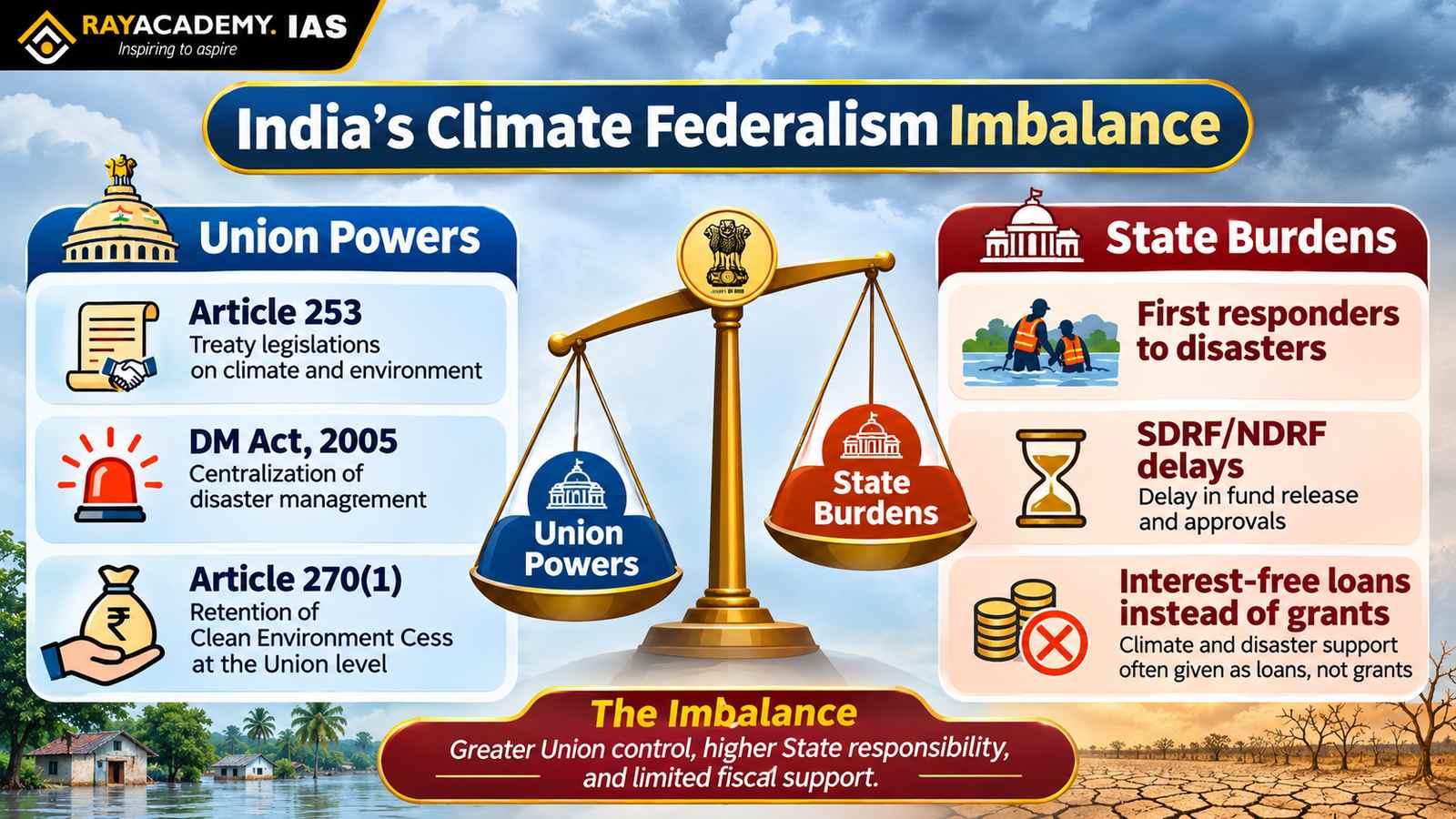
Treaty-Making Power Overriding State Subjects (Article 253): Key environmental statutes—including the Air (Prevention and Control of Pollution) Act, 1981 and the Environment (Protection) Act, 1986—were enacted under Article 253 to implement India’s international commitments from the 1972 Stockholm Conference. Because Article 253 empowers Parliament to legislate on any subject (including State List entries) to implement international treaties, framing climate change as a global treaty obligation enables the Union to occupy the policy field while States remain largely excluded from national climate-policy formulation.
2. Fiscal Centralization and Cesses Under Article 270(1)
Exclusion of Cesses from the Divisible Pool: Under Article 270(1) of the Constitution, cesses and surcharges levied by the Union for specific purposes are excluded from the divisible pool of taxes shared with State governments under Finance Commission recommendations.
The Clean Environment Cess Paradox: The Clean Environment Cess (formerly Clean Energy Cess) on coal—raised to ₹400 per tonne in 2016 and later subsumed into the GST Compensation Cess—was collected exclusively by the Union. States experiencing recurring Himalayan cloudbursts, floods, and landslides have no constitutional claim over these fossil-fuel revenues to finance local climate adaptation.
3. Indian Environmental Jurisprudence and Fundamental Rights
Right Against Adverse Effects of Climate Change: In M.K. Ranjitsinh v. Union of India (2024), the Supreme Court of India recognized a distinct fundamental right to be free from the adverse effects of climate change under Articles 14 (Right to Equality) and 21 (Right to Life), holding that the absence of a single umbrella climate statute does not diminish citizens' constitutional protection.
Polluter Pays & Absolute Liability Principles: Earlier landmark rulings—M.C. Mehta v. Union of India (1987) establishing absolute liability for hazardous enterprises, and Vellore Citizens' Welfare Forum v. Union of India (1996) embedding the Polluter Pays Principle—alongside the National Green Tribunal (NGT) Act, 2010, empower tribunals to award environmental compensation. However, systemic climate attribution and fiscal burden-sharing between the Union and States remain unresolved.
Prelims Focus: High-Yield Objective Facts
UPSC Prelims Quick-Revision Box:
Constitutional Articles, Disaster Funds & Judicial MilestonesArticle 253 (Legislation for Giving Effect to International Agreements): Empowers Parliament to make any law for the whole or any part of India for implementing any treaty, agreement, or convention with any other country or decision made at any international conference.
Article 270(1) (Taxes Levied and Distributed Between Union and States): Excludes duties and taxes referred to in Articles 268, 269, and 269A, surcharges (Article 271), and any cess levied for specific purposes from the divisible pool shared with States.
Disaster Management Act, 2005: Enacted using Entry 23 (Concurrent List); establishes the National Disaster Management Authority (NDMA) chaired by the Prime Minister, State Disaster Management Authorities (SDMAs) chaired by Chief Ministers, and District Disaster Management Authorities (DDMAs).
NDRF & SDRF (Sections 46 & 48 of DM Act, 2005):State Disaster Response Fund (SDRF): Primary fund available with State governments for immediate relief; Centre contributes 75% for general States and 90% for North-Eastern and Himalayan States.National Disaster Response Fund (NDRF): Supplements SDRF in cases of a "disaster of severe nature" following an Inter-Ministerial Central Team (IMCT) assessment; funded via cess/budgetary support.
Sikkim High Court Initiative (2026): In Re: Climatic Justice in the State of Sikkim (WP(PIL) No. 11 of 2026) directed State departments and all six districts to conduct climate-risk assessments and install Early Warning Systems (EWS) for 40 high-risk glacial lakes following the October 2023 Teesta Valley GLOF and 2026 regional flash floods.
Mains Analytical Breakdown: Significance vs. Multi-Dimensional Challenges
Significance of Mainstreaming Climate Federalism
Aligning Authority with Frontline Accountability: State and local governments act as first responders during cloudbursts, Glacial Lake Outburst Floods (GLOFs), cyclones, and heatwaves. Decentralizing climate governance empowers States to design localized adaptation plans suited to distinct agro-climatic zones.
Advancing Climate Justice & Constitutional Rights: Operationalizing the Supreme Court’s M.K. Ranjitsinh (2024) mandate under Articles 14 and 21 requires enforceable fiscal and institutional mechanisms so vulnerable populations—especially in fragile Himalayan and coastal ecosystems—are not left defenseless.
Shifting from Reactive Relief to Anticipatory Resilience: As emphasized by the Sikkim High Court, embedding district-level climate-risk assessments and early warning systems lowers long-term reconstruction costs compared to post-disaster patchwork relief.
Multi-Dimensional Challenges
Severe Vertical Fiscal Imbalance in Disaster Relief (Economic): States face stark gaps between assessed climate damages and Union assistance. For instance, after the 2023 Himachal Pradesh floods (losses pegged at ₹9,042 crore), the Union released ₹633.73 crore in immediate NDRF aid and sanctioned ₹2,006.40 crore for recovery nearly two years later. Similarly, following the July 2024 Wayanad landslides (298 deaths), declaring a "disaster of severe nature" took nearly five months, and rehabilitation assistance came as a 50-year interest-free loan (₹529.50 crore) rather than an outright grant. After the August–September 2025 Punjab floods, against a State demand of ₹20,000 crore, only ₹1,600 crore was announced.
Centralized Policy Design vs. Localized Impacts (Political & Governance): States have minimal participation in shaping national energy, industrial, and carbon-mitigation policies, yet bear the localized socio-economic fallout of extreme weather triggered by global and national emissions.
Pre-Emption and Liability Attribution Hurdles (Legal): Globally (as seen in Suncor v. Boulder in the U.S.) and domestically, attributing localized disaster losses to specific fossil-fuel polluters faces complex legal barriers of jurisdictional pre-emption and scientific causation, leaving real polluters largely unpenalized.
Ecological Fragility of Himalayan and Coastal States (Environmental): Himalayan States like Sikkim (hit by the October 2023 Teesta Valley GLOF) and Uttarakhand suffer disproportionately from infrastructure damage and ecosystem loss despite contributing negligibly to national greenhouse gas emissions.
Intergenerational and Regional Inequity (Ethical): Providing disaster rehabilitation as repayable loans rather than unconditional grants burdens future generations in disaster-hit States with public debt for climate crises they did not cause.
Way Forward: Reform-Oriented Policy Roadmap
Incorporate Climate Vulnerability in Finance Commission Devolution (16th Finance Commission Framework): Future Finance Commissions (under Article 280) should include a dedicated climate-vulnerability and ecological-fragility criterion in horizontal tax devolution formulas, compensating Himalayan and coastal States for maintaining carbon sinks and bearing disproportionate climate risks.
Reform NDRF/SDRF Guidelines for Time-Bound Grants Over Loans: Amend NDRF/SDRF norms to establish binding statutory timelines (e.g., 30 days) for declaring a "disaster of severe nature" and ensure post-disaster rehabilitation funds are disbursed as non-repayable grants rather than conditional loans.
Share Fossil-Fuel Cesses and Green Revenues with States: Restructure Article 270(1) fiscal transfers or create a dedicated, jointly governed National Climate Adaptation & Resilience Fund where revenues from coal and fossil-fuel levies are transparently shared with climate-vulnerable States.
Institutionalize Participatory, Anticipatory Climate Governance (Sikkim HC & 2nd ARC Model): Replicate the Sikkim High Court’s directive across all States by mandating district-level Climate Risk Assessments, expanding automated GLOF and flood Early Warning Systems, and empowering Panchayati Raj Institutions (PRIs) and Urban Local Bodies (ULBs) under the 73rd and 74th Amendments.
Strengthen Environmental Liability & Corporate Climate Accountability: Operationalize the Polluter Pays Principle through specialized National Green Tribunal (NGT) climate benches and mandatory corporate climate-risk disclosures (SEBI’s BRSR framework) to channel private capital into ecological restoration.
Value Addition for Mains
Empirical Disaster Financing Data (2023–2025): Highlighting concrete fiscal disparities strengthens Mains answers—such as the 2023 Himachal Pradesh floods (₹2,006.40 crore recovery plan sanctioned nearly two years post-disaster against ₹9,042 crore losses), the 2024 Wayanad landslides (₹529.50 crore provided as a 50-year interest-free loan after a 5-month delay), and the 2025 Punjab floods (₹1,600 crore announced against a ₹20,000 crore immediate demand).
Constitutional & Judicial Anchor: Pairing Article 21 (M.K. Ranjitsinh v. Union of India, 2024) with Cooperative Federalism underscores that "climate justice in India requires sharing both regulatory authority and fiscal burdens between the Union and the States before the next mega-disaster strikes".
Practice Questions for Active Recall
Prelims Practice MCQ
With reference to constitutional provisions and statutory frameworks governing environment and disaster management in India, consider the following statements:
The subject of "Disaster Management" is explicitly enumerated in the Concurrent List of the Seventh Schedule of the Constitution of India.
Article 253 empowers Parliament to enact laws on subjects in the State List for the purpose of implementing international treaties and agreements.
Under Article 270(1) of the Constitution, proceeds from any cess levied by the Union for specific purposes are excluded from the divisible pool of taxes shared with the States.
Which of the statements given above are correct?
(a) 1 and 2 only
(b) 2 and 3 only
(c) 1 and 3 only
(d) 1, 2, and 3
Correct Answer: (b) 2 and 3 only
Explanation:
Statement 1 is incorrect: The word "disaster" does not appear anywhere in the three Lists of the Seventh Schedule. Parliament enacted the Disaster Management Act, 2005 by drawing upon Entry 23 of the Concurrent List ("Social security and social insurance"), alongside residuary powers.
Statement 2 is correct: Article 253 grants Parliament overriding legislative competence to make laws for the whole or any part of India—even on State List matters—to implement international treaties, agreements, or conventions (such as the Air Act, 1981 and Environment Protection Act, 1986).
Statement 3 is correct: Under Article 270(1), surcharges and cesses levied for specific purposes (such as the Clean Environment Cess on coal) do not form part of the divisible pool of taxes distributed among States.
Mains Practice Question (GS Paper II — 150 Words | 10 Marks)
"While State governments act as first responders to climate-induced disasters, India’s constitutional and fiscal architecture concentrates climate policy authority and green revenues with the Union." Examine this federal asymmetry and suggest institutional and fiscal reforms to achieve climate justice.
Answer Structure Hints:
Introduction: Contextualize the emerging debate on climate federalism—citing recent judicial interventions like the Sikkim High Court’s suo motu PIL (In Re: Climatic Justice in the State of Sikkim, 2026) and the Supreme Court’s recognition of climate rights under Articles 14 and 21 (M.K. Ranjitsinh, 2024).
Body Part 1 (Constitutional & Fiscal Asymmetry): Explain how Article 253 enables Union dominance over environmental laws, how the DM Act, 2005 centralizes disaster governance, how Article 270(1) keeps cesses (like the Clean Environment Cess) outside the divisible pool, and cite delays/loan-based relief in Himachal Pradesh (2023), Wayanad (2024), and Punjab (2025).
Body Part 2 (Institutional & Fiscal Reforms): Recommend adding a climate-vulnerability criterion in Finance Commission devolution, reforming NDRF/SDRF to mandate time-bound grants over loans, sharing fossil-fuel levies with States, and adopting anticipatory, district-level climate governance.
Conclusion: Conclude with Cooperative Federalism, noting that durable climate resilience requires aligning fiscal resources with frontline State responsibilities.
Take this article with you
Save a reading copy for offline study.


