

Union Cabinet
On November 25, 2026, the Union Cabinet, chaired by Prime Minister Narendra Modi, approved the ₹11,000 crore Scheme for Enhancement of Construction and Infrastructure Equipment (CIE) Manufacturing Ecosystem. Announced earlier in the Union Budget 2026–27 on February 1, 2026, the eight-year scheme (FY 2026–27 to FY 2033–34) will be implemented by the Ministry of Heavy Industries (MHI) to boost domestic production of technologically advanced machinery and components while reducing India's heavy import reliance.
UPSC Syllabus Mapping:
General Studies Paper III (Indian Economy & Infrastructure): Indian Economy and issues relating to planning, mobilization of resources, growth, development and employment; Effects of liberalization on the economy, changes in industrial policy and their effects on industrial growth; Infrastructure: Energy, Ports, Roads, Airports, Railways etc.
General Studies Paper III (Science & Technology): Indigenization of technology and developing new technology (Heavy Engineering, Tunnel Boring Machines, and Capital Goods).
The approval comes amid heightened supply-chain vulnerabilities following export restrictions imposed by China on critical heavy machinery—such as Tunnel Boring Machines (TBMs), ship-to-shore port cranes, hydraulic excavators, and off-highway trucks—essential for India’s metro rail, highway, port, and tunnel infrastructure projects.
Static-Current Linkage: Capital Goods Policy, Production-Linked Incentives, and Geoeconomic Self-Reliance
Understanding the strategic significance of the CIE Manufacturing Ecosystem Scheme requires linking India’s National Capital Goods Policy and Atmanirbhar Bharat industrial framework with the macroeconomic role of capital goods.
Macroeconomic Role of the Capital Goods Sector
Multiplier Effect on Industrial Growth: Capital goods—machinery, machine tools, and heavy engineering equipment used to produce other goods and build physical infrastructure—serve as the mother industry of manufacturing. High import dependence in capital goods drains foreign exchange, inflates project execution costs, and exposes domestic infrastructure timelines to external supply disruptions.
National Capital Goods Policy, 2016: Formulated by the Ministry of Heavy Industries, the policy aimed to increase the share of domestic capital goods production, reduce import intensity, and establish Common Engineering Facility Centres (CEFCs) and world-class testing infrastructure across industrial clusters.
Evolution of Incentive-Based Industrial Policy. CIE Scheme
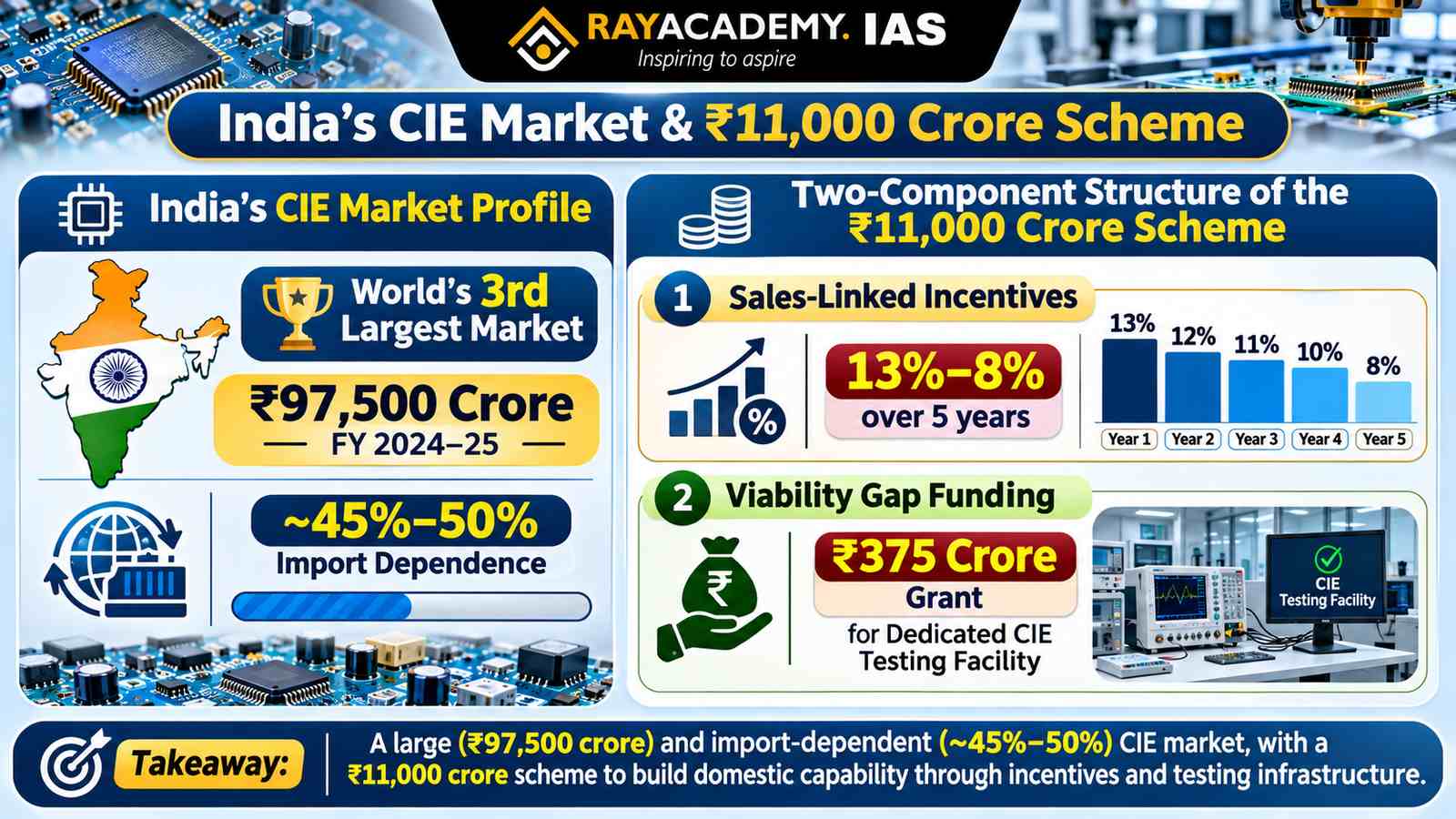
From PLI to Graded Sales-Linked Incentives: Unlike traditional Production Linked Incentive (PLI) schemes that exclusively target final Original Equipment Manufacturers (OEMs), the CIE scheme extends graded sales-linked incentives (13% down to 8% of incremental sales value over a five-year disbursement period from FY 2028–29 to FY 2032–33) to both approved OEMs and component manufacturers.
Infrastructure-Led Growth Convergence: India’s public capital expenditure push under PM Gati Shakti, Bharatmala, Sagarmala, and urban metro expansions has generated massive domestic demand (~₹1 lakh crore annually) for specialised earthmoving, tunnelling, and port-handling equipment.
Prelims Focus: High-Yield Objective Facts
Official Scheme Name: Scheme for Enhancement of Construction and Infrastructure Equipment (CIE) Manufacturing Ecosystem.
Nodal Ministry: Ministry of Heavy Industries (MHI), Government of India.
Total Outlay & Tenure: ₹11,000 crore over eight years (FY 2026–27 to FY 2033–34)—comprising two gestation years (FY 2026–27 to FY 2027–28) for setting up manufacturing facilities, five years (FY 2028–29 to FY 2032–33) for incentive disbursement, and one final settlement year (FY 2033–34).
Two Core Components:
Sales-Linked Incentive: Graded incentives ranging from 13% to 8% on Incremental Sales Value for eligible OEMs and component manufacturers.
Grant for CIE Testing Facility: A grant of up to ₹375 crore in the nature of Viability Gap Funding (VGF) to establish a dedicated, state-of-the-art CIE testing and certification facility in India.
7 Targeted Equipment Categories: Tunnel Boring Machines (TBMs), ship-to-shore cranes, hydraulic excavators, off-highway trucks, motor graders, piling rigs, and drilling machines/loaders (categories currently imported wholly or largely).
Global Market Ranking: India is the world’s third-largest market for construction and infrastructure equipment, trailing only China and the United States, with a market size of approximately ₹97,500 crore in FY 2024–25.
Mains Analytical Breakdown
Strategic and Economic Significance
De-Risking Critical Infrastructure Supply Chains: Indigenising Tunnel Boring Machines (TBMs) and ship-to-shore port cranes shields flagship projects—such as urban metro tunnels, Himalayan railway/highway tunnels, and major port expansions (e.g., Kamarajar Port)—from geopolitical export curbs and arbitrary delays.
Deepening the Domestic Component & MSME Ecosystem: Extending incentives directly to tier-1 and tier-2 component manufacturers (hydraulics, precision gears, transmissions, undercarriage assemblies, and electronic control units) prevents mere "screwdriver assembly" and builds genuine value-addition depth across MSME clusters.
Bridging the Testing and Homologation Deficit: Allocating ₹375 crore in Viability Gap Funding (VGF) for a dedicated CIE testing facility addresses a chronic bottleneck where domestic manufacturers previously relied on expensive overseas laboratories for safety, emission, and durability certification.
Export Competitiveness Under "Make in India for the World": Building economies of scale at home positions Indian engineering firms to supply cost-competitive, tropicalised construction machinery to emerging infrastructure markets across Africa, West Asia, and Southeast Asia.
Multi-Dimensional Challenges
Technological — High R&D Intensity and Intellectual Property Barriers: Advanced equipment such as large-diameter hard-rock TBMs and automated container cranes involve proprietary metallurgy, high-torque hydraulic systems, and precision sensors dominated by European, Japanese, and Chinese OEMs; bridging this technology gap requires sustained R&D and joint ventures.
Economic — Long Gestation Cycles and Capital Intensity: Heavy engineering plants require substantial upfront capital expenditure and skilled technical manpower, meaning domestic manufacturers could face aggressive price dumping from established foreign competitors during the two-year gestation window (FY 2026–28).
Infrastructure & Quality — Raw Material and Alloy Steel Bottlenecks: High-grade speciality alloy steels, heavy forgings, and precision bearings required for earthmoving machinery still face domestic supply constraints, risking continued upstream import dependence.
Environmental — Transition to Green and Low-Emission Machinery: Global construction equipment standards are rapidly shifting toward electric, hybrid, and hydrogen-powered machinery alongside stricter CEV Stage-V emission norms; new domestic capacities must avoid locking into obsolete diesel-only architectures.
Way Forward: Policy and Institutional Roadmap
Mandate Public Procurement Preference and Lifecycle Tendering: Converge the CIE scheme with Public Procurement (Preference to Make in India) Orders across NHAI, Indian Railways, Metro Rail Corporations, and Major Port Authorities, shifting tender evaluation from lowest upfront cost (L1) to Total Cost of Ownership (TCO) and local content weightage.
Facilitate Global Joint Ventures and Structured Technology Transfer: Leverage Foreign Direct Investment (FDI) and Make-II / R&D co-development frameworks with global leaders from Japan, Germany, and South Korea to localize core sub-assemblies (such as TBM cutterheads and variable-displacement hydraulic pumps).
Integrate Green Propulsion and Smart Telemetry Standards: Earmark a dedicated sub-window within the scheme for battery-electric off-highway trucks, hybrid excavators, and IoT-enabled predictive maintenance systems, aligning industrial growth with India’s Net-Zero 2070 commitments.
Operationalise Industry-Academia Skilling Centres: Partner with IITs, NITs, and the Infrastructure Equipment Skill Council (IESC) under Skill India to train specialised mechatronics engineers, precision welders, and heavy-equipment operators.
Fast-Track the VGF Testing Facility Under Hub-and-Spoke Model: Establish the ₹375 crore CIE Testing Facility near major heavy-engineering hubs (such as Pune, Chennai, or Bengaluru) with mutual recognition agreements (MRAs) with international certification bodies to accelerate global exports.
Value Addition Snippet (Official Cabinet & Market Data)
Market Size & Import Dependence (Cabinet Briefing, Nov 2026): India is the world’s 3rd largest CIE market (after China and the U.S.) with a valuation of ₹97,500 crore in FY 2024–25 and annual domestic project demand approaching ₹1 lakh crore, yet 45% to over 50% of this equipment is currently imported.
Fiscal Leverage Ratio: A targeted government outlay of ₹11,000 crore (including ₹375 crore VGF for testing infrastructure) is structured to catalyse private capital expenditure across 7 high-import equipment categories over an 8-year horizon (FY 2026–34).
Administrative Catchphrase for GS-3: "Securing infrastructure timelines under PM Gati Shakti requires indigenising not just concrete and steel, but the heavy machines that build them."
Active Recall Practice Exercises
Prelims Practice Question (Multi-Statement MCQ)
Q. With reference to the "Scheme for Enhancement of Construction and Infrastructure Equipment (CIE) Manufacturing Ecosystem" approved by the Union Cabinet in November 2026, consider the following statements:
The scheme will be implemented by the Ministry of Road Transport and Highways over a five-year period starting from FY 2026–27.
Under the scheme, sales-linked incentives on incremental sales value are extended to both eligible Original Equipment Manufacturers (OEMs) and component manufacturers.
The scheme includes a Viability Gap Funding (VGF) grant for establishing a dedicated construction and infrastructure equipment testing facility in India.
How many of the statements given above are correct?
(a) Only one
(b) Only two
(c) All three
(d) None
Correct Answer: (b) Only two
Explanation:
Statement 1 is incorrect: The scheme will be implemented by the Ministry of Heavy Industries (MHI)—not the Ministry of Road Transport and Highways—and has a total duration of eight years (FY 2026–27 to FY 2033–34), including a five-year incentive disbursement window from FY 2028–29 to FY 2032–33.
Statement 2 is correct: To build end-to-end domestic supply chains, graded sales-linked incentives (ranging from 13% to 8% of incremental sales value) cover both approved OEMs and component manufacturers across seven targeted equipment categories.
Statement 3 is correct: The second component of the scheme provides a grant of up to ₹375 crore in the nature of Viability Gap Funding (VGF) to set up a dedicated, state-of-the-art CIE testing facility in India.
Mains Practice Question (GS Paper III — 150 Words | 10 Marks)
Q. "Reducing import dependence in heavy capital goods is critical to insulating India’s infrastructure expansion from external supply-chain shocks." Examine the significance of the ₹11,000 crore Construction and Infrastructure Equipment (CIE) Manufacturing Scheme and discuss the structural bottlenecks that must be addressed for its success. (150 words)
Model Answer Structure:
Introduction (25 words): Contextualize the Union Cabinet’s November 2026 approval of the ₹11,000 crore CIE Manufacturing Ecosystem Scheme (implemented by the Ministry of Heavy Industries) amid ~45%–50% import dependence in India’s ₹97,500 crore CIE market.
Body Part 1 – Significance (60 words): Highlight supply-chain de-risking for critical machinery like Tunnel Boring Machines (TBMs) and port cranes against foreign export curbs; value-chain deepening by incentivising both OEMs and component manufacturers (13%–8% sales-linked support); and bridging certification deficits via the ₹375 crore VGF testing facility.
Body Part 2 – Structural Bottlenecks & Way Forward (50 words): Identify hurdles including proprietary R&D gaps, speciality alloy steel imports, and capital intensity. Suggest converging public procurement norms (PM Gati Shakti / metro / port tenders), promoting global joint ventures, and incentivising electric/low-emission machinery.
Conclusion (15 words): Conclude that indigenising heavy engineering anchors Atmanirbhar Bharat and sustainable infrastructure growth.
Take this article with you
Save a reading copy for offline study.


