

National Family Health Survey-6
On November 23, 2026, the Indian Council of Medical Research–National Institute of Nutrition (ICMR-NIN) released national anaemia prevalence findings from the SAMPADA (Survey for Assessment of Markers of Population Health, Activity, Diet and Anthropometry) 2023–2025 survey. Because the National Family Health Survey-6 (NFHS-6) fact sheets released earlier in 2026 excluded anaemia estimates to transition toward clinical blood testing, SAMPADA provides India’s new gold-standard epidemiological benchmark across 183 districts in 35 States and Union Territories.
UPSC Syllabus Mapping:
General Studies Paper II (Social Justice & Governance): Issues relating to development and management of Social Sector/Services relating to Health, Education, Human Resources; Welfare schemes for vulnerable sections of the population by the State and the performance of these schemes; Issues relating to poverty and hunger.
General Studies Paper III (Science & Technology): Science and Technology—developments and their applications and effects in everyday life; Public health diagnostics, nutritional biochemistry, and epidemiological surveillance.
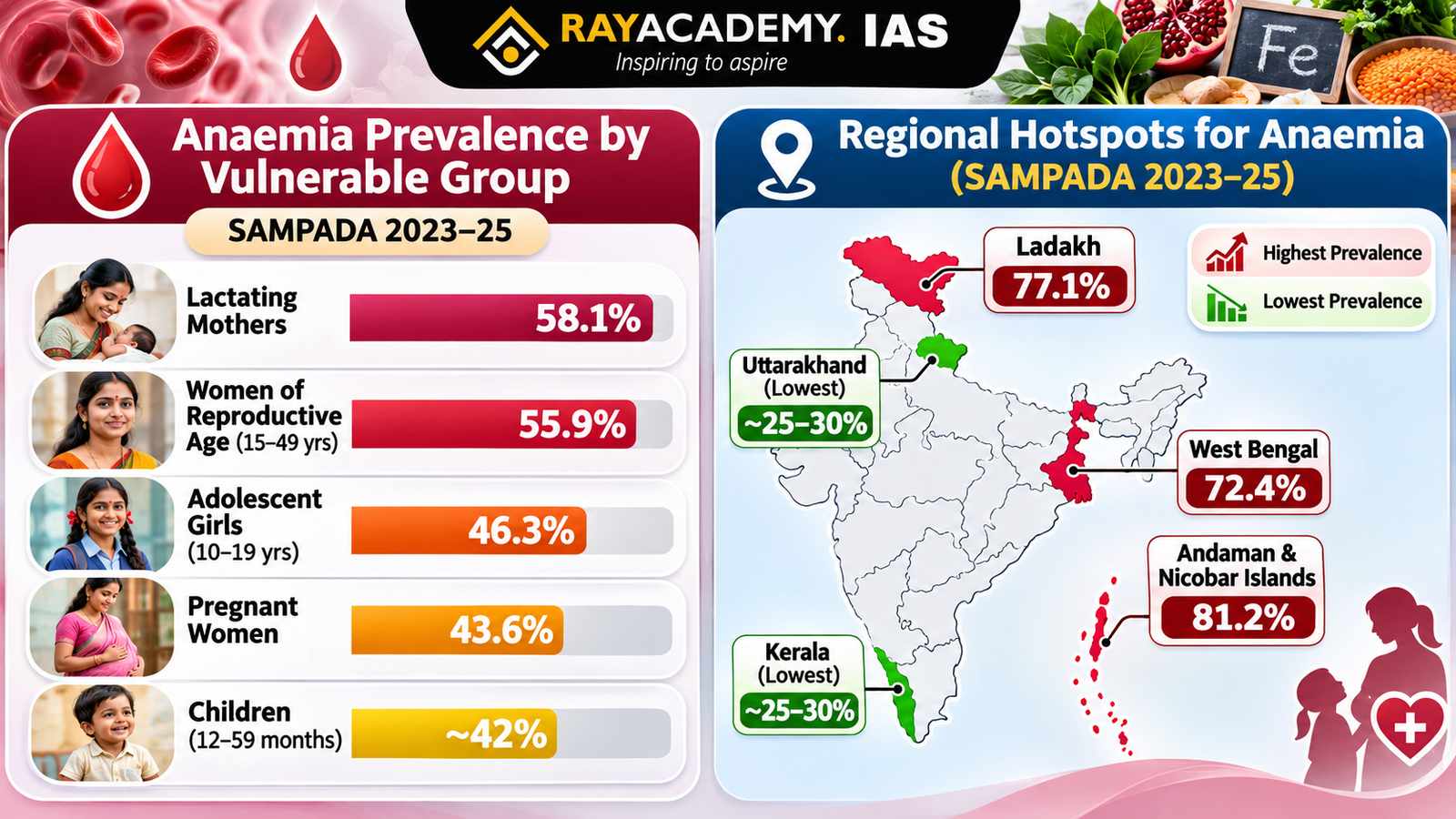
While overall anaemia prevalence declined across demographic cohorts compared to previous surveys—with severe anaemia sitting below 2%—the findings reveal a persistent public health challenge: 55.9% of non-pregnant, non-lactating women aged 15–49 years, 58.1% of lactating mothers, 46.3% of adolescent girls (10–19 years), and 43.6% of pregnant women remain anaemic. Crucially, iron deficiency drives only about half of anaemia cases, highlighting complex multi-nutrient deficits, infections, and genetic blood disorders.
Static-Current Linkage: Haematological Science, Diagnostic Evolution, and Constitutional Welfare Mandate
Understanding the policy implications of the ICMR-NIN SAMPADA survey requires linking physiological mechanisms of haemoglobin synthesis and diagnostic accuracy with India’s constitutional public health framework.
Physiological & Biochemical Basis of Anaemia
Clinical Definition: Anaemia is a physiological condition in which the number of healthy red blood cells (erythrocytes) or the concentration of haemoglobin—an iron-containing metalloprotein—falls below age- and sex-specific World Health Organization (WHO) thresholds, impairing oxygen transport to vital tissues and organs.
Multi-Factorial Etiology: While iron deficiency remains the leading single cause (accounting for roughly 50% of cases), SAMPADA’s biochemical sub-sample analysis confirms major contributions from Vitamin B12 and folate (Vitamin B9) deficiencies, chronic inflammation and parasitic infections (measured via C-reactive protein [CRP] and alpha-1-acid glycoprotein [AGP]), chronic kidney disease, and inherited haemoglobinopathies such as thalassaemia and sickle cell disease.
Dietary Phytate Inhibition: Cereal-heavy Indian diets rich in phytates (found in unfermented whole wheat and millets) and polyphenols (in tea and coffee) chelate non-heme iron in the gut, reducing intestinal absorption unless paired with ascorbic acid (Vitamin C).
Methodological Shift: Capillary Finger-Prick vs. Venous Blood Sampling
Why NFHS-6 Dropped Anaemia: Earlier NFHS rounds (NFHS-2 through NFHS-5) relied on capillary blood drops collected via finger-pricks and analysed on portable field photometers (HemoCue), which were susceptible to tissue-fluid dilution and environmental variations that often overestimated anaemia.
SAMPADA’s Gold-Standard Protocol: SAMPADA analysed over 1.7 lakh venous blood samples using automated haematology analysers, providing superior clinical accuracy and reproducibility while establishing a rigorous baseline for future longitudinal tracking.
Constitutional & Policy Framework
Article 47 (Directive Principles of State Policy): Directs the State to regard the raising of the level of nutrition and the standard of living of its people and the improvement of public health as among its primary duties.
Article 21 (Right to Life with Dignity): Interpreted by the Supreme Court (notably in PUCL v. Union of India) to encompass the Right to Food and Nutritional Security.
Prelims Focus: High-Yield Objective Facts
Implementing Agency & Nodal Ministry: Conducted by ICMR–National Institute of Nutrition (NIN) (headquartered in Hyderabad) under the Department of Health Research (DHR), Ministry of Health and Family Welfare (MoHFW).
SAMPADA Survey Scope (2023–2025):
Full Form: Survey for Assessment of Markers of Population Health, Activity, Diet and Anthropometry.
Sample Size: Covered over 2 lakh individuals across 81,000+ households in 183 districts spanning 35 States and Union Territories, analysing 1.7 lakh+ venous blood samples.
Biomarkers Assessed: Haemoglobin, serum ferritin (iron status), folate, Vitamin B12, and inflammatory markers CRP and AGP.
Flagship Government Programmes:
Anaemia Mukt Bharat (AMB), 2018: Operates on a 6×6×6 strategy—targeting 6 beneficiary groups (children 6–59 months, children 5–9 years, adolescents 10–19 years, women of reproductive age 15–49 years, pregnant women, and lactating mothers) through 6 institutional mechanisms and 6 key interventions (prophylactic Iron and Folic Acid [IFA] supplementation, deworming via National Deworming Day, intensified behaviour change communication, Point-of-Care [PoC] digital testing, mandatory iron-fortified foods, and addressing non-nutritional causes like malaria, haemoglobinopathies, and fluorosis).
Saksham Anganwadi and Poshan 2.0: Umbrella nutrition mission integrating supplementary nutrition, POSHAN Tracker ICT monitoring, and millet/dietary diversification.
National Sickle Cell Anaemia Elimination Mission (2023): Aims to eliminate sickle cell disease as a public health problem in India by 2047 through universal screening of 7 crore people aged 0–40 years in tribal-dominated districts.
Mains Analytical Breakdown
Significance of the SAMPADA Findings
Precision Public Health Diagnostics: Transitioning to automated venous blood analysis eliminates field-measurement distortions, enabling policymakers to distinguish mild physiological variations (<2% severe cases) from clinically urgent moderate-to-severe anaemia.
Paradigm Shift Beyond Iron-Only Supplementation: Demonstrating that nearly half of anaemia is non-iron-deficient (linked to Vitamin B12 deficiency, affecting nearly two-thirds of adolescents, alongside folate deficits and inflammation) enables targeted multi-micronutrient interventions rather than uniform IFA distribution.
Granular Sub-National Targeting: Identifying acute geographical outliers—such as Andaman & Nicobar Islands (81.2%), Ladakh (77.1%), and West Bengal (72.4%)—allows resources to be concentrated in high-burden agro-climatic and coastal/high-altitude zones.
Multi-Dimensional Challenges
Social & Gender — Intergenerational Cycle of Malnutrition: With over 55% of women of reproductive age and 46.3% of adolescent girls affected, maternal anaemia perpetuates an intergenerational cycle of Low Birth Weight (LBW), preterm delivery, maternal mortality, and impaired cognitive development in infants.
Nutritional & Cultural — Double Burden of Malnutrition and Ultra-Processed Diets: Across both low-income and affluent urban households, shifting consumption toward ultra-processed foods (UPFs) high in fat, sugar, and salt—coupled with predominantly vegetarian diets low in bioavailable Vitamin B12 and heme iron—creates a double burden of malnutrition (coexisting obesity and micronutrient "hidden hunger").
Administrative & Implementation — Supply-Compliance Gap in IFA Tablets: While Iron and Folic Acid (IFA) tablet distribution has expanded, actual adherence remains constrained by gastrointestinal side effects (nausea, gastritis), cultural myths during pregnancy, and helminthic (worm) infections that cause occult blood loss.
Methodological — Comparability Constraints Across Surveys: Because SAMPADA employed venous blood sampling whereas NFHS-5 used capillary finger-pricks, epidemiologists caution against interpreting lower headline percentages as a direct secular decline without adjusting for measurement differences.
Economic — Human Capital and Productivity Loss: Chronic fatigue and reduced aerobic work capacity among half of India’s female workforce directly depress labour productivity, educational attainment, and demographic dividend realisation.
Way Forward: Policy and Institutional Roadmap
Transition to Etiology-Specific Screening and Multi-Micronutrient Formulations: In line with NITI Aayog’s National Nutrition Strategy and SAMPADA’s biochemical findings, supplement standard IFA regimens with Vitamin B12 and folate fortification/supplementation for adolescents and pregnant women, backed by point-of-care haemoglobinopathy (sickle cell/thalassaemia) screening.
Promote Dietary Diversification and Bioavailability Enhancement: Leverage Poshan 2.0, PM POSHAN (Mid-Day Meal), and Public Distribution System (PDS) convergence to promote Poshan Vatikas (nutri-gardens), biofortified millets (Shree Anna), pulses, dark green leafy vegetables, and Vitamin C-rich fruits to enhance non-heme iron absorption while curbing UPF marketing.
Strengthen Decentralised Diagnostic Infrastructure: Equip Ayushman Arogya Mandirs (Health and Wellness Centres) with hub-and-spoke automated haematology analysers and digital Test-Treat-Talk (T3) camps to ensure timely clinical follow-up for moderate and severe anaemia cases.
Integrate WASH and Deworming Convergence: Align Anaemia Mukt Bharat with Swachh Bharat Mission and Jal Jeevan Mission to eliminate soil-transmitted helminths, malaria, and waterborne enteropathies that impair gut nutrient absorption.
Context-Specific State Action Plans for High-Burden Regions: Deploy tailored nutritional and clinical task forces in high-prevalence regions such as Andaman & Nicobar Islands, Ladakh, and West Bengal to address region-specific dietary gaps, altitude-adjusted haemoglobin cut-offs, and genetic disorders.
Value Addition Snippet (Official SAMPADA & Public Health Benchmarks)
SAMPADA 2023–25 Key Prevalence Figures (ICMR-NIN):
Lactating Mothers: 58.1% anaemic.
Women of Reproductive Age (15–49 yrs, non-pregnant/non-lactating): 55.9% anaemic.
Adolescent Girls (10–19 yrs): 46.3% anaemic (with nearly two-thirds of adolescents showing Vitamin B12 deficiency).
Pregnant Women: 43.6% anaemic.
Children (12–59 months): ~42% anaemic, while severe anaemia remains below 2% across most age cohorts.
Economic Cost Benchmark (World Bank / Economic Survey estimates): Iron-deficiency anaemia reduces physical work capacity by up to 15%–20% and costs developing economies roughly 1%–1.3% of GDP annually in lost human capital productivity.
Administrative Catchphrase for GS-2: "Eliminating anaemia requires moving from a 'one-size-fits-all' iron pill strategy to precision nutrition that addresses multi-micronutrient deficits, infections, and dietary diversity."
Active Recall Practice Exercises
Prelims Practice Question (Multi-Statement MCQ)
Q. With reference to the "SAMPADA Survey (2023–2025)" and India’s anaemia control framework, consider the following statements:
The SAMPADA survey was conducted by the ICMR–National Institute of Nutrition using venous blood sampling and automated analysers rather than capillary finger-prick tests.
According to the SAMPADA findings, iron deficiency is the sole cause of over 90% of anaemia cases among Indian women and adolescents.
Under the Anaemia Mukt Bharat strategy, prophylactic Iron and Folic Acid supplementation is complemented by biannual deworming and mandatory provision of iron-fortified foods in government-funded public health programmes.
How many of the statements given above are correct?
(a) Only one
(b) Only two
(c) All three
(d) None
Correct Answer: (b) Only two
Explanation:
Statement 1 is correct: Conducted by ICMR-NIN under the Department of Health Research, SAMPADA (2023–2025) used venous blood sampling and automated haematology analysers across 183 districts to provide clinical-grade haemoglobin and micronutrient estimates.
Statement 2 is incorrect: SAMPADA revealed that iron deficiency drives only about half (50%) of anaemia cases in vulnerable groups; the remaining burden is linked to Vitamin B12 and folate deficiencies, chronic infections/inflammation, and genetic blood disorders like thalassaemia and sickle cell disease.
Statement 3 is correct: Anaemia Mukt Bharat (AMB) follows a 6×6×6 strategy combining prophylactic IFA supplementation, deworming, behaviour change communication, digital testing/treatment, iron-fortified foods in public schemes, and management of non-nutritional causes.
Mains Practice Question (GS Paper II — 150 Words | 10 Marks)
Q. "India’s anaemia burden is not merely a problem of calorie or iron deficit, but a complex interplay of multi-nutrient deficiencies, dietary patterns, and regional disparities." Discuss in light of the ICMR-NIN SAMPADA survey findings and suggest a multi-sectoral strategy to strengthen Anaemia Mukt Bharat. (150 words)
Model Answer Structure:
Introduction (25 words): Cite the November 2026 ICMR-NIN SAMPADA survey (using gold-standard venous sampling), noting that despite lower overall incidence, 55.9% of reproductive-age women and 58.1% of lactating mothers remain anaemic.
Body Part 1 – Multi-Factorial Drivers (60 words): Explain that iron deficiency accounts for only ~50% of cases, alongside widespread Vitamin B12/folate deficits, parasitic infections, and haemoglobinopathies. Highlight the double burden of malnutrition from ultra-processed foods, phytate-rich diets inhibiting iron absorption, and stark regional disparities (e.g., Andaman & Nicobar at 81.2%, Ladakh at 77.1%).
Body Part 2 – Multi-Sectoral Strategy (50 words): Move beyond a one-size-fits-all iron approach toward multi-micronutrient supplementation (IFA + B12), dietary diversification under Poshan 2.0, automated diagnostics at Ayushman Arogya Mandirs, WASH/deworming convergence, and region-specific action plans.
Conclusion (15 words): Conclude that precision nutrition and health-system convergence are vital to realising Article 47 and India’s demographic dividend.
Take this article with you
Save a reading copy for offline study.


