

Union Ministry of Environment
A group of 69 former civil servants, operating under the Constitutional Conduct Group (CCG), has written an open letter to the Union Ministry of Environment, Forest and Climate Change (MoEFCC), Arunachal Pradesh Chief Minister Pema Khandu, and the Standing Committee of the National Board for Wildlife (SC-NBWL) seeking the immediate scrapping of the proposed 1,750-MW Demwe Lower Hydroelectric Project on the Lohit River in Arunachal Pradesh.
UPSC Syllabus Mapping:
General Studies Paper III (Environment & Ecology): Conservation, environmental pollution and degradation, environmental impact assessment (EIA); Disaster and disaster management.
General Studies Paper III (Infrastructure & Economy): Infrastructure: Energy, Ports, Roads, Airports, Railways etc.; Inclusive growth and issues arising from it.
General Studies Paper II (Governance & International Relations): Statutory, regulatory and various quasi-judicial bodies (NBWL & NGT); India and its neighbourhood—relations (Transboundary Brahmaputra river governance).
The letter warns that reviving the project—recently acquired by a new private developer in 2026 after remaining stalled since 2018—poses grave risks to tropical evergreen rainforests, endangered wildlife corridors near the Kamlang Tiger Reserve, and indigenous Mishmi tribal communities.
The former bureaucrats also questioned the July 2026 review by the SC-NBWL, alleging that the panel cleared a change in project ownership without conducting a fresh, comprehensive scientific wildlife assessment.
Static-Current Linkage: Environmental Laws, NBWL Mandate, and Transboundary River Principles
Understanding the controversy surrounding the Demwe Lower Hydroelectric Project requires examining India’s statutory environmental governance architecture alongside Himalayan river basin geography.
1. Statutory Role of the National Board for Wildlife (NBWL)
Constitutional & Legal Basis: Enacted under Section 5A of the Wild Life (Protection) Act, 1972 (inserted via the 2002 Amendment), the NBWL is the apex statutory body responsible for reviewing all wildlife-related matters and approving projects inside or around National Parks, Wildlife Sanctuaries, and Tiger Reserves.
Composition & Standing Committee: The NBWL is chaired by the Prime Minister, with the Union Minister of Environment, Forest and Climate Change serving as Vice-Chairperson. Routine project appraisals are delegated to the Standing Committee of the NBWL (SC-NBWL), which includes both official members and independent conservation experts.
Eco-Sensitive Zones (ESZ): Under the Environment (Protection) Act, 1986 and Supreme Court directives (Goa Foundation cases), projects located within 10 km of a Protected Area (or within its notified Eco-Sensitive Zone) require mandatory prior clearance from the SC-NBWL.
2. Forest Conservation & Scheduled Tribes Rights Frameworks
Van (Sanrakshan Evam Samvardhan) Adhiniyam, 1980 (Forest Conservation Act): Mandates prior approval of the Central Government before any State authority can divert forest land for non-forest purposes such as dams and reservoirs.
Scheduled Tribes and Other Traditional Forest Dwellers (Recognition of Forest Rights) Act, 2006 (FRA): Requires recognition of individual and community forest rights and prior informed consent of the Gram Sabha before diverting forest land—a critical governance gap in Arunachal Pradesh, where formal implementation of the FRA has remained contested.
3. Geography of the Lohit River and Prior Appropriation Doctrine
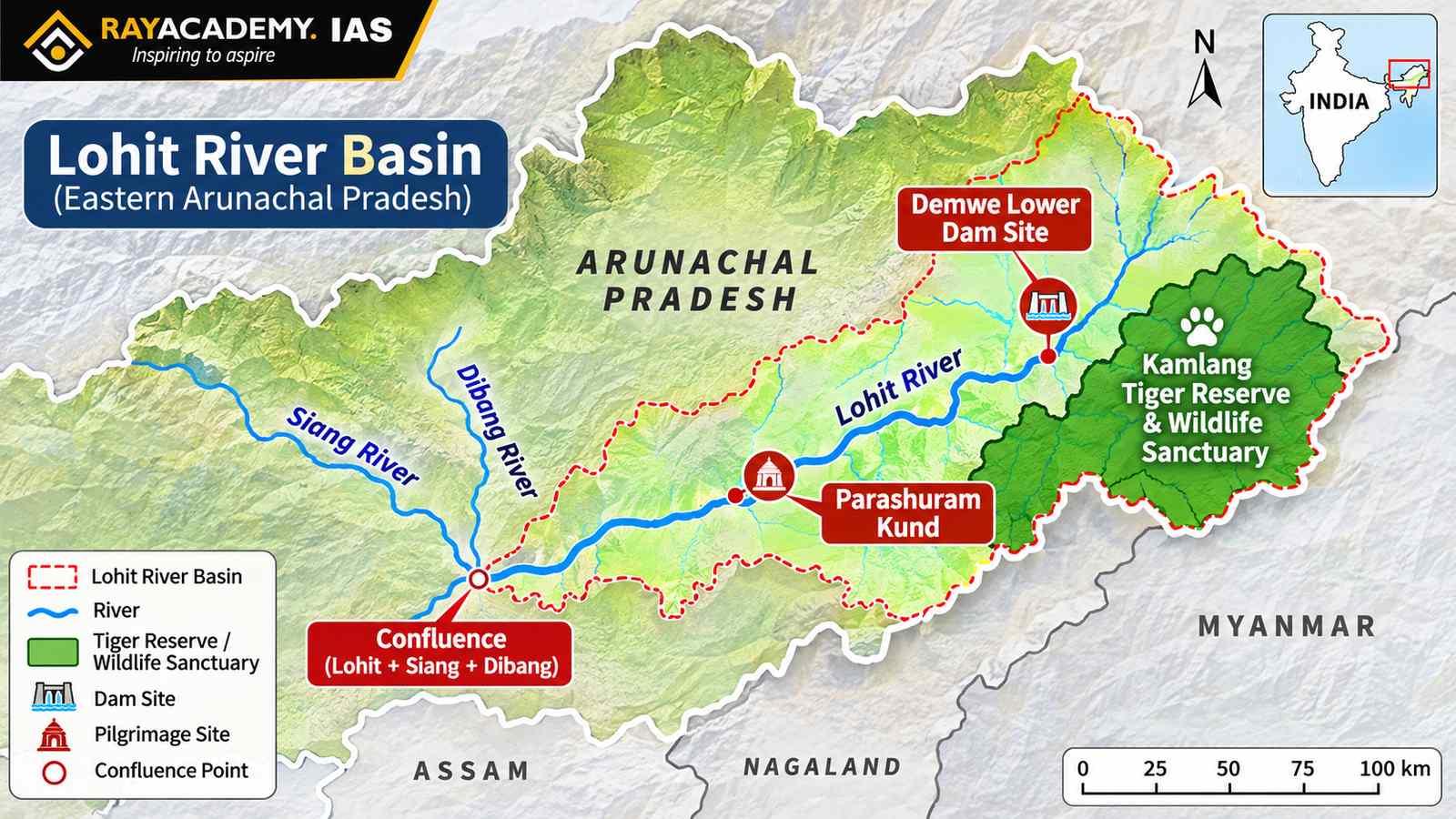
Lohit River System: Originating in eastern Tibet (where it is known as the Zayü Qu), the Lohit River enters Arunachal Pradesh through the Mishmi Hills, flows past Parashuram Kund, and merges with the Siang (Dihang) and Dibang rivers near Sadiya in Assam to form the Brahmaputra.
Doctrine of Prior Appropriation: Proponents of border hydropower often invoke the international water law principle of prior appropriation ("first in time, first in right") to argue that building dams establishes India’s downstream water rights against upstream Chinese projects on the Yarlung Tsangpo. However, hydrologists note that 70–80% of the Brahmaputra’s water volume in India is generated south of the McMahon Line by monsoon rainfall within Arunachal Pradesh and Assam.
Prelims Focus: High-Yield Objective Facts
UPSC Prelims Quick-Revision Box:
Demwe Project, Lohit Basin & Protected SpeciesProject Specifications: 1,750-MW Demwe Lower Hydroelectric Project on the Lohit River (Lohit District, Arunachal Pradesh); involves diverting 1,416 hectares of forest land, submerging ~1,590 hectares, and felling roughly 43,000 trees.
Proximity to Protected Areas: Located adjacent to the Kamlang Wildlife Sanctuary and Tiger Reserve (notified as India's 50th Tiger Reserve in 2016) and culturally sacred Parashuram Kund.
Key Threatened Fauna Cited in the Basin:White-Bellied Heron (Ardea insignis): Critically Endangered (IUCN Red List); Schedule I (WPA, 1972); inhabits undisturbed riverine pebble beds and forests of the Eastern Himalayas.
Bengal Florican (Houbaropsis bengalensis): Critically Endangered (IUCN Red List); Schedule I; grassland bird found in the Brahmaputra floodplains.Gangetic River Dolphin (Platanista gangetica): Endangered (IUCN Red List); Schedule I; India's National Aquatic Animal found in the Brahmaputra-Lohit river system.
National Green Tribunal (NGT) Precedent (2017): The NGT had suspended the project’s wildlife clearance in October 2017 on the ground that the Environment Minister had overridden unanimous objections of independent SC-NBWL experts.
Mains Analytical Breakdown: Significance vs. Multi-Dimensional Challenges. Demwe Lower
Strategic and Developmental Significance
Clean Energy & Peaking Power Capacity: Hydropower projects provide vital grid balancing and peaking power to complement intermittent solar and wind generation, supporting India’s Panchamrit target of 500 GW non-fossil fuel capacity by 2030.
Regional Economic & Revenue Potential: Arunachal Pradesh holds nearly 40% of India’s total hydropower potential (over 50,000 MW). State governments view large projects as engines for free power royalties (typically 12%), local area development funds, and road connectivity in remote border districts.
Flood Moderation Arguments: Proponents contend that engineered reservoir storage in eastern tributaries can help moderate peak monsoon discharge into the Assam valley, provided strict dam-safety protocols are enforced.
Multi-Dimensional Challenges
Environmental & Biodiversity Risks (Ecological): Submerging 1,590 hectares of primary tropical rainforest and operating a peaking-power dam (which causes sudden daily fluctuations in downstream river flow) threatens tiger movement corridors linking Kamlang with Namdapha, and destroys riverine habitats for the Critically Endangered White-Bellied Heron and Gangetic Dolphin.
Seismic & Geological Vulnerability (Disaster Management): The Eastern Himalayas fall under Seismic Zone V (highest earthquake risk). Constructing massive concrete gravity dams in steep, landslide-prone valleys increases the risk of reservoir-induced seismicity and catastrophic downstream dam-break floods.
Indigenous Rights & Cultural Displacement (Social & Ethical): Local Mishmi communities and student unions have opposed the project over the submergence of ancestral lands, non-implementation of the Forest Rights Act, 2006, and ecological threats to Parashuram Kund, a major pilgrimage site.
Regulatory & Institutional Governance Deficits (Political & Administrative): Reviving a project halted by the NGT in 2017 through ownership transfer—while relying on dated baseline studies rather than fresh Cumulative Impact Assessments (CIA)—raises concerns over regulatory capture and the dilution of independent scientific scrutiny inside the SC-NBWL.
Strategic Fallacy on Transboundary Water Rights (Geopolitical): Experts highlight that building downstream dams without a binding India–China transboundary water treaty cannot physically prevent upstream water diversion, making ecological and seismic costs disproportionately high relative to strategic gains.
Way Forward: Reform-Oriented Policy Roadmap
Mandate Basin-Wide Cumulative Impact Assessments (CIA) & Carrying Capacity Studies: In line with Supreme Court directions (post-2013 Uttarakhand floods) and MoEFCC guidelines, clearances for individual dams on Himalayan rivers like the Lohit must be paused until an updated, peer-reviewed carrying capacity and environmental flow (e-flow) study is completed.
Restore Scientific Independence of the SC-NBWL: Reform the composition of the Standing Committee of the NBWL so that independent ecological scientists and conservation institutions hold a decisive voice, ensuring statutory recommendations cannot be bypassed without recorded, scientifically tenable reasons.
Operationalize the Forest Rights Act (FRA), 2006 in Northeast India: Align forest diversion protocols with the Supreme Court’s Niyamgiri judgment (2013) by recognizing customary tribal land rights and securing genuine Gram Sabha consent prior to Stage-I forest clearance.
Shift to Decentralized, Run-of-River Micro-Hydel & Solar Hybrids: Following NITI Aayog’s Sustainable Himalayan Development framework, prioritize smaller, low-impact micro-hydel projects and distributed solar infrastructure that meet local energy needs without massive forest submergence.
Strengthen Transboundary Hydro-Diplomacy: Institutionalize data-sharing and ecological basin dialogues with upstream and downstream riparians rather than relying on ecologically risky border mega-dams as diplomatic signalling tools.
Value Addition for Mains
Official Hydropower & Biodiversity Benchmark (CEA & FSI Data): According to the Central Electricity Authority (CEA), Arunachal Pradesh possesses an estimated 50,328 MW of hydroelectric potential (the highest in India), yet lies entirely within the Eastern Himalaya Global Biodiversity Hotspot, where the India State of Forest Report (ISFR) records over 79% forest cover—requiring a delicate balance between green energy targets and irreplaceable carbon sinks.
Administrative Catchphrase for Mains Conclusions: "True sustainable development in the fragile Eastern Himalayas demands shifting from project-by-project clearance to basin-wide carrying capacity, ensuring that clean energy transitions do not erode ecological security or constitutional tribal rights."
Practice Questions for Active Recall
Prelims Practice MCQ
With reference to the Lohit River and environmental governance in India, consider the following statements:
The Lohit River originates in eastern Tibet, flows through Arunachal Pradesh, and joins the Siang River in Assam to form the Brahmaputra.
The National Board for Wildlife (NBWL) is a statutory body constituted under the Environment (Protection) Act, 1986, and is chaired by the Union Minister of Environment, Forest and Climate Change.
The White-Bellied Heron, naturally occurring in the riverine habitats of the Eastern Himalayas, is classified as Critically Endangered on the IUCN Red List.
Which of the statements given above are correct?
(a) 1 and 2 only
(b) 1 and 3 only
(c) 2 and 3 only
(d) 1, 2, and 3
Correct Answer: (b) 1 and 3 only
Explanation:
Statement 1 is correct: The Lohit River rises in eastern Tibet (Zayü County), enters Arunachal Pradesh, and merges with the Siang and Dibang rivers near Sadiya in Assam to form the Brahmaputra.
Statement 2 is incorrect: The National Board for Wildlife (NBWL) is constituted under Section 5A of the Wild Life (Protection) Act, 1972 (not the Environment Protection Act, 1986), and is chaired by the Prime Minister of India (with the Environment Minister as Vice-Chairperson).
Statement 3 is correct: The White-Bellied Heron (Ardea insignis) is listed as Critically Endangered on the IUCN Red List and is protected under Schedule I of the Wild Life (Protection) Act, 1972.
Mains Practice Question (GS Paper III — 150 Words | 10 Marks)
"Large hydropower projects in the Eastern Himalayas sit at the crossroads of India’s renewable energy ambitions, ecological fragility, and tribal rights." Examine the environmental and governance concerns surrounding the proposed Demwe Lower Hydroelectric Project and suggest reforms for sustainable river-basin management.
Answer Structure Hints:
Introduction: Contextualize the November 2026 appeal by former civil servants seeking the scrapping of the 1,750-MW Demwe Lower Hydroelectric Project on the Lohit River in Arunachal Pradesh.
Body Part 1 (Environmental & Governance Concerns): Highlight submergence of 1,590 ha of evergreen forest, proximity to Kamlang Tiger Reserve, threats to Critically Endangered species (White-Bellied Heron), Seismic Zone V risks, non-implementation of the Forest Rights Act, 2006, and procedural concerns over SC-NBWL clearances.
Body Part 2 (Reforms for River-Basin Management): Recommend mandatory Cumulative Impact Assessments (CIA), strict environmental flows (e-flows), strengthening independent expert scrutiny in the SC-NBWL, enforcing Gram Sabha consent, and prioritizing smaller, low-impact micro-hydel projects.
Conclusion: Conclude with Article 48A and Sustainable Development, emphasizing that energy security in the Himalayas must be anchored in ecological carrying capacity and participatory governance.
Take this article with you
Save a reading copy for offline study.


