

COP31
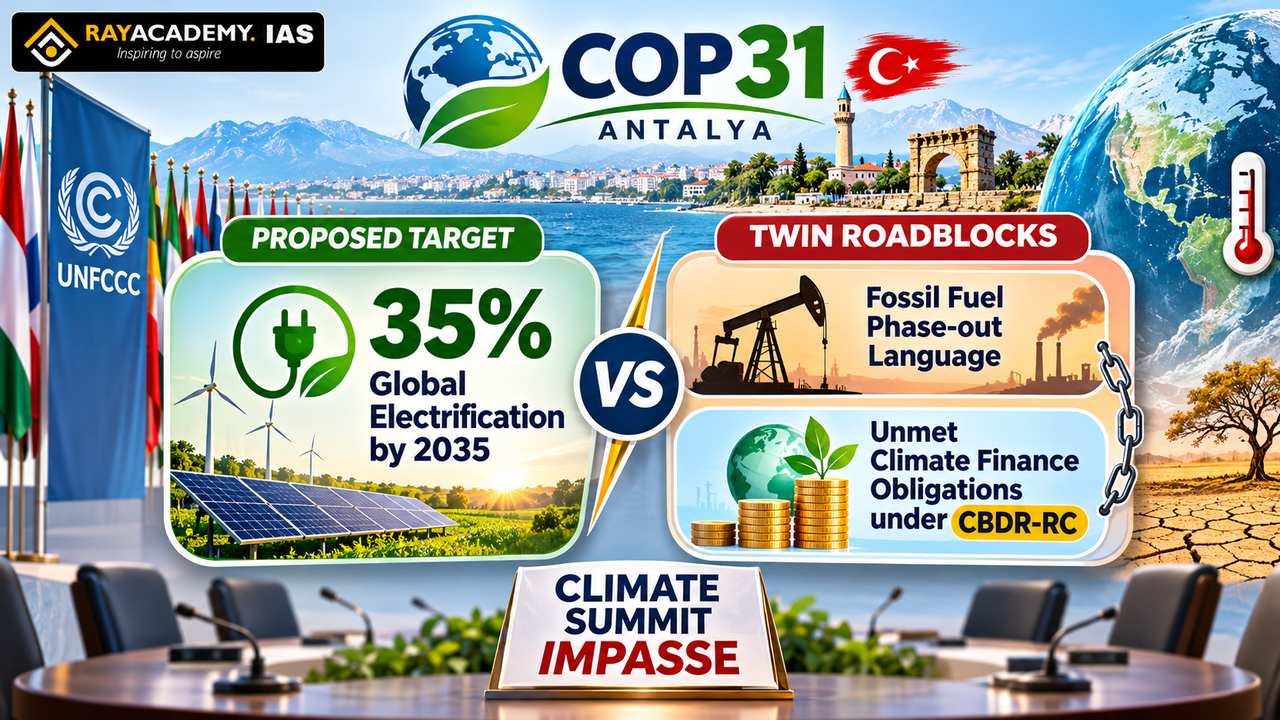
Deadlock at COP31 in Antalya: The 31st Conference of the Parties (COP31) to the United Nations Framework Convention on Climate Change (UNFCCC) in Antalya, Türkiye—jointly presided over by Türkiye and Australia—concluded in November 2026 after a nearly 50-hour overtime without consensus on an overarching political declaration (cover text).
UPSC Syllabus Mapping:
General Studies Paper II (International Relations): Important International institutions, agencies and fora—their structure, mandate; Effect of policies and politics of developed and developing countries on India’s interests.
General Studies Paper III (Environment & Conservation): Conservation, environmental pollution and degradation, environmental impact assessment; Global climate change negotiations, UNFCCC frameworks, climate finance, and energy transition.
Clash Over Fossil Fuel Language and 35% Electrification Target: While the COP31 leadership pushed an early cover text centered on a 35-by-35 Global Electrification Pledge (raising electricity's share of global final energy consumption to 35% by 2035), the European Union, Least Developed Countries (LDCs), small island states, and several Latin American nations—nearly 130 countries—rejected the draft for omitting any explicit reference to fossil fuels or their phase-out.
Unresolved Climate Finance & New Energy Demands: Despite incremental movement on the Just Transition work programme, negotiations deadlocked over climate finance delivery for developing nations, compounded by surging electricity demand from AI data centres and geopolitical energy security pressures.
Static-Current Linkage: UNFCCC Architecture, CBDR-RC, and Climate Finance
Understanding why the COP31 Antalya talks stalled requires examining the foundational principles of global climate governance, consensus rules, and historical emission responsibilities.
1. UNFCCC Consensus Decision-Making (Rule 42)
Unanimity Requirement: Unlike UN General Assembly resolutions decided by majority vote, UNFCCC COP decisions operate by consensus because Parties never formally adopted the voting majority clause under draft Rule 42 of the Rules of Procedure. Consequently, a vocal objection from even a single country or negotiating bloc can block the adoption of a cover text.
2. Principle of Common But Differentiated Responsibilities (CBDR-RC)
Historical Responsibility & Equity: Enshrined in Article 3(1) of the UNFCCC (1992) and operationalized in the Paris Agreement (2015), CBDR-RC recognizes that developed countries bear primary historical responsibility for cumulative greenhouse gas (GHG) emissions and possess superior financial and technological capabilities to lead mitigation while financing developing nations.
3. Evolution of Fossil Fuel & Energy Transition Milestones
COP26 Glasgow Climate Pact (2021): First COP decision to explicitly mention fossil fuels, calling for the "phasedown of unabated coal power" and phase-out of inefficient fossil fuel subsidies.
COP28 UAE Consensus (2023): Landmark First Global Stocktake decision calling on Parties to contribute to "transitioning away from fossil fuels in energy systems, in a just, orderly and equitable manner", alongside tripling renewable energy capacity by 2030.
COP29 Baku (2024) & New Collective Quantified Goal (NCQG): Established a post-2025 climate finance goal of at least $300 billion per year by 2035 from developed countries (within a broader $1.3 trillion mobilization target), though developing nations criticized the inadequate share of public grants.
Prelims Focus: High-Yield Objective Facts
UPSC Prelims Quick-Revision Box:
COP31 Antalya & UNFCCC Key ConceptsSummit Host & Co-Presidency: COP31 (November 2026) was held in Antalya, Türkiye, featuring a unique joint governance model with Türkiye holding the COP31 Presidency (Murat Kurum) and Australia serving as President of Negotiations (Chris Bowen).
35-by-35 Global Electrification Target: Proposed headline target at COP31 seeking to raise electricity’s share of global final energy consumption from roughly 20% today to 35% by 2035 (and over 50% by 2050).
Carbon Capture, Utilisation and Storage (CCUS): Technologies that capture CO₂ emissions from point sources (like thermal power plants or cement factories) or the atmosphere for permanent geological storage or industrial reuse; viewed by fossil-fuel producers as an abatement pathway, though critics warn against using it to delay fossil fuel phase-out.
Key Negotiating Blocs at UNFCCC:BASIC: Brazil, South Africa, India, and China (advocates of equity, CBDR-RC, and unencumbered development space).LMDCs (Like-Minded Developing Countries): Includes India, China, Saudi Arabia, Indonesia, etc., emphasizing historical responsibility and public climate finance.
AOSIS (Alliance of Small Island States) & LDCs: Most climate-vulnerable nations demanding strict 1.5°C alignment, rapid fossil fuel phase-out, and grant-based adaptation finance.
Mains Analytical Breakdown: Significance and Multi-Dimensional Challenges
Strategic and Policy Significance of the COP31 Debate
Highlighting Electrification as a Decarbonization Lever: Focusing on raising final energy electrification to 35% by 2035 underscores that clean power generation must be paired with end-use electrification in transport (EVs), buildings, and industry to cut direct fossil fuel combustion.
Exposing the Finance-Ambition Disconnect: The Antalya deadlock reinforces developing countries’ core argument—including India’s—that demanding aggressive mitigation pledges without delivering predictable, grant-based climate finance violates climate justice.
Protecting Developmental Space for Emerging Economies: India and China, despite leading global clean energy capacity additions, still serve vast populations requiring affordable, reliable baseload energy for poverty eradication and industrialization.
Multi-Dimensional Challenges in Global Climate Governance
Geopolitical & Energy Security Reversals (Political): Ongoing conflicts and supply disruptions have prompted several developed economies—previously vocal critics of coal—to shore up domestic natural gas reserves and delay domestic fossil exits, undermining diplomatic credibility.
Structural & Grid Costs of Renewables (Economic): Scaling solar installations and battery storage entails substantial land acquisition costs, grid modernization expenses to manage weather-driven intermittency, and high cost of capital in the Global South.
AI Data Centres & Digital Energy Drain (Technological): When the UNFCCC was drafted in 1992, negotiators did not foresee the massive electricity appetite of Artificial Intelligence (AI) training clusters and hyperscale data centres, which is straining power grids and slowing fossil fuel retirement.
Abatement vs. Phase-Out Contestation (Environmental): Divisive debates over Carbon Capture, Utilisation and Storage (CCUS) risk turning experimental, expensive abatement technologies into a pretext for prolonging unabated fossil fuel extraction while the global 1.5°C carbon budget rapidly shrinks.
Erosion of Multilateral Trust (Ethical & Institutional): Procedural friction—such as pushing cover texts prematurely without consensus and defaulting on historical finance commitments—threatens to reduce the UNFCCC COP process into a symbolic sideshow, dealing a blow to rules-based multilateralism.
Way Forward: Anchored in Authoritative Frameworks
Operationalize Grant-Based Climate Finance & De-Risking Mechanisms (Economic Survey & UNFCCC Standing Committee on Finance): Developed nations must fulfill and scale public grant and concessional finance commitments under Article 9 of the Paris Agreement, lowering the high cost of capital for renewable grid upgrades and battery storage in developing countries.
Integrate AI & Digital Infrastructure into Sustainable Energy Planning (IEA & NITI Aayog Frameworks): Governments and multilateral bodies should establish green compute standards, mandating hyperscale AI data centres to co-locate with dedicated renewable energy and storage capacity so digital expansion does not revive fossil fuel dependence.
Adopt a Differentiated, Phased Energy Transition Pathway (India’s LT-LEDS & Panchamrit Framework): Rather than uniform phase-out timelines that ignore developmental disparities, global climate pacts should back country-driven, equitable transition pathways—combining renewable expansion, green hydrogen, and prudent, strictly regulated deployment of CCUS in hard-to-abate sectors like steel and cement.
Reform COP Negotiation Procedures for Greater Transparency (UNFCCC Institutional Reform): Future COP Presidencies should ensure inclusive, party-driven drafting of cover texts rather than top-down early drafts, restoring trust in UNFCCC multilateralism.
Value Addition: Official Data Points for Mains Answers
India’s Clean Energy Leadership (Ministry of New & Renewable Energy / Economic Survey): India has achieved over 200 GW of non-fossil fuel installed electricity capacity (exceeding 45% of total installed capacity ahead of its 2030 NDC target) and is progressing toward its Panchamrit target of 500 GW non-fossil capacity by 2030.
Historical Emissions Equity Gap (UNEP Emissions Gap Report): Despite accounting for roughly 17% of the global population, India’s share in cumulative historical global CO₂ emissions (1850–2022) is under 4%, whereas developed economies (Annex I countries) account for over 50% of cumulative historical emissions.
Administrative Catchphrase for Mains Conclusions: "Durable climate multilateralism cannot be built on unfunded mandates; ambition in the Global South must be matched by accountability in the Global North."
Practice Questions for Active Recall
Prelims Practice Question (Multi-Statement Format)
Q. With reference to the 31st Conference of the Parties (COP31) to the UNFCCC and global climate governance, consider the following statements:
COP31 was held in Antalya, Türkiye, under a joint leadership arrangement between Türkiye and Australia.
The proposed "35-by-35" pledge at COP31 aimed to reduce global greenhouse gas emissions by 35% below 1990 levels by 2035.
Under the UNFCCC Rules of Procedure, formal COP decisions are adopted through consensus rather than a two-thirds majority vote.
Which of the statements given above is/are correct?
(a) 1 and 2 only
(b) 1 and 3 only
(c) 2 and 3 only
(d) 1, 2, and 3
Correct Answer: (b) 1 and 3 only
Explanation:
Statement 1 is correct: COP31 took place in Antalya, Türkiye in November 2026, with Türkiye holding the COP Presidency and Australia serving as President of Negotiations.
Statement 2 is incorrect: The "35-by-35" Global Electrification Pledge championed at COP31 sought to raise electricity’s share of global final energy consumption to 35% by 2035, not a 35% cut in total GHG emissions.
Statement 3 is correct: Because draft Rule 42 regarding voting was never formally adopted, UNFCCC COP decisions rely on consensus, allowing objections from individual countries or blocs to stall cover texts.
Mains Practice Question (150 Words | 10 Marks)
Q. "The deadlock at COP31 in Antalya underscores that global decarbonization targets cannot succeed without resolving historical inequities in climate finance and energy transition costs." Critically examine in the context of India’s climate diplomacy. (150 words)
Model Answer Structure:
Introduction: Contextualize the November 2026 COP31 Antalya impasse, where talks collapsed without a cover text over disagreements on fossil fuel phase-out language, the 35% electrification pledge, and climate finance.
Body Paragraph 1 (Structural & Financial Inequities): Analyze why developing economies require predictable, grant-based climate finance under CBDR-RC to offset high land, grid upgrade, and battery storage costs, while addressing new pressures like AI data centre energy demand.
Body Paragraph 2 (India’s Balanced Approach): Highlight India’s dual track—leading renewable deployment (200+ GW non-fossil capacity, International Solar Alliance) while safeguarding affordable energy access for poverty alleviation and opposing unilateral trade/climate conditionalities.
Conclusion: Conclude with a constructive way forward—operationalizing public grant finance, supporting country-specific transition pathways, and strengthening UNFCCC multilateralism.
Take this article with you
Save a reading copy for offline study.


