

IN-SPACe Report 2026
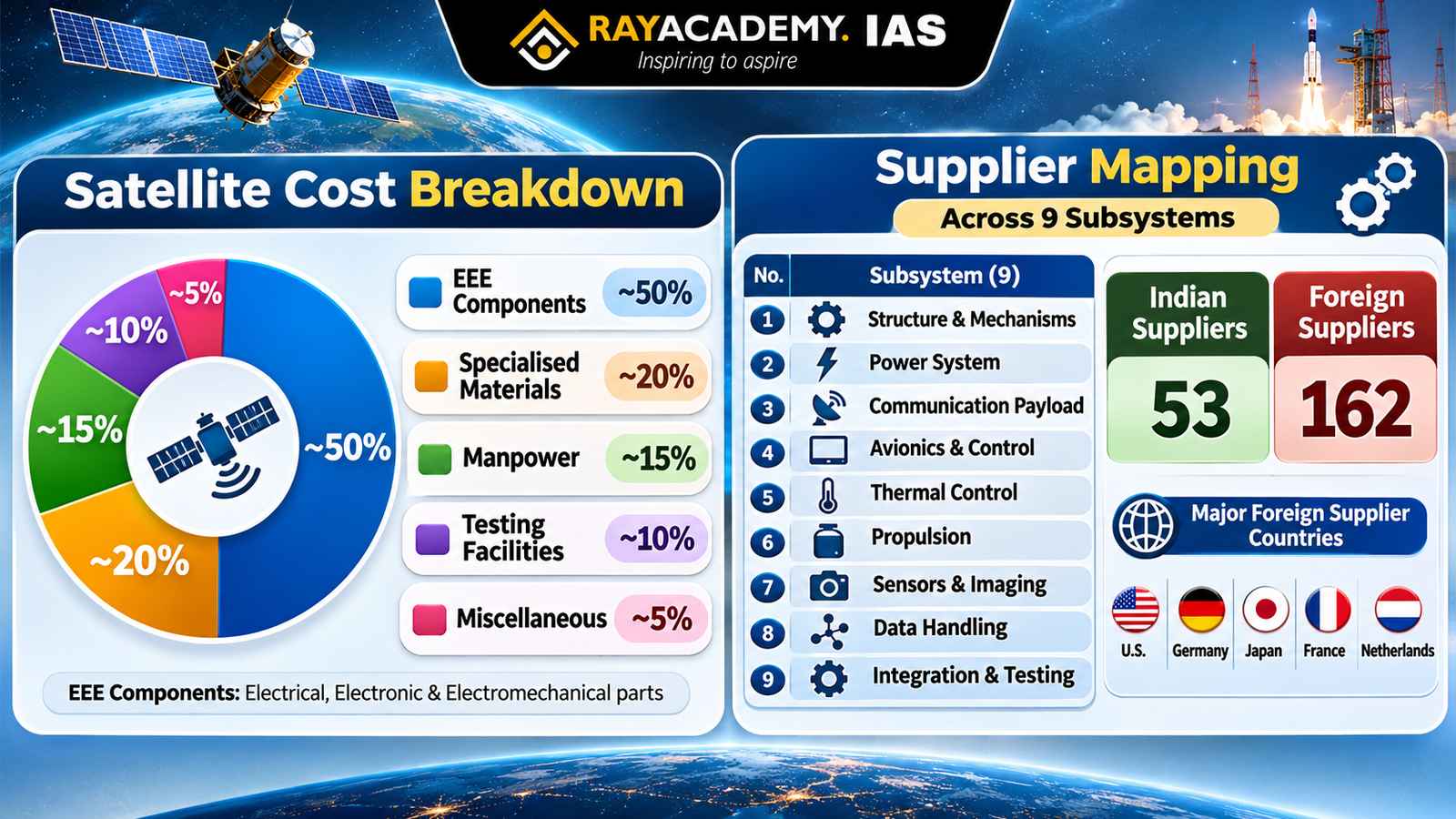
On November 25, 2026, the Indian National Space Promotion and Authorisation Centre (IN-SPACe) released a landmark report titled "Supply Chain Landscape of Satellite Manufacturing in India," revealing that India’s satellite manufacturing supply chain remains heavily dependent on foreign imports. According to the study, nearly 60% of total satellite manufacturing costs stem from imported Electrical, Electronic, and Electromechanical (EEE) components and specialised space-grade materials, with procurement lead times frequently stretching to 12–16 months.
UPSC Syllabus Mapping:
General Studies Paper III (Science & Technology): Awareness in the fields of IT, Space, Computers, robotics, nano-technology, bio-technology; Achievements of Indians in science & technology; Indigenization of technology and developing new technology.
General Studies Paper III (Indian Economy & Infrastructure): Indian Economy and issues relating to planning, mobilization of resources, growth, development and employment; Effects of liberalization on the economy, changes in industrial policy and their effects on industrial growth.
The findings come immediately after the 5th India International Space Conclave (IISC 2026) organised by the Indian Space Association (ISpA) in New Delhi, where Union Science and Technology Minister Dr. Jitendra Singh projected India’s space economy to expand from $9 billion to $40–45 billion over the next decade, driven by 400–500 private space companies.
Static-Current Linkage: Space Sector Reforms, Institutional Architecture, and Aerospace Manufacturing
Understanding the structural bottlenecks in India’s satellite supply chain requires connecting the post-2020 space sector liberalisation with the institutional roles of ISRO, IN-SPACe, and NSIL, as well as technical qualification standards in space engineering.
Institutional Architecture of India’s Space Ecosystem
Department of Space (DoS) & ISRO: Operates as the primary research and development (R&D) agency focusing on advanced missions, human spaceflight (Gaganyaan), and deep-space exploration, progressively transitioning routine manufacturing to industry.
IN-SPACe (Established June 2020): Functions as an autonomous, single-window nodal regulatory-cum-promotional agency under the Department of Space to authorize, regulate, and promote Non-Governmental Entities (NGEs) in building satellites, launch vehicles, and ground infrastructure.
NewSpace India Limited (NSIL, Incorporated 2019): Serves as the commercial arm of ISRO (a Central Public Sector Enterprise under DoS), responsible for demand-driven satellite launches, technology transfer to Indian industry, and commercial satellite ownership.
Indian Space Policy, 2023 & FDI Liberalisation (2024): Formally delineated roles across DoS, ISRO, IN-SPACe, NSIL, and NGEs, while permitting up to 100% Foreign Direct Investment (FDI) under the automatic route for manufacturing satellite components and systems, and up to 74% for satellite manufacturing and operation.
Technical Science Behind Satellite Supply Chains
Unlike terrestrial electronics, space-grade subsystems must survive extreme launch vibrations, thermal vacuum cycles, atomic oxygen erosion, and ionizing cosmic radiation. Consequently, components require radiation-hardened (rad-hard) semiconductors, Thermal Vacuum Chambers (TVAC), Electromagnetic Interference/Compatibility (EMI/EMC) labs, and stringent Space Qualification certifications—areas where domestic private infrastructure remains nascent.
Prelims Focus: High-Yield Objective Facts
Nodal Department & Regulator: Department of Space (DoS) (directly under the Prime Minister) and IN-SPACe (headquartered at Bopal, Ahmedabad; chaired by Dr. Pawan Kumar Goenka).
Key Findings of IN-SPACe Report (November 2026):
9 Core Satellite Subsystems Mapped: Structures, Propulsion, Thermal, Power, Communication, Data Handling, Attitude Determination & Control (ADC) & On-Board Computers (OBC), Mechanisms, and Optical & Synthetic Aperture Radar (SAR) Payloads.
Supplier Ratio: Identifies 53 Indian suppliers (largely concentrated in structural assemblies and propulsion components) versus 162 foreign suppliers (primarily from the United States, Germany, Japan, France, and the Netherlands).
Cost Structure: EEE components (~50%) and specialised materials (~20%) together account for nearly 60%–70% of satellite realisation costs.
Related Space Initiatives:
Indian Space Association (ISpA): Apex non-profit industry body launched in October 2021 representing private space and satellite companies.
Missile Technology Control Regime (MTCR): Multilateral export control regime (India joined in 2016) governing dual-use rocket and unmanned aerial delivery systems, historically restricting high-end propulsion and avionics transfers.
Mains Analytical Breakdown
Strategic and Economic Significance of Supply Chain Indigenisation
Capturing the Global Small-Satellite Boom: With global demand surging for Low Earth Orbit (LEO) constellations, high-resolution Earth observation, and satellite broadband, indigenising subsystems enables Indian firms to transition from "satellite assemblers" to global exporters of turnkey platforms and subsystems.
Strategic Autonomy and Geopolitical Resilience: Reducing reliance on foreign suppliers insulates India’s strategic communication, navigation (NavIC), and defence surveillance satellites from geopolitical sanctions, export-control bottlenecks, and global supply chain shocks.
High-Tech Spillovers and Employment Generation: Strengthening domestic capabilities in rad-hard electronics, carbon-fibre composites, and precision propulsion creates high-value manufacturing jobs and synergies with India’s Semiconductor Mission and defence aerospace corridors.
Multi-Dimensional Challenges
Economic — "Project-Based" Manufacturing and Low Economies of Scale: Most Indian private space firms operate on a bespoke, project-by-project manufacturing model rather than batch production, disincentivising capital-intensive investments in automation, tooling, and inventory stockpiling.
Infrastructural — Deficit in Testing and Qualification Facilities: Limited access to accredited TVAC, vibration, acoustic, radiation, and EMI/EMC testing facilities forces startups to either wait in long ISRO queues or ship hardware abroad for space qualification—raising costs and eroding global market credibility.
Operational — Long Procurement Lead Times (12–16 Months): Heavy dependence on imported EEE components and specialised alloys leads to 12–16 month procurement delays, causing mission slippages and reducing responsiveness to commercial launch windows.
Human Capital & R&D — Skill Gaps and Weak Technology Transfer: The IN-SPACe report flags acute shortages of trained engineers in satellite systems engineering, quality assurance, and qualification, compounded by low private-sector R&D expenditure and sluggish Transfer of Technology (ToT) from public institutions.
Regulatory & Financial — Need for Anchor Demand and Patient Capital: As highlighted at IISC 2026, hardware-heavy space startups require long-gestation patient capital and assured domestic government anchor demand to scale production sustainably.
Way Forward: Policy and Institutional Roadmap
Establish Common Testing and Qualification Clusters: Operationalise shared, NABL-accredited Assembly, Integration, and Testing (AIT) hubs and radiation-testing centres across Bengaluru, Hyderabad, Ahmedabad, and Tamil Nadu under a Public-Private Partnership (PPP) model to cut certification costs and turnaround times.
Generate Assured Domestic Anchor Demand: Following IN-SPACe Chairman Pawan Goenka’s recommendation at IISC 2026, Union Ministries (Agriculture, Railways, Defence, Jal Shakti, and Disaster Management) should procure Earth-observation data, IoT connectivity, and small satellites directly from Indian NGEs to create predictable batch-manufacturing demand.
Link Space Electronics with the India Semiconductor Mission (ISM): Introduce targeted Production Linked Incentive (PLI) support and R&D grants for domestic fabrication and packaging of radiation-hardened ASICs, space-grade solar cells, and lithium-ion batteries.
Streamline Customs, Export Controls, and SCOMET Clearances: Create a green-channel customs and Special Chemicals, Organisms, Materials, Equipment and Technologies (SCOMET) licensing framework via IN-SPACe to eliminate import-export friction for space-grade raw materials and sub-assemblies.
Industry-Academia Skilling and Structured ToT: Partner with ISRO, IITs, IIST (Thiruvananthapuram), and the National Skill Development Corporation (NSDC) to launch specialised certification programmes in satellite systems engineering and quality assurance while fast-tracking commercial ToT through NSIL.
Value Addition Snippet (Official Space Economy & Supply Chain Data)
Space Economy Trajectory (DoS / IN-SPACe Data, Nov 2026): India’s space economy is currently valued at approximately $9 billion (~2% of the global space market) and is projected to grow fivefold to $40–45 billion within a decade, aiming to capture 8%–10% of the global share.
Startup Ecosystem Expansion: Following the 2020 space sector reforms, India’s private space ecosystem has expanded from single-digit startups to 400–500 registered space companies and startups.
Administrative Catchphrase for GS-3: "True self-reliance in space requires moving from assembling imported subsystems to owning the entire space-qualified value chain."
Active Recall Practice Exercises
Prelims Practice Question (Multi-Statement MCQ)
Q. With reference to India’s space governance architecture and satellite manufacturing ecosystem, consider the following statements:
The Indian National Space Promotion and Authorisation Centre (IN-SPACe) functions as an autonomous single-window nodal agency under the Department of Space to authorize and promote private sector space activities.
Under India’s Foreign Direct Investment (FDI) policy for the space sector, 100% FDI under the automatic route is permitted for the manufacturing of satellite components and systems.
NewSpace India Limited (NSIL) is a statutory regulatory body established under the Indian Space Act to adjudicate spectrum disputes among private satellite operators.
How many of the statements given above are correct?
(a) Only one
(b) Only two
(c) All three
(d) None
Correct Answer: (b) Only two
Explanation:
Statement 1 is correct: IN-SPACe was established in June 2020 as an independent, single-window nodal regulatory-cum-promotional body under the Department of Space to enable and supervise Non-Governmental Entities (NGEs) in the space sector.
Statement 2 is correct: Under the liberalised FDI policy approved in 2024, up to 100% FDI under the automatic route is permitted for manufacturing components and systems/subsystems for satellites, ground segment, and user segment (while satellite manufacturing/operation allows up to 74% automatic FDI).
Statement 3 is incorrect: NewSpace India Limited (NSIL) is not a statutory regulator; it is a wholly owned Government of India company (Central Public Sector Enterprise) incorporated in 2019 under the Companies Act, 2013, serving as the commercial arm of ISRO for technology transfer, launch services, and commercial satellite missions.
Mains Practice Question (GS Paper III — 150 Words | 10 Marks)
Q. "India’s ambition to become a global hub for satellite manufacturing is constrained by upstream supply-chain vulnerabilities and testing bottlenecks." Analyse the structural gaps identified in the IN-SPACe report and suggest policy measures to indigenise India’s space manufacturing ecosystem. (150 words)
Model Answer Structure:
Introduction (25 words): Contextualize the November 2026 IN-SPACe report highlighting that nearly 60% of satellite costs stem from imported components, alongside India’s goal of a $40–45 billion space economy.
Body Part 1 – Structural Gaps (60 words): Identify key bottlenecks: heavy import reliance for EEE components and specialised materials (162 foreign vs. 53 Indian suppliers), 12–16 month procurement delays, inadequate testing/qualification facilities (TVAC, radiation), project-based low-scale manufacturing, and skill deficits in systems engineering.
Body Part 2 – Policy Measures (50 words): Recommend PPP-based shared testing/certification clusters, government anchor demand across ministries to spur batch production, PLI linkage with the India Semiconductor Mission for rad-hard electronics, fast-track customs/SCOMET clearances, and NSIL-led technology transfer.
Conclusion (15 words): Conclude that building a space-qualified domestic supply chain will secure both commercial competitiveness and strategic autonomy.
Take this article with you
Save a reading copy for offline study.


