

IndiaAI Mission
Release of Sovereign Indic Foundation Models: In November 2026, the IndiaAI Mission under the Union Ministry of Electronics and Information Technology (MeitY) announced the launch of three indigenous foundation Large Language Models (LLMs)—EKA-1, Dhir 2B, and Dhir 5B—designed to expand artificial intelligence adoption across India’s regional languages.
UPSC Syllabus Mapping:
General Studies Paper III (Science & Technology): Awareness in the fields of IT, Space, Computers, robotics, nano-technology, bio-technology; Indigenization of technology and developing new technology (Artificial Intelligence, Large Language Models, and Sovereign Compute).
General Studies Paper II (Governance & Social Justice): Important aspects of governance, transparency and accountability, e-governance—applications, models, successes, limitations, and potential; Issues relating to development and management of Social Sector/Services.
Language Coverage & Functional Capabilities: EKA-1 covers all 22 Scheduled Indian languages for complex tasks such as mathematics, coding, and reasoning, while Dhir 2B and Dhir 5B support 10 Indian languages tailored for document retrieval and enterprise/governance services.
The Data & Tokeniser Bottleneck: AI researchers emphasize that compute infrastructure alone cannot democratize AI unless India overcomes the acute shortage of culturally grounded, annotated datasets for "low-resource" languages and eliminates the "token tax" imposed by English-centric tokenisers.
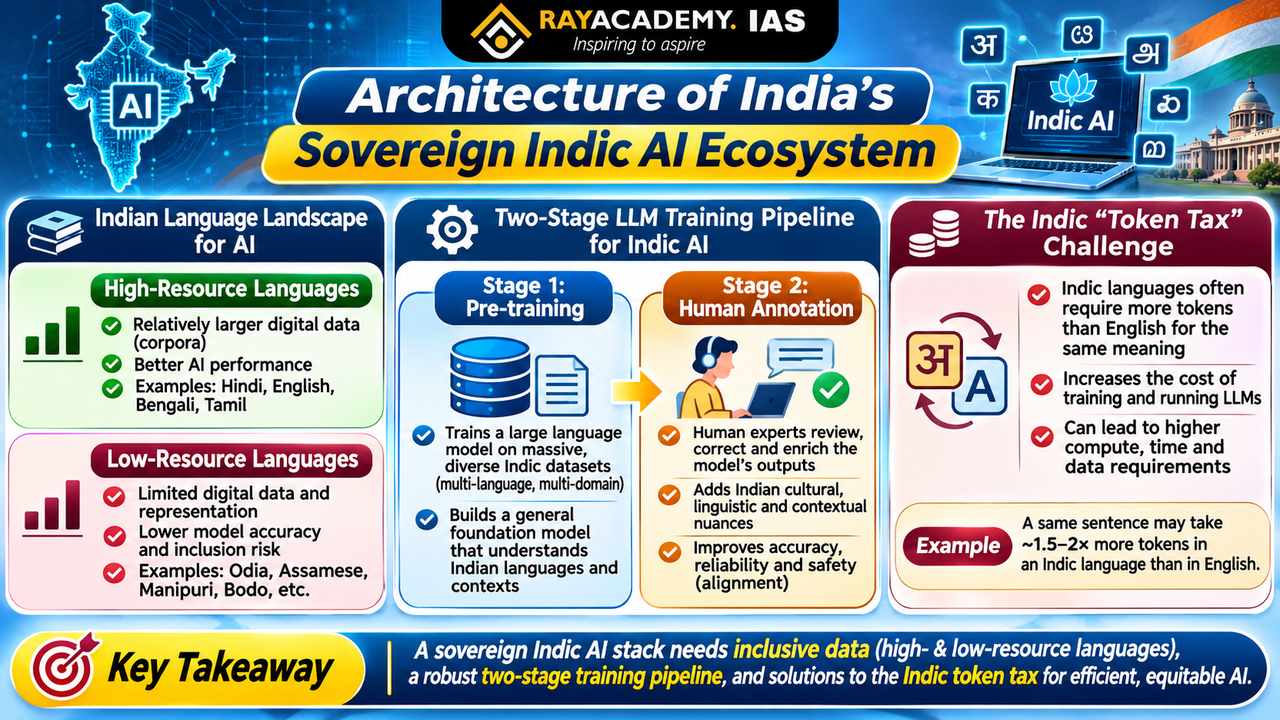
Static-Current Linkage: Constitutional Language Framework, LLM Mechanics, and Digital Public Infrastructure
Understanding why culturally rooted data is vital for indigenous AI models requires linking constitutional linguistic provisions with the technical mechanics of Large Language Models (LLMs) and India’s Digital Public Infrastructure (DPI) strategy:
1. Constitutional & Linguistic Context of India
Eighth Schedule of the Constitution: Recognizes 22 official languages (expanded from the original 14 via the 21st, 71st, and 92nd Constitutional Amendment Acts).
Article 29(1) & Article 350A: Protect the right of any section of citizens having a distinct language, script, or culture to conserve the same, and promote mother-tongue instruction.
Linguistic Diversity Reality: India is home to speakers of over 19,500 languages and dialects. While English and Hindi qualify as "high-resource" languages due to abundant digitized literature and web text, dozens of widely spoken Indian languages—such as Assamese, Bhojpuri, Dogri, and Santali—remain "low-resource" in digital corpora.
2. Technical Principles: How LLMs Learn and Tokenise Text
Two-Tier Data Pipeline:
Unlabelled Pre-Training Data: Raw text and speech (Wikipedia, news, digitized books) used to teach the model grammar, vocabulary, and next-word prediction.
Annotated & Domain-Specific Data: Thousands of hours of speech recordings and text tagged with structural metadata by native speakers and domain experts so the model grasps local idioms, agricultural practices, and cultural context.
Tokenisation & the "Token Tax": LLMs process text by breaking words into numerical units called tokens using a tokeniser. Because global tokenisers (such as those in GPT-4) were optimized for English, they fragment Indic scripts into granular subword and byte-level pieces—meaning a sentence taking 10 tokens in English can consume 35 to 140 tokens in an Indian language, inflating computational cost and latency.
3. India’s Sovereign AI & Language Initiatives . Indigenous AI Models
IndiaAI Mission (Approved March 2024; Outlay ₹10,371.92 crore): Implemented by the IndiaAI Independent Business Division (IBD) under Digital India Corporation (MeitY) to build sovereign GPU compute capacity, IndiaAI Datasets Platform, and indigenous foundation models.
Project BHASHINI (National Language Translation Mission): Builds open-source voice and text datasets (Bhasha Daan) to enable real-time translation across Indian languages in public service delivery.
Prelims Focus: High-Yield Objective Facts for UPSC
Quick Revision Fact Box:
IndiaAI Mission, Indic LLMs & Constitutional LanguagesNodal Ministry: Ministry of Electronics and Information Technology (MeitY). Newly Released Indigenous LLMs (Nov 2026):EKA-1: Supports all 22 Scheduled Languages; built for reasoning, coding, and mathematics.
Dhir 2B & Dhir 5B: Parameter-efficient models supporting 10 Indian languages; optimized for document retrieval and government/business workflows. Key Technical Concepts:Low-Resource Language: Defined in NLP/AI not by speaker population size (e.g., Bhojpuri has tens of millions of speakers), but by the scarcity of digitized, machine-readable, and annotated linguistic datasets.
Tokeniser: Software component that converts human text into numerical tokens; Indic-specific tokenisers reduce token inflation ("token tax") and inference cost.
Eighth Schedule Amendments (Quick Recap):21st Amendment (1967): Added Sindhi.71st Amendment (1992): Added Konkani, Manipuri, and Nepali.92nd Amendment (2003): Added Bodo, Dogri, Maithili, and Santali (bringing the total to 22).
Mains Analytical Breakdown
Significance of Culturally Grounded Indic AI Models
Democratizing Last-Mile Governance & Welfare: Sovereign multilingual AI breaks the English literacy barrier, enabling rural citizens to access healthcare advisories, agricultural extension services, judicial records, and welfare portals in their native tongue.
Preserving Indigenous Knowledge Systems: Digitizing oral histories, folklore, and local ecological knowledge in collaboration with regional communities prevents marginalized languages from fading in an internet-first economy.
Reducing Inference Costs for Indian Startups: Building native Indic tokenisers cuts token consumption by up to 70%, making commercial AI APIs affordable for Indian MSMEs, ed-tech, and agri-tech innovators.
Ensuring Digital & Strategic Sovereignty: Domestic foundation models reduce reliance on foreign proprietary LLMs whose training biases and data governance policies may not align with India’s socio-legal context.
Multi-Dimensional Challenges in Building Regional Language AI
Translation Bias & Contextual Hallucinations (Technological & Social): Models trained predominantly on machine-translated web text or dry government gazettes strip away everyday spoken nuances—producing regionally irrelevant advice (such as recommending asparagus instead of locally available drumsticks to a Tamil user, or misinterpreting local land/legal norms).
Labour-Intensive Annotation Bottlenecks (Economic & Administrative): High-quality speech transcription and semantic tagging cannot be fully automated; it requires thousands of hours of paid work by native linguists and domain experts across dialects.
The "Token Tax" & Compute Asymmetry (Economic): English-centric tokenisers penalize Indian language users with higher per-token API costs and slower response speeds, exacerbating the digital divide.
Data Privacy & Copyright Governance (Legal & Ethical): Scraping community archives, regional literature, and public speech raises questions around Informed Consent, Intellectual Property Rights (IPR), and compliance with the Digital Personal Data Protection (DPDP) Act, 2023.
Distortion of Living Languages (Cultural): Generating synthetic AI text solely for digital service delivery risks standardizing artificial, translation-heavy dialects rather than reflecting authentic community usage.
Way Forward: Anchored in Authoritative Frameworks
To build truly inclusive, accurate, and cost-effective Indic AI models under the IndiaAI Mission, policy and R&D efforts should prioritize four interventions:
Incentivize Community-Anchored Corpus Creation (IndiaAI Datasets Platform & BHASHINI): Move beyond web scraping by funding district-level linguistic fellowships, university departments, and community radio archives to collect authentic conversational speech and domain-specific text (agriculture, primary health, local law) in low-resource languages.
Mandate Native Indic Tokenisers & Benchmarking Standards (MeitY & NITI Aayog AI Frameworks): Establish open-source Indic tokeniser benchmarks under IndiaAI to minimize token-per-sentence ratios across all 22 Scheduled languages and major tribal dialects, lowering commercial API costs.
Domain-Specific Fine-Tuning with Human-in-the-Loop Validation (2nd ARC e-Governance Principles): Pair Dhir-series and EKA-1 models with Retrieval-Augmented Generation (RAG) grounded in verified state-level agricultural, medical, and legal repositories, audited by regional domain experts to eliminate hallucinated advice.
Establish Fair Licensing & Data Sovereignty Protocols (DPDP Act, 2023 & Copyright Law): Formulate transparent attribution and compensation frameworks for regional publishers, folklorists, and content creators whose works enrich sovereign AI datasets.
Value Addition Snippet (For Mains Introductions & Conclusions)
Linguistic & Technical Benchmarks:
India encompasses over 19,500 spoken languages and dialects, yet English-centric tokenisers impose a 3.5x to 14x "token tax" on Indian scripts (requiring 35 to 140 tokens for a sentence that takes just 10 tokens in English).
Under the ₹10,371.92 crore IndiaAI Mission, indigenous models like EKA-1 (covering all 22 Scheduled languages) and Dhir 2B/5B (10 languages) mark a decisive shift toward sovereign multilingual AI.
Analytical Catchphrase for Mains Answers: "True AI sovereignty for Bharat requires more than teraflops of GPU compute—it demands culturally grounded regional datasets and native Indic tokenisers so technology speaks the language of every citizen."
Active Recall: UPSC Practice Questions
1. Prelims Practice Question (Multi-Statement Format)
With reference to Artificial Intelligence (AI) development in Indian regional languages and the IndiaAI Mission, consider the following statements:
In Natural Language Processing (NLP), a "low-resource language" is defined strictly as a language spoken by fewer than one million people.
Tokenisers designed primarily for English often split Indian scripts into numerous subword or byte-level pieces, increasing token count and inference cost for Indian languages.
The indigenous foundation model EKA-1, launched under the IndiaAI Mission, covers all 22 languages listed in the Eighth Schedule of the Constitution.
Which of the statements given above is/are correct?
(a) 1 and 2 only
(b) 2 and 3 only
(c) 3 only
(d) 1, 2, and 3
Correct Answer: (b) 2 and 3 only
Explanation:
Statement 1 is incorrect: In computational linguistics and AI, a low-resource language is defined by the lack of digitized, machine-readable, and annotated linguistic datasets, regardless of how large its speaking population is (for example, Bhojpuri is spoken by tens of millions of people yet remains a low-resource language in AI).
Statement 2 is correct: English-optimized tokenisers fragment Indic scripts into many subword/byte-level tokens—requiring 35 to 140 tokens for a sentence that takes 10 tokens in English—thereby increasing computational cost and latency ("token tax").
Statement 3 is correct: Released under MeitY’s IndiaAI Mission, EKA-1 covers all 22 Scheduled Indian languages and is built for reasoning, mathematics, and coding.
2. Mains Practice Question (150 Words | 10 Marks)
Q. "While sovereign compute infrastructure is necessary, the true democratization of Artificial Intelligence in India hinges on culturally grounded datasets for low-resource languages and native Indic tokenisers." Discuss. (150 words)
Model Answer Structure Hint:
Introduction: Contextualize the release of indigenous foundation models (EKA-1, Dhir 2B, Dhir 5B) under MeitY’s IndiaAI Mission and highlight why data quality and tokenisation determine real-world accessibility across India’s 19,500+ languages and dialects.
Body:
Why Datasets & Tokenisers Matter: Explain how reliance on web-scraped or translated text strips cultural context (causing hallucinations in health, farming, and law) and how English-centric tokenisers impose a 3.5x–14x "token tax" on Indian scripts.
Reform Measures: Suggest community-led speech/text annotation (Project BHASHINI), open-source Indic tokenisers, domain-specific fine-tuning, and fair IPR/DPDP data governance.
Conclusion: Conclude that pairing sovereign compute with locally rooted linguistic datasets bridges the digital divide and preserves India’s indigenous knowledge systems.
Take this article with you
Save a reading copy for offline study.