

International Space Summit
High-Level Space Engagements (2026):Marking over six decades of bilateral space cooperation (1964–2026), France and India deepened institutional and industrial ties during the International Space Summit in Paris (led by ISRO Chairman V. Narayanan), the Bengaluru Space Expo (BSX), and high-level ministerial talks in New Delhi between French Minister Philippe Baptiste and Union Minister Dr. Jitendra Singh.
UPSC Syllabus Mapping:
General Studies Paper II (International Relations): Bilateral, regional and global groupings and agreements involving India and/or affecting India’s interests; Effect of policies and politics of developed and developing countries on India’s interests.
General Studies Paper III (Science & Technology): Awareness in the fields of IT, Space, Computers, robotics, nano-technology, bio-technology; Achievements of Indians in science & technology; Indigenization of technology and developing new technology.
Guest of Honour at India International Space Conclave 2026: As Guest of Honour, France reaffirmed its commitment to "Make in India, together with France" across private space startups following India’s first privately developed orbital launch vehicle reaching orbit in July 2026.
TRISHNA & Space Sustainability Push: Both nations spotlighted the joint TRISHNA thermal infrared Earth-observation mission alongside coordinated diplomacy on space debris mitigation and space sustainability.
Static-Current Linkage: Strategic Autonomy, Space Diplomacy, and International Space Law
Understanding the durability of the India-France space partnership requires linking bilateral strategic doctrines with space technology milestones and global outer space governance:
1. Strategic Autonomy as the Bedrock of Bilateral Ties
First Strategic Partner (1998): France became the first Western nation to establish a Strategic Partnership with India in 1998, refusing to impose sanctions after India’s Pokhran-II nuclear tests.
Shared Doctrine of Strategic Autonomy: Both Paris and New Delhi anchor their foreign policy in strategic autonomy—building sovereign technological and decision-making capacities rather than entering rigid military alliances. France has consistently supported India’s permanent membership in a reformed UN Security Council (UNSC) and India’s entry into multilateral export control regimes (MTCR, Wassenaar Arrangement, Australia Group).
2. Evolution of ISRO–CNES Technological Cooperation
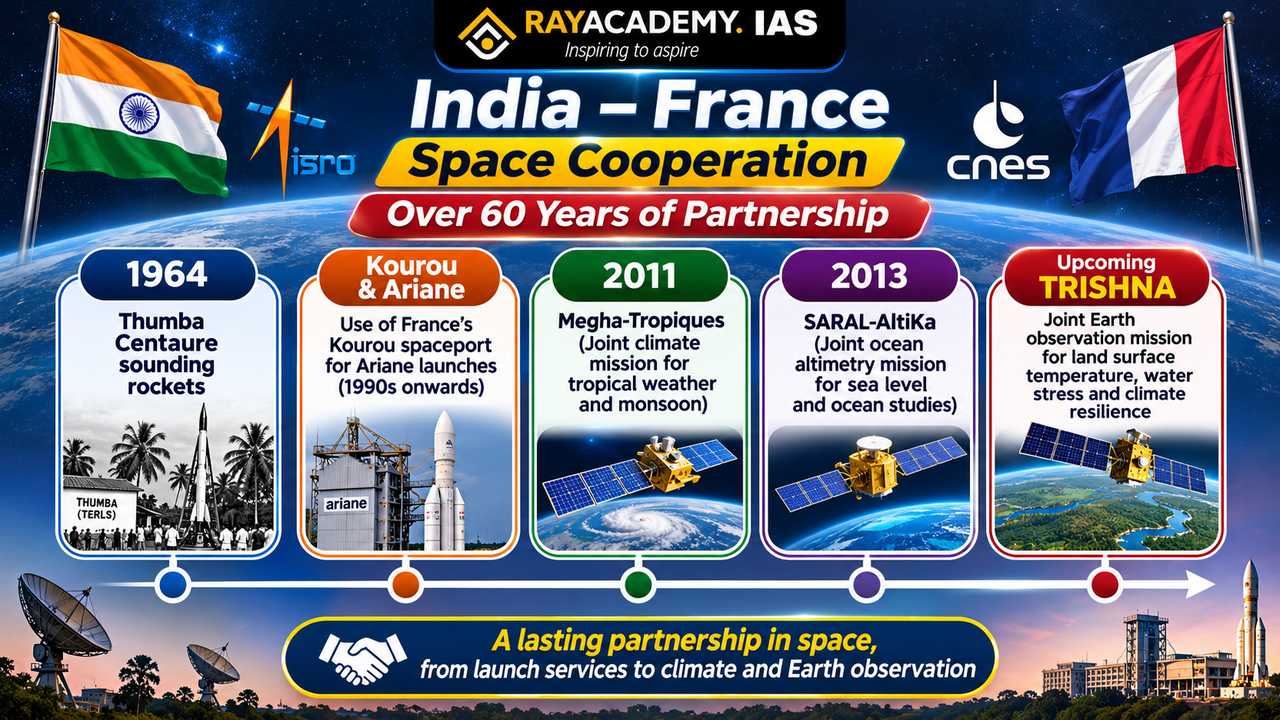
Foundational Era (Thumba to Kourou): Initiated in 1964, French assistance enabled India to manufacture Centaure sounding rockets at Thumba and master solid-propulsion technology (including the Viking engine lineage used in ISRO’s Vikas engine), laying the groundwork for the Rohini series.
Mutual Launch & Earth Observation: Europe’s Ariane rockets operating from the Guiana Space Centre in Kourou (French Guiana) have launched over 20 Indian communication satellites, while ISRO’s PSLV has orbited French Earth-observation satellites like SPOT.
Joint Climate & Oceanographic Satellites:
Megha-Tropiques (2011): Studies the tropical water cycle and energy exchanges in the atmosphere.
SARAL-AltiKa (2013): Ka-band altimetry mission for precision oceanography and sea-level monitoring.
TRISHNA (Thermal infraRed Imaging Satellite for High-resolution Natural resource Assessment): Joint ISRO–CNES mission combining a French thermal infrared instrument with an Indian satellite platform and visible/short-wave infrared optical sensor to monitor evapotranspiration, water stress, and urban heat islands.
3. International Space Governance & Outer Space Law
Outer Space Treaty (1967): Establishes space as the "province of all mankind," prohibits national appropriation of celestial bodies, bans weapons of mass destruction in orbit, and mandates state responsibility for national space activities (including private entities).
Liability Convention (1972) & Registration Convention (1975): Govern state liability for damage caused by space objects and mandatory UN registration of orbital launches.
Prelims Focus: High-Yield Objective Facts for UPSC
Quick Revision Fact Box:
India-France Space Missions & Institutional ArchitectureSpace Agencies: ISRO (Indian Space Research Organisation, under the Department of Space, directly overseen by the Prime Minister) and CNES (Centre National d'Études Spatiales, France’s national space agency).
Geographical Specifics (Thumba to Kourou):Thumba Equatorial Rocket Launching Station (TERLS): Located near Thiruvananthapuram, Kerala, chosen for its proximity to the Earth’s magnetic equator (ideal for studying the equatorial electrojet and upper atmosphere).
Guiana Space Centre (Kourou): Located in French Guiana (South America, ~5° North of the geographic equator), providing an eastward launch slingshot effect from Earth's rotation and safe ocean downrange trajectory.
TRISHNA Mission Payloads: Carries two primary payloads—TIR (Thermal Infra-Red) sensor developed by CNES and VNIR-SWIR (Visible–Near Infrared & Short-Wave Infrared) optical sensor developed by ISRO—operating in a sun-synchronous orbit.
Mains Analytical Breakdown
Significance of the India-France Space Partnership
De-Risking Supply Chains & Co-Development: Moving from a buyer-seller dynamic to co-design and co-production ("Make in India, together with France") strengthens indigenous manufacturing across propulsion, avionics, and satellite payloads.
Climate Action & Precision Resource Governance: Missions like TRISHNA generate high-resolution thermal data critical for agricultural water-use efficiency, drought forecasting, and climate adaptation across the Global South.
Catalyzing India’s Private NewSpace Ecosystem: Linking French aerospace primes with India’s 400+ space startups accelerates technology transfer, venture funding, and global commercial market access following India’s first private orbital launch in July 2026.
Norm-Setting in Space Sustainability: Joint advocacy by two major spacefaring democracies strengthens international norms against space debris proliferation and irresponsible anti-satellite (ASAT) testing.
Multi-Dimensional Challenges & Emerging Imperatives
Space Debris & Orbital Congestion (Environmental & Technological): Rapid proliferation of commercial mega-constellations in Low Earth Orbit (LEO) increases collision risks (Kessler Syndrome) and threatens critical communication and navigation infrastructure.
Regulatory & Export-Control Friction (Legal & Administrative): Integrating private startups into cross-border joint ventures requires harmonizing dual-use technology transfer protocols, Intellectual Property Rights (IPR) sharing, and domestic space legislation.
Weaponization of Outer Space (Geopolitical & Security): Growing counter-space capabilities, cyber-attacks on ground stations, and GPS jamming challenge the peaceful use of outer space, demanding resilient Space Situational Awareness (SSA).
Commercial Competition & Cost Pressures (Economic): Both ISRO/NSIL and Europe’s Arianespace face intense pricing competition from reusable commercial launch providers, necessitating rapid innovation in reusable launch vehicles (RLV) and small-satellite launchers (SSLV).
Way Forward: Anchored in Authoritative Frameworks
To elevate the India-France space partnership into a global benchmark for sustainable and inclusive space governance, four strategic measures are essential:
Enact a Comprehensive National Space Activities Act (Parliamentary Standing Committee & Indian Space Policy 2023): Provide statutory backing to IN-SPACe, clarify third-party liability caps, insurance mandates, and spectrum allocation for private Indian space companies collaborating with French firms.
Operationalize Joint Space Situational Awareness (SSA) & Debris Mitigation (UN COPUOS Guidelines): Establish real-time data sharing between ISRO’s NETRA (Network for Space Object Tracking and Analysis) and French military/civilian space surveillance radars to enforce UN COPUOS Long-Term Sustainability (LTS) Guidelines.
Establish an Indo-French Space Innovation & Venture Corridor (NITI Aayog & Bilateral Horizon 2047 Roadmap): Create joint R&D incubation funds connecting Toulouse’s aerospace cluster with Bengaluru and Hyderabad space hubs to co-develop reusable propulsion, quantum satellite communications, and in-orbit servicing.
Democratize TRISHNA Climate Data for the Global South (International Solar Alliance & CDRI Synergy): Integrate thermal infrared water-stress analytics from TRISHNA into multilateral platforms like the Coalition for Disaster Resilient Infrastructure (CDRI) to assist developing nations in climate-smart agriculture.
Value Addition Snippet (For Mains Introductions & Conclusions)
Space Sector Growth & Startup Benchmarks: Following India’s landmark space sector reforms in 2020 and the Indian Space Policy 2023, India’s space ecosystem has expanded to over 400 space startups, achieving its first privately developed orbital launch in July 2026. India aims to expand its share of the global space economy from ~2% ($8.4 billion) to 8–10% ($44 billion) by 2033.
Diplomatic Catchphrase for Mains Answers: "From Thumba’s sounding rockets in 1964 to Kourou’s heavy launchers and TRISHNA’s climate sensors in 2026, India-France space cooperation exemplifies strategic autonomy translated into shared planetary stewardship."
Active Recall: UPSC Practice Questions
1. Prelims Practice Question (Multi-Statement Format)
With reference to India-France space cooperation and space missions, consider the following statements:
The TRISHNA mission is a joint Earth-observation satellite project between ISRO and France’s CNES designed to monitor land surface temperature, water stress, and agricultural evapotranspiration.
Megha-Tropiques and SARAL-AltiKa are joint Indo-French satellite missions launched to study tropical atmospheric water cycles and ocean altimetry, respectively.
Under the Indian Space Policy 2023, NewSpace India Limited (NSIL) functions as the autonomous single-window regulatory body responsible for authorizing private space launches.
Which of the statements given above is/are correct?
(a) 1 and 2 only
(b) 2 and 3 only
(c) 1 only
(d) 1, 2, and 3
Correct Answer: (a) 1 and 2 only
Explanation:
Statement 1 is correct: TRISHNA (Thermal infraRed Imaging Satellite for High-resolution Natural resource Assessment) is a joint ISRO–CNES mission combining a French thermal infrared payload and an Indian optical payload to study surface energy balance, water management, and climate change.
Statement 2 is correct: Megha-Tropiques (2011) investigates the tropical atmosphere and climate, while SARAL-AltiKa (2013) conducts precision oceanographic altimetry.
Statement 3 is incorrect: Under the Indian Space Policy 2023, IN-SPACe (not NSIL) is the autonomous single-window nodal agency that authorizes and regulates Non-Governmental Entities (NGEs), whereas NSIL acts as ISRO’s commercial arm.
2. Mains Practice Question (150 Words | 10 Marks)
Q. "Spanning over six decades from Thumba to Kourou, the India-France space partnership has evolved from foundational technology assistance to industrial co-production and global space sustainability." Discuss. (150 words)
Model Answer Structure Hint:
Introduction: Trace the 60+ year trajectory (1964–2026) anchored in strategic autonomy, transitioning from French sounding-rocket/propulsion support at Thumba and Ariane launches at Kourou to joint climate missions and private-sector synergy.
Body:
Institutional & Scientific Evolution: Highlight solid propulsion transfer, 20+ Ariane launches, Megha-Tropiques, SARAL-AltiKa, and the upcoming TRISHNA thermal imaging mission.
Industrial Co-Production & Space Governance: Discuss "Make in India, together with France" across 400+ Indian space startups (post-July 2026 private orbital launch), Gaganyaan support, and joint advocacy on space debris mitigation and space law.
Conclusion: Conclude with the need for a statutory Space Activities Act and joint Space Situational Awareness (SSA) under the Horizon 2047 framework to secure outer space as a sustainable global commons.
Take this article with you
Save a reading copy for offline study.


