

India’s Exports
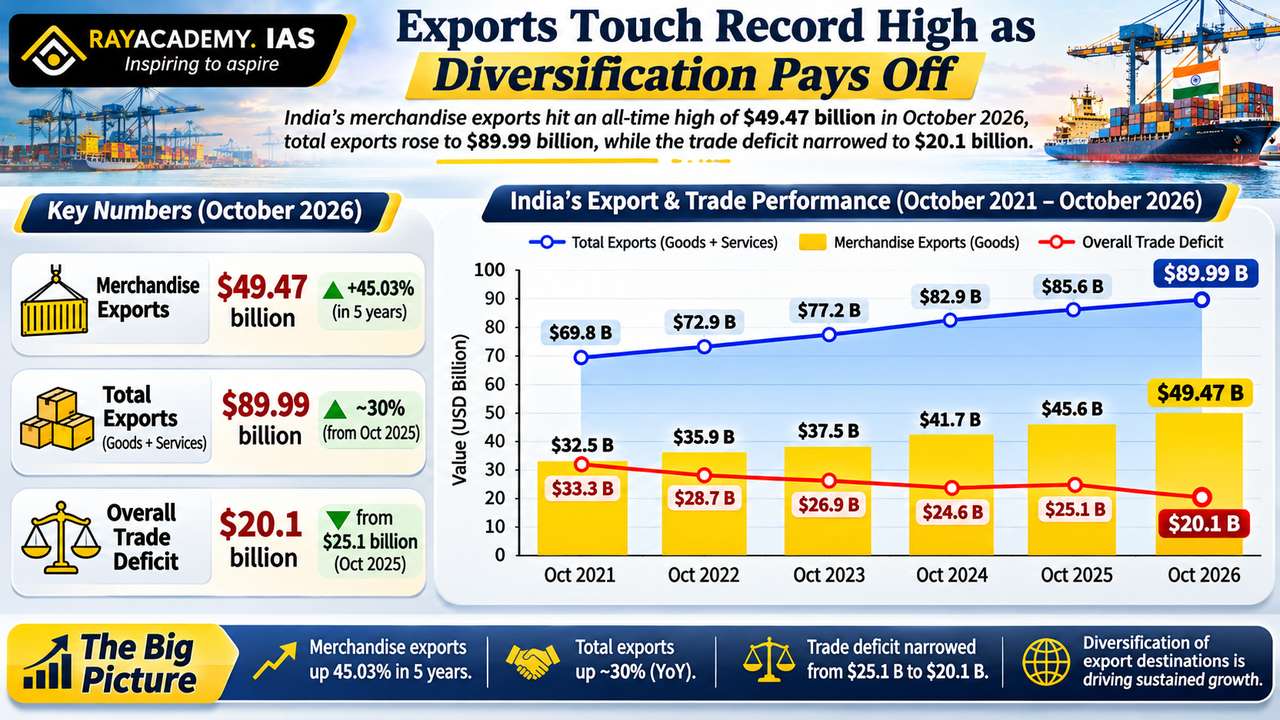
All-Time Monthly Export Peak: Official data released by the Ministry of Commerce and Industry shows that India’s merchandise exports surged 45.03% year-on-year (YoY) to a record $49.47 billion ($49.5 billion) in October 2026—the highest monthly goods export value and fastest monthly growth rate in five years.
UPSC Syllabus Mapping:
General Studies Paper III (Indian Economy): Indian Economy and issues relating to planning, mobilization of resources, growth, development and employment; Effects of liberalization on the economy, changes in industrial policy and their effects on industrial growth; External sector, Foreign Trade Policy, and Balance of Payments (BoP).
Combined Exports & Narrower Overall Trade Deficit:
Including services ($40.51 billion), India’s total exports jumped nearly 30% YoY to $89.99 billion, outpacing total import growth (16.6% to $110.1 billion) and narrowing the overall trade deficit from $25.1 billion (October 2025) to $20.1 billion.
Broad-Based Market Diversification: According to Commerce Secretary Rajesh Agrawal, export expansion was not confined to a single sector or geography, with 43 of India’s top 50 export destinations registering positive YoY growth.
Static-Current Linkage . India’s Exports Touch Record High
Constitutional & Statutory Foundations of Foreign Trade: Under Entry 41 of the Union List (Seventh Schedule) of the Constitution of India, trade and commerce with foreign countries falls exclusively within the legislative competence of Parliament. Operational trade governance is anchored in the Foreign Trade (Development and Regulation) Act, 1992, under which the Union Government notifies the Foreign Trade Policy (FTP).
Foreign Trade Policy (FTP) 2023 & Export Diversification: Launched as a dynamic, open-ended policy framework without an end date, FTP 2023 shifted India’s export strategy from fiscal subsidies (which faced WTO compliance challenges) toward remission of duties (RoDTEP), Districts as Export Hubs (DEH), e-commerce export promotion, and rupee trade settlement mechanisms.
Free Trade Agreements (FTAs) & Market Access: India’s pivot toward bilateral and regional trade agreements—including operationalized pacts with the UAE (CEPA), Australia (ECTA), the EFTA bloc (TEPA), and recent agreements with the United Kingdom and New Zealand—has reduced tariff barriers and integrated Indian manufacturers into diversified Global Value Chains (GVCs).
Balance of Payments (BoP) & Services Cushion: In India’s BoP accounting (compiled by the RBI), a structural merchandise trade deficit (driven by crude oil, electronics, and capital goods imports) is routinely offset by a robust net services surplus (IT/BPM, Global Capability Centres, consulting) and private remittances, keeping the Current Account Deficit (CAD) within sustainable macroeconomic thresholds.India’s Exports Touch Record High
Prelims Focus: High-Yield Objective Facts
Dimension / Institution | Key Facts & Specifications for UPSC Prelims |
Nodal Ministry & Agencies | Ministry of Commerce and Industry (Department of Commerce); Directorate General of Foreign Trade (DGFT) administers the Foreign Trade Policy (FTP) and issues Importer-Exporter Codes (IEC). |
Trade Data Compilation | Merchandise trade data is compiled monthly by DGCI&S (Directorate General of Commercial Intelligence and Statistics, Kolkata); Services trade data is compiled by the Reserve Bank of India (RBI). |
Key October 2026 Metrics | • Merchandise Exports: $49.47 billion (+45.03% YoY; 5-year high monthly growth). |
• Merchandise Imports: $89.35 billion (+16.5% YoY).
• Combined Exports (Goods + Services): $89.99 billion (+29.9% YoY).
• Overall Trade Deficit: $20.1 billion (narrowed from $25.1 billion in Oct 2025). | | RoDTEP & RoSCTL Schemes | Remission of Duties and Taxes on Exported Products (RoDTEP) refunds embedded central, state, and local taxes/levies (such as mandi tax, electricity duty, fuel VAT) not refunded under GST, making it WTO-compliant. | | Districts as Export Hubs (DEH) | Initiative implemented by DGFT in coordination with State Governments to identify export-potential products/services in every district and resolve local logistics/quality bottlenecks. |
Mains Analytical Breakdown
Significance of Record Export Performance and Diversification
Insulation Against Geopolitical & Tariff Shocks: Achieving positive growth across 43 of India’s top 50 export destinations demonstrates reduced over-reliance on traditional Western markets, cushioning the economy against localized demand slowdowns or unilateral tariff headwinds.
Volume-Led Manufacturing Competitiveness: Trade analysts note that merchandise exports growing faster than merchandise imports indicates genuine expansion in underlying export volumes—not merely price inflation—reflecting gains from Production Linked Incentive (PLI) schemes in electronics, pharmaceuticals, engineering goods, and refined petroleum products.
Macroeconomic & Currency Stability: Narrowing the overall monthly trade deficit to $20.1 billion eases pressure on the Current Account Deficit (CAD), conserves foreign exchange reserves, and supports Indian Rupee (INR) stability amid global financial volatility.
Services Sector as a Strategic Shock Absorber: Steady expansion in high-value services exports (driven by Global Capability Centres (GCCs) and digital engineering) continues to offset a substantial portion of the goods trade gap.
Multi-Dimensional Challenges
Economic — Persistent Merchandise Trade Deficit & Energy Vulnerability: Despite record goods exports, merchandise imports climbed to $89.35 billion (widening the goods-only trade gap to nearly $39.9 billion). Because India imports roughly 85% of its crude oil requirements, West Asian geopolitical disruptions and crude price volatility continually threaten the import bill.
Structural — High Concentration in Refined Petroleum & Imported Inputs: A substantial portion of October’s export surge was driven by petroleum products and assembly-intensive electronics, where domestic value addition remains moderate compared to East Asian manufacturing peers.
Trade Governance — Non-Tariff Barriers (NTBs) & Green Protectionism: Even as FTAs lower customs duties, Indian exporters face stringent Sanitary and Phytosanitary (SPS) norms, Technical Barriers to Trade (TBT), and emerging carbon levies like the European Union’s Carbon Border Adjustment Mechanism (CBAM).
Logistics & MSME Bottlenecks: High inland freight costs, port turnaround delays, and limited access to affordable trade finance constrain small and medium exporters (MSMEs) from scaling up in newly opened FTA markets.
Environmental — Carbon Intensity of Export-Oriented Manufacturing: Rapid growth in refined petroleum, chemicals, and heavy engineering exports increases industrial emissions, requiring alignment with India’s Net-Zero 2070 commitments to retain market access in climate-conscious economies.
Way Forward
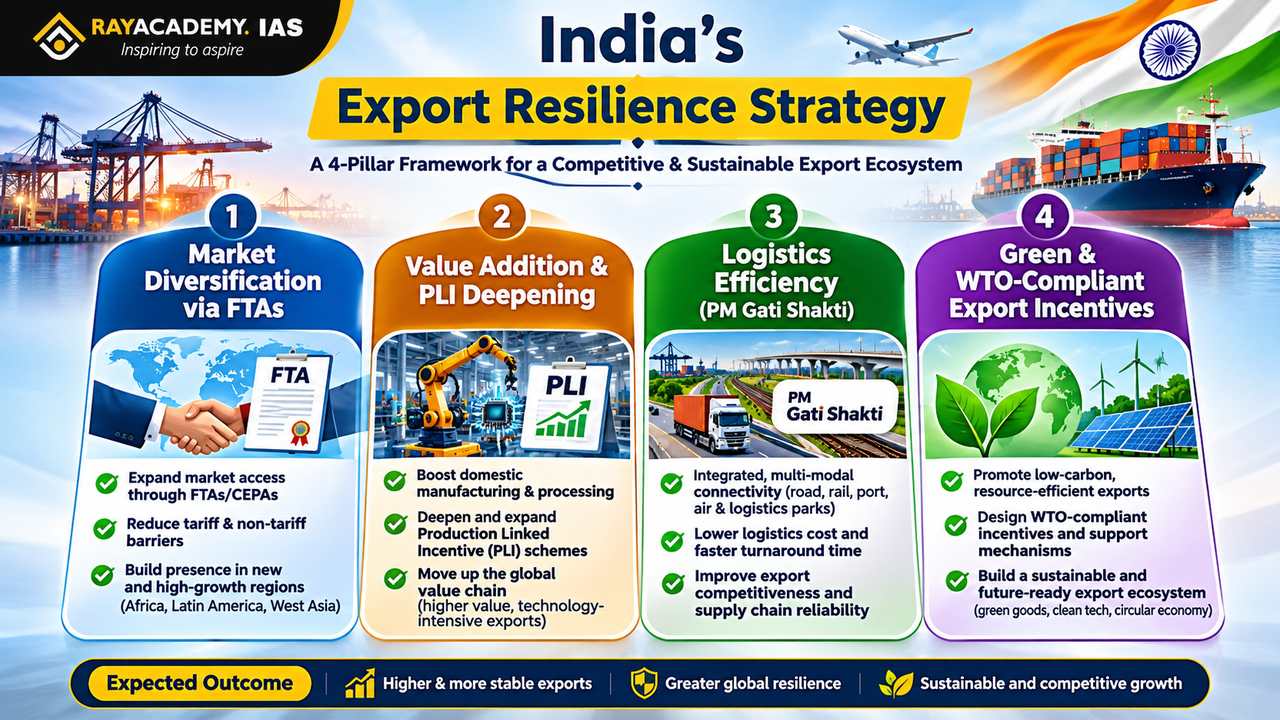
Deepen Domestic Value Addition Under PLI 2.0: Transition from final-stage assembly to component ecosystem manufacturing (semiconductors, specialty chemicals, active pharmaceutical ingredients, and capital machinery) so export growth translates into higher net foreign exchange retention and domestic employment.
Operationalize the Trade Connect e-Platform & FTA Utilization: As recommended by NITI Aayog’s Trade Watch frameworks, simplify Rules of Origin (RoO) compliance and digitize certificates of origin so MSMEs can effectively utilize India’s newly signed FTAs (UK, New Zealand, EFTA, UAE, Australia).
Lower Logistics Costs via PM Gati Shakti & National Logistics Policy: Accelerate multimodal connectivity—integrating Dedicated Freight Corridors (DFCs), inland container depots, and port automation—to bring India’s logistics costs down toward global benchmarks (~8% of GDP).
Greening Indian Exports Against CBAM: Establish accredited domestic carbon-verification standards and incentivize renewable energy adoption in MSME export clusters (textiles, steel, aluminum, chemicals) to preempt Carbon Border Adjustment Mechanism (CBAM) penalties.
Expand Trade Finance & Cross-Border Rupee Settlement: Strengthen ECGC (Export Credit Guarantee Corporation) coverage for non-traditional markets in Africa and Latin America, while operationalizing Special Rupee Vostro Accounts (SRVAs) to reduce dollar-liquidity bottlenecks in bilateral trade.
Value Addition for Mains
Official Trade Benchmark (Ministry of Commerce & Industry, Nov 2026): In October 2026, India’s total exports reached an all-time monthly high of $89.99 billion (merchandise at $49.47 billion, up 45.03% YoY), with 43 of the top 50 export destinations recording positive growth and narrowing the overall trade deficit to $20.1 billion.
Economic Survey & Policy Anchor: As emphasized in the Economic Survey, integrating into Global Value Chains (GVCs) by "assembling in India for the world"—backed by PM Gati Shakti infrastructure and WTO-compliant RoDTEP tax remission—is essential to capture global supply chain reallocations (China+1 strategy) on the road to Viksit Bharat 2047.
Practice Questions for Active Recall
Prelims Practice MCQ
With reference to India’s external sector and trade governance frameworks, consider the following statements:
Monthly data on India’s merchandise exports and imports is compiled by the Directorate General of Commercial Intelligence and Statistics (DGCI&S), whereas services trade data is compiled by the Reserve Bank of India (RBI).
The Remission of Duties and Taxes on Exported Products (RoDTEP) scheme is designed to refund embedded central, state, and local levies that are not reimbursed under the Goods and Services Tax (GST) regime.
Under the Seventh Schedule of the Constitution of India, trade and commerce with foreign countries is placed in the Concurrent List.
Which of the statements given above are correct?
(a) 1 and 2 only
(b) 2 and 3 only
(c) 1 and 3 only
(d) 1, 2, and 3
Correct Answer: (a) 1 and 2 only
Explanation:
Statement 1 is correct: DGCI&S (under the Ministry of Commerce and Industry) compiles and releases monthly merchandise trade statistics, while the RBI compiles services trade and overall Balance of Payments data.
Statement 2 is correct: RoDTEP provides a WTO-compliant mechanism to rebate embedded, unrefunded taxes and duties (such as electricity duty, mandi tax, and VAT on fuel used in transport) incurred during export production.
Statement 3 is incorrect: Trade and commerce with foreign countries falls under Entry 41 of the Union List (not the Concurrent List) in the Seventh Schedule of the Constitution.
Mains Practice Question (GS Paper III — 150 Words | 10 Marks)
"While record merchandise and services exports demonstrate the resilience of India’s trade diversification strategy, persistent import dependencies continue to test external sector stability." Examine the drivers behind India’s recent export surge and suggest structural reforms to achieve sustainable trade balance.
Answer Structure Hints:
Introduction: Contextualize the October 2026 trade data—merchandise exports hitting a record $49.47 billion (+45.03% YoY) and combined exports reaching $89.99 billion, narrowing the overall trade deficit to $20.1 billion.
Body Part 1 (Drivers of Export Surge): Highlight broad-based geographic diversification (43 of top 50 destinations posting positive growth), volume-led competitiveness in petroleum, electronics, and engineering goods, FTA market access, and the strong services trade surplus.
Body Part 2 (Import Dependencies & Structural Reforms): Note vulnerability to crude oil imports (~85% import dependence) and intermediate goods ($89.35 billion goods imports). Recommend deepening domestic value addition under PLI, lowering logistics costs via PM Gati Shakti, enhancing MSME FTA utilization, and greening exports against CBAM.
Conclusion: Conclude with the Economic Survey’s vision of deeper Global Value Chain (GVC) integration to ensure resilient, export-led growth toward Viksit Bharat 2047.
Take this article with you
Save a reading copy for offline study.


