

OPSC conducted the OCS Mains 2025 General Studies Paper 3 (Economy, Agriculture, Environment, Science and Technology, Disaster Management and Internal Security) on 4 November 2026. We reflected 10 of its 17 questions in the RAYACADEMY IAS OCS Mains Test Series, including very close matches on MSP, cyber security and CERT-In, flood management, defence and space indigenisation, algorithmic bias and farm income diversification. We covered the remaining 7 in our classroom programme and notes.
This OCS Mains 2025 GS Paper 3 analysis has three parts. First, a theme-wise breakdown of the 2025 question paper. Second, a 2024 vs 2025 comparison with the OCS 2024 GS 3 paper, so you can see how OPSC's question pattern is shifting. Third, a question-by-question look at how we guided our students through this paper before they entered the exam hall. GS 3 is the most current-affairs-driven paper in OCS Mains, and the 2025 paper proved it: the RBI's rupee measures, Odisha's Gender Budget 2026-27, the Environment Audit Rules 2025, India's revised NDC and the 16th Finance Commission award all appeared.
If you are preparing for OCS 2026 or the Odisha Administrative Service (OAS) exam, this OCS GS Paper 3 analysis and its previous year questions (PYQs) show exactly where to focus.
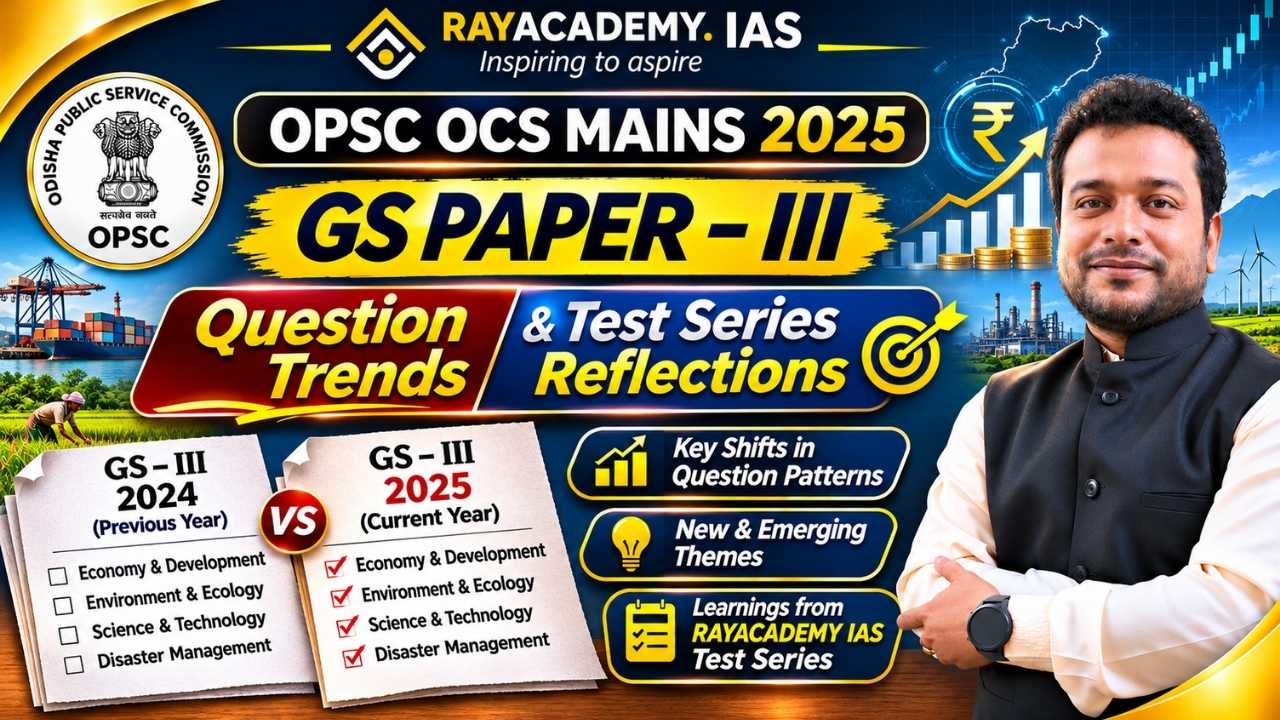
OCS Mains 2025 GS Paper 3 Analysis: Question paper overview
The OCS Mains 2025 GS Paper 3 had 17 questions for 250 marks in 3 hours. Group A had 12 questions, of which candidates attempted any 10 (250 words, 15 marks each). Group B had 5 compulsory questions (300 words, 20 marks each).
Theme-wise distribution of OCS GS Paper 3 questions
Theme | 2025 questions | Count |
Economy and public finance | Q1, Q2, Q4, Q14 | 4 |
Energy, environment and climate | Q5, Q6, Q8, Q16 | 4 |
Science and technology | Q11, Q12, Q13 | 3 |
Internal security and cyber security | Q9, Q10, Q17 | 3 |
Agriculture | Q3, Q15 | 2 |
Disaster management | Q7 | 1 |
Key features of the OCS Mains 2025 GS Paper 3
Current affairs drove the paper. 7 of 17 questions were tied to recent developments: the RBI's June rupee measures, Odisha's Gender Budget 2026-27, the EAC-PM paper on the duck curve, the Environment Audit Rules 2025, India's revised NDC for 2031-2035, the 16th Finance Commission award and the crackdown on online child sexual abuse material.
Odisha's economy was tested directly. Mining's share in Odisha's GSVA, the District Mineral Foundation, Odisha's Gender Budget and the 16th Finance Commission's award for Odisha made up 3 questions.
Balanced spread. No single area dominated. Economy and environment had 4 questions each, and science, security and agriculture had 2 to 3 each.
Definitional openers. Many questions began with "What is" (MSP, environmental auditing, NDCs, CERT-In, human trafficking, nanorobots), rewarding crisp definitions followed by analysis.
OCS Mains 2025 GS Paper 3 Analysis: 2025 vs 2024 comparison
The OCS GS Paper 3 kept the same backbone in both years: Odisha's economy, agriculture, environmental regulation and current-affairs-pegged questions. What changed was the focus within it. Environment and energy shrank, security moved from left-wing extremism to digital and human security, and disaster management returned.
Theme-wise comparison of OCS GS Paper 3, 2024 vs 2025
Theme | OCS 2024 GS 3 | OCS 2025 GS 3 | Change |
Energy, environment and climate | 6 (Q2, Q6, Q7, Q9, Q15, Q16) | 4 | Down 2 |
Economy and public finance | 4 (Q1, Q12, Q13, Q14) | 4 | No change |
Agriculture | 3 (Q4, Q8, Q17) | 2 | Down 1 |
Science and technology | 2 (Q3, Q11) | 3 | Up 1 |
Internal security and cyber security | 2 (Q5, Q10) | 3 | Up 1 |
Disaster management | 0 | 1 | Up 1 |
Odisha-specific questions (across themes) | 4 (Q4, Q5, Q12, Q14) | 3 (Q2, Q4, Q14) | Down 1 |
Current-affairs-pegged questions | 7 | 7 | No change |
Themes OPSC asked in both years
Recurring theme | OCS 2024 GS 3 | OCS 2025 GS 3 |
Odisha's budget and finances | Q12: Structure and priorities of the Odisha State Budget; Q14: Viksit Odisha roadmap | Q2: Odisha's Gender Budget 2026-27; Q14: 16th Finance Commission award for Odisha |
Energy transition | Q6: Ethanol blending; Q7: Strategic Petroleum Reserve; Q15: SHANTI Act, 2025 | Q5: Duck curve and grid flexibility |
Environmental regulation | Q2: NBA Regulations, 2025; Q9: Strategic Environmental Assessment; Q16: Easing of sulphur emission norms | Q6: Environment Audit Rules, 2025; Q16: Industrial pollution of rivers |
Farm productivity and income | Q8: Small landholdings and productivity; Q17: Micro-irrigation and cropping patterns | Q15: High-value crop diversification |
Border security | Q10: Organised crime and terrorism in border areas | Q10: BSF and cross-border human trafficking |
Algorithms and everyday technology | Q11: How Google Maps suggests routes | Q13: Algorithmic bias |
Space | Q3: Space debris | Q11: Defence and space indigenisation |
What changed in 2025
Security went digital. In 2024, OPSC asked about the SOG's role against left-wing extremism in Odisha and organised crime in border areas. In 2025, it asked about CERT-In, human trafficking and online child sexual abuse material. Left-wing extremism did not appear.
From how technology works to its ethics. 2024 asked how Google Maps suggests routes. 2025 asked about the causes and consequences of algorithmic bias.
Environment and energy fell from 6 to 4 questions. 2024 had ethanol, the SPR, nuclear policy, biodiversity rules, SEA and sulphur norms. 2025 kept environmental regulation but cut energy to one question, the duck curve.
Disaster management returned. 2024 had none. 2025 asked about NDMA guidelines for monsoon floods.
Group B kept the same structure. Both years had one Odisha finance question (Viksit Odisha in 2024, the 16th Finance Commission in 2025), one agriculture question, one environment question and two current-affairs questions.
What this means for OCS 2026
OPSC keeps the GS 3 structure stable but changes the topic within each slot. Expect an Odisha finance question, a farm income question, an environmental regulation question and at least one digital security question again. That is why we build our test series on PYQ trends. We turned 2024 themes such as ethanol blending, left-wing extremism in Odisha, Odisha's budgeting, irrigation and land reforms into fresh test questions, and added cyber security, AI ethics and flood management before the 2025 paper asked them.
How we built the RAYACADEMY IAS test series for OCS GS Paper 3
We designed our OCS Mains Test Series from the ground up for the OPSC pattern. It is not a UPSC series adapted for Odisha.
Sectional tests for every GS 3 area
We set separate tests on the economy, agriculture and infrastructure, science and technology, and internal security, so our students built depth one area at a time.
Odisha's economy at the core
We set dedicated questions on Odisha's mining and mineral resources, government budgeting in Odisha, Odisha's agriculture and fisheries, and the State's flagship schemes, including Subhadra and Mission Shakti.
Full-length tests and open mocks
We trained time management through full-length tests (FLTs) and open mocks that mixed every GS 3 area in the exact OCS format: 17 questions, Group A and Group B, 250 marks, 3 hours.
Current affairs up to the last month
We updated our GS 3 questions through 2026, covering COP30, the India Semiconductor Mission, the National Quantum Mission, the BioE3 Policy, critical minerals and AI governance.
Bilingual, English and Odia
We set every question in both languages, so students writing in either medium practise in their own language.
OCS Mains 2025 GS Paper 3 Analysis: Question-by-question RAYACADEMY IAS reflections
Below, each OCS Mains 2025 GS 3 question appears beside the RAYACADEMY IAS test question we set, exactly as it appeared in our test series.
Colour code: green = very high overlap (85% and above), yellow = strong overlap (70% to 84%), orange = partial or no test overlap, with full classroom coverage.
Section | OCS 2025 GS III question | RAYACADEMY IAS test question (Test No.) | Reflection analysis |
Economy | Q1. In June this year, the RBI adopted the same step used during 2013 Taper Tantrum to strengthen Indian rupee in dollar term and to improve foreign currency reserve. Discuss. Also analyse its long term implications. | No test question on this theme. | Classroom coverage: In our economy and current affairs classes, we covered the RBI's rupee-support measures, the 2013 taper tantrum playbook and their impact on forex reserves. |
Economy | Q2. What is the gender vision of Odisha's Gender Budget 2026-27? How are allocations distributed between gender-specific and gender-sensitive interventions and to what extent do they address existing gender disparities and advance gender parity in Odisha? | "Subhadra Yojana represents a shift from in-kind welfare to direct financial empowerment of women." Discuss the design features of the scheme and analyze the structural challenges in ensuring inclusive coverage. (Test 20, Q1) | Partial overlap (50%) + classroom coverage: We tested Odisha's budgeting and its flagship women's schemes. In our Odisha budget class, we covered the Gender Budget 2026-27. |
Agriculture | Q3. What do you mean by "Minimum Support Price" (MSP) and how many crops are covered under the MSP in India? Explain how does the MSP protect agricultural producers? | What is Minimum Support Price (MSP)? Discuss the debate around a legal guarantee for MSP and its likely implications for Indian agriculture and the economy. (Test 13, Q11) | Very high overlap (90%): Our test opened with the same "What is MSP?" and went deeper into the MSP debate. We had our students write on MSP twice. |
Odisha economy | Q4. Mining and quarrying constitute an important component of Odisha's industrial sector. Examine the trend in their contribution to the Gross State Value Added of Odisha. Critically assess the performance of the District Mineral Foundation in improving the socio-economic well-being of communities affected by mining and quarrying activities. | Evaluate the impact of mining on the environment and the livelihood of local communities in Odisha. (Test 4, Q16) | Strong overlap (75%): We tested mining's contribution to Odisha's economy and its impact on affected communities in three questions, the two halves of this question. |
Energy | Q5. The recent EAC-PM Working Paper says that to meet the "duck curve" in more of a challenge of flexibility than generation. Discuss the phenomenon, its causative factors and measures & policy intervention to address this issue. | Discuss the role of energy-storage systems in facilitating large-scale integration of renewable energy in India. (Test 29, Q5) | Strong overlap (80%): The duck curve is the grid-flexibility problem of renewable integration. We had already trained our students on energy storage, the main solution. |
Environment | Q6. What is environmental auditing? Discuss the salient features of the Environment Audit Rules, 2025 and examine their role in strengthening environmental compliance in India. | Discuss the major sources of environmental pollution and degradation in India. Critically evaluate the effectiveness of Environmental Impact Assessment in addressing them. (Test 24, Q15) | Partial overlap (45%) + classroom coverage: We tested environmental compliance through the EIA framework. In current affairs classes, we covered the Environment Audit Rules, 2025. |
Disaster management | Q7. With reference to the National Disaster Management Authority (NDMA) guidelines, discuss the structural and non-structural measures required to mitigate the impacts of recurrent monsoon floods in India. Illustrate your answer with suitable examples from recent flood events. | What are flash floods? Discuss the major causes of flash floods in India and evaluate the effectiveness of existing disaster management measures in mitigating their impact. (Test 4, Q12) | Very high overlap (85%): We tested floods and flood mitigation in three different papers, with the NDMA framework at the centre. |
Climate | Q8. What are Nationally Determined Contributions (NDCs) under the Paris Agreement? Discuss the key features of India's revised NDC for 2031-2035 and analyse how it seeks to balance climate ambition with economic growth, energy security, and climate justice. | Examine the significance of COP30's shift in narrative from diplomatic pledges to concrete implementation. How do frameworks like the Global Mutirão Agreement redefine global climate accountability? (Test 11, Q3) | Strong overlap (70%): We trained our students on COP30, climate accountability and India's climate commitments, the context of the revised NDC. |
Security | Q9. What is CERT-In? What is the role of CERT-In in Cyber Security in India? | What do you understand by cyber security? Discuss the different types of cyber threats faced by India and evaluate the effectiveness of existing institutional mechanisms to counter them. (Test 18, Q6) | Very high overlap (90%): CERT-In is India's lead institutional mechanism for cyber security. We had our students evaluate it in two tests. |
Security | Q10. What is Human Trafficking? Discuss the role of Border Security Force (BSF) in preventing cross-border human trafficking in India. | Examine the security challenges along India’s borders with its neighbours. Analyse how geopolitical dynamics and non-state actors shape these challenges. Propose comprehensive policy responses to tackle this emerging threat. (Test 19, Q4) | Strong overlap (70%): We trained our students on border security, non-state actors and organised crime, the framework for a human trafficking answer. |
Science and technology | Q11. Indigenization of Technology is key to achieving strategic autonomy and reducing external dependence. Examine India's efforts towards indigenization in the field of defence and space infrastructure. | Highlight the major achievements of India in space technology in recent years. How can India leverage its space capabilities for socio-economic development and strategic autonomy? (Test 18, Q15) | Very high overlap (90%): Our test used the same phrase, "strategic autonomy", for space. We covered indigenous defence through the Pralay missile, and tested space in three papers. |
Science and technology | Q12. What are nanorobots? How they can help targeted breast cancer therapy? | Discuss recent developments in Artificial Intelligence, robotics and nanotechnology and their applications and effects on everyday life, with reference to India's IndiaAI Mission. (Test 24, Q1) | Partial overlap (50%) + classroom coverage: We tested robotics and nanotechnology together. In our science classes, we covered nanomedicine and targeted drug delivery. |
Science and technology | Q13. Analyse the causative factors and consequences of algorithmic bias. Suggest some ameliorative measures. | AI can either amplify women’s empowerment or automate discrimination. Examine this statement. Illustrate with domains where women are most vulnerable. (Test 19, Q5) | Very high overlap (85%): "Automate discrimination" is algorithmic bias. We had our students write on its causes, consequences and fixes before the exam. |
Odisha economy | Q14. Evaluate the award of the 16th Finance Commission (FC) for Odisha in comparison with those of the 15th FC. The 16th FC has discontinued sector-specific and state-specific grants and revenue deficit grants under Article 275. Analyze how this change will affect Odisha's finances during the five-year award period. | Discuss the changing nature of State finances in India after the introduction of the Goods and Services Tax. Examine the challenges before State governments. Highlight the measures required to strengthen fiscal autonomy. (Test 19, Q2) | Partial overlap (50%) + classroom coverage: We tested State finances and Odisha's budgeting. In class, we covered the 16th Finance Commission award and what it means for Odisha. |
Agriculture | Q15. Examine the strategy for high-value crop diversification in India for a sustainable farm income growth. | “Sustainable growth in farmers' income requires diversification of income sources rather than merely increasing crop yields.” Discuss with reference to livestock, fisheries, horticulture, agro-processing and allied activities in Odisha. (Test 16, Q14) | Very high overlap (90%): Same idea, same words: "sustainable" farm income through diversification into high-value horticulture and allied activities. |
Environment | Q16. Despite strengthening environmental regulations and river rejuvenation programmes, industrial effluent continues to degrade the water quality of many Indian rivers. Discuss the major mitigation strategies for industrial pollution of rivers and critically examine the effectiveness of recent government initiatives in this regard. | Discuss the major sources of environmental pollution and degradation in India. Critically evaluate the effectiveness of Environmental Impact Assessment in addressing them. (Test 24, Q15) | Partial overlap (55%) + classroom coverage: We tested industrial pollution and environmental governance. In class, we covered Namami Gange and river pollution control. |
Security | Q17. Explain the recent crackdown of Govt. of India against online Child Sexual Abuse Materials (CSAM). Enumerate the legal and institutional architectures to combat the digital child sexual abuse. | Discuss the challenges to internal security posed by the misuse of communication networks and social media platforms. Also outline the mandate of key security agencies in India and Odisha in addressing these challenges. (Test 24, Q17) | Partial overlap (50%) + classroom coverage: We tested the misuse of digital platforms, security agencies' mandates and the POCSO framework. In current affairs classes, we covered the government's recent crackdown. |
OCS GS Paper 3 statistical summary: RAYACADEMY IAS reflection rate
We reflected 10 of 17 questions of the OCS Mains 2025 GS Paper 3 in our test series and covered the other 7 in our classroom programme. Average question-level overlap across all 17 questions: 66%.
Match level | Questions | Count | Share |
Very high overlap (85% and above) | Q3, Q7, Q9, Q11, Q13, Q15 | 6 | 35% |
Strong overlap (70% to 84%) | Q4, Q5, Q8, Q10 | 4 | 24% |
Partial or no test overlap + classroom coverage | Q1, Q2, Q6, Q12, Q14, Q16, Q17 | 7 | 41% |
What this means in marks
Group A: 120 of 150 marks on fully practised themes. 8 of the 12 Group A questions had very high or strong overlap with our tests. For the other 2 answers, we had prepared our students partially in tests and fully in class.
Group B: 40 of 100 marks. We had prepared our students directly for Q13 (algorithmic bias) and Q15 (crop diversification).
Overall: 160 of 250 marks (64%) were answerable from themes we had made our students write on under test conditions.
Repetition that pays. We tested floods in 3 papers, space technology in 3, MSP in 2 and cyber security in 2. The 2025 paper asked all four.
OCS GS Paper 3 preparation strategy for OCS 2026
The OCS Mains 2025 GS Paper 3 rewards candidates who track the economy and policy news month by month, know Odisha's economy, and can explain technology in plain terms.
1. Follow economic and policy news every month
7 of 17 questions were pegged to recent events: RBI measures, Budgets, Finance Commission awards, new rules and climate commitments. Read the RBI's monetary policy statements, the Union and Odisha Budgets and the Economic Survey.
2. Know Odisha's economy in numbers
Learn Odisha's GSVA by sector, the role of mining and the District Mineral Foundation, the Odisha Budget and Gender Budget, and Finance Commission transfers to Odisha. The Odisha Economic Survey is your main source.
3. Master the definitional opener
Many questions began with "What is": MSP, environmental auditing, NDCs, CERT-In, human trafficking and nanorobots. Open with a crisp, accurate definition, then move to analysis.
4. Cover science and technology through applications
Algorithmic bias, nanorobots in cancer therapy, and defence and space indigenisation were all asked through their real-world use. Learn each technology with one Indian application and one ethical issue.
5. Link security to institutions
CERT-In, the BSF and the legal framework against online child abuse show that OPSC asks which agency does what. Prepare a one-page note on India's security and cyber institutions and their mandates.
6. Write under timed conditions
Ten Group A and five Group B answers in 3 hours leave about 10 minutes per answer. We had made our students write on 10 of the 17 2025 themes under exam conditions before the exam.
Suggested 12-month timeline for OCS 2026
Phase | Duration | Focus |
Foundation | Months 1 to 4 | Ramesh Singh or equivalent for economy, NCERTs for science and environment, OCS GS 3 PYQs (2024 and 2025) |
Integration | Months 5 to 8 | Economic Survey, Odisha Economic Survey, Budgets, sectional tests, daily answer writing |
Intensive | Months 9 to 12 | Full-length tests and open mocks, monthly current affairs revision, Odisha economy update |
OCS Mains 2025 GS Paper 3 analysis
The OCS Mains 2025 GS Paper 3 tested what we trained our students for: agriculture, disaster management, cyber security, space and defence technology, and Odisha's mining economy. We prepared them for 6 questions with very high overlap and 4 more with strong overlap, and we covered the rest, mostly the newest current affairs, in our classroom programme.
That was no accident. We built sectional tests for every GS 3 area, kept Odisha's economy at the centre, set every question in English and Odia, and updated our current affairs coverage every month. For OCS 2026, the question is not whether these themes will return. It is whether you will have written on them before the exam.
Take this article with you
Save a reading copy for offline study.


