

HARIMAU SHAKTI–VI
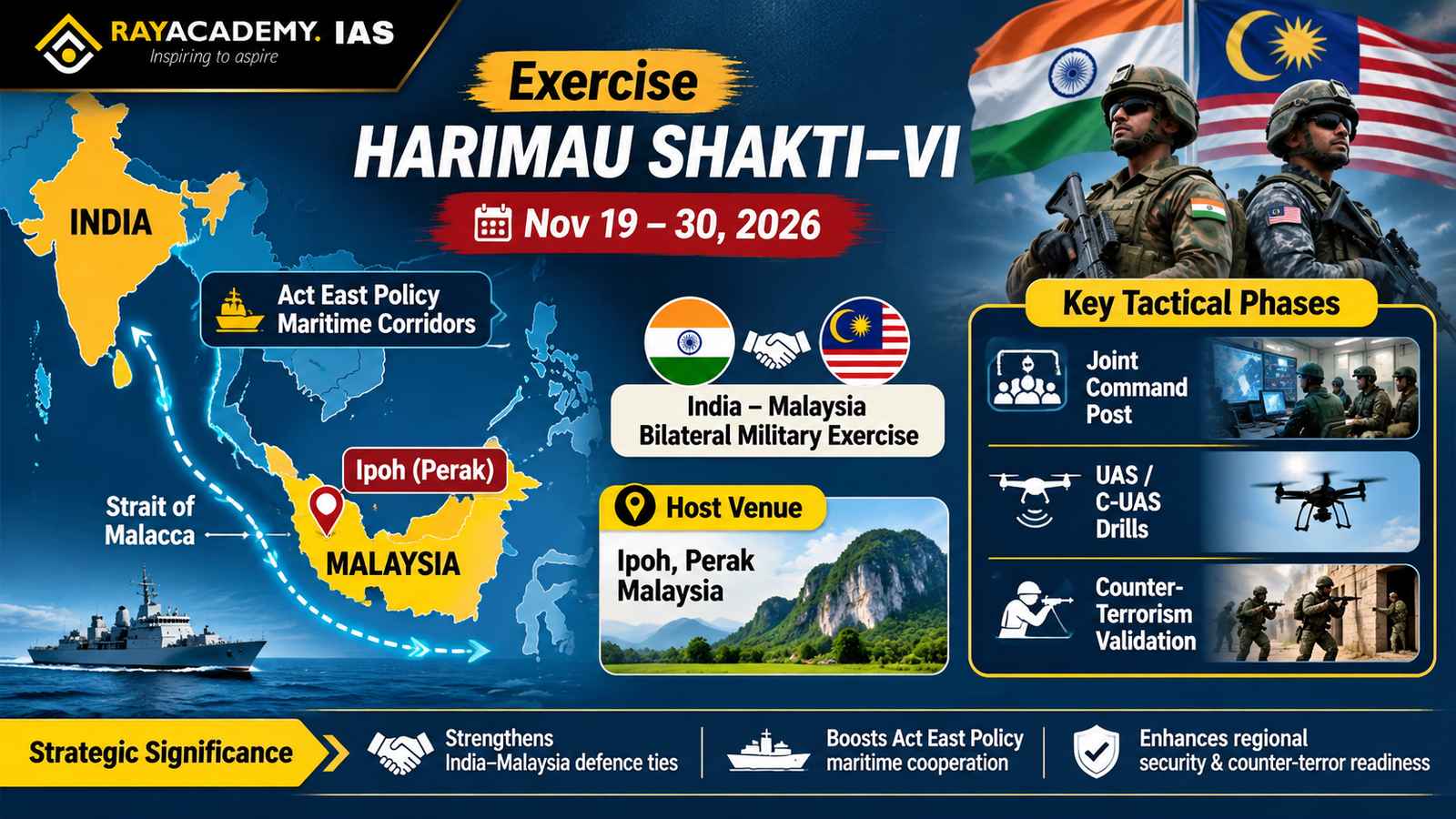
The 6th edition of the India–Malaysia Joint Military Exercise HARIMAU SHAKTI–VI commenced on November 19, 2026, at Ipoh, Malaysia, and will run through November 30, 2026.
UPSC Syllabus Mapping:
General Studies Paper II (International Relations): Bilateral, regional and global groupings and agreements involving India and/or affecting India’s interests; India and its neighbourhood- relations.
General Studies Paper III (Internal Security & Defence): Various Security forces and agencies and their mandate; Challenges to internal security through communication networks, basics of cyber security; Indigenization of technology and developing new technology.
Conducted alternately in India and Malaysia, this bilateral army training exercise features 120 personnel from each contingent. The 2026 edition focuses on rehearsing sub-conventional operations under Chapter VII of the United Nations mandate, emphasizing coordinated counter-terrorism operations in jungle and semi-urban terrain alongside the integration of Unmanned Aerial Systems (UAS) and Counter-Unmanned Aerial System (C-UAS) technologies.
Static-Current Linkage: India–Malaysia Defence Architecture and UN Peacekeeping
Understanding the strategic weight of Exercise HARIMAU SHAKTI–VI requires connecting bilateral defence diplomacy with international peacekeeping mandates and India's broader Indo-Pacific outreach.
1. Evolution of India–Malaysia Bilateral Defence Ties
Institutional Foundation: India and Malaysia established formal diplomatic relations in 1957 and signed a foundational Memorandum of Understanding (MoU) on Defence Cooperation in 1993 (amended in July 2023 to broaden industrial and technological collaboration).
Comprehensive Strategic Partnership (CSP): Elevated to an Enhanced Strategic Partnership in 2015 and upgraded to a Comprehensive Strategic Partnership (CSP) in August 2024—further reinforced during Prime Minister Narendra Modi's official visit to Kuala Lumpur in February 2026—defence cooperation forms a core pillar of bilateral ties.
Tri-Service Exercise Matrix: Alongside the Army's Exercise HARIMAU SHAKTI (initiated in 2012; 5th edition held at Mahajan Field Firing Range, Rajasthan in December 2025), the two nations conduct Exercise SAMUDRA LAKSAMANA (bilateral naval exercise) and Exercise UDARA SHAKTI (bilateral air force exercise), institutionalizing dialogue through the Malaysia–India Defence Cooperation Meeting (MIDCOM).
2. Chapter VII of the United Nations Charter & Sub-Conventional Warfare
UN Chapter VII Mandate (Articles 39–51): Unlike Chapter VI (pacific settlement of disputes), Chapter VII of the UN Charter empowers the UN Security Council to determine threats to peace and authorize enforcement actions—including Peace Enforcement operations—where peacekeepers must neutralize armed spoilers and terrorist networks.
Asymmetric & Drone-Enabled Warfare: Modern sub-conventional operations (counter-insurgency and counter-terrorism) increasingly involve low-cost commercial drones used by non-state actors for reconnaissance and payload delivery. Integrating UAS and C-UAS capabilities into bilateral tactical drills directly addresses these emerging asymmetric threats.
3. Act East Policy & Strait of Malacca Geopolitics
Act East & MAHASAGAR Vision: Upgraded from the Look East Policy in 2014, India's Act East Policy and MAHASAGAR (Mutual and Holistic Advancement for Security and Growth Across Regions) vision prioritize security partnerships with littoral states of the Strait of Malacca—one of the world's most vital maritime chokepoints connecting the Indian Ocean to the South China Sea.
Prelims Focus: High-Yield Objective Facts
Dimension / Institution | Key Facts & Specifications for UPSC Prelims |
Exercise HARIMAU SHAKTI–VI | • Edition & Dates: 6th edition, conducted from 19 to 30 November 2026. |
• Venue: Ipoh (capital of Perak state, located in the Kinta Valley of Peninsular Malaysia).
• Contingent Strength: 120 military personnel from each side (Indian Army & Royal Malaysian Army).
• Previous Edition (5th): Held in Mahajan Field Firing Range, Rajasthan (December 2025). | | Core Operational Mandate | Joint rehearsal of sub-conventional operations under Chapter VII of the UN Mandate in jungle and semi-urban terrain, featuring a Joint Command Post and Surveillance Centre, cordon-and-search, raids, combat engineering, UAS, and C-UAS drills. | | India–Malaysia Tri-Service Drills | • Army: HARIMAU SHAKTI
• Navy: SAMUDRA LAKSAMANA
• Air Force: UDARA SHAKTI | | UN Charter Chapter VII | Encompasses Articles 39 to 51; governs actions with respect to threats to the peace, breaches of the peace, and acts of aggression (including Article 51 on the inherent right of individual or collective self-defence). | | Geographical Specifics — Malaysia | Divided into Peninsular Malaysia (bordering Thailand to the north and Singapore to the south) and East Malaysia on the island of Borneo (Sabah and Sarawak, bordering Brunei and Indonesia); faces Sumatra (Indonesia) across the Strait of Malacca. |
Mains Analytical Breakdown
Significance for India's Defence Diplomacy and Regional Security
Enhancing Tactical Interoperability & Counter-Terror Synergy: Progressive training phases—moving from cross-training to a simulated Counter-Terrorism validation exercise—enable the Indian Army and Royal Malaysian Army to harmonize Tactics, Techniques, and Procedures (TTPs) for both bilateral contingencies and joint UN Peacekeeping deployments.
Modernizing Asymmetric Warfare Readiness: Dedicated emphasis on Unmanned Aerial Systems (UAS) for intelligence, surveillance, and reconnaissance (ISR) alongside Counter-UAS (C-UAS) neutralisation prepares infantry units for drone-saturated semi-urban and jungle battlefields.
Strengthening ASEAN Centrality & Indo-Pacific Stability: Deepening military-to-military trust with Malaysia—a key ASEAN member situated astride the Strait of Malacca—reinforces India's Act East Policy and contributes to a free, open, and rules-based Indo-Pacific without forming rigid military alliances.
Catalyzing Defence Industrial Outreach: Regular joint exercises complement defence industry engagement (such as Hindustan Aeronautics Limited's regional office in Kuala Lumpur and bilateral defence expos), creating long-term export avenues for indigenous Indian C-UAS, radar, and combat engineering platforms.
Multi-Dimensional Challenges
Geopolitical Balancing in Southeast Asia (Political): Like most ASEAN states, Malaysia practices careful hedging between major powers; bilateral military drills must remain strictly focused on non-traditional security and peacekeeping to avoid regional diplomatic sensitivities.
Technological & Doctrinal Asymmetries (Operational): Integrating heterogeneous communications hardware, encrypted data links, and command-and-control protocols across two armies during live C-UAS and Joint Command Post operations requires standardized electronic interfaces.
Rapid Evolution of Rogue Drone Threats (Technological): Commercial off-the-shelf (COTS) micro-drones, swarm tactics, and fibre-optic-guided UAVs evolve faster than conventional military procurement cycles, requiring continuous doctrinal updates.
Jungle & Semi-Urban Ecological Pressures (Environmental): High-intensity combat engineering drills, live-fire exercises, and tactical mobility in ecologically sensitive tropical rainforests require strict environmental protocols to prevent habitat disturbance.
Way Forward
Institutionalize Joint C-UAS & Electronic Warfare Doctrine: Building on the operational lessons of HARIMAU SHAKTI–VI, the Ministry of Defence and Integrated Defence Staff (IDS) should codify standardized Counter-UAS and electronic warfare SOPs for both domestic counter-insurgency grids and bilateral exercises.
Link Military Diplomacy with Indigenous Defence Exports (Atmanirbhar Bharat): Operationalize the amended India–Malaysia Defence Cooperation MoU and NITI Aayog's defence indigenization frameworks by showcasing Indian-made anti-drone systems, tactical communications, and combat engineering equipment during joint validation drills.
Expand Tri-Service & Maritime Domain Awareness Synergy: Synchronize Army drills (HARIMAU SHAKTI) with naval (SAMUDRA LAKSAMANA) and air (UDARA SHAKTI) exercises, alongside real-time information sharing via the Information Fusion Centre – Indian Ocean Region (IFC-IOR) in Gurugram to secure the Strait of Malacca.
Strengthen UN Peacekeeping Co-Deployment Frameworks: Leverage joint training under Chapter VII of the UN Mandate—as recommended in 2nd ARC and parliamentary standing committee reports on external affairs—to explore co-deployed engineering, medical, or quick-reaction contingents in United Nations missions.
Value Addition for Mains
Bilateral Defence & Strategic Benchmark (2026): Conducted alternately since 2012, the 6th edition of Exercise HARIMAU SHAKTI in Ipoh, Malaysia (Nov 19–30, 2026) brings together 240 soldiers (120 per side) under the India–Malaysia Comprehensive Strategic Partnership, directly operationalizing Article 51 of the Constitution of India (promotion of international peace and security) and India's Act East Policy.
Doctrinal Anchor for Mains Conclusions: As India's Joint Doctrine of the Indian Armed Forces emphasizes, "Military diplomacy and joint exercises build strategic trust, enhance interoperability in sub-conventional operations, and serve as vital instruments for regional peace and stability."
Practice Questions for Active Recall
Prelims Practice MCQ
With reference to India–Malaysia bilateral military exercises and United Nations peacekeeping mandates, consider the following statements:
Exercise HARIMAU SHAKTI is an annual bilateral naval exercise conducted between the Indian Navy and the Royal Malaysian Navy.
The 6th edition of Exercise HARIMAU SHAKTI (2026) focuses on sub-conventional operations under Chapter VII of the United Nations mandate, including Unmanned Aerial Systems (UAS) and Counter-UAS drills.
Chapter VII of the United Nations Charter empowers the UN Security Council to authorize enforcement measures to maintain or restore international peace and security.
Which of the statements given above are correct?
(a) 1 and 2 only
(b) 2 and 3 only
(c) 1 and 3 only
(d) 1, 2, and 3
Correct Answer: (b) 2 and 3 only
Explanation:
Statement 1 is incorrect: Exercise HARIMAU SHAKTI is a bilateral Army exercise between the Indian Army and the Royal Malaysian Army (not a naval exercise; the bilateral naval exercise is SAMUDRA LAKSAMANA, and the air exercise is UDARA SHAKTI).
Statement 2 is correct: Held at Ipoh, Malaysia (Nov 19–30, 2026), HARIMAU SHAKTI–VI focuses on joint sub-conventional and counter-terrorism operations under Chapter VII of the UN mandate in jungle and semi-urban terrain, with special emphasis on UAS and Counter-UAS (C-UAS) capabilities.
Statement 3 is correct: Chapter VII of the UN Charter (Articles 39–51) authorizes the UN Security Council to determine threats to peace and take non-military or military enforcement action to restore international peace and security.
Mains Practice Question (GS Paper II & GS Paper III — 150 Words | 10 Marks)
"Bilateral joint military exercises like HARIMAU SHAKTI–VI not only enhance tactical interoperability against emerging asymmetric threats such as rogue drones, but also serve as vital instruments of India's Act East Policy." Discuss the operational and strategic significance of India–Malaysia defence cooperation.
Answer Structure Hints:
Introduction: Contextualize the commencement of the 6th edition of Exercise HARIMAU SHAKTI–VI at Ipoh, Malaysia (Nov 19–30, 2026) with 120 personnel from each army under the India–Malaysia Comprehensive Strategic Partnership.
Body Part 1 (Operational Significance — GS-3): Highlight joint rehearsal of sub-conventional counter-terrorism operations under UN Chapter VII, jungle/semi-urban warfare drills, establishment of a Joint Command Post, and integration of UAS and Counter-UAS (C-UAS) capabilities against hostile drones.
Body Part 2 (Strategic Significance — GS-2): Explain how army drills—alongside SAMUDRA LAKSAMANA and UDARA SHAKTI—advance India's Act East Policy, strengthen security cooperation with a key Strait of Malacca littoral state, and open defence export avenues.
Conclusion: Conclude with Article 51 and institutionalizing MIDCOM and defence-industrial synergy to sustain regional peace and stability in the Indo-Pacific.
Take this article with you
Save a reading copy for offline study.


